Tag Archives: modeling

Color-Coated Casting in the Entertainment and Fashion Industries.

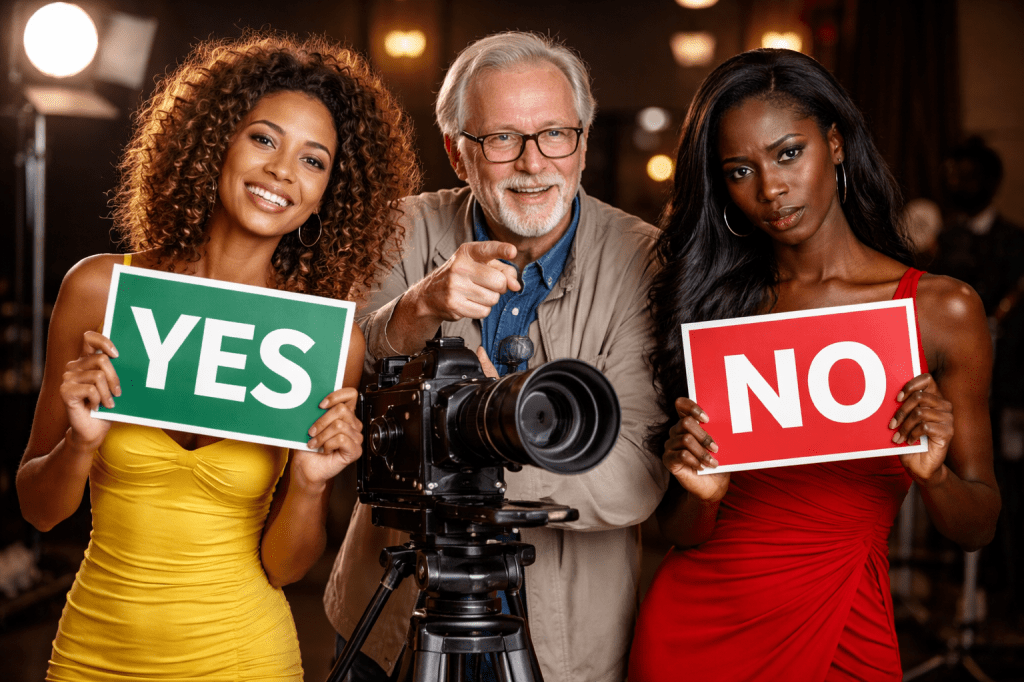
Color-coated casting—commonly understood as colorism within media industries—remains one of the most insidious and underexamined forms of discrimination affecting Black entertainers. It operates not through outright exclusion alone, but through selective inclusion, where lighter skin is consistently privileged over darker skin within the same racial group. This hierarchy shapes who is seen, who is celebrated, and ultimately, who is remembered.

The origins of colorism in entertainment can be traced to the historical aftermath of slavery and colonialism, where proximity to whiteness was associated with privilege, safety, and access. During early American theater and film, Black representation was either absent or distorted through caricature. As Black actors slowly entered the industry, lighter-skinned individuals were often chosen because they aligned more closely with Eurocentric ideals of beauty and acceptability.

By the Golden Age of Hollywood, these biases had become institutionalized. Studios, largely controlled by white executives, curated an image of Blackness that was palatable to white audiences. This meant casting individuals who visually softened racial difference—lighter skin, looser curls, and more “ambiguous” features—while excluding darker-skinned actors from leading roles.

Color-coated casting has had a profound impact on the fashion industry, where models of darker skin tones have historically been underrepresented or relegated to niche categories such as “ethnic” or “urban.” Runways, magazine covers, and high-profile campaigns have favored lighter-skinned or biracial models, who are perceived as more commercially viable or “relatable” to global audiences. This preference not only limits opportunities for darker-skinned models but also reinforces narrow beauty standards that equate desirability with proximity to whiteness. Even when darker-skinned models are featured, they are often styled, photographed, or digitally lightened to align with these Eurocentric aesthetics, sending the implicit message that darker tones are less acceptable. Iconic Black models such as Naomi Campbell and Alek Wek have challenged these norms, yet the industry continues to grapple with systemic bias, showing that talent alone is not enough to overcome deeply entrenched colorism. This practice affects not only careers but also the perception of beauty in society at large, shaping cultural ideals and influencing consumer preferences.

The practice persists today under the guise of “marketability.” Industry decision-makers often argue that lighter-skinned actors have broader appeal, particularly in international markets. This economic justification masks a deeper issue: the continued prioritization of whiteness as the universal standard.

The experiences of Lupita Nyong’o powerfully illustrate this reality. Before her rise to global acclaim, she has spoken openly about being told she was “too dark” for television. Even after winning an Academy Award, she encountered a narrow range of roles, many of which were rooted in historical trauma rather than contemporary complexity.

Similarly, Halle Berry, despite becoming the first Black woman to win the Academy Award for Best Actress, has acknowledged the persistent lack of substantial roles for Black women. Her success did not dismantle the system; rather, it exposed how rare such breakthroughs are.

Actresses like Viola Davis have also addressed colorism directly, noting that darker-skinned women must often work twice as hard for half the recognition. Davis has spoken about how her appearance influenced the types of roles she was offered, often being cast in characters defined by struggle rather than desirability.

In contrast, lighter-skinned or racially ambiguous actresses such as Zendaya and Zoë Saldana have frequently been positioned as the “face” of diversity. While their success is valid, it also reflects the industry’s preference for representations of Blackness that align more closely with Eurocentric aesthetics.

Colorism extends beyond film into the fashion industry, where beauty standards are even more rigid. Darker-skinned models have historically been underrepresented on runways, in advertising campaigns, and on magazine covers. When they are included, they are often styled in ways that exoticize rather than normalize their beauty.

There have also been documented cases where the skin tones of Black celebrities, including Beyoncé, were digitally altered in post-production to appear lighter. This practice reinforces harmful messages about which shades of Blackness are considered acceptable or aspirational.

For Black men, colorism manifests differently but remains equally impactful. Darker-skinned male actors are often typecast into roles that emphasize physicality, aggression, or hardship, while lighter-skinned men are more likely to be portrayed as romantic leads or emotionally complex characters.

Actors such as Idris Elba have broken through some of these barriers, yet even his career reflects a pattern where recognition often comes with roles that emphasize strength and intensity rather than vulnerability or softness.

In sports, the effects of colorism are visible in media representation and endorsement deals. Lighter-skinned athletes are frequently marketed as more relatable or marketable, while darker-skinned athletes are reduced to their physical abilities. This dynamic perpetuates stereotypes that extend far beyond the playing field.

The responsibility for color-coated casting lies in multiple layers of power. Studio executives, casting directors, fashion editors, and brand managers all contribute to maintaining these standards. However, these decisions are also influenced by broader societal biases that have been conditioned over centuries.

Media ownership plays a critical role. When decision-making power is concentrated among individuals who benefit from existing hierarchies, there is little incentive to challenge them. This lack of diversity behind the scenes directly impacts the diversity seen on screen and on runways.

Audience conditioning is another factor. Generations of viewers have been exposed to narrow representations of beauty, leading to internalized preferences that reinforce industry practices. This creates a feedback loop where demand and supply continuously validate one another.

Importantly, colorism is not solely imposed from outside the Black community. It can also be perpetuated internally, as historical conditioning has influenced perceptions of beauty and worth within the community itself. This internalization complicates efforts to dismantle the system.

Despite these challenges, resistance has emerged. Movements advocating for darker-skinned representation have gained momentum, and more creators are intentionally casting actors who reflect the full spectrum of Black identity.

Actresses, models, and public figures are increasingly using their platforms to challenge beauty norms and demand equitable treatment. Their voices have sparked critical conversations about inclusion, authenticity, and representation.

However, progress remains uneven. While there are more opportunities than in previous decades, systemic change has been slow, and colorism continues to shape casting decisions in subtle yet significant ways.

Ultimately, color-coated casting is not just about who gets hired—it is about whose stories are told, whose beauty is validated, and whose humanity is fully recognized. Until the industry confronts its biases at both structural and cultural levels, true equity will remain out of reach.

References (APA Style)

Berry, H. (2002). Academy Award acceptance speech and subsequent interviews on representation.

Davis, V. (2016). Emmy acceptance speech and interviews on race and colorism in Hollywood.

Hunter, M. (2007). The persistent problem of colorism: Skin tone, status, and inequality. Sociology Compass, 1(1), 237–254.

Nyong’o, L. (2014). Speech at Essence Black Women in Hollywood Luncheon.

Norwood, K. J. (2015). Color matters: Skin tone bias and the myth of a postracial America. Routledge.

Thompson, M. S., & Keith, V. M. (2001). The blacker the berry: Gender, skin tone, self-esteem, and self-efficacy. Gender & Society, 15(3), 336–357.

Wilder, J. (2015). Color stories: Black women and colorism in the 21st century. Temple University Press.
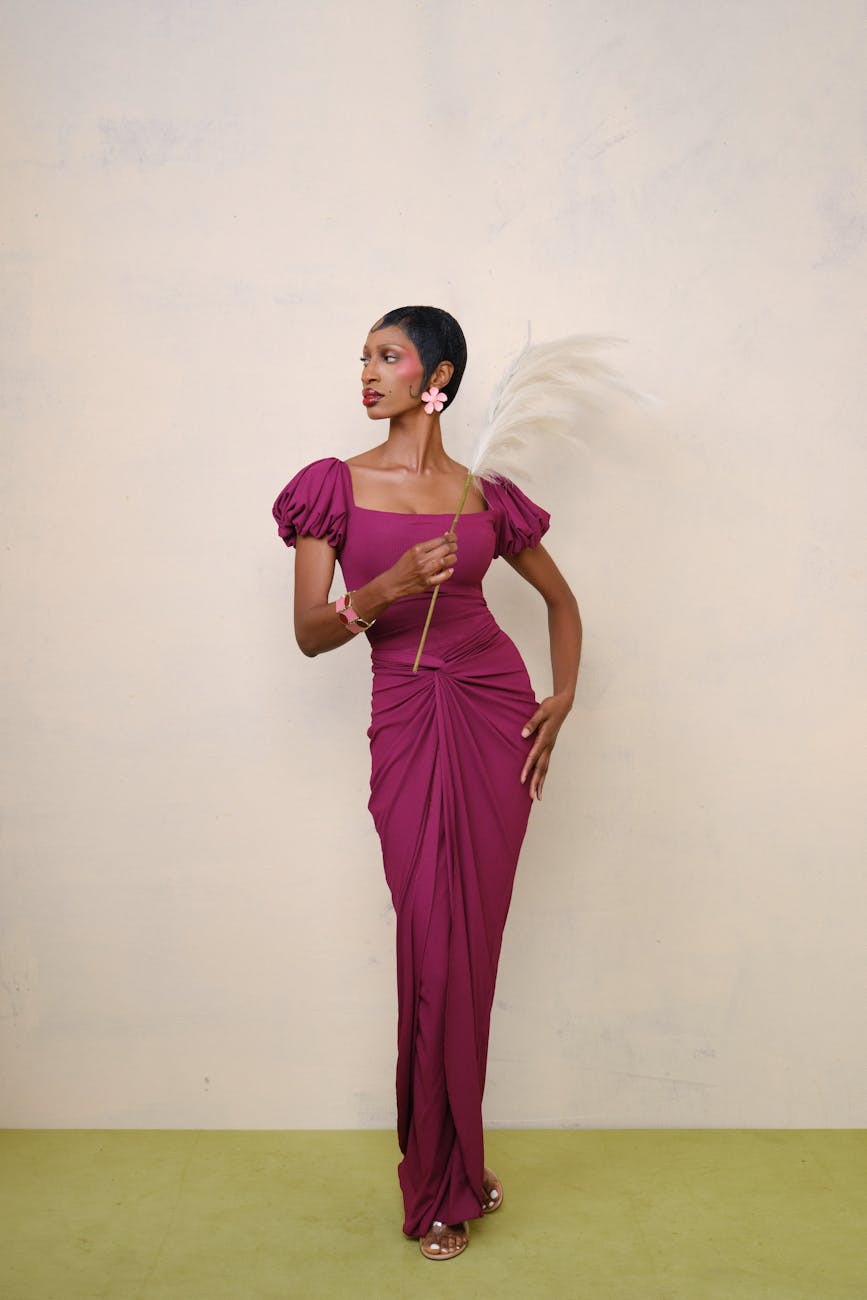
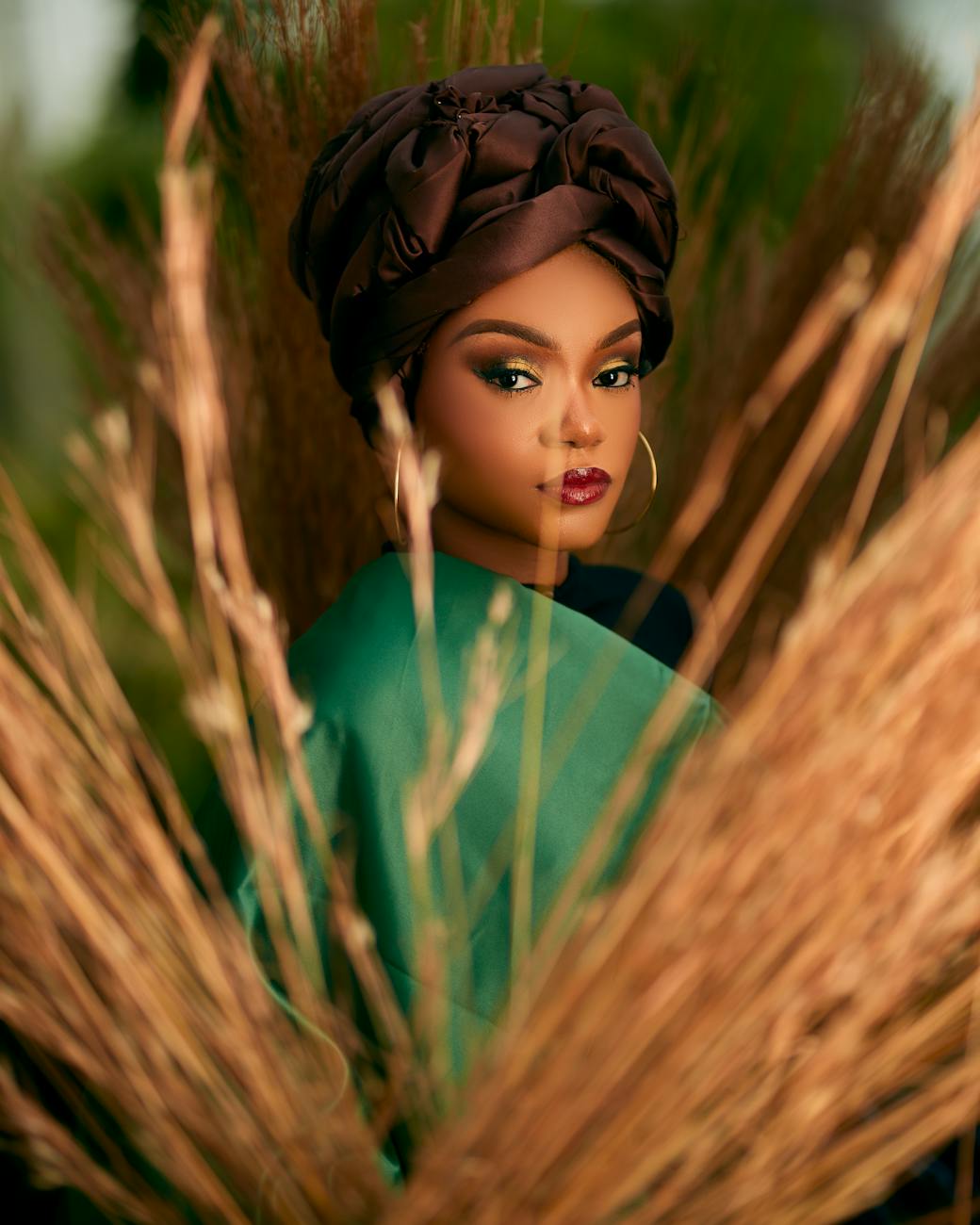
Black Women in Modeling: Redefining Beauty Standards.

Photo by magapls . on Pexels.com

For decades, the modeling industry has been dominated by Eurocentric ideals of beauty, where light skin, straight hair, and narrow features were privileged as the standard. Within this landscape, Black women faced barriers of both racism and colorism, often excluded from mainstream campaigns and denied equal opportunities. Yet, despite these challenges, Black women have transformed modeling, reshaping global beauty standards and redefining what it means to be seen, valued, and celebrated. Their journey is not only a story of fashion but also of resilience, representation, and cultural affirmation.

The entrance of Naomi Sims in the late 1960s marked a revolutionary moment for dark-skinned Black women in fashion. As the first African American supermodel to gain international recognition, Sims broke through racial barriers when she appeared on the cover of Ladies’ Home Journal in 1968. Her success challenged the industry’s exclusionary practices and paved the way for others, such as Beverly Johnson, who became the first Black model on the cover of Vogue in 1974. These women shattered long-held myths that Black beauty could not sell magazines or luxury products, demonstrating that Blackness itself was aspirational, marketable, and worthy of celebration.

The 1970s and 1980s further opened doors for iconic models like Iman, Grace Jones, and Pat Cleveland. Each redefined beauty in unique ways—Iman with her regal East African features, Grace Jones with her bold and androgynous style, and Cleveland with her theatrical runway presence. Together, they created new aesthetic possibilities that went far beyond Eurocentric limitations. They represented a multiplicity of Black beauty—dark, angular, bold, elegant, and unapologetically different. By their very existence, they destabilized narrow ideals and demanded recognition of global, diverse standards of beauty.

Despite these advances, systemic bias and colorism persisted. Dark-skinned Black women, particularly from Africa and the Caribbean, continued to face underrepresentation well into the 1990s and early 2000s. Lighter-skinned models often received more opportunities due to the industry’s preference for proximity to whiteness. Yet, the rise of models like Alek Wek, who emerged in the 1990s with her deep ebony complexion and Sudanese features, marked another turning point. Wek’s success signaled that beauty could not be confined to a singular mold. She inspired a new generation of dark-skinned models and young Black girls who saw themselves reflected on runways and in magazines for the first time.

In the 21st century, the impact of Black women in modeling has grown exponentially. Figures like Naomi Campbell, who dominated the 1990s supermodel era, paved the way for contemporary icons such as Lupita Nyong’o, Adut Akech, Anok Yai, and Duckie Thot. These women not only dominate global campaigns but also use their platforms to speak against colorism, racism, and lack of diversity in the industry. Their voices are as revolutionary as their beauty, pushing the conversation forward and demanding structural change in fashion houses, casting agencies, and media representation.

Beyond individual representation, Black women in modeling have also changed the commercial landscape. Rihanna’s Fenty Beauty and Iman’s earlier cosmetics line demonstrated that products must reflect the wide spectrum of skin tones that Black women embody. Similarly, natural hair movements and the celebration of Afrocentric features in beauty campaigns signify a shift toward inclusivity. Where once Black women were asked to assimilate into white-centered aesthetics, today they are celebrated for bringing their authentic selves into the fashion world.

The redefinition of beauty standards by Black women in modeling is not merely about fashion—it is deeply cultural and psychological. Representation affirms identity, counters internalized racism, and dismantles harmful hierarchies of color. For Black girls and women, seeing models who look like them is transformative, affirming that their features, skin, and hair are beautiful in their own right. This shift is biblical in scope as well, reflecting Psalm 139:14 (KJV), “I will praise thee; for I am fearfully and wonderfully made.” In reclaiming beauty, Black women in modeling have not only shifted an industry but have spoken life into generations of women once told they were not enough.

Despite the progress, challenges remain. Black models still face pay disparities, tokenism, and limited opportunities compared to their white counterparts. Fashion magazines may showcase diversity on the surface while maintaining exclusionary practices behind the scenes. Yet, the trajectory is undeniable: Black women have fundamentally reshaped the narrative of beauty and continue to expand its horizons.

Ultimately, Black women in modeling represent more than just physical appearance—they embody cultural survival, creativity, and the dismantling of oppressive beauty hierarchies. Their contributions reveal that true beauty cannot be confined to one standard. Instead, beauty is expansive, global, and reflective of God’s diverse creation. Through their presence, talent, and advocacy, Black women in modeling have redefined beauty for themselves and for the world.


References

Collins, P. H. (2000). Black feminist thought: Knowledge, consciousness, and the politics of empowerment. Routledge.
Craig, M. L. (2006). Race, beauty, and the tangled knot of a guilty pleasure. Feminist Theory, 7(2), 159–177.
Hall, R. E. (2010). An historical analysis of skin color discrimination in America: Victimism among victim group populations. Springer.
Johnson, B. (2012). The face that changed it all. Atria Books.
Lewis, R., & Neal, A. (2020). Colorism and the fashion industry: Shifting standards of representation. Journal of Black Studies, 51(5), 452–469.
Nyong’o, L. (2014). Speech on beauty and representation. Essence Awards.
Tate, S. A. (2009). Black beauty: Aesthetics, stylization, politics. Ashgate.
The Holy Bible, King James Version. (1611/2017). Thomas Nelson.

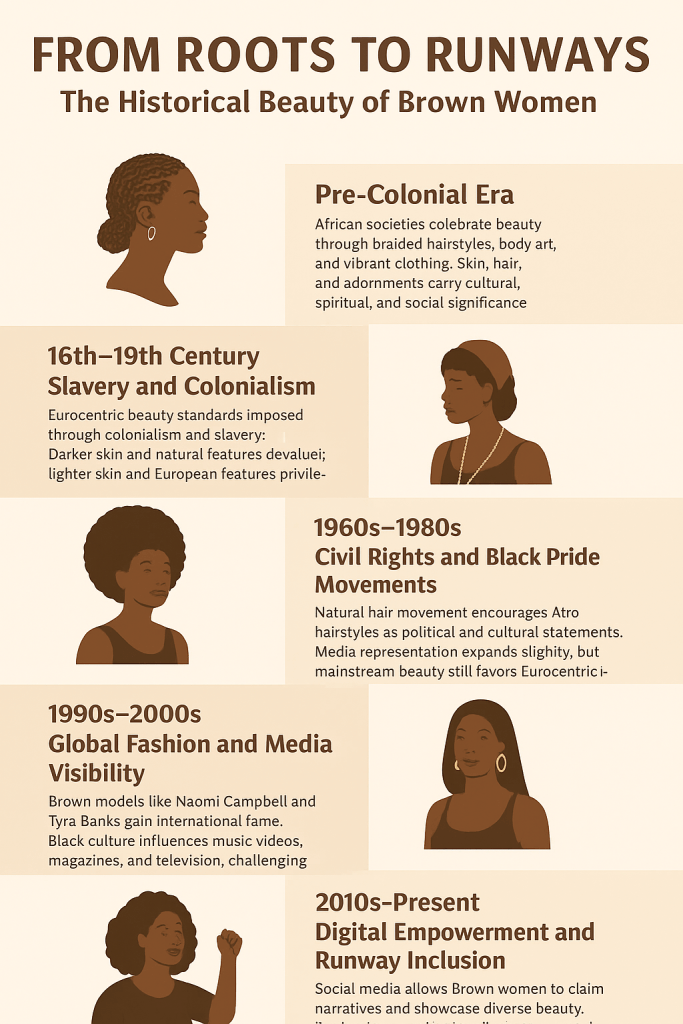
From Roots to Runways: The Historical Beauty of Brown Women

Photo by Al Ameen Saddiq on Pexels.com

The beauty of Brown women is deeply intertwined with culture, history, and resilience. From ancestral traditions to modern fashion runways, Brown women have navigated societies that often imposed Eurocentric standards while cultivating unique forms of self-expression, artistry, and elegance. Exploring this trajectory—from historical roots to contemporary visibility—reveals not only aesthetic contributions but also the resilience and empowerment embedded in the legacy of Brown women.

Ancestral Traditions and Cultural Significance

Throughout African, Caribbean, and Latin American societies, beauty has historically been expressed through hairstyles, skin care, adornments, and textiles. Braided and twisted hairstyles, body art, and vibrant clothing often carried social, spiritual, or cultural meaning, signaling status, heritage, or community affiliation (Byrd & Tharps, 2014). These traditions celebrated melanin-rich skin, facial features, and natural hair textures long before the imposition of colonial beauty standards. Beauty, in these contexts, was both personal and collective—a reflection of identity and heritage.

Colonialism, Slavery, and the Imposition of Eurocentric Standards

The transatlantic slave trade and colonial regimes brought systemic oppression that devalued darker skin and natural features. European ideals of beauty—fair skin, straight hair, and Eurocentric facial features—became markers of social privilege and desirability (Hunter, 2007). Despite these pressures, Brown women preserved cultural beauty practices, maintaining pride in their appearance and transmitting ancestral knowledge through generations. This resistance demonstrates that beauty has always been inseparable from resilience and identity affirmation.

African American Beauty Culture and the Harlem Renaissance

In the United States, the Harlem Renaissance (1920s–1930s) provided a platform for Black artistic expression, including beauty and fashion. Women like Josephine Baker, with her daring style and signature elegance, challenged mainstream perceptions while celebrating African aesthetics. Beauty salons became cultural hubs where women exchanged styling techniques, supported one another, and fostered community identity (Perry, 2009). These spaces cultivated confidence, creativity, and empowerment, demonstrating that beauty is not merely aesthetic but also sociocultural.

Modern Visibility and Runway Influence

In contemporary fashion, Brown women increasingly claim visibility and redefine industry standards. Models like Adut Akech, Duckie Thot, and Naomi Campbell have dominated international runways, demonstrating that melanin-rich beauty is not niche but universal. Designers are incorporating diverse features and complexions into campaigns, acknowledging the historical exclusion and striving toward inclusion. Social media further amplifies these voices, allowing Brown women to influence global perceptions directly.

Timeline: The Historical Beauty of Brown Women

Pre-Colonial Era

  • African societies celebrate beauty through braided hairstyles, body art, and vibrant clothing.
  • Skin, hair, and adornments carry cultural, spiritual, and social significance.

16th–19th Century: Slavery and Colonialism

  • Eurocentric beauty standards imposed through colonialism and slavery.
  • Darker skin and natural features devalued; lighter skin and European features privileged.
  • Brown women preserve cultural beauty practices covertly or in safe community spaces.

1920s–1930s: Harlem Renaissance

  • Black artistic expression flourishes; women like Josephine Baker challenge mainstream norms.
  • Beauty salons become cultural hubs for skill-sharing, empowerment, and community.

1960s–1980s: Civil Rights and Black Pride Movements

  • Natural hair movement encourages Afro hairstyles as political and cultural statements.
  • Media representation expands slightly, but mainstream beauty still favors Eurocentric ideals.

1990s–2000s: Global Fashion and Media Visibility

  • Brown models like Naomi Campbell and Tyra Banks gain international fame.
  • Black culture influences music videos, magazines, and television, challenging stereotypes.

2010s–Present: Digital Empowerment and Runway Inclusion

  • Social media allows Brown women to claim narratives and showcase diverse beauty.
  • Models like Adut Akech, Duckie Thot, and public figures like Lupita Nyong’o redefine global standards.
  • Colorism awareness movements (#MelaninMagic, #BrownSkinPoppin) increase representation and self-love advocacy.

Present & Future

  • Celebration of melanin-rich skin, natural hair, and diverse features continues to grow globally.
  • Beauty becomes a tool of empowerment, cultural pride, and resistance against systemic bias.

Media Representation and Colorism

While progress has been made, media representation continues to favor lighter-skinned women. Colorism—preference for lighter shades within communities of color—persists, reinforcing hierarchical beauty standards (Hunter, 2007). Visibility of darker-skinned models, actresses, and influencers challenges these norms, offering representation that affirms a broader spectrum of beauty. Public figures like Lupita Nyong’o and Tracee Ellis Ross exemplify this shift, inspiring younger generations to embrace their natural features proudly.

Beauty as Resistance and Empowerment

The historical beauty of Brown women reflects both aesthetic expression and resistance. Maintaining traditional hairstyles, advocating for natural skin care, and claiming space in fashion and media are acts of empowerment. Each choice affirms identity, challenges dominant beauty paradigms, and honors ancestral legacy. Brown women’s beauty has always been inseparable from cultural pride, resilience, and agency.

Conclusion

From roots to runways, the beauty of Brown women is a testament to heritage, resilience, and self-expression. Historical traditions, artistic contributions, and contemporary visibility reveal that beauty is not merely physical; it is cultural, social, and political. Celebrating this legacy affirms the value of melanin-rich skin, natural hair, and diverse features, ensuring that the beauty of Brown women continues to inspire confidence, empowerment, and cultural pride for generations to come.


References

  • Byrd, A. D., & Tharps, L. L. (2014). Hair story: Untangling the roots of Black hair in America. St. Martin’s Press.
  • Hunter, M. (2007). The persistent problem of colorism: Skin tone, status, and inequality. Sociology Compass, 1(1), 237–254.
  • Perry, I. (2009). Prophets of the hood: Politics and poetics in Hip Hop. Duke University Press.

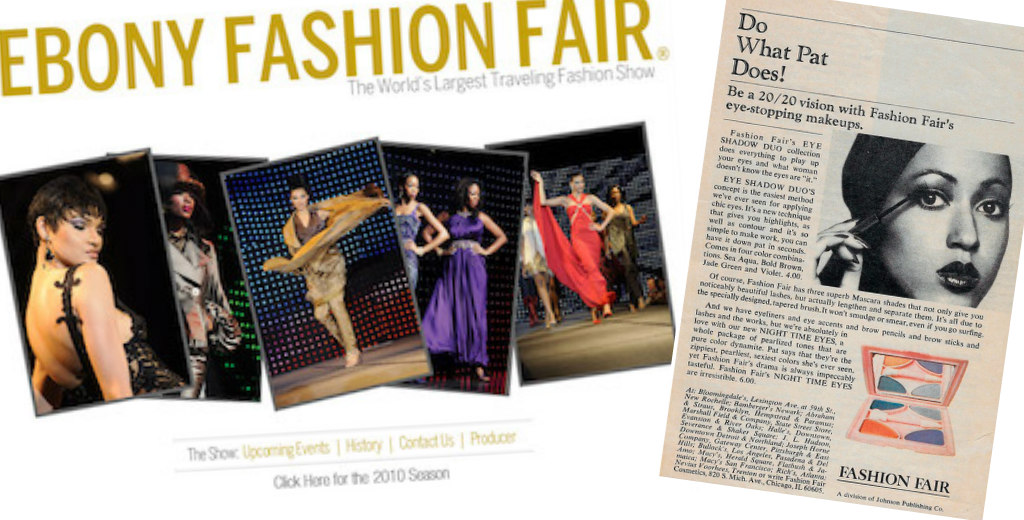
💄 Shades of Success: The Fashion Fair Legacy 💄

These advertisements are the property of their respective owners.

💄💄💄💄

Fashion Fair Cosmetics was founded in 1973 by Eunice Johnson, the trailblazing wife of John H. Johnson, founder of Ebony and Jet magazines. Born Eunice Walker in Selma, Alabama, in 1916, she married John in 1941 and became an influential force in both publishing and fashion. The couple had one daughter, Linda Johnson Rice, who would later lead Johnson Publishing Company. Eunice Johnson’s vision for Fashion Fair emerged from her experience organizing the Ebony Fashion Fair, a traveling fashion show she began in 1958 to raise money for Black charities. While touring, she discovered a lack of makeup shades for darker skin tones—prompting her to create a cosmetics line specifically designed for women of color (Taylor, 2016).

The Fashion Fair brand quickly became an international success. Ebony and Jet magazines, both owned by Johnson Publishing, were instrumental in promoting the cosmetics line, featuring glamorous spreads of Black models such as Pat Cleveland, Barbara Summers, and Jennifer Lawson. These models embodied elegance and sophistication, challenging Eurocentric beauty norms. The line expanded beyond foundation and lipsticks to include skincare products, eventually becoming the largest Black-owned cosmetics company in the world. At its peak in the late 1970s and 1980s, Fashion Fair reportedly generated annual revenues exceeding $20 million from its cosmetics division alone (Byrd & Tharps, 2014). While its core was cosmetics, the company did not primarily sell clothing; instead, the Ebony Fashion Fair fashion shows featured high-end designer garments from global couture houses as part of its fundraising and branding strategy.

✨ Ebony Fashion Fair vs. Fashion Fair Cosmetics ✨

Ebony Fashion FairFashion Fair Cosmetics
Founded: 1958 by Eunice Johnson as a traveling fashion show.Founded: 1973 by Eunice Johnson as a cosmetics line for women of color.
Purpose: Raise funds for African American charities while showcasing high fashion to Black audiences.Purpose: Provide makeup shades that catered specifically to darker skin tones, which were ignored by mainstream beauty brands.
Products: No physical products for sale; featured garments from top designers like Yves Saint Laurent, Givenchy, and Oscar de la Renta.Products: Cosmetics (foundation, lipsticks, eyeshadow, skincare), with shades suited for a diverse range of Black complexions.
Promotion: Advertised in Ebony and Jet magazines, plus national press; toured across the U.S., Canada, and Caribbean.Promotion: Featured in Ebony and Jet magazines, department store counters, and special events tied to the fashion shows.
Key Figures: Models like Pat Cleveland, Barbara Summers, and Jennifer Lawson graced the runway.Key Figures: Many of the same Ebony Fashion Fair models were used in cosmetics ads, linking beauty and fashion images.
Impact: Elevated Black representation in haute couture, inspiring cultural pride.Promotion: Advertised in Ebony and Jet magazines, plus national press; toured across the U.S., Canada, and the Caribbean.

The era of Fashion Fair’s dominance spanned the 1970s through the 1990s, a time when Black representation in beauty and fashion industries was still severely limited. The brand’s products filled a void in the marketplace, offering shades that had never been available in mainstream beauty lines. Fashion Fair not only thrived financially but also reshaped the beauty landscape by validating and celebrating darker skin tones. Even as competition grew in the 2000s, the company’s legacy as a cultural pioneer remained strong, influencing today’s inclusive beauty brands. Eunice Johnson’s work stands as a testament to how one woman’s vision—rooted in cultural pride and social responsibility—could transform both an industry and the self-image of generations of Black women.


References

Byrd, A. D., & Tharps, L. L. (2014). Hair story: Untangling the roots of Black hair in America (2nd ed.). St. Martin’s Press.

Taylor, U. Y. (2016). The promise of patriarchy: Women and the Nation of Islam. University of North Carolina Press.