
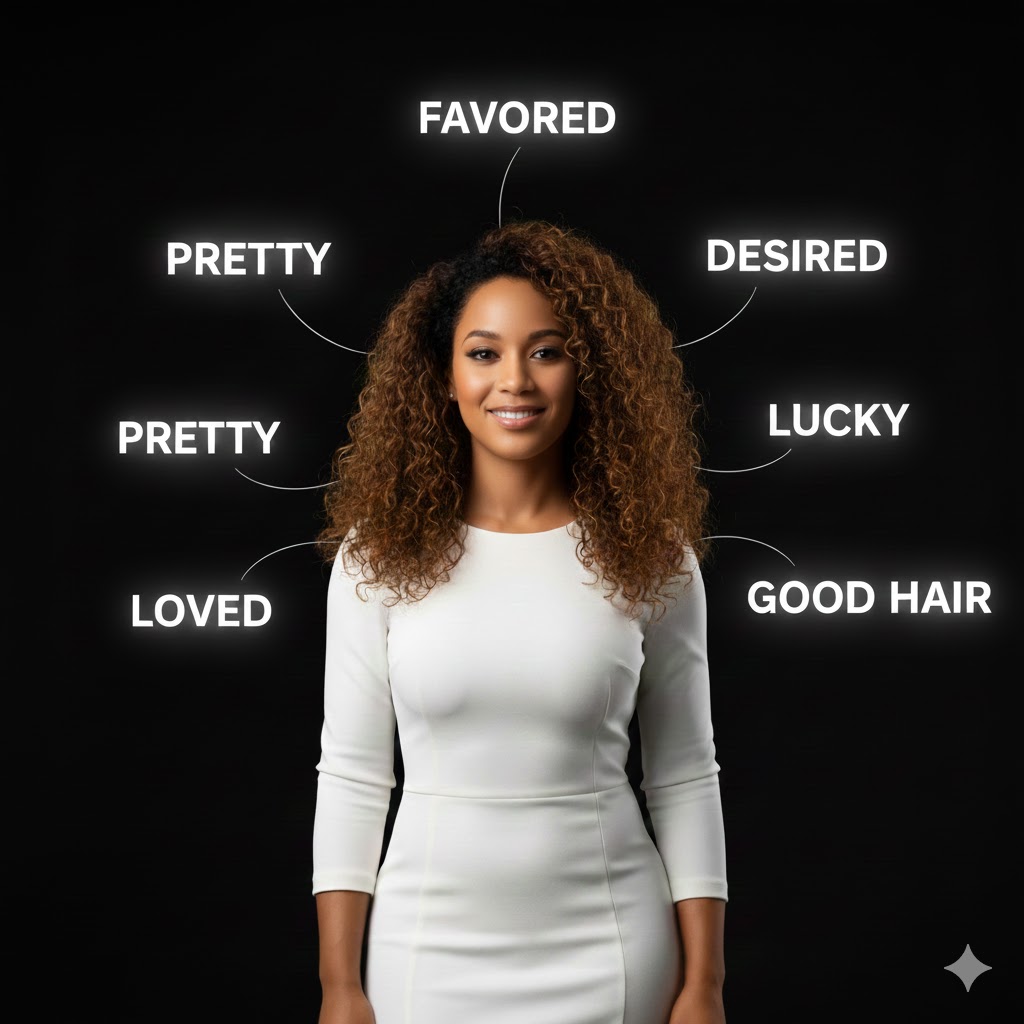
Light skin privilege refers to the systemic advantages afforded to lighter-skinned individuals within communities of color, particularly among Black people, due to proximity to whiteness. Unlike individual bias, light skin privilege is structural, psychological, and generational. It operates quietly, often denied by those who benefit from it, yet its effects are measurable across beauty standards, economic outcomes, social treatment, and intimate relationships.
This privilege did not emerge naturally within Black communities. It was manufactured during European colonization and chattel slavery, where whiteness was constructed as superior and Blackness as inferior. Lighter skin, often produced through rape and coercion, was weaponized as a marker of status, creating a hierarchy that mirrored white supremacy itself.
During slavery, lighter-skinned enslaved people were more frequently assigned to domestic labor, received marginally better treatment, and were sometimes granted access to education. These differences were intentional strategies designed to fracture unity and cultivate internal division. Privilege was used as control, not compassion.
After emancipation, these hierarchies were absorbed into Black social life. Light skin became associated with refinement, femininity, intelligence, and safety. Dark skin, by contrast, was framed as aggressive, excessive, or undesirable. These associations were reinforced through religion, pseudoscience, and Eurocentric aesthetics.
Beauty culture remains one of the most visible sites of light skin privilege. Lighter-skinned women are consistently perceived as prettier, softer, and more desirable, regardless of facial symmetry or physical features. Research confirms that skin tone alone significantly affects perceived attractiveness (Hunter, 2007).
This bias extends into romantic relationships and marriage markets. Lighter-skinned women receive more marriage proposals and are more frequently viewed as suitable long-term partners, while darker-skinned women are often fetishized, overlooked, or relegated to temporary desire (Russell et al., 1992).
Light skin privilege also shapes assumptions about personality. Lighter-skinned individuals are more likely to be described as kind, trustworthy, and pleasant. This reflects the psychological “halo effect,” where physical appearance influences moral judgment (Eagly et al., 1991).
These perceptions produce material benefits. Lighter-skinned people are more likely to receive gifts, favors, leniency, and informal mentorship. Their mistakes are forgiven more readily, while darker-skinned individuals are punished more harshly for similar behavior.
In the job market, light skin privilege is well-documented. Lighter-skinned Black employees earn higher wages, receive more promotions, and are perceived as more professional and competent than darker-skinned peers with identical credentials (Monk, 2014).
Light-skinned men benefit from a different expression of privilege. They are more often seen as intelligent, articulate, and leadership-oriented. Dark-skinned men, by contrast, are stereotyped as threatening, criminal, or volatile, regardless of behavior.
Dark skin penalty refers to the systematic disadvantages imposed on darker-skinned individuals across social, economic, and relational domains. It is the inverse of light skin privilege and functions as punishment for visible distance from whiteness. This penalty affects employment, education, marriage, policing, and mental health, often beginning in childhood and compounding across a lifetime.
Colorism functions as an internal caste system that ranks people within the same racial group. Like caste, it is inherited, normalized, enforced socially, and resistant to challenge. By replicating colonial hierarchy internally, colorism ensures oppression continues even without direct white enforcement.
These stereotypes have deadly consequences. Dark-skinned men experience harsher policing, longer prison sentences, and greater surveillance. Skin tone has been shown to influence sentencing outcomes even within the same racial category (Monk, 2019).
Within families, light skin privilege is often introduced early. Lighter-skinned children may be praised more, protected more, and spoken of as “the pretty one” or “the smart one,” while darker-skinned siblings are disciplined more harshly or emotionally neglected.
Relatives may invest more resources and expectations into lighter-skinned children, assuming greater future success. Darker-skinned children internalize these messages, shaping self-esteem, ambition, and emotional health well into adulthood (Cross, 1991).
Church spaces are not exempt. Lighter skin is often overrepresented in leadership, visibility, and marriageability narratives. Yet Scripture explicitly condemns partiality based on appearance (James 2:1–9, KJV).
Biblically, light skin privilege violates God’s law. “The Lord is no respecter of persons” (Acts 10:34, KJV). Favoritism rooted in skin tone is sin, regardless of cultural normalization.
Psychologically, light skin privilege fractures Black unity. It redirects rage inward, turning community members against one another rather than confronting the system that created the hierarchy. Fanon identified this as internalized colonialism (Fanon, 1952).
Healing requires naming privilege without defensiveness. Acknowledging benefit does not equal guilt, but denial perpetuates harm. Scripture calls for truth as the first step toward freedom (John 8:32, KJV).
Families, institutions, and communities must intentionally dismantle these hierarchies. Silence sustains injustice. Preference is not neutral when it aligns consistently with oppression.
The dilemma of light skin privilege is not about reversing hierarchy but abolishing it. Liberation requires rejecting shade-based worth entirely and restoring divine valuation rooted in humanity, righteousness, and character.
Until light skin privilege is confronted spiritually, psychologically, and structurally, inequality will persist within communities already burdened by racism. God’s justice demands better.
References
The Holy Bible, King James Version. (1611). Various passages.
Russell, K., Wilson, M., & Hall, R. (1992). The color complex: The politics of skin color among African Americans. Anchor Books.
Hunter, M. (2007). “The persistent problem of colorism: Skin tone, status, and inequality.” Sociology Compass, 1(1), 237–254.
Monk, E. P. (2014). “Skin tone stratification among Black Americans.” Social Forces, 92(4), 1317–1337.
Monk, E. P. (2019). “The color of punishment: African Americans, skin tone, and the criminal justice system.” Ethnic and Racial Studies, 42(10), 1593–1612.
Cross, W. E. (1991). Shades of Black: Diversity in African-American identity. Temple University Press.
Eagly, A. H., et al. (1991). “What is beautiful is good, but…” Psychological Bulletin, 110(1), 109–128.
Fanon, F. (1952). Black skin, white masks. Grove Press.
Wilkerson, I. (2020). Caste: The origins of our discontents. Random House.
 THE BROWN GIRL DILEMMA