Tag Archives: Israel

Bloodlines and Bondage: The Untold Biblical Genealogy of the Black Diaspora

Photo by nappy on Pexels.com

The genealogy of the Black diaspora is a tapestry woven from millennia of movement, resilience, and divine purpose. For centuries, African people have been misrepresented, with their histories erased or distorted, obscuring their identity as part of the biblical lineage of the “chosen people.” The Hebrew Scriptures, in conjunction with modern genetic research, provide compelling evidence that many Black communities are descendants of the ancient Israelites. This paper traces the genealogy of the Black diaspora, exploring bloodlines, the E1B1A haplogroup, the diaspora’s origins, and the biblical connections to Jerusalem, while contextualizing the historical impact of slavery and migration.


Biblical Genealogy of the Black Chosen People

The Bible records that the descendants of Ham, specifically through Cush (Genesis 10:6–8, KJV), were settled in Africa. These descendants include the ancient kingdoms of Kush, Egypt, and parts of Sub-Saharan Africa, establishing a biblical precedent for African peoples as integral to the lineage of Israel. Deuteronomy 28 details blessings and curses, many of which scholars argue correspond with the historical experiences of the African diaspora. The scriptures provide a genealogical framework that links Africans to the broader story of the Israelites, emphasizing their role in God’s covenantal plan.


The Black Diaspora and Historical Context

The Black diaspora refers to the global dispersion of African peoples through migration, trade, conquest, and slavery. Starting with the transatlantic slave trade, millions of Africans were forcibly removed from their homelands, scattering the descendants of biblical Cush and Ham across the Americas, Europe, and the Caribbean. This diaspora disrupted the natural genealogical continuity, creating a legacy of bondage but also resilience. Historical records, oral traditions, and archaeology show that African civilizations prior to slavery had complex social, political, and religious structures, underscoring the depth of lineage that preceded forced displacement.


Genetics and the E1B1A Haplogroup

Modern genetic studies provide an additional layer of evidence for tracing African genealogies. The E1B1A Y-chromosome haplogroup is prevalent among West and Central African populations and is strongly associated with descendants of the African diaspora. This haplogroup traces paternal lineage and corroborates historical accounts of migrations from Northeast Africa toward the Nile Valley and across the continent. By linking genetics to biblical and historical records, researchers can identify patterns of descent consistent with the movements of Cushite and Hamitic peoples, reinforcing the continuity of Black Israelite lineage.


Tracing the Lineage Back to Jerusalem

Several biblical passages suggest that African peoples had connections to the Holy Land long before slavery. Psalm 87:4 (KJV) notes, “I will make mention of Rahab and Babylon to them that know me,” which scholars interpret as recognizing the inclusion of Cush and other African nations in God’s covenantal history. Historical interactions, including trade, migration, and the establishment of Jewish communities in Africa, provide evidence that Africans had religious and genealogical ties to Jerusalem and the Israelite tradition long before forced dispersal. The Ethiopian eunuch in Acts 8:27–39 further illustrates the integration of Africans into the biblical story of faith and covenant.


Legacy, Continuity, and Resilience

Despite centuries of enslavement, colonization, and cultural erasure, the genealogical and spiritual identity of African peoples as descendants of the biblical Israelites endures. The diaspora’s bloodlines, preserved through genetics and oral tradition, testify to resilience and divine continuity. Recognizing these connections empowers African descendants to reclaim identity, history, and purpose. The Bible consistently underscores the importance of remembering and honoring one’s lineage: “Remember the days of old, consider the years of many generations: ask thy father, and he will shew thee; thy elders, and they will tell thee” (Deuteronomy 32:7, KJV).


Conclusion

The biblical genealogy of the Black diaspora reveals a profound and often overlooked truth: African peoples are deeply intertwined with the history of Israel. From the descendants of Cush and Ham to the modern African diaspora, bloodlines and genetics such as E1B1A corroborate biblical and historical narratives. By tracing these lineages, scholars and communities alike can reclaim their rightful place in history, affirm spiritual identity, and honor the enduring legacy of the chosen people. Understanding the genealogy of the Black diaspora is both an act of scholarship and a restoration of truth.


References

  • De Gruy, J. (2005). Post Traumatic Slave Syndrome: America’s Legacy of Enduring Injury and Healing. Uptone Press.
  • Diop, C. A. (1974). The African Origin of Civilization: Myth or Reality. Chicago Review Press.
  • Franklin, J. H., & Moss, A. A. (2000). From Slavery to Freedom: A History of African Americans (8th ed.). McGraw-Hill.
  • Hammer, M. F., et al. (2001). Hierarchical patterns of global human Y-chromosome diversity. Molecular Biology and Evolution, 18(7), 1189–1203. https://doi.org/10.1093/oxfordjournals.molbev.a003906
  • Van Sertima, I. (1976). They Came Before Columbus: The African Presence in Ancient America. Random House.
  • The Holy Bible, King James Version.

E1B1A (Genetic Code of the Chosen)

E1B1A, also known as E-M2, is a Y-DNA (Y-chromosome) haplogroup—a genetic lineage passed exclusively from father to son. It is one of the most common paternal lineages among men of West and Central African descent, especially among the Yoruba, Igbo, Ewe, Fula, and other Bantu-speaking peoples. It is also prevalent among African Americans, Afro-Caribbeans, and Afro-Brazilians—largely because of the transatlantic slave trade.


🔬 Scientific Overview of E1B1A

  • Haplogroup Name: E1b1a (formerly known as E3a)
  • Current Label in Genetics: E-M2 (E1b1a1)
  • Region of Origin: Sub-Saharan Africa
  • Estimated Age: ~20,000 to 30,000 years ago
  • Genetic Trait: Passed only through the male line (father to son via the Y chromosome)

🌍 Where E1B1A is Found

  • High frequency in West Africa: Nigeria, Ghana, Benin, Cameroon
  • Caribbean & Americas: Especially among descendants of the transatlantic slave trade
  • African Americans: Around 60–70% of African-American men belong to E1B1A

🔁 Why It Matters

  1. Ancestral Tracking: E1B1A helps trace paternal ancestry directly to West Africa.
  2. Diaspora Connection: Found heavily among descendants of enslaved Africans, especially in the U.S., Caribbean, and Latin America.
  3. Tribal Links: Often linked with the Yoruba, Igbo, and Bantu tribes, who were among those captured during the slave trade.

📖 Biblical & Cultural Interpretations

Many researchers and Hebrew Israelite scholars believe E1B1A may correspond with the patrilineal line of the ancient Israelites, especially in light of:

  • Deuteronomy 28:68, which describes being taken into slavery by ships.
  • The historical pattern of curses and captivity matching the transatlantic slave trade.
  • Baruch 4:6 (KJV): “Ye were sold to the nations, not for your destruction: but because ye moved God to wrath, ye were delivered unto the enemies.”

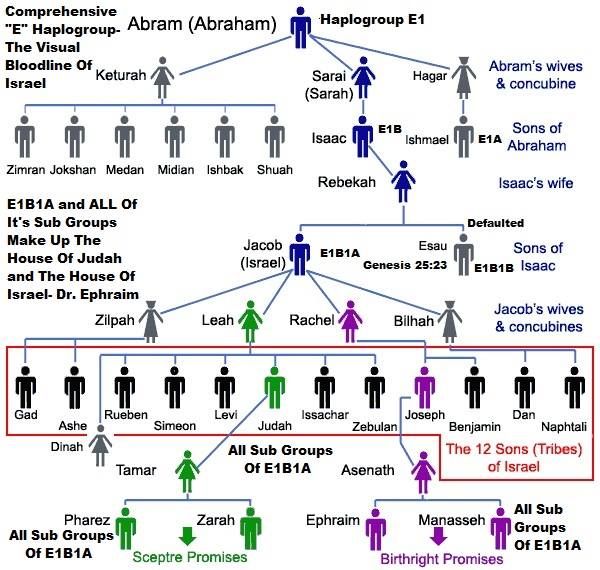
This has led some to identify the E1B1A lineage as belonging to the descendants of Jacob (Israel) and believe it is the genetic marker of the lost tribes of Israel—specifically the tribe of Judah.


⚠️ Common Misconceptions

  • Not all Africans have E1B1A. Some have E1B1B, A, B, or other lineages.
  • E1B1B is often associated with North Africa, the Middle East, and sometimes Esau’s lineage (biblically speaking, the twin brother of Jacob).
  • Y-DNA only traces the male line, so a person’s complete ancestry includes many other lines not captured by Y-DNA.

🧬 Exploring Haplogroup E1b1a: Genetics, Identity & Heritage

Interview with interview with Dr. Yehoshua Ben Ephraim from my book “The Brown Girl Dilemma” 2017

1. Background & Identity

I am originally from Charleston, South Carolina. My intellectual formation is both traditional and autodidactic: I hold an Associate’s, Bachelor’s, and Master’s degree from accredited universities, complemented by an honorary doctorate for substantial contributions to theology and genetics. My expertise spans theology, philosophy, psychology, human behavior, and genetics, sustained by lifelong reading and interdisciplinary inquiry.


2. Origins of the Research

My investigation into lineage and identity was driven by the need to reclaim a lost heritage. Unlike other communities whose ancestral origins in Africa are preserved through tribal or national identity (e.g., Egyptian, Ethiopian), many Black Americans lack this clarity. Genetic research revealed that a significant number of African-descended individuals in the Americas carry Y‑DNA Haplogroup E1b1a, predominantly among the Yoruba and Igbo of Nigeria. This discovery prompted an exploration into how this genetic signature intersects with historical lineage, particularly the prophetic narratives in Deuteronomy 28.


3. The Y‑DNA Haplogroup of the Twelve Tribes of Israel

Through ancestral genetic and scriptural analysis, I concluded that the lineage of Jacob (the Patriarch of Israel) corresponds with Haplogroup E1b1a. The biblical reference in Deuteronomy 28:68, which mentions future enslavement “by ships,” appears prophetic when aligned with the transatlantic slave trade and the predominance of E1b1a among enslaved Africans. Y‑chromosome inheritance is paternally transmitted and unchanged, allowing us to trace a direct male line from Jacob to present-day descendants of the twelve tribes.


4. Genetic Comparison: Ashkenazi Jews & E1b1b

Genesis 25:23 declares that the nations of Jacob and Esau would diverge. Genetically, Esau’s descendants align with Haplogroup E1b1b, which is prevalent in certain Middle Eastern and North African populations. Many Ashkenazi Jews display E1b1b or haplogroup J—distinct from E1b1a, which supports a separate ancestral line. Misattributions linking E1b1b to Black Israelites are thus historically and scientifically flawed.


5. African Tribes & Mixed Lineage

Several African ethnic groups—such as the Lemba, Ashanti, and Igbo—carry both E1b1a and E1b1b haplogroups, reflecting historical admixture. Modern diaspora communities (e.g., in Brazil, the Caribbean, and the United States) also reflect this genetic diversity, consistent with historical migration and intermarriage patterns.


6. The Debate on Black Hebrew Israelites

DNA makes lineage claims far more objective. Since E1b1a is exclusive to the male line of Jacob, any claimant to Israelite identity must test positive for E1b1a. Others may have spiritual, cultural, or chosen affiliation but lack genetic continuity. This clarity undercuts ambiguous identity claims by non-E1b1a lineages.


7. Biracial Identity & Patriarchal Lineage

Y‑DNA is strictly paternal, affecting male descendants. However, cultural and genetic heritage in biracial individuals is influenced by both parents. Thus, while only biological fathers transmit Y‑DNA, biracial Israelite identity can be recognized through maternal collateral lines but requires genetic evidence for formal claim.


8. How DNA Defines National Lineage

Beyond identifying immediate relations, subgroups within E1b1a trace the fourteen branches of Jacob’s descendants (including Joseph’s sons, Ephraim and Manasseh). Genetic markers may eventually assist in mapping modern individuals to specific tribes.


9. Deuteronomy 28 in Context

Deuteronomy 28 outlines blessings and curses tied to Israel’s fidelity. Subsequent exile and dispersal—interpreted as the African diaspora—mirror the conditions described. This scriptural prophecy frames the historical and genetic narrative of descendants of Jacob (the Negroid lineage).


10. Present State & Path Forward

In 2017, many descendants remain disconnected from authentic identity, often identifying broadly as “African American.” This lack of specificity perpetuates cultural dislocation. Romans 9:27 suggests only a remnant attains covenantal alignment—highlighting the need for genealogical clarity and spiritual awakening. My role is to provide empirical—and scriptural—evidence. Change begins when we reconnect with identity and commit to obeying divine statutes.


🔍 Conclusion

  • E1b1a marks the paternal lineage of Jacob (Israel).
  • It is the definitive tool to distinguish genetic Israelites from others.
  • Recognizing this genetic truth is essential to rightful identity.
  • Following identity restoration comes moral and spiritual responsibility.

References:

Jobling, M. A., Hurles, M. E., & Tyler-Smith, C. (2013). Human Evolutionary Genetics. Garland Science.

Kittles, R. A., & Weiss, K. M. (2003). Race, ancestry, and genes: Implications for defining disease risk. Annual Review of Genomics and Human Genetics, 4(1), 33–67. https://doi.org/10.1146/annurev.genom.4.070802.110300

Underhill, P. A., et al. (2000). The phylogeography of Y chromosome binary haplotypes and the origins of modern human populations. Annals of Human Genetics, 64(Pt 3), 223–241. https://doi.org/10.1046/j.1529-8817.2000.00085.x

U.S. National Library of Medicine. (n.d.). Y chromosome haplogroups. Genetics Home Reference. https://ghr.nlm.nih.gov/primer/genomicresearch/ychromosome

Akbar, N. (1996). Breaking the Chains of Psychological Slavery. Mind Productions.

hooks, b. (1992). Black Looks: Race and Representation. South End Press.

Fanon, F. (1967). Black Skin, White Masks. Grove Press.

Russell-Cole, K., Wilson, M., & Hall, R. E. (2013). The Color Complex: The Politics of Skin Color in a New Millennium. Anchor Books.

American Psychological Association. (2019). Ethnic and Racial Disparities in Mental Health Care.