
The Ebony Dolls series celebrates the extraordinary beauty, brilliance, and timeless femininity of Black women across generations. This collection honors the women whose presence reshapes standards, whose elegance defies shallow stereotypes, and whose radiance reflects both royal ancestry and divine craftsmanship. Each profile explores not only physical beauty but the depth behind it — resilience, artistry, heritage, intellect, and the unique glow that only melanin can produce.
This series highlights the royalty, actresses, models, musicians, public figures, entrepreneurs, and cultural icons who embody the full spectrum of Black womanhood. From deep chocolate to light warm caramel, from soft curls to sculpted coils, from statuesque silhouettes to girl-next-door sweetness, The Ebony Dolls pays homage to the diversity and glory of Black feminine identity. Their lives tell stories of triumph, discipline, creativity, spiritual rootedness, and the unbreakable grace passed down from African queens to modern-day trailblazers.
With each installment, readers will encounter a stunning profile — a blend of biography, cultural commentary, beauty analysis, career achievements, and personal reflections. Every woman will be honored in her own right: her skin, her features, her accomplishments, her family, her growth, her legacy. The Ebony Dolls is more than a beauty series; it is a celebration of sacred womanhood, Black excellence, and the divine imprint upon every daughter of the diaspora.
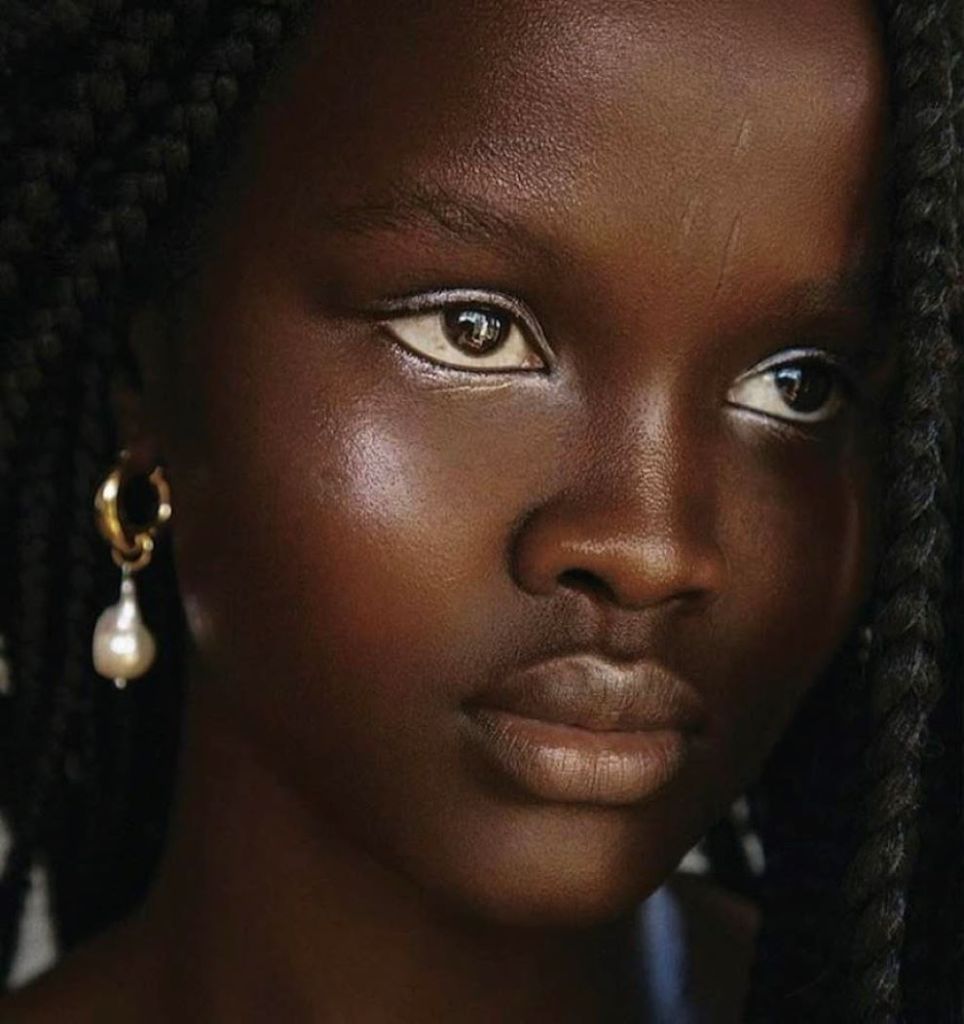
The story of melanated beauty is one of power, grace, and divine design. Melanin, the pigment that gives skin its rich and radiant tone, is not merely biology — it is a cultural and spiritual emblem. The Bible captures this truth beautifully when the Shulamite woman proclaims, “I am black, but comely” (Song of Solomon 1:5, KJV). In this statement, dark skin is affirmed as beautiful and desirable, worthy of admiration and dignity.
🌑 What is Melanin and Why It Matters
Melanin is a complex polymer produced by melanocytes, responsible for the pigmentation of skin, hair, and eyes. People with higher levels of eumelanin (brown/black melanin) not only possess deeper skin tones but also benefit from natural UV protection, reduced visible aging, and a lower risk of sun-related skin cancers (Taylor, 2020). This unique biological gift is part of the reason why melanated women are often noted for their youthful glow well into middle and later life.
Beyond biology, melanin carries cultural symbolism. African traditions often link dark skin to vitality, fertility, and divine connection. Psychologists note that embracing skin tone can be an act of resistance against colorism, boosting self-esteem and promoting psychological resilience (Hunter, 2011).
🌑 The Beauty of Queen Nefertiti
Queen Nefertiti of Ancient Egypt is perhaps the earliest celebrated icon of melanated beauty. Her name literally means “the beautiful one has come,” and her iconic limestone bust — with its regal posture, almond-shaped eyes, and perfect symmetry — continues to mesmerize the world thousands of years later. Nefertiti was more than a queen; she was a leader who helped guide Egypt through a religious revolution alongside Pharaoh Akhenaten. Her image remains a symbol of grace, authority, and divine femininity.
🌑 Naomi Campbell: The Supermodel Pioneer
Naomi Campbell redefined fashion. Born in 1970 in London, she became the first Black model to appear on the covers of French Vogue and TIME magazine. Known for her fierce walk and striking cheekbones, Campbell’s career opened doors for future melanated models. She turned the runway into a global stage, proving that Black women’s beauty is universal.
🌑 Lupita Nyong’o: Dark Skin as Royalty
Oscar-winning actress Lupita Nyong’o uses her platform to uplift girls with dark skin, urging them to love themselves. Her natural hair, deep complexion, and regal red-carpet presence challenged industries that favored lighter-skinned women. Lupita is living proof that Blackness is not just beautiful — it is royal.
🌑 Skai Jackson: The New Generation
Young doll-like actress Skai Jackson has become a role model for Gen Z, using her voice against bullying and injustice. She represents a generation of melanated girls embracing natural hair, deep skin tones, and self-confidence at an early age. Her presence in the media encourages young girls to see their beauty reflected on screen.
🌑 Halle Berry: Hollywood’s Trailblazer
Halle Berry shattered barriers by becoming the first Black woman to win an Academy Award for Best Actress. Known for her delicate facial features, big eyes, and magnetic screen presence, Berry opened doors for other actresses of color in leading roles.
🌑 Yara Shahidi: Beauty Meets Brilliance
Actress and activist Yara Shahidi combines intelligence with elegance. Known for her curls, poise, and thoughtful activism, Yara exemplifies a new standard for melanated beauty — one that prizes intellect, social justice, and self-expression.
🌑 Josephine Baker: The Bronze Venus
Josephine Baker, born in 1906, became one of the most famous entertainers in the world during the Jazz Age. Known as the “Bronze Venus,” she captivated Paris with her performances, bringing African and African American beauty to international stages. She was not just a performer — she was also a spy for the French Resistance during World War II and a civil rights activist. Her elegance, short hair, and magnetic stage presence made her one of the first global Black beauty icons.
🌑 Diana Ross: The Supreme Star
Diana Ross, lead singer of The Supremes, defined glamour in the Motown era. Her big hair, dazzling gowns, and signature voice helped elevate Black beauty into mainstream America. Ross inspired generations with her confidence, proving that Black women could be both elegant and unapologetically bold in their style.
🌑 Eartha Kitt: The Catwoman of Class
Eartha Kitt, with her sultry voice and feline grace, became one of Hollywood’s most distinctive stars. Known for her role as Catwoman in the 1960s Batman series, she embodied mystery and sensuality. Kitt was also outspoken against injustice, famously criticizing the Vietnam War during a White House luncheon — a testament that beauty and courage often walk hand in hand.
🌑 Ebony Dolls of the Past: Fashion Pioneers
Donyale Luna, the first Black model on the cover of Vogue (1966), and Beverly Johnson, the first on American Vogue (1974), broke racial barriers in fashion. They made it possible for Naomi Campbell and countless others to dominate runways decades later.
🌑 African Queens: The Divine Legacy of Melanated Beauty
The history of melanated beauty is inseparable from the power, wisdom, and elegance of African queens and goddesses. These figures not only defined aesthetic standards but also embodied leadership, courage, and spiritual authority, reminding the world that beauty and power coexist.
Queen Makeda (The Queen of Sheba) — Celebrated in Ethiopian and biblical history, Makeda is renowned for her wisdom, diplomacy, and regal presence. According to tradition, she visited King Solomon in Jerusalem, bearing gifts and profound questions, demonstrating intellect matched by beauty (1 Kings 10:1–13, KJV). Makeda represents the archetype of the melanated queen whose beauty is inseparable from intelligence and influence.
Cleopatra VII — Perhaps the most famous African queen in Western history, Cleopatra combined political genius with striking beauty. Although her lineage was Macedonian, historical records suggest her Egyptian identity and cultural integration contributed to her iconic appearance and persona. Cleopatra’s charm, eloquence, and strategic acumen make her an enduring symbol of melanated allure and leadership.
Queen Nzinga Mbande — The 17th-century warrior queen of Ndongo and Matamba (modern-day Angola) fought Portuguese colonizers to protect her people. Nzinga’s beauty was legendary, but it was her courage, tactical brilliance, and diplomacy that cemented her legacy. She embodies the idea that melanated beauty is inseparable from power and resilience.
Queen Hatshepsut — One of Ancient Egypt’s most successful female pharaohs, Hatshepsut ruled with wisdom and stability. Often depicted in statues and reliefs with the regalia of kings, her beauty was paired with authority, showing that melanated women could command both respect and admiration in societies dominated by men.
🌑 Psychology of Beauty and the Melanated Woman
Research shows that symmetrical faces and certain waist-to-hip ratios are universally attractive, but culture plays a major role in determining beauty standards (Rhodes, 2006; Singh, 1993). In Western media, melanated women were historically excluded from beauty narratives, leading to internalized biases. The recent resurgence of celebrating natural hair, full lips, and dark skin has created a cultural shift that affirms mental wellness and positive identity development for Black girls (Awad et al., 2015).
🌑 Spiritual Dimensions of Melanated Beauty
Biblically, beauty is connected to character and purpose. 1 Peter 3:3–4 (KJV) reminds us that inner beauty — the “ornament of a meek and quiet spirit” — is of great value in God’s sight. Proverbs 31:30 (KJV) warns, “Favor is deceitful, and beauty is vain: but a woman that feareth the Lord, she shall be praised.” This frames melanated beauty not just as physical adornment but as spiritual power.
🌑 Legacy and Future
From Queen Nefertiti to Josephine Baker, from Naomi Campbell to Lupita Nyong’o, from Diana Ross to Yara Shahidi, melanated beauty has defined eras and inspired the world. These women — past and present — are more than muses. They are leaders, visionaries, and cultural architects. They remind us that Black beauty is not a passing trend but an eternal standard, a reflection of divine creativity and human brilliance.
References
- Awad, G. H., Norwood, C., Taylor, D. S., et al. (2015). Beauty and body image concerns among African American college women. Journal of Black Psychology, 41(6), 540–564.
- Hunter, M. (2011). Buying racial capital: Skin-bleaching and cosmetic surgery in a globalized world. The Journal of Pan African Studies, 4(4), 142–164.
- Rhodes, G. (2006). The evolutionary psychology of facial beauty. Annual Review of Psychology, 57, 199–226.
- Singh, D. (1993). Adaptive significance of waist-to-hip ratio and female physical attractiveness. Journal of Personality and Social Psychology, 65(2), 293–307.
- Taylor, S. (2020). Advances in understanding of skin of color. Journal of the American Academy of Dermatology, 82(1), 157–166.
- The Holy Bible, King James Version.
 THE BROWN GIRL DILEMMA