
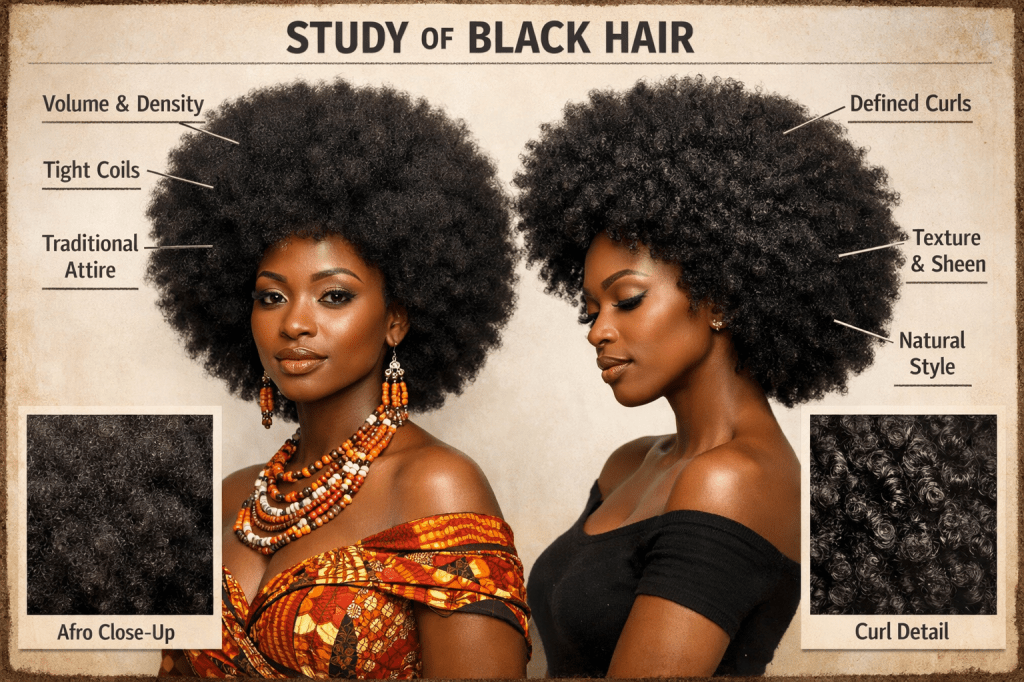
Black hair is not merely a biological feature but a profound cultural, historical, and spiritual marker that has shaped identity across the African continent and the African diaspora. Its textures, patterns, and styles communicate lineage, status, resistance, creativity, and survival. To study Black hair is to study a living archive of African civilizations, colonial disruption, and modern reclamation.
From an anthropological perspective, Black hair exhibits the widest range of natural textures found in human populations, particularly tightly coiled and spiral patterns commonly categorized as Type 4 hair. These textures are not accidental; they are adaptive traits shaped by evolution in equatorial climates, aiding thermoregulation and protecting the scalp from intense ultraviolet radiation (Jablonski, 2012).
In precolonial African societies, hair functioned as a sophisticated language. Styles signified age, marital status, ethnic affiliation, wealth, fertility, and spiritual rank. Among the Yoruba, Himba, Maasai, and Wolof peoples, hair was adorned with beads, cowrie shells, clay, and oils, transforming the head into a crown that reflected both communal belonging and divine order (Sieber & Herreman, 2000).
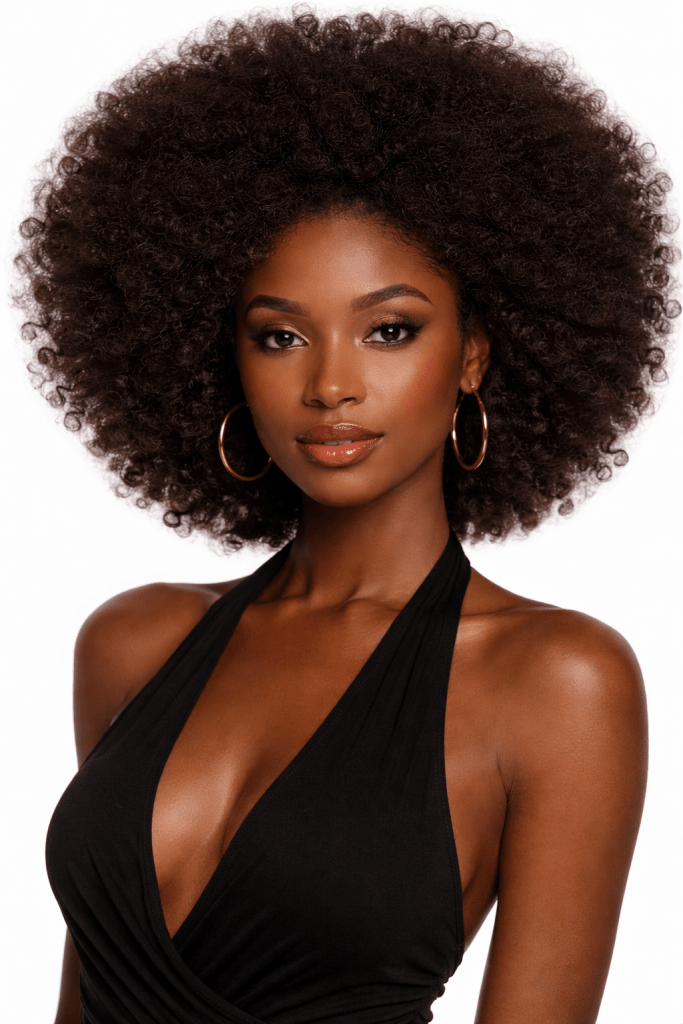
Hair care itself was a communal ritual. Grooming involved social bonding, storytelling, and intergenerational knowledge transfer. Natural oils such as shea butter and palm oil were used not only for aesthetics but for scalp health and protection, underscoring an advanced understanding of cosmetic science long before Western industrial products emerged (Byrd & Tharps, 2014).
The transatlantic slave trade violently disrupted these traditions. Enslaved Africans were often forcibly shaved upon capture, a symbolic stripping of identity, dignity, and ancestry. This act was not hygienic alone; it was psychological warfare designed to erase memory and enforce submission (White & White, 1995).
During slavery in the Americas, Black hair became politicized. European beauty standards elevated straight hair as “civilized” and denigrated African textures as inferior. These ideologies were embedded into laws, social hierarchies, and labor systems, reinforcing racial domination through aesthetics (Banks, 2000).
Post-emancipation, many Black people adopted hair straightening practices as survival strategies within hostile racial economies. Straight hair often afforded greater access to employment and social mobility. This was not self-hatred, but adaptation within systems that punished African appearance (Rooks, 1996).
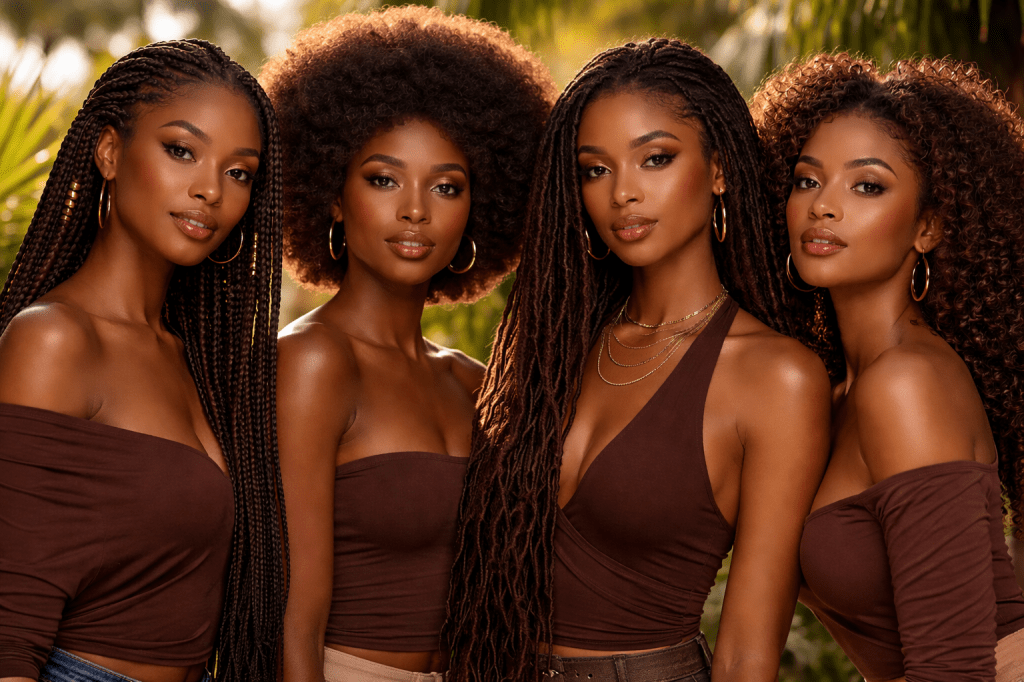
The 20th century marked a turning point as Black intellectuals and artists challenged Eurocentric norms. The Harlem Renaissance and later the Black Power Movement reframed natural hair as political resistance. The Afro became a visible declaration of pride, autonomy, and rejection of assimilation (Van Deburg, 1992).
Scientifically, Black hair has been misunderstood and understudied. Traditional cosmetology training and dermatological research historically centered straight hair models, leading to misclassification of Black hair as “problematic” rather than biologically distinct. Contemporary research now recognizes the unique elliptical follicle shape and curl geometry of Afro-textured hair (Franbourg et al., 2003).
Psychologically, hair plays a critical role in self-concept and racial identity development. Studies show that acceptance of natural hair correlates with higher self-esteem among Black women and girls, while hair discrimination is linked to anxiety, workplace bias, and internalized racism (Rosette & Dumas, 2007).
Black women, in particular, bear the heaviest social burden regarding hair. Their hair has been hyper-policed in schools, workplaces, and the military, prompting legal interventions such as the CROWN Act, which affirms natural hairstyles as protected expressions of racial identity (Greene, 2021).
In African spiritual systems, hair is often seen as sacred—an extension of the soul and a conduit of spiritual energy. Many traditions hold that the head is the highest point of the body and closest to the divine, making hair an integral component of ritual purity and spiritual discipline (Mbiti, 1990).
The global natural hair movement of the 21st century represents a reclamation of ancestral knowledge. Social media, digital archives, and grassroots education have empowered millions to unlearn colonial beauty myths and embrace their God-given design. This movement is both aesthetic and epistemological.
Economically, Black hair has fueled a multibillion-dollar global industry, yet Black communities have historically been excluded from ownership and profit. Recent shifts toward Black-owned brands and ethical sourcing reflect a growing demand for economic justice within beauty culture (Wilkinson-Weber & DeNicola, 2016).
From a genetic standpoint, African hair diversity mirrors the deep genetic diversity of African populations themselves. Africa contains the oldest and most varied human gene pools, and hair texture variation is a visible testament to this biological richness (Tishkoff et al., 2009).
Education systems are increasingly recognizing the importance of inclusive representation. When Black hair is normalized in textbooks, media, and academic studies, it disrupts deficit narratives and affirms Black children’s embodied identities as worthy of study and respect.
In media and visual culture, the afro, locs, braids, and twists function as counter-hegemonic symbols. They resist homogenization and assert presence in spaces that once demanded erasure. Representation of natural hair is thus inseparable from struggles for visibility and equity.
The study of Black hair also intersects with gender, class, and theology. In many faith traditions, debates around modesty, submission, and beauty are projected onto Black women’s hair, revealing how control over hair often mirrors control over bodies and voices.
In diasporic contexts, Black hair connects past and present, Africa and the Americas. It carries memory even when language and geography are lost. Each coil becomes a lineage marker, a living genealogy etched into the body.
Ultimately, Black hair is evidence of survival. Despite centuries of violence, ridicule, and regulation, it continues to grow—defiant, adaptive, and beautiful. To study Black hair is to study resilience written in keratin and culture.
As scholarship expands, Black hair must be treated not as a niche topic but as a legitimate interdisciplinary field encompassing anthropology, biology, history, psychology, theology, and cultural studies. Its significance reaches far beyond appearance into the core of human identity.
In honoring Black hair, academia participates in restorative justice—correcting historical distortions and affirming that what was once marginalized is, in truth, central to understanding humanity itself.
References
Banks, I. (2000). Hair matters: Beauty, power, and Black women’s consciousness. NYU Press.
Byrd, A. D., & Tharps, L. L. (2014). Hair story: Untangling the roots of Black hair in America (2nd ed.). St. Martin’s Press.
Franbourg, A., Hallegot, P., Baltenneck, F., Toutain, C., & Leroy, F. (2003). Current research on ethnic hair. Journal of the American Academy of Dermatology, 48(6), S115–S119.
Greene, T. (2021). The CROWN Act and the fight against hair discrimination. Harvard Civil Rights–Civil Liberties Law Review, 56, 487–515.
Jablonski, N. G. (2012). Living color: The biological and social meaning of skin color. University of California Press.
Mbiti, J. S. (1990). African religions and philosophy (2nd ed.). Heinemann.
Rooks, N. (1996). Hair raising: Beauty, culture, and African American women. Rutgers University Press.
Rosette, A. S., & Dumas, T. L. (2007). The hair dilemma: Conformity versus authenticity in corporate America. Academy of Management Journal, 50(4), 785–807.
Sieber, R., & Herreman, F. (2000). Hair in African art and culture. The Museum for African Art.
Tishkoff, S. A., et al. (2009). The genetic structure and history of Africans and African Americans. Science, 324(5930), 1035–1044.
Van Deburg, W. L. (1992). New day in Babylon: The Black Power movement and American culture. University of Chicago Press.
Wilkinson-Weber, C. M., & DeNicola, A. (2016). Critical craft: Technology, globalization, and capitalism. Bloomsbury.
 THE BROWN GIRL DILEMMA