During the transatlantic slave trade and the centuries of bondage that followed, enslavers in the Americas constructed a false version of Christianity designed to pacify, manipulate, and dominate African people. This was not true biblical faith but a political weapon deliberately engineered to uphold racial hierarchy, economic exploitation, and social control. Enslaved Africans quickly recognized that the Christianity of the slave master contradicted both Scripture and the spirit of the God of justice, yet this distorted theology was imposed on them through law, violence, and psychological manipulation.
The “Slave Bible”: Christianity Rewritten for Control
Slaveholders created an edited version of Scripture often called The Slave Bible (published in 1807 by the Society for the Conversion of Negro Slaves). This Bible omitted as much as 90% of the Old Testament and 50% of the New Testament.
Removed sections included:
- The Exodus story
- Passages about freedom and liberation
- Scriptures against oppression
- Texts about God judging unjust rulers
- Lines affirming Israel’s identity, dignity, and divine purpose
Left in were:
- Scriptures about obedience
- Passages about servants submitting to masters
- Verses promoting patience in suffering
It was a theological tool of psychological enslavement.
White Supremacist Christian Doctrine
Slaveholders used a twisted theology that claimed:
- Africans were “cursed” (misusing the Curse of Ham)
- Slavery was God’s will
- Whites were divinely ordained rulers
- Black people were naturally inferior
- Saving souls was more important than saving bodies
- Obedience to the master = obedience to God
This doctrine had no biblical basis, but it was taught to justify kidnapping, rape, brutality, terror, and forced labor.
Enslavement Suppressed the Real Biblical Themes
The enslavers intentionally hid the Bible’s central themes:
- Liberation (Exodus, Isaiah, Luke 4:18)
- God’s anger at oppression
- Justice and righteousness
- Equality of all people
- Condemnation of kidnapping (Exodus 21:16)
- Prophecy about Israel going into slavery (Deuteronomy 28)
Enslaved Africans quickly realized the true Bible was a book of freedom, not submission.
Christianity Was Used as Propaganda
White preachers delivered sermons tailored to slaves:
- “Be obedient to your masters.”
- “God wants you to accept your place.”
- “Heaven will reward you for your suffering.”
- “Do not question authority.”
This version of Christianity served plantations—not God.
Enslaved People Were Forbidden to Read
Slaveowners passed laws making it illegal for Africans to:
- Read the Bible
- Learn to read or write
- Gather for worship without white oversight
- Preach freely
Why?
Because the true Bible inspires:
- liberation
- identity
- dignity
- resistance to injustice
- divine worthiness
Slaveholders knew the real Scriptures would destroy the slave system.
The Creation of the “Missionary Slave Church”
Enslavers established controlled churches with:
- White pastors
- Supervised sermons
- Carefully selected verses
- No teaching about Exodus or justice
- No Hebrew identity
- No African dignity
This church preached loyalty to the plantation rather than loyalty to God.
The Real Christianity of the Enslaved Was Different
The enslaved Africans created their own underground faith traditions:
- Secret prayer meetings (“hush harbors”)
- Spirit-led worship
- Use of coded spirituals
- Identification with ancient Israel
- Reading the full Bible in secret
- Hope of divine justice and liberation
They saw themselves as the children of Israel in bondage.
Misuse of Paul’s Letters
Slaveholders twisted Paul’s letters about servants in the Roman household system and applied them to chattel slavery, which is fundamentally different.
Biblically:
- Chattel slavery is condemned.
- Kidnapping is punishable by death.
- God liberates oppressed people.
- Masters and servants in Scripture were not racial, hereditary, or lifelong bondage.
Slaveowners selectively misinterpreted Scripture to protect their wealth.
The Curse of Ham: The Biggest Lie
Enslavers falsely taught that Africans were descendants of Ham and “cursed to be slaves.”
This lie:
- is not in the Bible
- misquotes Genesis
- was created in the Middle Ages to justify racism
- became a tool of colonial oppression
Biblically, the curse was on Canaan—not all African people.
Why Did Slaveholders Need This False Christianity?
Because true Christianity:
- condemns slavery
- empowers the oppressed
- reveals the humanity of all people
- uplifts the poor
- demands justice
- has a God who destroys oppressive empires (Egypt, Babylon, Assyria, Rome)
False Christianity was the only way to maintain slavery’s brutality while pretending to be righteous.
It Was Christianity Without Christ
It lacked:
- love
- justice
- mercy
- repentance
- righteousness
- truth
- liberation
It was a political religion masquerading as faith.
The Real Bible Was a Threat to Slavery
Once enslaved Africans encountered the full Scriptures, many identified more with Moses than with Paul, and more with Israel than with Rome.
This realization fueled:
- rebellions
- escapes
- abolitionist movements
- The formation of independent Black churches
The real gospel is a gospel of freedom.
The false Christianity used to control enslaved people was:
- a colonial weapon
- a manipulated theology
- a stripped-down Bible
- a slave-owner-approved religion
- a tool of white supremacy
- a distortion of Scripture
- completely opposed to true biblical teaching
The enslaved were given a religion of obedience, while they discovered a God of liberation.
The heart of this false Christianity lay in its selective use of Scripture. Slaveowners removed or rewrote large portions of the Bible to eliminate themes of liberation, divine justice, and human dignity. The infamous “Slave Bible,” published in 1807, cut out nearly all references to freedom, rebellion, and God’s judgment of oppressive rulers. What remained were verses emphasizing obedience, submission, and quiet suffering. This intentional mutilation of the Word of God reveals how deeply slave societies feared the truth of Scripture.
Another core component of this false faith was the misinterpretation of key biblical passages. Enslavers twisted Paul’s instructions to servants—directed at Roman household servants, not enslaved Africans—to justify racial slavery. They also weaponized the so-called Curse of Ham, falsely teaching that African people were destined by God to be slaves. This was a complete distortion of Genesis, where the curse was placed on Canaan, not on Ham, and certainly not on an entire continent of people. Such teachings served the interests of white supremacy, not the teachings of Christ.
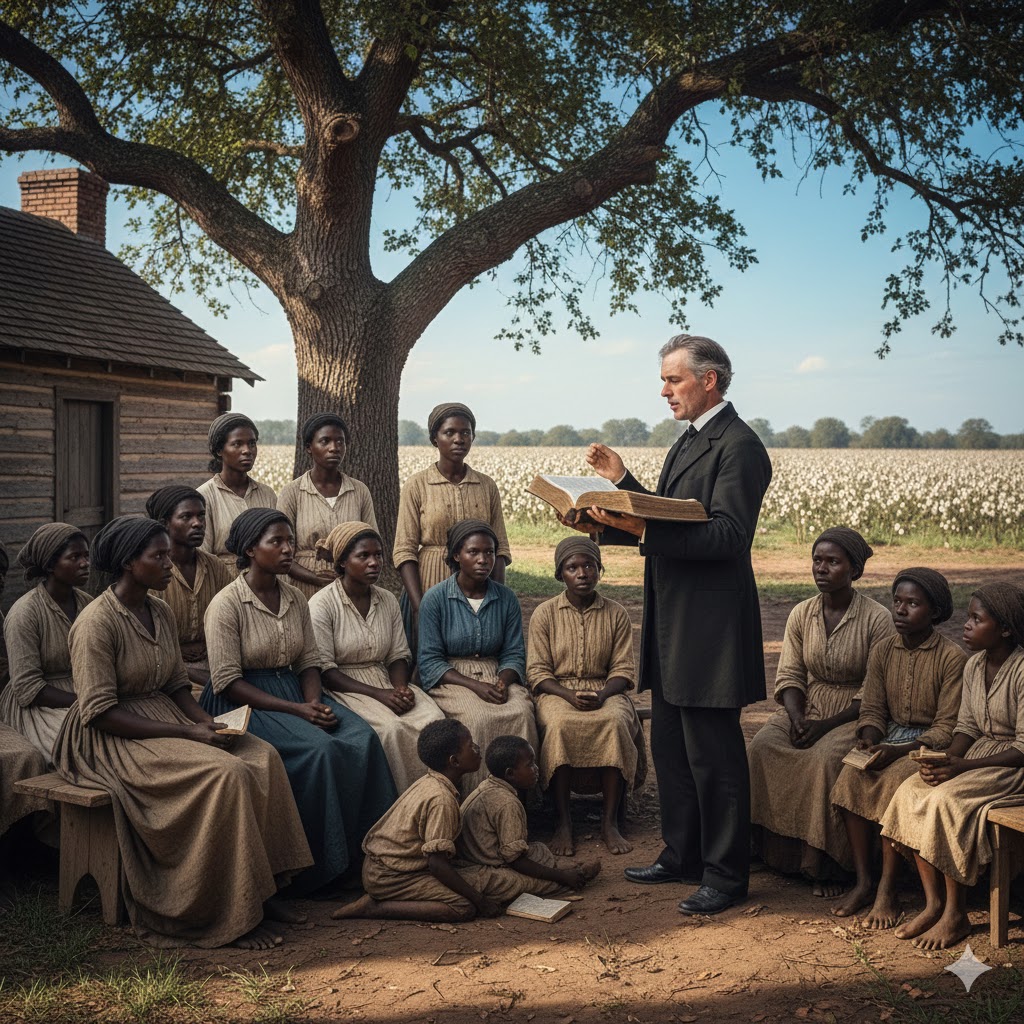
To maintain control, slaveholders created highly monitored “plantation churches.” In these spaces, white preachers delivered sermons promoting obedience and reinforcing racial hierarchy. Enslaved people were forbidden to gather independently for worship or to read Scripture for themselves. Laws were enacted across the South prohibiting Black literacy, because the master class understood that an educated believer—armed with the full truth of the Bible—posed a threat to the entire slave system.
This corrupted Christianity also taught enslaved Africans that their suffering was divinely ordained and that they should accept their earthly bondage in exchange for heavenly reward. Such doctrine had no biblical foundation and directly contradicted the character of a God who liberates His people from oppression, from Egypt to Babylon. By promising spiritual salvation while denying physical freedom, enslavers created a theology that separated the soul from the body, ensuring Black labor remained controlled while white consciences remained untroubled.
Yet enslaved Africans discerned the difference between the slave master’s religion and the liberating God of Scripture. In secret gatherings known as “hush harbors,” they forged a true and living Christianity rooted in Exodus, the prophets, the Psalms, and the teachings of Jesus. These clandestine meetings were spaces of healing, communal strength, and spiritual resistance. They prayed for deliverance, sang coded spirituals, and interpreted Scripture through the lens of their lived suffering, affirming a God who hears the cries of the oppressed.
One of the most striking differences between enslaved people’s faith and the enslavers’ religion was the identification with Ancient Israel. Enslaved Africans saw themselves in the story of Moses and the Hebrews—people chosen, persecuted, and promised deliverance by the Most High. This connection was not accidental; it emerged from both spiritual intuition and cultural memory. The master’s Christianity feared this narrative because it empowered enslaved people to see themselves as a sacred people, not property.
The false Christianity of the slaveholder was a Christianity of control, not conversion. Its purpose was not salvation but subjugation. The gospel presented to enslaved people required no repentance from the enslaver, no justice, no righteousness, no love for neighbor. It fabricated a God who blessed the whip, sanctioned the auction block, and smiled upon exploitation. Such a God was an idol created in the image of white supremacy, not the God of Abraham, Isaac, and Jacob.
This enslaver religion also functioned as a political tool. It stabilized the economic foundation of the South by training enslaved people to be compliant, fearful, and psychologically dependent. The message was clear: disobedience to the master meant disobedience to God. This spiritual intimidation reinforced the legal and physical terror already used to maintain slavery.
Despite this oppressive system, enslaved Africans consistently resisted. They sought out the full Bible, interpreted Scripture on their own terms, and cultivated a theology of liberation centuries before formal emancipation. Their understanding of God was holistic—addressing body, spirit, community, and collective freedom. This real Christianity fueled rebellions, escapes, and abolitionist movements, demonstrating the power of faith when aligned with truth.
The false Christianity of slavery also had long-lasting effects. It helped build structures of racism within American churches that persist today. Segregated congregations, discriminatory theology, and racial bias in religious institutions can all be traced back to the slaveholder’s version of faith. This legacy demands honest reckoning and structural repentance from modern Christianity.
Theologically, the Christianity used to control enslaved people was heretical. It denied the prophetic tradition, ignored Christ’s teachings about justice, and contradicted the biblical command to free the oppressed. It rewrote Scripture to accommodate human cruelty. By transforming the Bible into a plantation manual, enslavers positioned themselves not as followers of Christ but as manipulators of His Word.
Enslaved people, however, preserved the truth. Their Christianity was closer to the biblical narrative than the faith preached by their captors. They understood God as deliverer, protector, and judge of unjust nations. Their spirituals, prayers, and testimonies proclaimed a theology of hope in the face of terror, dignity in the face of dehumanization, and destiny in the face of denial.
This distinction between the master’s religion and the enslaved people’s faith became central to the moral authority of Black churches after emancipation. The Black church emerged as a center of community empowerment, civil rights activism, and spiritual resilience precisely because its roots were grounded in liberation, not oppression.
The enslavers’ Christianity was an empire-serving religion, aligned with power rather than truth. It rejected the biblical mandate to “proclaim liberty to the captives” and comfort the brokenhearted. It silenced the prophets and crucified Christ, who stood with the marginalized. Enslaved Africans recognized this and refused to accept a God who endorsed their suffering.
In the end, the false Christianity used to enslave Black people was a counterfeit gospel—one designed to erase identity, suppress resistance, and perpetuate injustice. Yet the enslaved uncovered the true God beneath the lies, reading between the lines, trusting their own spiritual intuition, and embracing a faith that affirmed their humanity and promised their freedom.
This powerful distinction—between a religion of domination and a faith of liberation—continues to shape the spiritual landscape of Black communities today. The legacy of true Christianity, preserved by the enslaved, is a testament to resilience, revelation, and the unbreakable connection between divine truth and human freedom.
References
Blight, D. W. (2018). Frederick Douglass: Prophet of freedom. Simon & Schuster.
Cone, J. H. (2011). The cross and the lynching tree. Orbis Books.
Gomez, M. A. (1998). Exchanging our country marks: The transformation of African identities in the colonial and antebellum South. University of North Carolina Press.
Horsley, R. A. (2003). Jesus and empire: The kingdom of God and the new world disorder. Fortress Press.
Raboteau, A. J. (2004). Slave religion: The “invisible institution” in the antebellum South. Oxford University Press.
Williams, D. (1993). Theology and the Black experience. Fortress Press.










 THE BROWN GIRL DILEMMA