
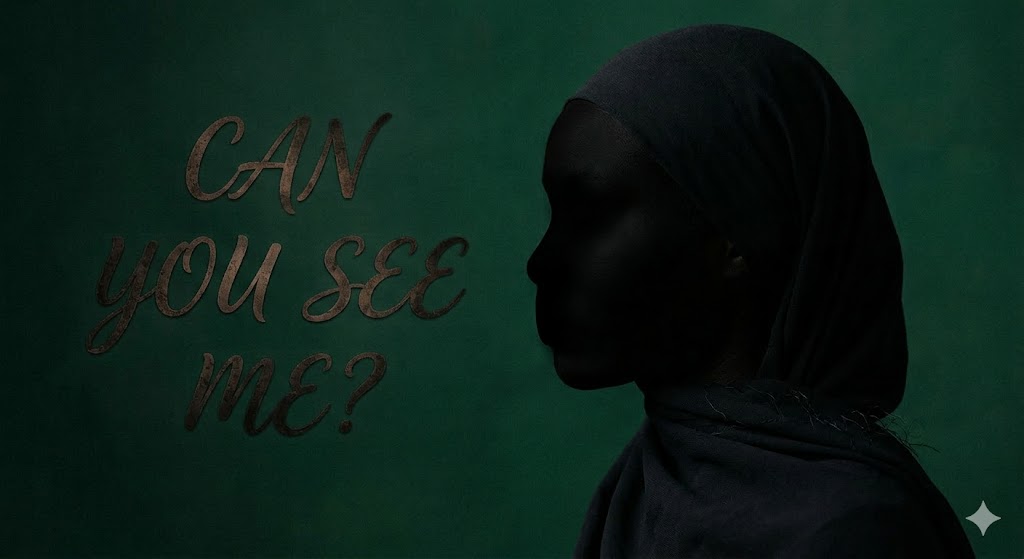
The unseen Black woman lives at the intersection of power and pain, shaped by histories that sought to silence her and a world that often refuses to acknowledge her presence. Her story is one of resilience, complexity, and unshakable dignity—a story too often misinterpreted or completely ignored. From the days of enslavement to contemporary society, the Black woman remains both foundational and marginalized, desired yet devalued, visible only when convenient yet erased when truth is required. She is the cultural womb of nations, and yet she continues to battle the shadows of invisibility.
Historically, Black women have been overlooked and unprotected by social structures that elevate others while dismissing their humanity. During slavery, their labor and bodies were exploited without recognition or care, laying the foundation for stereotypes that still persist today. This invisibility is not accidental but systematically produced through institutions that benefit from her silence. Scholars have long noted that the Black woman is rarely seen as the standard of beauty, intelligence, or femininity in mainstream society, despite her profound contributions (Collins, 2000).
Rejection by other races, particularly within a white-dominated beauty and social hierarchy, has created layers of psychological warfare against the Black woman’s self-worth. Colorism—rooted in colonialism—has placed lighter skin on a pedestal while disregarding darker-skinned women. Media representation has amplified this hierarchy, rewarding proximity to whiteness and punishing features deeply tied to African ancestry. The Black woman’s rejection is not just personal; it is structural, echoing across fashion, film, workplace settings, and even healthcare outcomes.
Yet perhaps even more painful is the rejection she often experiences within her own community. Internalized racism and colorism, taught across generations, have led some Black men and women to subconsciously prefer lighter skin or Eurocentric features. This is not natural or innate—it is learned behavior shaped by centuries of conditioning. Enslavers strategically favored lighter-skinned enslaved people for domestic labor and created hierarchies among the enslaved that persist today. These psychological wounds have evolved but not disappeared.
Despite this, the Black woman’s beauty remains unmatched and deeply rooted in cultural, genetic, and ancestral strength. Her beauty defies narrow Western standards and emerges in endless forms—in tightly coiled hair, deep brown hues, high cheekbones, full lips, and regal posture. Studies on global beauty standards are increasingly recognizing the universality of features traditionally associated with African women, challenging outdated paradigms (Wade, 2017). Black beauty has not only survived exclusion; it has reshaped global culture, influencing art, fashion, language, and music.
The unseen Black woman is the backbone of movements, families, and spiritual communities, often leading without acknowledgment. She nurtured children who weren’t her own during slavery. She pioneered movements for civil rights while others received the spotlight. She protected her community, advocated for justice, and birthed cultural revolutions only to be written out of the narrative. Even today, Black women are the most educated demographic in America yet remain underpaid and under-promoted (NCES, 2022). This contradiction shows a society eager to benefit from her labor but unwilling to reward her leadership.
Her invisibility also appears in modern love dynamics. Many Black women face rejection on dating apps, in media pairings, and in social perceptions. Studies reveal that Black women are the most marginalized demographic in online dating algorithms (Hobbs et al., 2019). The social myth that Black women are “too strong,” “too independent,” or “undesirable” is not only untrue but dehumanizing. These narratives shape how the world interacts with Black women and how Black women learn to navigate relationships, often feeling unseen or undervalued.
But the unseen Black woman is not just a victim of rejection. She is a survivor who has learned to adapt, rebuild, and reimagine herself. She creates communities of healing—sister circles, natural hair movements, maternal health activism, and artistic spaces where she can breathe freely. She redefines beauty on her own terms, crafts new languages of empowerment, and challenges the structures that diminish her. She is not waiting for validation from society because she recognizes her worth internally.
Her spirituality has long been a source of strength. From traditional African religions to Christianity and modern spiritual practices, the Black woman’s connection to the divine has given her clarity and purpose. She understands suffering and redemption not as abstract concepts but lived realities. Her prayers have carried families, her faith has sustained movements, and her moral compass has shaped entire communities.
Black women have also served as cultural innovators, setting trends that the world imitates yet rarely credits. Hairstyles, fashion, vernacular, music, and social movements all bear the imprint of Black womanhood. The global appropriation of Black culture, without acknowledgment or respect, further demonstrates how she can be hyper-visible in influence yet invisible in recognition.
The unseen Black woman continues to face stereotypes—angry, loud, aggressive—labels manufactured to control her. These stereotypes mask her real emotions, preventing her from expressing pain, frustration, or vulnerability. They create barriers in workplaces, where she must work twice as hard while navigating biases that others do not face. They silence her in medical settings, where her pain is dismissed, leading to disproportionate maternal mortality rates.
Yet she persists. She continues to rise in academic fields, corporate leadership, entrepreneurship, and political influence. From Kamala Harris to Viola Davis, from everyday mothers to grassroots organizers, Black women are shaping the future. They are rewriting the narrative in real time, proving that invisibility is not destiny but a condition imposed by others.
Despite rejection from society, Black women remain deeply connected to one another. The solidarity found among Black women is powerful, nurturing, and healing. Within these bonds, they see each other fully. They uplift, affirm, and celebrate what the world ignores. In those circles, the unseen Black woman becomes seen again.
This invisibility has generational roots, but modern generations are actively dismantling it. Social media has allowed Black women to tell their own stories, challenge Eurocentric standards, and build platforms that center their experiences. From beauty influencers to scholars, Black women now control narratives once dictated by others.
The unseen Black woman is learning to rest, prioritize her mental health, and unlearn survival mode. She is healing from generational trauma, redefining femininity, and embracing softness without fear. She is discovering that her worth is inherent, not earned through suffering or sacrifice.
She is also demanding accountability—from media, corporations, governments, healthcare, and within her own communities. Black women are no longer silent about colorism, misogynoir, or the ways they have been mistreated. This new era is one of self-advocacy and bold truth-telling.
The unseen Black woman is not unseen because she lacks brilliance or beauty—she is unseen because society refuses to acknowledge what it cannot control. But she is rising, reclaiming her power, name by name, voice by voice. She carries the legacy of ancestors who walked through fire and still birthed nations. Her story is not one of defeat but victory.
Ultimately, the unseen Black woman is becoming the most visible she has ever been. She is taking her place in history and demanding that the world recognize her. Her resilience, beauty, intellect, and spiritual depth are undeniable. She is no longer waiting to be seen—she is choosing to be seen, loudly and unapologetically. And in doing so, she transforms not only her world but the world around her.
References
Collins, P. H. (2000). Black feminist thought: Knowledge, consciousness, and the politics of empowerment. Routledge.
Hobbs, L., Owen, J., & Gerstenberger, K. (2019). Online dating preferences and racial biases. Journal of Social and Personal Relationships, 36(7), 1992–2013.
National Center for Education Statistics. (2022). Status and trends in the education of racial and ethnic groups.
Wade, L. (2017). Beauty standards and race: A sociocultural analysis. Sociology Compass, 11(6), e12482.
 THE BROWN GIRL DILEMMA