Tag Archives: Business

Black Women in Leadership: Navigating Corporate America with Excellence

Black women in leadership occupy a unique position in corporate America, balancing professional responsibilities with societal expectations and systemic challenges. Their presence in executive roles is still disproportionately low, yet their impact is profound, influencing organizational culture, decision-making, and diversity initiatives. Understanding the nuances of effective leadership for Black women requires examining both personal development and structural navigation.

Effective leadership begins with self-awareness. Understanding one’s strengths, weaknesses, and leadership style allows Black women to lead authentically. Emotional intelligence, including the ability to empathize, communicate effectively, and manage interpersonal dynamics, is a cornerstone of effective leadership. Self-aware leaders inspire trust, credibility, and loyalty among colleagues and teams.

Mentorship and sponsorship are critical tools for advancement. Black women leaders benefit from relationships with mentors who provide guidance, feedback, and strategic advice. Sponsorship, in contrast, involves advocates who actively promote career growth and visibility within the organization. Building these networks creates pathways for recognition, promotion, and professional influence.

Strategic vision is another essential component. Leaders must articulate clear goals, communicate expectations, and inspire their teams to execute strategies effectively. Black women leaders who demonstrate clarity of vision often create alignment across departments, foster collaboration, and drive organizational success. This requires both analytical acumen and the ability to translate complex strategies into actionable initiatives.

Resilience is particularly important for Black women navigating corporate environments that may be implicitly or explicitly biased. Developing mental toughness, stress management skills, and adaptive coping strategies allows leaders to persevere despite obstacles. Resilient leaders model composure under pressure and create organizational cultures that value problem-solving and growth mindset approaches.

Communication skills are indispensable. Leaders must be able to present ideas persuasively, negotiate effectively, and manage conflict constructively. Public speaking, active listening, and storytelling are tools that enable Black women leaders to convey their vision, inspire teams, and advocate for themselves and others in executive spaces.

Cultural competence strengthens leadership efficacy. Black women leaders often serve as bridges across diverse teams, translating experiences and perspectives in ways that enhance inclusion. Understanding systemic inequities, microaggressions, and organizational dynamics enables leaders to create environments where diverse employees feel valued and empowered to contribute meaningfully.

Time management and delegation are practical strategies that elevate leadership effectiveness. Leaders who prioritize tasks, delegate responsibilities appropriately, and focus on high-impact activities maximize productivity while preventing burnout. This is especially critical for Black women who may face disproportionate scrutiny and pressure to excel continuously.

Confidence balanced with humility is another hallmark of effective leadership. Black women must advocate for themselves while maintaining openness to feedback and collaboration. Demonstrating confidence encourages respect and authority, while humility ensures approachability and fosters a team-oriented culture.

Decision-making skills are essential. Leaders must analyze complex data, anticipate potential outcomes, and make informed choices. Integrating input from diverse stakeholders while remaining decisive ensures that leadership decisions are strategic, ethical, and aligned with organizational goals.

Professional branding and visibility cannot be overlooked. Black women leaders must actively showcase their accomplishments, engage in professional networks, and maintain a presence in high-profile projects. Visibility not only enhances career advancement but also positions leaders as role models for aspiring professionals.

Continuous learning is vital in dynamic corporate landscapes. Engaging in professional development, leadership programs, and executive education helps Black women stay abreast of industry trends, technological innovations, and best practices. Lifelong learning enhances credibility, adaptability, and overall leadership impact.

Advocacy for equity and inclusion is integral. Black women leaders often champion policies and initiatives that create equitable opportunities for employees across racial, gender, and socioeconomic lines. Their leadership influences organizational culture and sets a precedent for accountability in diversity and inclusion efforts.

Networking beyond the organization amplifies influence. Participation in professional associations, conferences, and thought leadership initiatives creates access to resources, knowledge, and collaborative opportunities. Expanding networks strengthens leadership presence and facilitates the exchange of innovative ideas.

Ultimately, effective leadership for Black women requires a holistic approach: blending personal development, strategic vision, resilience, communication, cultural competence, and advocacy. By leveraging these skills and strategies, Black women can navigate corporate America successfully, break barriers, and leave lasting legacies that inspire future generations.


References

Catalyst. (2020). Women in leadership at S&P 500 companies. https://www.catalyst.org/research/women-in-sp-leadership/

Herring, C., & Henderson, L. (2019). Diversity in organizations: Current perspectives and future directions. Routledge.

Ibarra, H., Carter, N. M., & Silva, C. (2010). Why men still get more promotions than women. Harvard Business Review. https://hbr.org/2010/09/why-men-still-get-more-promotions-than-women

Sandberg, S. (2013). Lean in: Women, work, and the will to lead. Knopf.

Thomas, D. A., & Ely, R. J. (1996). Making differences matter: A new paradigm for managing diversity. Harvard Business Review, 74(5), 79–90.

The Rise of Black Digital Influence: Culture, Commerce, and Community

The digital era has ushered in unprecedented opportunities for Black voices to shape culture, commerce, and community globally. Platforms such as TikTok, Instagram, YouTube, and podcasts have provided unprecedented visibility, allowing Black creators to redefine aesthetics, narratives, and influence in ways previously constrained by traditional gatekeepers.

Black digital influence is first and foremost cultural. Social media has amplified Afrocentric beauty, hairstyles, fashion, and music, creating a global dialogue that celebrates Black identity. From natural hair movements to streetwear trends, Black creators are driving culture forward while reclaiming representation.

Historically, Black creativity was often commodified without proper recognition or compensation. Digital platforms now allow Black creators to assert ownership, narrate their stories, and monetize their craft independently, transforming cultural influence into economic empowerment.

The rise of Black influencers in music exemplifies this cultural and commercial convergence. TikTok, in particular, has propelled songs by Black artists to viral status, shaping charts, influencing mainstream media, and allowing independent artists to compete with major labels.

Fashion and beauty industries have experienced profound disruption. Black models, designers, and stylists utilize social media to challenge Eurocentric beauty standards, normalize diversity, and directly market products to global audiences. Platforms bypass traditional gatekeeping, giving Black creatives control over brand narrative.

Black digital influence also serves as a form of historical and cultural education. Creators use social media to teach African and African American history, genealogy, and social justice issues, providing accessible knowledge and fostering community awareness.

Podcasts and YouTube channels led by Black hosts have become platforms for intellectual discourse, storytelling, and entrepreneurship. Figures such as Tiffany Aliche (the Budgetnista) or content creators focusing on Black history and culture expand knowledge while creating wealth and visibility.

Entrepreneurship has flourished through digital influence. Black-owned businesses now reach global markets via e-commerce, digital marketing, and online services. The ability to sell directly to consumers allows creators to bypass traditional barriers in retail and finance.

Digital finance, including cryptocurrency and NFTs, has further expanded avenues for Black economic empowerment. Innovators are using blockchain technology to create wealth, preserve intellectual property, and invest in community-driven projects, demonstrating the convergence of technology and culture.

Social media has amplified activism. Movements like #BlackLivesMatter have demonstrated the power of digital platforms in mobilizing communities, influencing legislation, and shaping global conversations around racial justice and accountability.

The rise of Black digital influence also strengthens intergenerational knowledge transfer. Younger creators draw on ancestral narratives, cultural memory, and historical resilience while innovating content, products, and platforms for a modern audience.

Representation is another critical aspect. Black digital creators provide aspirational figures for youth, illustrating that cultural pride, entrepreneurship, and intellectual contribution can coexist with influence and wealth in a digital-first world.

Digital influence is not without challenges. Algorithmic bias, cyberbullying, content theft, and platform censorship can disproportionately affect Black creators. Navigating these obstacles requires both strategic knowledge and community solidarity.

Black digital communities have formed networks of support. Collaborative projects, cross-promotion, and mentorship among creators amplify reach and provide protection against exploitation, ensuring sustainability of influence and commerce.

Cultural appropriation remains a concern. Black creators must continually assert ownership over cultural products and narratives, educating global audiences while safeguarding the integrity of Black cultural expression.

Despite challenges, Black digital influence demonstrates resilience, creativity, and innovation. It transforms pain into art, oppression into opportunity, and visibility into empowerment. Black creators are setting trends, defining aesthetics, and reclaiming narratives at an unprecedented pace.

The intersection of faith and digital influence is also notable. Some creators incorporate spiritual guidance, moral frameworks, and community values into their content, blending cultural empowerment with ethical leadership.

Black digital entrepreneurship challenges traditional economic barriers. Influencers, content creators, and business owners leverage platforms to build brands, create jobs, and circulate wealth within Black communities, contributing to broader social and economic mobility.

Globalization amplifies Black influence. Creators in the diaspora connect with audiences worldwide, fostering cross-cultural exchange, solidarity, and shared identity, illustrating the universal impact of Black creativity and innovation.

Ultimately, the rise of Black digital influence reflects the ongoing evolution of Black excellence. It merges culture, commerce, and community into a powerful force for visibility, education, and empowerment, creating a legacy that is both digital and enduring.


References

Gates, H. L. (2011). In search of our roots: How 19 extraordinary African Americans reclaimed their past. Crown.

West, C. (2017). Race matters. Beacon Press.

Tutu, D., & Tutu, M. (2014). The book of forgiving: The fourfold path for healing ourselves and our world. HarperOne.

Noble, S. U. (2018). Algorithms of oppression: How search engines reinforce racism. NYU Press.

McKelvey, F., & Mulla, D. (2022). Digital Blackness: The power and politics of Black social media. Routledge.

Walker, K., & Brooks, C. (2021). Black digital entrepreneurship: Culture, commerce, and community. Palgrave Macmillan.

Aliko Dangote: The Richest Man in Africa

Aliko Mohammad Dangote is one of the most influential business figures on the African continent, known for his unmatched industrial footprint across multiple sectors. Born on April 10, 1957, in Kano, Nigeria, he emerged from a family whose legacy in commerce dates back generations. Growing up in a household connected to trade and entrepreneurship gave him early exposure to business fundamentals that would later inform his industrial empire.

His great-grandfather, Alhassan Dantata, was one of the wealthiest men in West Africa in the early 20th century, which placed Dangote within a lineage of economic leadership. Despite this background, Dangote’s ascent into modern global wealth was not inherited; instead, he built his conglomerate through strategic investments, reinvestment of profits, and a deep understanding of Africa’s economic needs.

Dangote’s business journey began in 1977 when he started a trading enterprise focused on importing sugar, rice, and other basic commodities. With a small loan from an uncle, he quickly found success by identifying gaps in Nigeria’s supply chain. This strength in commodity trading laid the foundation for more ambitious ventures in manufacturing and industrial production.

As Nigeria and other African nations faced growing demand for construction materials, Dangote shifted from trading to manufacturing. This move proved transformative. Cement production became the cornerstone of his wealth, with Dangote Cement rising to become the largest cement producer in Africa. The company expanded rapidly across borders and now operates in several African countries.

Sugar refining, flour milling, salt production, and logistics soon joined the portfolio, turning Dangote Group into a true continental powerhouse. Manufacturing enabled Dangote to reduce Nigeria’s reliance on imported goods, creating thousands of jobs and stimulating infrastructure growth across the region. This shift from trading to large-scale industrialisation is one of the defining aspects of his business success.

Dangote’s wealth surged as his companies grew, consistently placing him at the top of Africa’s wealth rankings. While fluctuations in currency and commodity prices occasionally shift positions, Dangote has held the title “richest man in Africa” for over a decade, according to major global wealth indexes. His dominance in multiple essential industries makes his economic influence both significant and stable.

A list of Africa’s wealthiest individuals often places Dangote first, followed by figures such as Johann Rupert, Nicky Oppenheimer, Nassef Sawiris, Naguib Sawiris, Abdul Samad Rabiu, and Mike Adenuga. These individuals represent diverse industries such as luxury goods, mining, telecommunications, and manufacturing, but Dangote stands out for building Africa’s largest home-grown industrial conglomerate.

His impact on Africa extends far beyond wealth. Dangote’s businesses have created millions of direct and indirect jobs, strengthened national economies, and brought vital infrastructure to regions that previously relied heavily on foreign imports. His companies have become symbols of African self-sufficiency and industrial capability, reshaping economic landscapes from West Africa to East Africa.

Dangote Cement alone revolutionized construction sectors across the continent, enabling more affordable housing, public works, and urban development. His entry into fertilizer production has had major implications for agricultural self-reliance, while his oil refinery—one of the largest privately owned refineries in the world—aims to significantly reduce Africa’s dependence on imported fuel.

For Nigeria specifically, Dangote is a monumental figure. His industries bolster the country’s GDP, expand its manufacturing sector, and contribute substantially to tax revenue. The refinery project is expected to change Nigeria’s fuel economy by transforming the nation from an importer to a potential exporter of refined petroleum products. This structural shift could reposition Nigeria’s economic identity globally.

Philanthropically, Dangote’s foundation supports healthcare, education, nutrition, and disaster relief across the continent. He has funded major campaigns against malnutrition, disease outbreaks, and pandemic emergencies. His charitable work reflects a commitment to human development alongside industrial progress.

His personal life is rooted in Northern Nigerian traditions. Dangote married early, divorced, remarried, and later divorced again. He has three daughters—Maria, Halima, and Fatima—and an adopted son, Abdulrahman. Despite his immense wealth, Dangote is known for his relatively private lifestyle, placing stronger emphasis on business growth than on public spectacle.

He was educated at schools in Kano before attending Al-Azhar University in Egypt, where he studied business. His education, combined with his family’s commercial influence, shaped his entrepreneurial outlook. From selling simple products as a child to controlling multibillion-dollar industries, his journey displays a consistent drive and business instinct.

Dangote’s rise was not without challenges. He maneuvered through Nigeria’s volatile economic environment, currency devaluations, changing government policies, and intense competition. Yet his strategic focus on essential goods—products people rely on daily—made his businesses recession-resistant and consistently profitable.

The history of his empire is also a history of African industrialisation. While many African billionaires derive wealth from inherited mining assets or globalized sectors, Dangote stands apart as a builder of factories, refineries, plants, and supply chains. His operations bring value directly to African soil, fostering development through manufacturing rather than raw-resource export.

Today, Dangote is not only a symbol of personal achievement but a symbol of African economic possibility. His success demonstrates the potential for African-led industrial transformation, inspiring entrepreneurs across the continent to invest locally and expand boldly.

In summary, Aliko Dangote is widely considered the richest man in Africa because of his vast industrial empire, dominant market position, and sustained economic influence. His contributions to Nigeria and the continent have been profound, reshaping industries, improving infrastructure, and setting a powerful example of African entrepreneurship. His life story—from a trading stall in Kano to global billionaire status—remains one of the most remarkable narratives in modern African history.


References

Britannica. (n.d.). Aliko Dangote.
Investopedia. (n.d.). How Aliko Dangote Became the Richest African.
Wikipedia. Aliko Dangote.
Wikipedia. Wealth of Aliko Dangote.
Wikipedia. List of Africans by Net Worth.
Dangote Group Official Website.
Bloomberg Billionaires Index.
Forbes Africa Billionaires List.

How to Become a Brand Ambassador. #socialmedia #brandambassador

A brand ambassador is a person who represents a company’s products or services, promoting them in a positive light to increase awareness, sales, and loyalty. Becoming a brand ambassador requires strategic planning, consistent personal branding, and professional networking. Understanding the requirements of brands, knowing how to approach them, and maintaining credibility are essential for success.

The first step is to define your niche. Brands often look for ambassadors whose lifestyle, interests, or expertise align with their product. For example, a fitness brand seeks athletes or fitness influencers, while a luxury fashion label may target individuals with a glamorous aesthetic. Clearly defining your niche ensures that you are seen as a credible and authentic representative.

List of Top Brands to Work With as a Brand Ambassador

Luxury Fashion & Accessories:

  • Hermès
  • Gucci
  • Louis Vuitton
  • Prada
  • Chanel

Beauty & Skincare:

  • Fenty Beauty (Rihanna)
  • Sephora
  • MAC Cosmetics
  • Estée Lauder
  • L’Oréal

Sports & Activewear:

  • Nike
  • Adidas
  • Under Armour
  • Puma
  • Reebok

Tech & Electronics:

  • Apple
  • Samsung
  • Microsoft
  • Google
  • Sony

Lifestyle & Food:

  • Starbucks
  • Red Bull
  • Coca-Cola
  • Amazon (various programs)
  • Airbnb

Automotive & Luxury Vehicles:

  • Mercedes-Benz
  • BMW
  • Tesla
  • Porsche
  • Lexus

Emerging & Digital Brands:

  • Canva
  • Glossier
  • Peloton
  • TikTok (creator programs)
  • Shopify

Building a personal brand is crucial. A strong, consistent presence on social media platforms, blogs, or professional portfolios communicates professionalism and influence. Maintaining high-quality content, authentic engagement, and a coherent aesthetic attracts the attention of brands. According to Forbes (2021), “A personal brand that is consistent and authentic increases visibility and credibility with potential partners.”

Engagement is more important than follower count. Brands prioritize individuals who foster genuine interaction with their audience, as active engagement often leads to higher conversion rates. Metrics such as likes, comments, shares, and click-through rates can be presented when approaching brands, demonstrating value beyond raw numbers.

To get noticed, networking is essential. Attend industry events, workshops, or online forums where brand representatives or marketing professionals are present. Building relationships through professional interactions increases the likelihood of being considered for ambassador roles. LinkedIn and industry-specific platforms are particularly effective for connecting with brand managers.

When approaching a brand, research thoroughly. Understand the company’s products, target audience, mission, and values. Tailoring your proposal to align with their goals demonstrates preparation and professionalism. Brands are more likely to respond positively to ambassadors who understand their market positioning.

Crafting a proposal or pitch is the next step. Highlight your influence, engagement metrics, personal alignment with the brand, and creative ideas for promoting their products. Be concise, professional, and visually appealing. Providing examples of past collaborations or campaign success stories adds credibility.

Contracting with a brand requires careful consideration. Most brand ambassador programs outline responsibilities, compensation, exclusivity clauses, and duration. Ensure you review contracts thoroughly or seek professional advice to avoid unfavorable terms. Legal clarity protects your interests and maintains a professional relationship.

Negotiating compensation is part of the process. Some brands offer free products, while others provide monetary payment, affiliate commissions, or event fees. Understand your value, and be prepared to present a clear case for why your influence merits fair compensation.

Content creation is a core responsibility. Ambassadors must produce high-quality visuals, videos, or posts that showcase the product authentically. Creativity, consistency, and alignment with brand guidelines are critical. Failure to maintain quality can jeopardize the partnership.

Authenticity is essential for long-term success. Audiences are adept at detecting insincerity. Only endorse products you genuinely believe in or use. Brands prefer ambassadors who naturally fit their image rather than those solely motivated by profit.

Some of the best brands to endorse include global lifestyle companies like Nike, Adidas, Hermès, Gucci, Sephora, Apple, and luxury automotive brands, depending on your niche and audience demographics. Selecting brands strategically ensures your promotions resonate with your followers.

Understanding platform-specific strategies increases effectiveness. Instagram, TikTok, and YouTube favor visually compelling content, while LinkedIn and blogs are suited for professional endorsements. Tailor your approach to each platform to maximize engagement.

Consistency in posting and maintaining engagement is vital. Regular updates, authentic storytelling, and timely responses to comments enhance credibility. Brands often monitor consistency before renewing or expanding ambassador agreements.

Tracking results demonstrates your impact. Keep analytics of engagement, conversions, website clicks, or affiliate sales. Presenting data-driven evidence strengthens your reputation as a reliable partner for future campaigns.

Collaboration with other influencers or ambassadors can expand reach. Co-promotions and shared campaigns increase visibility and reinforce authority in your niche. Networking within the ambassador community often opens doors to more prestigious partnerships.

Professionalism extends beyond social media. Timely communication, adherence to deadlines, and respectful negotiation contribute to long-term relationships with brands. Your reputation as reliable and professional is as valuable as your audience size.

Continuous learning is key. Study marketing trends, social media algorithms, and audience behavior. Staying informed helps adapt strategies, ensuring you remain attractive to brands and competitive in the industry.

Brand ambassadors must also understand ethical considerations. Transparency with audiences, including disclosure of sponsorships or affiliate partnerships, builds trust and complies with legal regulations like FTC guidelines.

Finally, patience and persistence are essential. Success rarely happens overnight. Consistent effort, relationship-building, and strategic self-promotion gradually establish you as a sought-after brand ambassador.

By combining a strong personal brand, niche expertise, authentic engagement, and professionalism, anyone can position themselves for ambassador roles. Understanding contracts, selecting brands strategically, and tracking impact ensures not only initial opportunities but long-term growth in the industry.

References

Forbes. (2021). How to build your personal brand as an influencer. Forbes. https://www.forbes.com/sites/forbesagencycouncil/2021/03/08/how-to-build-your-personal-brand-as-an-influencer/

Business Insider. (2022). What is a brand ambassador and how to become one. Business Insider. https://www.businessinsider.com/brand-ambassador

Influencer Marketing Hub. (2023). Brand ambassador programs: How to get noticed and get hired. Influencer Marketing Hub. https://influencermarketinghub.com/brand-ambassador-programs/

Entrepreneur. (2022). 10 tips to become a successful brand ambassador. Entrepreneur. https://www.entrepreneur.com/article/brand-ambassador-tips

Federal Trade Commission (FTC). (2021). Disclosures 101 for social media influencers. https://www.ftc.gov/tips-advice/business-center/guidance/disclosures-101-social-media-influencers

HubSpot. (2022). The ultimate guide to influencer marketing and brand ambassadorship. HubSpot. https://blog.hubspot.com/marketing/influencer-marketing

Social Media Examiner. (2023). How to become a brand ambassador in 2023. Social Media Examiner. https://www.socialmediaexaminer.com/how-to-become-a-brand-ambassador/

    Mentorship and Networking for Career Success.

    Photo by nappy on Pexels.com

    Career success is rarely achieved in isolation. Behind most accomplished professionals are networks of mentors, advisors, and peers who provide guidance, encouragement, and opportunities. For Black women navigating systemic barriers, mentorship and networking are particularly crucial for building visibility, credibility, and professional growth. These tools not only facilitate skill development but also foster confidence, resilience, and strategic decision-making.

    Mentorship offers a unique space for learning from the experience of others. A mentor provides not only technical guidance but also emotional support and perspective, helping mentees navigate complex workplace dynamics. Psychologically, mentorship aligns with social learning theory, which suggests that individuals learn behaviors, strategies, and problem-solving techniques by observing and interacting with experienced role models (Bandura, 1977). In practice, a mentor can help identify strengths and weaknesses, provide constructive feedback, and encourage goal-setting aligned with long-term career objectives.

    Networking, on the other hand, broadens access to opportunities. Building professional relationships allows individuals to connect with peers, industry leaders, and potential collaborators. Networking is more than social interaction—it is a strategic tool for knowledge sharing, opportunity discovery, and professional advocacy. Research demonstrates that professionals with robust networks are more likely to receive promotions, gain leadership roles, and access career-enhancing opportunities (Burt, 1992).

    🌟 Mentorship & Networking Toolkit for Career Success

    1. Finding and Choosing Mentors

    • Look for multiple mentors: Seek mentors in your field, outside your organization, and even cross-industry to gain diverse perspectives.
    • Align with values and goals: Choose mentors whose experience and principles resonate with your career aspirations.
    • Observe and learn: Identify mentors whose behaviors, leadership style, and communication you admire.

    Questions to ask potential mentors:

    • “What skills were most critical for your success?”
    • “What mistakes did you make early in your career that I can avoid?”
    • “How did you navigate challenges in a male- or Eurocentric-dominated workplace?”

    2. Building and Maintaining Networks

    • Attend events: Conferences, webinars, and professional workshops are ideal spaces to connect with peers and leaders.
    • Join affinity groups: Professional organizations like National Black MBA Association, Black Women in Science & Engineering, or Lean In Circles provide structured networking.
    • Engage online: LinkedIn and professional forums are excellent platforms to maintain visibility and relationships.

    Networking tips:

    • Offer value: Share resources, knowledge, or support to strengthen connections.
    • Follow up consistently: Send thank-you notes or check-ins after meetings.
    • Be authentic: Let relationships grow naturally without forced agendas.

    3. Maximizing Mentorship Relationships

    • Set clear goals: Define what you hope to achieve through mentorship (skills, promotions, leadership development).
    • Be open to feedback: Accept constructive criticism as a tool for growth.
    • Act on guidance: Demonstrate initiative and follow through on mentor suggestions.

    Questions to ask during mentorship sessions:

    • “How can I position myself for leadership roles in my field?”
    • “Which skills should I develop in the next 6–12 months?”
    • “Can you recommend opportunities to expand my professional visibility?”

    4. Reverse Mentoring

    • Offer your expertise: Teach senior colleagues about technology trends, diversity issues, or cultural insights.
    • Create mutual learning: Both mentor and mentee benefit, fostering respect and collaboration.

    5. Leveraging Community Support

    • Seek accountability partners: Peers can provide encouragement, motivation, and constructive challenge.
    • Celebrate successes: Share milestones within your network to inspire and build credibility.
    • Mentor others: Pay it forward to create a cycle of empowerment.

    6. Faith and Psychological Principles

    • Proverbs 27:17 (KJV): “Iron sharpeneth iron; so a man sharpeneth the countenance of his friend.”
    • 2 Timothy 2:2: Mentorship ensures skills and leadership pass to the next generation.
    • Psychological research: Strong social support increases self-efficacy, resilience, and career satisfaction (Cohen & Wills, 1985).

    7. Key Takeaways

    • Mentorship and networking are interlinked tools for career growth.
    • Seek mentors strategically, maintain authentic relationships, and engage in reciprocal learning.
    • Communities, both professional and faith-based, strengthen resilience and provide long-term support.
    • Your network is a source of opportunity, guidance, and generational impact.

    For Black women, mentorship and networking take on added significance. Structural inequities, implicit bias, and underrepresentation in leadership roles create barriers that mentorship can help navigate. Organizations such as National Black MBA Association, Black Women in Science & Engineering, and Lean In Circles provide structured networks and mentorship programs that empower Black women to thrive professionally.

    Biblical principles also support the value of mentorship and networking. Proverbs 27:17 (KJV) states: “Iron sharpeneth iron; so a man sharpeneth the countenance of his friend.” This illustrates that growth is amplified through relationships, accountability, and guidance. Likewise, the Apostle Paul’s relationship with Timothy (2 Timothy 2:2) demonstrates the power of intentional mentorship in fostering skills, leadership, and faith-driven purpose.

    Practical strategies for leveraging mentorship and networking include: seeking mentors both within and outside one’s organization, attending professional conferences, joining affinity groups, and maintaining consistent communication with professional contacts. Active listening, offering value in relationships, and demonstrating reliability strengthen networks and build mutual trust. Mentors are most effective when there is clarity about goals, openness to feedback, and a willingness to act on advice.

    Moreover, mentees should embrace the concept of reverse mentoring, where emerging professionals offer insights to senior colleagues, particularly on evolving technologies, cultural trends, or social perspectives. This approach creates a reciprocal, dynamic mentorship ecosystem, fostering intergenerational learning and respect.

    Ultimately, mentorship and networking cultivate not only career success but also confidence, resilience, and strategic insight. They provide a support system, amplify visibility, and create pathways for leadership. By actively seeking and nurturing professional relationships, Black women and other underrepresented professionals can overcome barriers, maximize potential, and leave a lasting impact in their industries.


    References

    • Bandura, A. (1977). Social Learning Theory. Prentice Hall.
    • Burt, R. S. (1992). Structural Holes: The Social Structure of Competition. Harvard University Press.
    • Bible (KJV). Proverbs 27:17; 2 Timothy 2:2.
    • Ibarra, H., Carter, N. M., & Silva, C. (2010). Why men still get more promotions than women. Harvard Business Review.

    How to Become a Brand Ambassador?

    Photo by Godisable Jacob on Pexels.com

    In today’s digital marketplace, brand ambassadors have become essential in shaping consumer perceptions and driving brand loyalty. A brand ambassador is an individual who represents, endorses, and promotes a company’s products or services, often leveraging personal influence to increase visibility and trust (Keller, 2013). With the rise of social media, ambassadors have become a central marketing strategy, bridging the gap between businesses and consumers through authentic representation.

    Understanding the Role of a Brand Ambassador

    A brand ambassador is more than a spokesperson—they embody the values, image, and culture of a brand. Ambassadors often create content, attend events, and interact with communities to increase brand awareness and credibility (Freberg, Graham, McGaughey, & Freberg, 2011). Unlike traditional advertising, ambassadors provide relatable and humanized promotion, which enhances consumer trust.

    Step-by-Step Guide: How to Become a Brand Ambassador

    1. Define Your Personal Brand

    • Identify your niche (fashion, fitness, beauty, tech, lifestyle, etc.).
    • Highlight your unique values, personality, and style.
    • Keep your message consistent across all platforms.

    📌 Tip: Ask yourself—what do I want to be known for?


    2. Build and Strengthen Your Online Presence

    • Choose 1–2 main platforms (Instagram, TikTok, YouTube, LinkedIn).
    • Post high-quality content consistently (photos, videos, reels, blogs).
    • Engage with your audience—reply to comments, start conversations, run polls.

    📌 Tip: Engagement rate matters more than follower count.


    3. Create Authentic Content

    • Share lifestyle posts that naturally include your favorite brands.
    • Tell stories instead of just advertising—authenticity builds trust.
    • Showcase your creativity (unboxings, tutorials, “day in the life,” reviews).

    📌 Tip: Brands notice when you already support them without being paid.


    4. Grow Your Network

    • Tag brands in your posts.
    • Use hashtags strategically.
    • Collaborate with other influencers or ambassadors.
    • Attend local events, trade shows, and networking opportunities.

    📌 Tip: Relationships matter—brands scout through social engagement.


    5. Reach Out to Brands

    • Create a professional media kit (bio, audience demographics, engagement stats, sample posts).
    • Send polite pitches to brands you love.
    • Sign up for influencer/ambassador platforms like AspireIQ, BrandSnob, or Influenster.

    📌 Tip: Start with smaller or local brands before approaching global ones.


    6. Be Professional and Reliable

    • Meet deadlines for sponsored posts.
    • Follow brand guidelines (logos, hashtags, tag requirements).
    • Stay respectful and ethical online—brands look for positive reputations.

    📌 Tip: Treat this like a job, not just free products.


    7. Measure and Show Results

    • Track engagement (likes, shares, saves, comments, link clicks).
    • Share insights with brands to prove your value.
    • Use analytics tools (Instagram Insights, TikTok Analytics, Google Analytics).

    📌 Tip: Brands are more likely to rehire ambassadors who show measurable results.


    8. Stay Authentic and Evolve

    • Never promote products you don’t believe in—audiences can sense inauthenticity.
    • Keep learning new marketing trends.
    • Grow with your audience and diversify your content.

    📌 Tip: Authentic ambassadors get the longest partnerships.


    Quick Checklist:

    • Personal brand defined
    • Social media optimized
    • Consistent, authentic content
    • Active networking and collaborations
    • Professional media kit created
    • Pitches sent to brands
    • Track results and improve
    • Long-term authenticity maintained

    Building a Strong Personal Brand

    The first step toward becoming a brand ambassador is cultivating a strong personal brand. Personal branding involves crafting a consistent and authentic identity that highlights one’s unique strengths, style, and values (Montoya & Vandehey, 2002). Individuals must showcase professionalism, creativity, and relatability across their platforms, as companies often seek ambassadors whose personal image aligns with their brand’s mission.

    Developing an Online Presence

    A strong online presence is crucial. Social media platforms such as Instagram, TikTok, and YouTube serve as vital spaces for showcasing content, growing an audience, and demonstrating influence (Djafarova & Trofimenko, 2019). Engagement is more valuable than sheer follower count, as brands look for ambassadors who can foster genuine connections with audiences. Consistency in posting, storytelling, and interaction helps build credibility and visibility.

    Networking and Brand Partnerships

    Networking plays a critical role in becoming a brand ambassador. Attending industry events, engaging with companies online, and collaborating with other influencers can open doors to partnerships. Many brands scout potential ambassadors by monitoring individuals who already support and promote their products authentically (Schau & Gilly, 2003). Thus, aspiring ambassadors should organically incorporate their favorite brands into content before seeking official partnerships.

    Brand Ambassador vs. Spokesmodel

    1. Definition & Role

    • Brand Ambassador
      • A long-term representative who embodies the brand’s values and lifestyle.
      • Promotes the brand across multiple platforms (social media, events, personal networks).
      • Focuses on building relationships and creating authentic engagement.
    • Spokesmodel
      • A hired face or personality used in advertisements, campaigns, or promotional events.
      • Represents the brand in a professional, sometimes short-term contract.
      • Focuses on appearance, presentation, and scripted brand messaging.

    2. Relationship with the Brand

    • Brand Ambassador → Often has an ongoing partnership. They become part of the brand identity and may use the product in daily life.
    • Spokesmodel → Usually hired for specific campaigns, commercials, or events. The relationship is transactional and tied to image/appearance.

    3. Marketing Approach

    • Brand Ambassador → Relies on authenticity, word-of-mouth marketing, and personal influence. Often leverages social media to connect with followers.
    • Spokesmodel → Relies on visual appeal, professionalism, and advertising campaigns (TV, print, digital).

    4. Skills & Requirements

    • Brand Ambassador
      • Strong social media presence.
      • Relatable personality and communication skills.
      • Ability to engage communities and foster trust.
    • Spokesmodel
      • Photogenic and camera-ready presence.
      • Modeling or public speaking skills.
      • Ability to represent the brand’s desired look and voice.

    5. Example

    • Brand Ambassador → Serena Williams partnering with Nike not only to model apparel but to embody strength, resilience, and excellence in women’s sports.
    • Spokesmodel → Tyra Banks modeling for CoverGirl ads—serving as the face of a beauty campaign without ongoing lifestyle integration.

    In short:

    • A brand ambassador promotes a brand authentically and long-term, often through lifestyle and social media influence.
    • A spokesmodel is a professional “face” of the brand for ads or campaigns, usually short-term and more image-focused.

    Professionalism and Longevity

    Sustaining a career as a brand ambassador requires professionalism, reliability, and adaptability. Ambassadors must meet deadlines, maintain ethical standards, and continuously evolve with trends in digital marketing (Khamis, Ang, & Welling, 2017). Those who maintain authenticity while delivering measurable impact often establish long-term relationships with companies, enhancing both personal and brand credibility.

    Conclusion

    Becoming a brand ambassador is a journey that requires authenticity, consistency, and professionalism. By building a strong personal brand, developing a digital presence, and fostering genuine relationships with both audiences and companies, individuals can position themselves as valuable assets in today’s marketing landscape. As businesses increasingly rely on personal influence over traditional advertising, opportunities for aspiring ambassadors continue to expand.


    References

    • Djafarova, E., & Trofimenko, O. (2019). ‘Instafamous’–credibility and self-presentation of micro-celebrities on social media. Information, Communication & Society, 22(10), 1432-1446.
    • Freberg, K., Graham, K., McGaughey, K., & Freberg, L. A. (2011). Who are the social media influencers? A study of public perceptions of personality. Public Relations Review, 37(1), 90-92.
    • Keller, K. L. (2013). Strategic Brand Management: Building, Measuring, and Managing Brand Equity. Pearson.
    • Khamis, S., Ang, L., & Welling, R. (2017). Self-branding, ‘micro-celebrity’ and the rise of Social Media Influencers. Celebrity Studies, 8(2), 191-208.
    • Montoya, P., & Vandehey, T. (2002). The Brand Called You: Make Your Business Stand Out in a Crowded Marketplace. McGraw Hill.
    • Schau, H. J., & Gilly, M. C. (2003). We are what we post? Self‐presentation in personal web space. Journal of Consumer Research, 30(3), 385-404.

    Affiliate Marketing 101: Strategies, Tips, and Tools to Earn Online.

    Affiliate marketing is a performance-based marketing strategy where you promote someone else’s products or services and earn a commission for each sale or action generated through your unique referral link. Essentially, you act as a middleman connecting the product with the customer.

    It benefits three parties:

    1. The Merchant: Gains more sales or leads without upfront marketing costs.
    2. The Affiliate (You): Earns a commission for driving traffic or sales.
    3. The Customer: Finds products through trusted recommendations.

    In today’s digital world, affiliate marketing has emerged as one of the most popular ways to earn income online. At its core, affiliate marketing is a performance-based strategy where individuals, known as affiliates, promote products or services and earn a commission for every sale, click, or action generated through their unique referral links. It creates a win-win scenario: merchants increase their sales without upfront costs, affiliates earn money by promoting products, and customers gain access to trusted recommendations. For those looking to build a sustainable online income, understanding the fundamentals of affiliate marketing is essential.

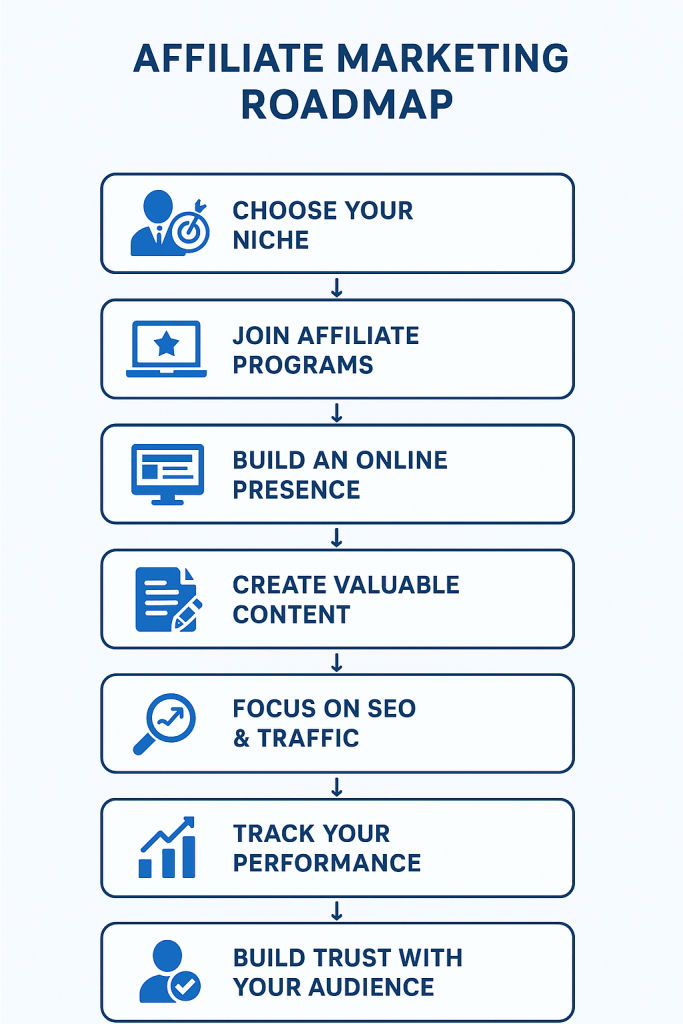
    The first step to getting started in affiliate marketing is choosing a niche. A niche is a specific area of interest or industry, such as beauty, fitness, technology, travel, or personal finance. By focusing on a niche, affiliates can build authority and trust with their audience, ensuring that promotions resonate effectively. Once a niche is selected, the next step is to join reputable affiliate programs. Popular networks include Amazon Associates, ShareASale, CJ Affiliate, ClickBank, and Rakuten Marketing. Each platform offers unique benefits, from a wide variety of products to higher commission rates on digital goods, making it possible for affiliates to choose programs that align with their niche and audience.

    Choose Your Niche:
    Focus on a specific industry or topic you are passionate about, such as beauty, fitness, finance, tech, or travel. A clear niche builds trust and authority with your audience.

    Select Affiliate Programs/Companies:
    Start with reputable companies and networks. Popular options include:

    • Amazon Associates – Easy to join; wide range of products.
    • ShareASale – Thousands of merchants in various niches.
    • CJ Affiliate (Commission Junction) – High-quality brands and reliable tracking.
    • ClickBank – Digital products, often higher commissions.
    • Rakuten Marketing – Big brands and global reach.

    Build an Online Presence:
    You’ll need a platform to promote products:

    • Blog or Website: SEO content drives organic traffic.
    • Social Media: Instagram, TikTok, or Pinterest for visual promotions.
    • YouTube: Tutorials and reviews can be highly effective.
    • Email Marketing: Build a subscriber list for recurring promotions.

    Affiliate Marketing Tips & Tricks: Quick-Start Guide

    1. Choose Your Niche Wisely

    • Pick a topic you are passionate about.
    • Focus on a specific audience to build authority.

    2. Join Reputable Affiliate Programs

    • Amazon Associates – Wide variety of products.
    • ClickBank – High commissions on digital products.
    • ShareASale / CJ Affiliate / Rakuten – Access to quality brands.

    3. Build an Online Presence

    • Start a blog, YouTube channel, or social media profile.
    • Use email lists to reach your audience directly.

    4. Create Valuable Content

    • Tutorials, reviews, comparison guides, and “how-to” articles.
    • Incorporate affiliate links naturally—don’t force them.

    5. Focus on SEO & Traffic

    • Optimize your website for search engines to attract organic visitors.
    • Use paid ads strategically for faster results.

    6. Track Your Performance

    • Use analytics to monitor clicks, conversions, and top-performing products.
    • Adjust strategies based on what works best.

    7. Build Trust with Your Audience

    • Be honest about affiliate links.
    • Share genuine experiences and product recommendations.

    8. Diversify & Scale

    • Join multiple affiliate programs to avoid relying on one source.
    • Reinvent and expand your content to reach more audiences.

    9. Be Patient & Consistent

    • Earnings grow over time with effort, testing, and optimization.
    • Focus on quality and value rather than quick profits.

    10. Learn from Successful Affiliates

    • Follow top affiliates in your niche.
    • Study strategies that consistently convert traffic into sales.

    Building a strong online presence is crucial for affiliate marketing success. Affiliates can leverage blogs, websites, social media platforms, YouTube channels, and email marketing to reach potential customers. Content marketing, such as product reviews, tutorials, comparison guides, and “how-to” articles, allows affiliates to provide value while naturally integrating affiliate links. Search engine optimization (SEO) further amplifies reach by attracting organic traffic, while paid advertisements on Google, Facebook, or Instagram can target highly specific audiences to increase conversions. Trust is key; affiliates who provide genuine recommendations and showcase real experiences often see higher engagement and sales.

    Content Marketing: Create valuable content like product reviews, “how-to” guides, and comparison articles.

    SEO Optimization: Rank your content in search engines to attract free organic traffic.

    Paid Ads: Facebook Ads, Google Ads, or influencer partnerships to drive targeted traffic.

    Email Campaigns: Promote products to a dedicated audience with newsletters and promotions.

    Social Proof & Trust: Use testimonials, case studies, and real experiences to boost credibility.

    Successful affiliate marketers employ a combination of strategies to maximize earnings. Tracking performance through analytics enables affiliates to determine which products and promotional methods yield the best results. Diversifying income streams by joining multiple programs and promoting various products reduces risk and increases potential revenue. Email marketing campaigns to a loyal subscriber list can generate recurring income, and integrating social proof—such as testimonials, case studies, or user-generated content—helps establish credibility. Affiliates who prioritize quality over quantity and remain transparent about affiliate links build long-term relationships with their audience.

    Pick products you personally trust and align with your audience.

    Focus on quality over quantity; promote fewer, high-value products.

    Track your performance with analytics to see what converts.

    Diversify income streams with multiple affiliate programs.

    Always disclose affiliate links; honesty builds trust with your audience.

    The earning potential in affiliate marketing varies widely based on niche, traffic, and conversion rates. Beginners might earn between $50 and $500 per month, intermediate affiliates can generate $500–$5,000 monthly, and experienced marketers with multiple platforms and email lists can earn upwards of $50,000 per month. Physical products typically offer lower commissions (1%–10%), while digital products can provide higher rates (30%–75%). The key to success lies in patience, consistency, and reinvesting earnings to scale one’s efforts gradually.

    • Commissions vary by product and program:
      • Physical products: ~1%–10% per sale (Amazon).
      • Digital products: ~30%–75% per sale (ClickBank).
    • Income depends on traffic, conversion rates, and niche:
      • Beginners: $50–$500/month
      • Intermediate: $500–$5,000/month
      • Advanced: $5,000–$50,000+/month (top affiliates often scale with multiple websites and email lists)

    Tip: Start small, reinvest earnings, and scale gradually for sustainable income.

    In conclusion, affiliate marketing offers a flexible and potentially lucrative way to earn online, provided one approaches it with strategy, integrity, and dedication. By selecting the right niche, collaborating with reputable programs, establishing a robust online presence, and implementing targeted marketing strategies, aspiring affiliates can establish a sustainable source of income. With continuous learning, testing, and adaptation, affiliate marketing not only provides financial opportunities but also allows individuals to share valuable products and services with audiences around the world.

    👉 These REFERENCES provide both academic depth and real-world industry insights.

    Books & Academic Sources

    • Chaffey, D., & Ellis-Chadwick, F. (2019). Digital Marketing (7th ed.). Pearson.
    • Evans, D. S., & Schmalensee, R. (2016). Matchmakers: The New Economics of Multisided Platforms. Harvard Business Review Press.
    • Strauss, J., & Frost, R. (2016). E-Marketing (7th ed.). Routledge.

    Industry & Professional Sources

    Statistics & Earnings Potential

    • Statista. (2023). Affiliate Marketing – Statistics & Facts. Retrieved from https://www.statista.com
    • Business Insider Intelligence. (2021). The Affiliate Marketing Report.

    👉 These references provide both academic depth and real-world industry insights.

    Building a Personal Brand as a Brown Woman.

    Photo by Anna Nekrashevich on Pexels.com

    In the contemporary landscape, personal branding has emerged as a critical strategy for professional growth, social influence, and cultural representation. For Brown and Black women, the stakes are even higher. Building a personal brand goes beyond self-promotion; it is an act of reclaiming narrative authority in a society that has often misrepresented or silenced their voices. Personal branding, therefore, becomes a tool of visibility, resilience, and empowerment. This essay examines the personal branding strategies of two iconic Black women: Oprah Winfrey and Issa Rae. By comparing their approaches across generations and platforms, this analysis highlights the evolving dynamics of branding, authenticity, and representation.

    The Power of Self-Definition

    Personal branding begins with self-definition—the process of clarifying identity, values, and purpose. For Brown women, this is particularly important given the intersectional challenges of racism, sexism, and colorism. Building a brand requires intentional resistance against stereotypes that often confine women of color to narrow roles. Instead, personal branding allows them to craft narratives of multidimensionality: as leaders, creatives, entrepreneurs, and change-makers. The cases of Oprah Winfrey and Issa Rae reveal that the ability to define oneself, rather than be defined by others, is the foundation of lasting influence.

    Oprah Winfrey: Authenticity as a Brand Pillar

    Oprah Winfrey represents the archetype of authentic branding. Rising from poverty in rural Mississippi to becoming a billionaire media mogul, her story embodies resilience and transformation. Throughout her career, Oprah cultivated a brand rooted in vulnerability, empathy, and empowerment. By openly discussing her struggles with trauma, weight, and self-worth, she established a deep emotional connection with audiences (Konieczka, 2019). This authenticity became the cornerstone of her influence, allowing her to transcend cultural barriers and emerge as a global figure of inspiration.

    Expansion into Multimedia Empire

    Oprah’s brand expanded beyond her iconic talk show into publishing (O, The Oprah Magazine), television (OWN: The Oprah Winfrey Network), philanthropy (The Oprah Winfrey Leadership Academy for Girls), and digital platforms. Each extension of her brand reinforced her identity as a figure of empowerment, wisdom, and compassion. Importantly, Oprah leveraged her personal brand to amplify others, launching the careers of authors like Iyanla Vanzant and Dr. Phil. Her model demonstrates that for Brown women, personal branding can function as a multiplier effect—empowering not only the individual but also their community.

    Issa Rae: The Digital Blueprint

    In contrast, Issa Rae represents the millennial and digital-native approach to personal branding. Her breakout project, The Misadventures of Awkward Black Girl (2011), began as a YouTube web series. It disrupted mainstream media portrayals of Black women by showcasing vulnerability, humor, and awkwardness—traits often denied to women of color (Everett, 2019). Rae’s use of digital platforms exemplifies how social media democratizes branding, allowing creators to bypass traditional gatekeepers and directly connect with audiences. Her success illustrates how authenticity, relatability, and representation can generate strong brand loyalty in the digital age.

    Transition to Mainstream Media

    Issa Rae’s leap from YouTube to HBO with Insecure marked a significant evolution in her brand. While staying true to her digital roots, Rae successfully navigated into mainstream entertainment without losing her cultural authenticity. Her brand emphasizes representation, often centering the complexities of Black womanhood, relationships, and identity. Unlike Oprah’s brand, which often appeals to a universal ethos of resilience and inspiration, Rae’s brand thrives on specificity—portraying stories that resonate with a generation of Black women navigating contemporary realities (Harris, 2020).

    Community Building Through Branding

    Both Oprah and Issa Rae exemplify how personal branding can extend beyond individual success to community impact. Oprah built platforms to amplify other voices through her talk show and publishing ventures. Similarly, Issa Rae has leveraged her brand to uplift Black creatives by launching Raedio, a music platform, and collaborating with production teams to ensure diversity in Hollywood. This shows that personal branding, for Brown women, often becomes a form of cultural activism—challenging systemic exclusion while creating opportunities for others.

    Generational Shifts in Branding Strategies

    A generational comparison reveals key shifts in branding strategies. Oprah’s rise relied heavily on broadcast television, a centralized medium that demanded broad appeal. Her brand was universal, designed to resonate across diverse demographics. In contrast, Issa Rae’s rise leveraged decentralized, digital platforms where niche communities thrive. Her brand thrives on specificity and cultural authenticity rather than universal appeal. This reflects broader societal changes: where Oprah had to code-switch for mainstream acceptance, Rae capitalized on digital spaces that rewarded cultural specificity.

    The Role of Authenticity in Both Journeys

    Despite generational differences, authenticity remains the common denominator in both women’s brands. Oprah’s openness about her struggles with poverty and trauma humanized her brand. Rae’s willingness to embrace awkwardness and vulnerability challenged stereotypes about Black women. Authenticity, then, emerges as the most powerful branding tool for Brown women navigating industries shaped by racialized and gendered perceptions. Authenticity transforms personal branding from a mere marketing strategy into a form of empowerment.

    Comparative Overview

    CategoryOprah WinfreyIssa Rae
    Era & Platform1980s–2000s, Broadcast TV & Print Media2010s–present, Digital & Streaming Platforms
    Brand FoundationAuthenticity, Empathy, EmpowermentAuthenticity, Humor, Cultural Specificity
    Signature StyleTalk show host, media mogul, philanthropistWriter, producer, actress, digital creative
    Expansion StrategyMagazine, OWN Network, Book Club, PhilanthropyYouTube, HBO series, Raedio (music platform)
    Audience ReachGlobal, universal appeal across demographicsMillennials, Gen Z, niche cultural communities
    Community ImpactLaunched careers of authors, created school for girlsCreated opportunities for Black creatives in Hollywood
    ChallengesNavigating racism & sexism in mainstream TVBreaking into Hollywood as a digital-native Black woman
    Legacy/InfluenceGlobal cultural icon, reshaped daytime televisionModel for digital-first, culturally authentic branding

    Personal Branding as Resistance

    For Brown women, branding is inherently political. In societies where media has historically perpetuated negative or narrow stereotypes, self-branding becomes an act of resistance. Oprah redefined the role of a Black woman in daytime television by centering empathy and empowerment. Issa Rae redefined portrayals of young Black women in scripted television by normalizing their complexities. Both women demonstrate that personal branding is not only about visibility but about reshaping cultural narratives and resisting erasure.

    Implications for Future Generations

    The branding journeys of Oprah and Issa Rae offer valuable lessons for future generations of Brown women. Oprah illustrates the power of authenticity, resilience, and legacy-building through mainstream platforms. Issa Rae illustrates the importance of digital entrepreneurship, cultural specificity, and grassroots community building. Together, their stories reveal that personal branding is not monolithic but adaptable—shaped by time, technology, and cultural context. Future Brown women leaders can draw from both models to navigate new industries and claim their space with confidence.

    Conclusion

    Building a personal brand as a Brown woman is an act of empowerment, resistance, and cultural affirmation. Oprah Winfrey and Issa Rae, though separated by generation and platform, both demonstrate the transformative potential of personal branding when rooted in authenticity and intentionality. Oprah pioneered a universal, broadcast-centered brand that reshaped global narratives about Black women. Issa Rae built a digital-first, culturally specific brand that amplified representation in new media landscapes. Together, they highlight that personal branding is not merely about individual success but about reshaping collective identity, amplifying marginalized voices, and leaving a legacy for generations to come.


    References

    • Everett, A. (2019). Digital diaspora: Race, gender and space in digital media culture. SUNY Press.
    • Harris, T. (2020). Issa Rae and the power of representation in media branding. Journal of Black Media Studies, 7(2), 145–160.
    • Konieczka, S. (2019). Oprah Winfrey as a cultural icon: Branding authenticity and empowerment. Journal of Popular Culture, 52(1), 1–19.

    Entrepreneurship as a Tool for Independence.

    Photo by nappy on Pexels.com

    Entrepreneurship is more than an economic endeavor; it is a philosophy of independence, self-determination, and empowerment. In societies where systemic oppression has historically limited access to resources and opportunities, entrepreneurship becomes a means of liberation. For the Black community in particular, entrepreneurship has served as both a survival strategy and a path to autonomy. This essay explores entrepreneurship as a tool for independence through historical, psychological, spiritual, and economic lenses.

    Historical Foundations of Entrepreneurship and Independence

    Historically, Black entrepreneurship has played a critical role in resisting oppression. During slavery, enslaved Africans often engaged in informal economies—trading goods, crafts, and services to supplement survival and assert a degree of autonomy (Walker, 2009). Following emancipation, many African Americans established independent businesses, ranging from barbershops and tailoring shops to banks and insurance companies. One of the most famous examples is Tulsa’s Greenwood District, commonly referred to as Black Wall Street. This thriving community symbolized financial independence and collective empowerment before its destruction during the 1921 Tulsa Race Massacre (Hill, 2021).

    These examples demonstrate that entrepreneurship has historically been a means of circumventing racial barriers. In environments where mainstream systems excluded Black people from wealth accumulation, business ownership became a vital tool for independence and survival.

    Psychological Empowerment through Entrepreneurship

    Beyond economics, entrepreneurship fosters psychological independence. Psychologists argue that autonomy, competence, and purpose are core human needs (Deci & Ryan, 2000). By creating one’s own business, individuals are able to reclaim control over their work, exercise creativity, and establish a sense of agency. This is especially significant for those in marginalized communities, where systemic racism has historically stripped individuals of self-worth and opportunity (Franklin & Moss, 2018).

    Entrepreneurship, therefore, functions as a psychological corrective—helping individuals move from a survival mindset to a growth mindset. The entrepreneur learns resilience, adaptability, and vision, qualities that counteract the generational trauma of oppression. Proverbs 22:29 (KJV) highlights the dignity of mastery and skill: “Seest thou a man diligent in his business? he shall stand before kings; he shall not stand before mean men.” Entrepreneurship thus not only provides sustenance but restores dignity and confidence.

    Spiritual Dimensions of Independence

    The biblical perspective frames entrepreneurship as stewardship and a means of honoring God. Scripture consistently emphasizes work, diligence, and the blessings of independence. Ecclesiastes 3:13 (KJV) declares, “Every man should eat and drink, and enjoy the good of all his labour, it is the gift of God.” Entrepreneurship allows individuals to embrace this divine gift by transforming labor into ownership rather than dependency.

    Furthermore, Deuteronomy 28 outlines blessings tied to obedience, including economic prosperity and independence: “And the Lord shall make thee the head, and not the tail; and thou shalt be above only, and thou shalt not be beneath” (Deut. 28:13, KJV). Entrepreneurship, when practiced with integrity and stewardship, reflects these principles of leadership, headship, and generational blessing.

    Entrepreneurship and Community Independence

    While entrepreneurship fosters individual independence, its impact on communities is equally transformative. Businesses that circulate wealth within Black communities strengthen economic independence and resilience. According to research, every dollar spent in a Black-owned business circulates within the community far less than in other groups due to systemic economic exclusion (DuBois, 1903/2017; Anderson, 2017). Increasing entrepreneurship helps reverse this cycle, promoting collective empowerment and reducing dependence on external systems that often perpetuate inequality.

    This community-centered entrepreneurship is in line with the biblical mandate to care for widows, orphans, and the marginalized (James 1:27, KJV). Independence through entrepreneurship is not about selfish gain but about establishing sustainable systems of empowerment that uplift entire families and neighborhoods.

    Entrepreneurship in the Digital Age

    In today’s economy, entrepreneurship increasingly involves technology, global networks, and digital innovation. Digital platforms lower barriers to entry, allowing entrepreneurs to bypass traditional gatekeepers such as banks and corporations. For example, Black entrepreneurs are increasingly leveraging e-commerce, social media, and digital services to reach global audiences and build scalable businesses (Gore & White, 2018).

    This shift represents a new form of independence, where ownership extends beyond physical spaces into digital economies. By embracing digital entrepreneurship, individuals not only gain autonomy but also position themselves to create generational wealth.

    Case Studies of Black Entrepreneurs and Independence

    Oprah Winfrey: Media Ownership and Cultural Independence

    Oprah Winfrey’s career demonstrates how entrepreneurship can transcend barriers of poverty, race, and gender to create unparalleled independence. Born into poverty in rural Mississippi and raised in difficult circumstances, Winfrey faced systemic racism, gender bias, and personal trauma. Yet, she leveraged her gifts in communication to build a media empire that extended far beyond her role as a talk show host. By founding Harpo Productions in 1986, Oprah took ownership of her intellectual property, gaining control over her brand, creative direction, and financial future.

    Her entrepreneurial independence translated into cultural independence. Unlike many entertainers who remain dependent on networks and studios, Oprah’s ownership allowed her to tell stories that reflected authenticity, spirituality, and empowerment. This independence enabled her to create O, The Oprah Magazine, OWN: The Oprah Winfrey Network, and philanthropic initiatives such as the Oprah Winfrey Leadership Academy for Girls in South Africa. Her career exemplifies Proverbs 31:16 (KJV): “She considereth a field, and buyeth it: with the fruit of her hands she planteth a vineyard.” Oprah’s vineyard has been both financial and cultural, cultivating independence not just for herself but for others who draw strength from her example.

    Daymond John: Fashion Entrepreneurship and Cultural Expression

    Daymond John’s story reveals how entrepreneurship allows cultural independence and representation. In the early 1990s, growing up in Queens, New York, John observed the lack of representation in mainstream fashion for urban youth. Out of this gap, he founded FUBU (For Us, By Us), which became an international clothing brand symbolizing Black pride and cultural ownership. By sewing hats and shirts at home and selling them in his neighborhood, John turned a grassroots idea into a billion-dollar enterprise.

    FUBU was not just a fashion label; it was a declaration of independence. It created a platform where Black identity and style were celebrated on global stages, shifting cultural power and financial gains toward the community that inspired it. Today, John extends this independence into mentorship, serving as an investor and advisor on Shark Tank. By investing in others, he demonstrates that entrepreneurship is cyclical—independence must be multiplied and passed forward. His career reflects Matthew 25:21 (KJV), where the faithful steward is rewarded: “Well done, thou good and faithful servant: thou hast been faithful over a few things, I will make thee ruler over many things.”

    Madam C.J. Walker: Pioneering Economic Freedom for Black Women

    Madam C.J. Walker, often cited as the first self-made Black woman millionaire in America, embodies how entrepreneurship historically functioned as liberation. Born Sarah Breedlove in 1867, the daughter of formerly enslaved parents, Walker faced the dual oppressions of racism and sexism. She began developing hair-care products for Black women after struggling with her own scalp disorders, eventually founding the Madam C.J. Walker Manufacturing Company.

    Her company was revolutionary not just in its products but in its employment model. Walker trained thousands of Black women as sales agents, enabling them to achieve financial independence at a time when domestic service was the primary employment option available. Her wealth also translated into philanthropy, supporting educational institutions like Tuskegee Institute and movements for racial justice. Walker’s life illustrates Proverbs 14:1 (KJV): “Every wise woman buildeth her house: but the foolish plucketh it down with her hands.” By building her business, Walker built houses, schools, and legacies of independence for countless women.

    Robert F. Smith: Redefining Independence through Finance and Philanthropy

    Robert F. Smith, founder and CEO of Vista Equity Partners, represents entrepreneurship at the highest levels of finance and global investment. Born in Denver, Colorado, in 1962, Smith studied engineering before transitioning into finance, where he recognized the potential of investing in software companies. Today, Vista Equity Partners manages tens of billions in assets, making Smith one of the wealthiest African Americans in history.

    Smith’s independence is both financial and philanthropic. In 2019, he made headlines by paying off the student loan debt of Morehouse College’s graduating class, a gesture that symbolized not only generosity but liberation from financial bondage. His actions underscore the idea that entrepreneurial independence is not meant to be hoarded but shared to empower others. In a biblical sense, his philanthropy echoes Galatians 5:13 (KJV): “For, brethren, ye have been called unto liberty; only use not liberty for an occasion to the flesh, but by love serve one another.” Smith’s example demonstrates that true independence is measured by how it uplifts the collective.

    Challenges to Independence

    Despite its potential, entrepreneurship is not free from challenges. Access to capital remains a significant barrier, with studies showing that Black entrepreneurs are denied loans at higher rates and face limited venture capital investment (Fairlie & Robb, 2008). Structural racism, market discrimination, and lack of mentorship further restrict opportunities. These challenges highlight that while entrepreneurship can be a tool for independence, systemic reforms are necessary to level the playing field.

    Nevertheless, entrepreneurship teaches perseverance, and overcoming such obstacles strengthens resilience. As James 1:4 (KJV) reminds us, “But let patience have her perfect work, that ye may be perfect and entire, wanting nothing.”

    Conclusion

    Entrepreneurship serves as one of the most powerful tools for independence, both individually and collectively. Historically, it has allowed marginalized groups to carve out autonomy in hostile environments. Psychologically, it instills confidence, creativity, and resilience. Spiritually, it aligns with biblical principles of stewardship, diligence, and leadership. Economically, it circulates wealth and strengthens communities. While challenges remain, entrepreneurship continues to be a pathway toward liberation and a means of building generational prosperity. For those seeking independence, entrepreneurship is not merely a career choice but a strategy of survival, empowerment, and faith-driven advancement. The stories of Oprah Winfrey, Daymond John, Madam C.J. Walker, and Robert F. Smith illustrate how entrepreneurship functions as a tool for independence across eras and industries. Each demonstrates a unique dimension of independence—cultural, financial, communal, or philanthropic—while collectively affirming that entrepreneurship is a path of liberation. Historically, it enabled survival in hostile systems; today, it fuels innovation, generational wealth, and community empowerment. Rooted in creativity, resilience, and stewardship, entrepreneurship continues to reflect the biblical promise of being “the head and not the tail” (Deut. 28:13, KJV). As these entrepreneurs show, independence through entrepreneurship is not simply personal—it is a legacy, a testimony, and a strategy for collective freedom.


    References

    Anderson, C. (2017). PowerNomics: The national plan to empower Black America. PowerNomics Corporation of America.

    Deci, E. L., & Ryan, R. M. (2000). The “what” and “why” of goal pursuits: Human needs and the self-determination of behavior. Psychological Inquiry, 11(4), 227–268.

    DuBois, W. E. B. (2017). The souls of Black folk. Oxford University Press. (Original work published 1903)

    Fairlie, R. W., & Robb, A. M. (2008). Race and entrepreneurial success: Black-, Asian-, and White-owned businesses in the United States. MIT Press.

    Franklin, J. H., & Moss, A. A. (2018). From slavery to freedom: A history of African Americans (9th ed.). McGraw-Hill.

    Hill, M. L. (2021). We still here: Pandemic, policing, protest, and possibility. Haymarket Books.

    Walker, J. E. K. (2009). The history of Black business in America: Capitalism, race, entrepreneurship (Vol. 1 & 2). UNC Press.

    Gore, D., & White, J. (2018). Black digital entrepreneurship and empowerment in the 21st century. Journal of Business and Economic Development, 3(2), 45–54.


    🚀 How to Start a Business: Foundations, Funding, and Lessons from Global Leaders

    🔹🔹🔹

    From Vision to Venture: Starting Businesses, Nonprofits, and Foundations.

    Photo by Ylanite Koppens on Pexels.com

    “The way to get started is to quit talking and begin doing.” – Walt Disney


    🔹 🔹🔹🔹🔹🔹

    Starting a business is both an act of courage and strategy. It involves transforming an idea into a structured enterprise that provides value, generates income, and sustains growth. In today’s competitive market, understanding how to build a business from scratch, secure funding, and model success after leading entrepreneurs is critical. This paper explores the process of starting a business, the difference between business ownership and entrepreneurship, successful business models, and case studies of business leaders such as Elon Musk.


    🔹 Steps to Start a Business

    1. Idea Generation – Identify a need in the market or a problem to solve.
    2. Market Research – Analyze industry demand, competition, and target audience.
    3. Business Plan Development – Outline mission, vision, goals, financial projections, and marketing strategy.
    4. Legal Structure & Registration – Decide on sole proprietorship, LLC, corporation, or partnership.
    5. Funding & Capital – Secure startup capital through personal savings, loans, or investors.
    6. Operations Setup – Obtain licenses, permits, equipment, and hire staff if necessary.
    7. Branding & Marketing – Develop a strong identity through logo, website, and social media.
    8. Launch & Growth Strategy – Introduce the product/service, gather feedback, and scale.

    🔹 Funding Options for Startups

    • Bootstrapping – Using personal savings or reinvesting early profits.
    • Bank Loans & Credit – Traditional financing with repayment terms.
    • Angel Investors – Individuals investing in exchange for equity.
    • Venture Capitalists (VCs) – Firms funding high-growth startups for ownership stakes.
    • Crowdfunding – Raising small contributions from a large group online (e.g., Kickstarter).
    • Government Grants & SBA Loans – Small Business Administration programs and innovation grants.

    🔹 Entrepreneurship vs. Business Ownership

    While often used interchangeably, the two are distinct:

    • Business Ownership – Managing an existing model for profit, often in stable markets (e.g., running a franchise or retail store).
    • Entrepreneurship – Innovating and creating new solutions, often involving higher risk and disruption (Schumpeter, 1942).

    Entrepreneurs are creators of new ventures, while business owners are managers of proven models.


    📘 The Difference Between a Nonprofit and a Foundation

    1. Definition

    • Nonprofit Organization (NPO):
      A nonprofit is an organization established to provide services, support, or advocacy for a public or community cause (such as education, healthcare, social justice, poverty relief, or religious work). Its main goal is not to make profit but to reinvest any surplus funds back into its mission (Worth, 2021).
    • Foundation:
      A foundation is a special type of nonprofit, usually created to give out money in the form of grants to other organizations or individuals. Foundations are often funded by a wealthy individual, family, or corporation (e.g., the Bill & Melinda Gates Foundation). They don’t usually provide direct services but instead support nonprofits that do.

    2. Purpose

    • Nonprofit: Focused on programs and services (running a shelter, providing food, mentoring youth).
    • Foundation: Focused on funding and grants (giving money to other nonprofits to do the work).

    3. How to Start

    • Starting a Nonprofit:
      1. Choose a mission.
      2. File articles of incorporation.
      3. Apply for 501(c)(3) tax-exempt status (in the U.S.).
      4. Create bylaws and a board of directors.
      5. Register with your state and IRS.
      6. Start fundraising and running programs.
    • Starting a Foundation:
      1. Decide whether it’s a private foundation (funded by one person/family/company) or a public foundation (funded by donations from the public).
      2. Establish an endowment or funding pool.
      3. File incorporation papers and apply for tax-exempt status.
      4. Develop grant-making guidelines.
      5. Build a board to review and approve grants.

    4. Pros and Cons

    Nonprofit Pros

    • Can directly serve and impact the community.
    • Eligible for donations, grants, and tax exemptions.
    • Build programs that align with your vision.

    Nonprofit Cons

    • Requires constant fundraising.
    • Heavy regulation and paperwork.
    • Must stay transparent with finances and operations.

    Foundation Pros

    • Greater control over funds and how they are distributed.
    • Can operate long-term through an endowment.
    • High social prestige and influence.

    Foundation Cons

    • Requires significant startup capital.
    • Restricted in political activity and lobbying.
    • Less direct community engagement (usually just funding others).

    5. Key Differences at a Glance

    FeatureNonprofit OrganizationFoundation
    PurposeProvides services/programsGives grants/funding
    FundingDonations, grants, membership feesEndowment, family/corporate wealth
    IRS Status501(c)(3) or other categoriesUsually 501(c)(3) private foundation
    Community RoleDirect service providerFinancial supporter of nonprofits
    Startup CostLow to moderateHigh (needs endowment/funding pool)

    6. Biblical & Ethical Connection

    The Bible emphasizes charitable giving and stewardship: “He that hath pity upon the poor lendeth unto the LORD” (Proverbs 19:17, KJV).

    • Nonprofits reflect this by serving the needy directly.
    • Foundations reflect this by empowering others financially to continue God’s work.

    Most Successful Foundation and Nonprofit Organizations in the World

    1. Foundation: Bill & Melinda Gates Foundation

    • Overview: Established in 2000 by Bill Gates and Melinda French Gates, this foundation stands as one of the largest and most influential philanthropic institutions globally, particularly in global health, poverty reduction, and education.AP NewsWikipedia
    • Assets & Impact: As of 2024, its endowment is approximately $77.2 billion.Wikipedia Over its first 25 years, it spent around $100 billion—about half on health initiatives, notably funding major vaccine and public-private campaigns like Gavi and the Global Fund.AP News
    • Legacy & Criticism: While revolutionary in philanthropy, the foundation has faced critique for favoring quick, scalable interventions over systems-building in health.AP News Bill Gates plans to close the foundation by 2045, accelerating its giving to spend over $200 billion in the next two decades.VoxAP News

    2. Other Major Foundations by Endowment

    According to recent rankings, the top endowments globally include:Wikipedia

    RankFoundationEndowment (USD)
    1Novo Nordisk Foundation~$167 billion
    2Tata Trusts~$100 billion+
    3Bill & Melinda Gates Foundation~$50.2 billion
    4Wellcome Trust~$42.8 billion
    Others like Mastercard, La Caixa, Howard Hughes, Ford, etc.
    • Novo Nordisk Foundation (Denmark) leads in sheer endowment with ~$167 billion.
    • Tata Trusts (India) holds ~$100B+ globally.
    • Wellcome Trust (UK) and Ford Foundation (US) are also among the wealthiest and most impactful.Wikipedia

    3. Nonprofit: Open Society Foundations

    • Overview: Founded by George Soros in 1984, this organization works globally to promote democracy, human rights, education, public health, and independent media.
    • Scale: In its early 2000s activity period, it was making $400M–$900M in annual global development spending.DevexFunds for NGOs
    • Global Reach: Operates across more than 70 countries, supporting civil society and democratic initiatives.Devex

    Why These Organizations Stand Out

    • Bill & Melinda Gates Foundation—unmatched in both financial endowment and global health impact, with innovative public-private models.
    • Novo Nordisk Foundation & Tata Trusts—massive funding capabilities with regional and global influence.
    • Open Society Foundations—unique for its role in civic rights, governance, and media empowerment rather than direct service delivery.

    • Largest have enormous endowments, allowing them to sustain multi-decade impact.
    • Strategic influence and grantmaking are key: foundations like Gates deploy capital deliberately across public-private partnerships.
    • Diverse missions: from global health (Gates), scientific research (Wellcome), to civil society and democracy (Open Society).
    • Structural transparency and scrutiny: While impact is substantial, these entities also face criticism around governance and focus.AP NewsFinancial TimesReddit

    🔹 Four Successful Business Models

    1. Technology Startups – e.g., software, artificial intelligence, and fintech companies.
    2. E-commerce & Retail – Online shops, dropshipping, and subscription-based services.
    3. Real Estate – Property investment, rentals, and real estate development.
    4. Health & Wellness – Fitness, nutrition, and mental health industries.

    These industries thrive due to scalability, consistent demand, and adaptability in shifting markets.


    🔹 Case Study: Elon Musk

    Elon Musk began as an entrepreneur in the 1990s with Zip2, a city guide software company sold to Compaq for $307 million. He reinvested his earnings into X.com, an online payments platform that became PayPal, later acquired by eBay for $1.5 billion. Musk then shifted into industries others avoided—electric vehicles (Tesla), private space exploration (SpaceX), and renewable energy (SolarCity). His success stems from risk tolerance, relentless innovation, and reinvestment of profits into new ventures (Vance, 2015).


    🔹 Most Successful Businesses & Leaders of All Time

    • Amazon (Jeff Bezos) – Revolutionized global e-commerce.
    • Apple (Steve Jobs & Tim Cook) – Leading in design, technology, and consumer products.
    • Microsoft (Bill Gates) – Software dominance and philanthropy.
    • Berkshire Hathaway (Warren Buffett) – Investment empire through value-based strategies.
    • Ford Motor Company (Henry Ford) – Pioneer of mass production and the modern assembly line.

    These leaders represent innovation, resilience, and adaptability—cornerstones of business longevity.


    🔹 Conclusion

    Starting a business requires vision, discipline, and adaptability. Entrepreneurs create disruption, while business owners sustain stability. With the right funding, structure, and innovation, small beginnings can evolve into world-changing enterprises. From Walt Disney’s creativity to Elon Musk’s futuristic vision, the blueprint for success lies in combining risk with strategy, persistence, and reinvestment.


    📚 References

    • Schumpeter, J. A. (1942). Capitalism, socialism and democracy. Harper & Brothers.
    • Vance, A. (2015). Elon Musk: Tesla, SpaceX, and the quest for a fantastic future. HarperCollins.
    • Drucker, P. (1985). Innovation and entrepreneurship: Practice and principles. Harper & Row.
    • U.S. Small Business Administration. (2023). Funding programs.

    Worth, M. J. (2021). Nonprofit Management: Principles and Practice (6th ed.). SAGE Publications.

    IRS. (2023). Charitable Organizations. U.S. Internal Revenue Service. https://www.irs.gov/charities-non-profits

    Anheier, H. K. (2014). Nonprofit Organizations: Theory, Management, Policy. Routledge.