
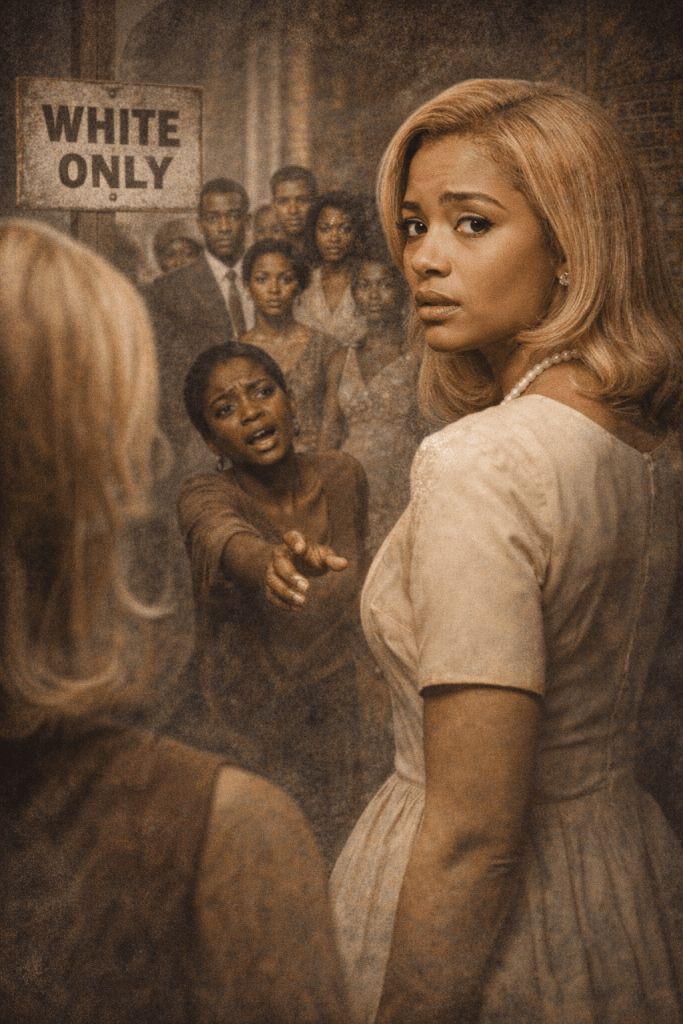
Passing as White is one of the most psychologically complex survival strategies produced by racism in America. It refers to the act of a Black person presenting themselves as white to escape racial oppression, gain social mobility, or avoid discrimination. While often discussed as a historical phenomenon, passing is fundamentally a psychological condition rooted in fear, internalized racism, and the desire for safety in a white supremacist society.
Psychologically, passing is not merely about skin tone or physical appearance; it is about identity suppression. It requires the individual to constantly perform whiteness—altering speech, behavior, social circles, family history, and even emotional expression. The person must erase their Blackness not only from public view, but from their own self-concept to survive the performance.
Looking white becomes a form of social camouflage. Lighter skin, straighter hair, ambiguous features, and European phenotypes allow some Black people to “blend in” within white spaces. However, this blending comes at a profound cost: the continuous denial of one’s ancestry, culture, and lived reality.
Passing emerges from racial terror. In societies where Blackness is punished economically, socially, and physically, passing becomes a method of protection. It is an adaptation to violence. Instead of confronting racism directly, the individual attempts to escape it by exiting Blackness altogether.
This phenomenon was powerfully dramatized in the film Imitation of Life, which tells the story of a light-skinned Black woman who rejects her Black mother to live as white. The film exposes the emotional devastation of passing: the shame, the secrecy, the grief, and the permanent sense of unbelonging.
What happens psychologically when white people discover that someone who has been passing is actually Black is often catastrophic. The individual is typically met with betrayal, hostility, disgust, or expulsion. White acceptance is conditional, and once racial truth is revealed, the person is stripped of the social privileges they had gained.
This moment of “discovery” often triggers identity collapse. The passer is rejected by the white world they tried to assimilate into, while also feeling disconnected from the Black world they abandoned. They become socially homeless—belonging fully to neither group.
Self-hatred is at the core of passing. It is not simply strategic; it is an internalized ideology. The person has absorbed the belief that Blackness is inferior, dangerous, or shameful, and that proximity to whiteness equals safety, value, and humanity.
Passing also produces chronic psychological stress. The individual lives in constant fear of exposure. Every conversation, family detail, photograph, or social interaction becomes a potential threat. This creates a life of hypervigilance, anxiety, and emotional isolation.
One of the most famous real-life examples of passing is Anatole Broyard, a highly respected literary critic and writer who lived as a white man for most of his life. Broyard concealed his Black identity even from his own children and wife, believing that revealing his ancestry would destroy his career and social standing.
After his death, his children discovered the truth, leading to deep emotional consequences. Broyard’s life became a symbol of the tragic cost of passing—success built on erasure, achievement built on denial, and legacy built on silence.
Passing not only distorts how others see one; it also distorts how one experiences love, intimacy, and belonging. Romantic relationships become performances. Friendships become guarded. Family becomes a threat to exposure. The passer must constantly choose between truth and survival.
This creates what psychologists call identity fragmentation. The person splits themselves into parts: the public self and the hidden self. Over time, the hidden self becomes increasingly suppressed, producing depression, dissociation, and internal conflict.
Passing also reinforces white supremacy at a structural level. It validates the idea that whiteness is the ultimate form of social legitimacy, while Blackness is something to escape. Each individual act of passing becomes a silent confirmation of racial hierarchy.
Historically, passing was most common during Jim Crow, when Black people faced segregation, lynching, housing discrimination, and legal exclusion. For some, passing was the only way to access education, employment, or physical safety. It was not always about shame; sometimes it was about survival.
However, survival strategies can become psychological prisons. What begins as protection can evolve into permanent self-rejection. Over time, the person may forget how to exist authentically, even in private.
The modern version of passing still exists, but in more subtle forms. It appears in aesthetic assimilation, name changes, cultural distancing, anti-Black rhetoric, and identity ambiguity. Some people no longer pass racially, but culturally and ideologically.
At its deepest level, passing is a spiritual crisis. It represents a rupture between the self and its origins. The person disconnects from ancestral memory, collective identity, and historical truth in exchange for conditional acceptance.
Many who once passed later experience a psychological awakening. As they age, they begin to feel the emptiness of erasure. They realize that no amount of assimilation can replace the loss of authentic identity. What was gained socially is lost existentially.
Reclaiming Black identity after passing often involves grief. Grief for the years spent hiding, for the relationships built on falsehood, and for the self that was denied. It is not simply a return—it is a reconstruction.
The desire to now “be who you are” represents a form of psychological decolonization. It is the rejection of internalized racism and the re-embrace of ancestral truth. It is a recognition that safety without authenticity is not freedom.
True healing from passing requires confronting the ideology that made it necessary. It requires dismantling the belief that whiteness equals humanity and Blackness equals limitation. Until that belief is destroyed, passing will continue to exist.
Passing as White is not just a historical curiosity. It is a mirror held up to a society that made Black identity something people felt they had to escape in order to live.
The tragedy is not that some people passed.
The tragedy is that a world existed where passing felt necessary.
References
Fanon, F. (1967). Black skin, white masks. Grove Press.
Gates, H. L. Jr. (1996). Thirteen ways of looking at a Black man. Random House.
Hobbs, A. (2014). A chosen exile: A history of racial passing in American life. Harvard University Press.
Larsen, N. (1929). Passing. Alfred A. Knopf.
Rockquemore, K. A., & Brunsma, D. L. (2002). Beyond Black: Biracial identity in America. Rowman & Littlefield.
Smith, S. M. (2006). The performance of race: Passing and the aesthetics of identity. Cultural Critique, 63, 1–27.
Sollors, W. (1997). Neither Black nor white yet both: Thematic explorations of interracial literature. Oxford University Press.
Broyard, B. (2007). One drop: My father’s hidden life—A story of race and family secrets. Little, Brown and Company.
Wilkerson, I. (2020). Caste: The origins of our discontents. Random House.
Du Bois, W. E. B. (1903). The souls of Black folk. A.C. McClurg & Co.
 THE BROWN GIRL DILEMMA