
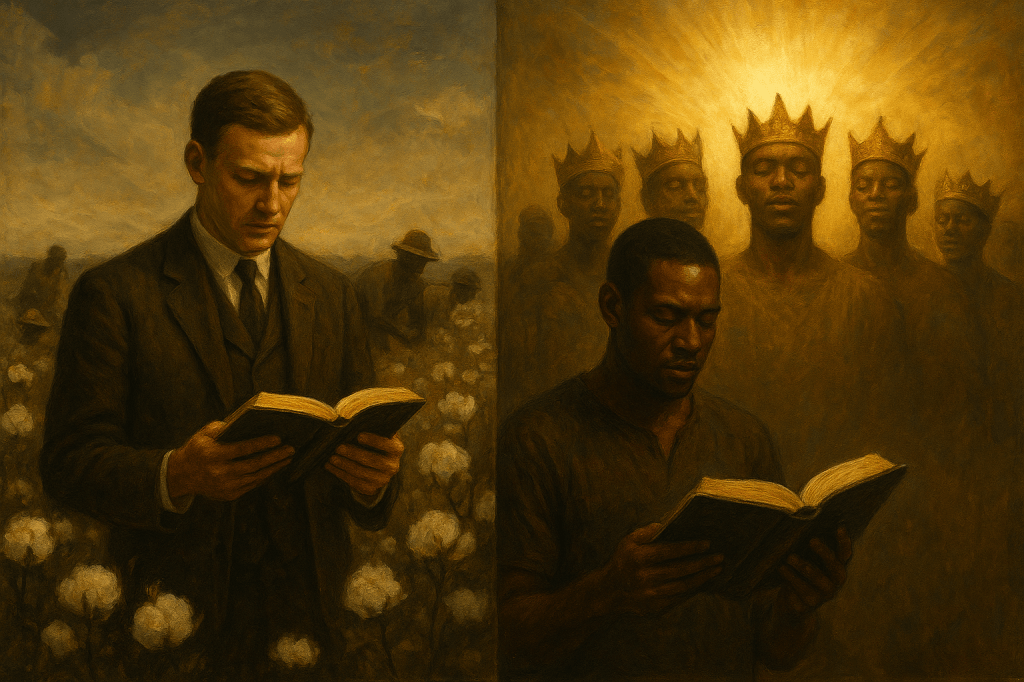
Worldview Shapes Interpretation
European biblical interpretation largely developed within imperial, Greco-Roman, and later Enlightenment frameworks, emphasizing hierarchy, legalism, and institutional authority. African and Black biblical interpretation, by contrast, has historically been experiential, communal, oral, and survival-centered, reading Scripture through lived oppression rather than abstract theology.
The Bible as Empire vs. the Bible as Survival
For Europe, the Bible often functioned as a tool of empire—used to justify monarchy, colonialism, and racial hierarchy. For African and African-descended peoples, the Bible became a text of endurance, liberation, and divine justice amid enslavement, exile, and sufferingEuropean Emphasis on Control and Order
European theology prioritized:
- Church authority
- Doctrinal uniformity
- Obedience to rulers (Romans 13 emphasized)
- Salvation abstracted from material conditions
This lens often muted or reinterpreted passages about oppression, captivity, and divine judgment against empires.
African/Black Emphasis on Exodus and Justice
African and Black readers gravitated toward:
- Exodus
- Deuteronomy 28
- The prophets
- Psalms of lament
- Revelation’s overthrow of empire
Scripture was read as God siding with the oppressed, not legitimizing oppression.
Historical Memory vs. Abstract Theology
African biblical interpretation preserved historical consciousness—genealogy, land, lineage, and curses/blessings—while European theology increasingly spiritualized Scripture, detaching it from concrete history.
Deuteronomy 28 as a Point of Divergence
Europe largely framed Deuteronomy 28 as ancient Israelite history only. Many African-descended interpreters see it as a prophetic template, mapping captivity, forced labor, ships, loss of identity, and global dispersion onto the transatlantic slave trade.
The Role of the Enlightenment
The European Enlightenment desacralized Scripture, elevating reason over revelation, which later influenced canon criticism, textual skepticism, and selective theology that privileged Western norms.
What Books Were Removed from the Bible?
The Apocrypha / Deuterocanonical Books
Several books were removed or relegated to “non-canonical” status, particularly in Protestant Bibles after the 16th century.
Removed or excluded books include:
- 1 Esdras
- 2 Esdras (4 Ezra)
- Tobit
- Judith
- Wisdom of Solomon
- Sirach (Ecclesiasticus)
- Baruch
- Letter of Jeremiah
- Additions to Esther
- Prayer of Azariah
- Susanna
- Bel and the Dragon
- 1 Maccabees
- 2 Maccabees
These books were never “lost” to Africa—only excluded by Europe.
Why Were These Books Removed?
Key reasons include:
- They challenged centralized church power
- They emphasized divine justice against oppressors
- They reinforced covenantal law and judgment
- They complicated European theological control
Martin Luther and later Protestant reformers removed them from standard Bibles, labeling them “useful but not inspired.”
Political Theology at Work
Books like the Wisdom of Solomon condemn unjust rulers. Maccabees celebrate resistance to the empire. Baruch emphasizes exile and repentance. These themes conflicted with colonial and imperial agendas.
Suppression of Apocalyptic Knowledge
Books like Enoch and 2 Esdras contain cosmology, angelology, and judgment narratives that undermine human supremacy and racial hierarchy.
Race and Canon Formation
Europeans controlling the canon during colonial expansion ensured Scripture could be used to:
- Enforce obedience
- Justify slavery
- Silence rebellion
- Promote passive salvation
African-descended readers later reclaimed Scripture against these distortions.
African Christianity Predates Europe
Africa Is Not a Late Convert
Christianity flourished in Ethiopia, Egypt, Nubia, and North Africa centuries before Europe institutionalized the Church.
Biblical Geography Is African-Centered
Scripture references:
- Cush
- Mizraim (Egypt)
- Ethiopia
- Libya
African peoples are not marginal to the Bible—they are foundational.
Oral Tradition vs. Written Control
African biblical engagement preserved oral memory, song, lament, and testimony, while Europe emphasized written codices controlled by elite institutions.
Theological Consequences of Removal
Loss of Justice-Centered Theology
Removing books narrowed theology away from historical accountability, exile, and covenant justice.
Spiritualization of Suffering
European theology often reframed suffering as divinely ordained rather than divinely condemned—an interpretation enslaved people instinctively rejected.
Black Biblical Hermeneutics
Black theology reads Scripture from the bottom up, centering God’s response to suffering bodies, not abstract doctrine.
Scripture as Resistance
For African-descended peoples, the Bible became a counter-text, exposing the hypocrisy of Christian slaveholders and affirming divine judgment.
Conclusion: Two Bibles, Two Lenses
European Christianity often used the Bible to rule.
African and Black Christianity used the Bible to survive.
The difference is not the text itself, but who controls interpretation, which books are included, and whose suffering is acknowledged. Reclaiming the removed books and reading Scripture through historical truth restores the Bible’s original moral power.
References
The Holy Bible, King James Version. (1611/1769).
The Ethiopian Orthodox Tewahedo Church Canon.
Cone, J. H. (1997). God of the oppressed. Orbis Books.
Heschel, A. J. (2001). The prophets. Harper Perennial.
Pagels, E. (1979). The gnostic gospels. Random House.
Charlesworth, J. H. (Ed.). (1983). The Old Testament pseudepigrapha. Yale University Press.
 THE BROWN GIRL DILEMMA