AI and dating represent a new chapter in how human beings seek connection, compatibility, and companionship. Artificial intelligence refers to computer systems designed to simulate aspects of human intelligence, such as learning, pattern recognition, and decision-making. In the context of dating, AI is used to analyze behavior, preferences, communication styles, and values to help people form more compatible matches.
Unlike traditional dating methods rooted in proximity, family networks, or chance encounters, AI-driven dating relies on data. Algorithms examine user input, past interactions, and psychological indicators to predict relational compatibility. This shift marks a movement from intuition-led matching to evidence-informed pairing.
One of the primary promises of AI in dating is efficiency. AI reduces the overwhelming nature of modern dating by filtering options and narrowing choices. Rather than endlessly scrolling through profiles, users are presented with matches that are more closely aligned with their stated and demonstrated preferences.
AI can also improve self-awareness. Many platforms use reflective questions, behavioral feedback, and pattern analysis to help users understand their dating habits, attachment styles, and relational blind spots. This can encourage personal growth alongside the selection of a partner.
Compared to traditional online dating, AI goes beyond static profiles and surface-level traits. Online dating typically relies on photos, short bios, and user-selected preferences, which are often aspirational rather than accurate. AI, by contrast, evaluates behavior over time, including communication patterns and decision-making tendencies.
AI-driven systems can also reduce some forms of bias present in human judgment. By focusing on compatibility metrics rather than immediate attraction alone, AI has the potential to elevate values such as shared goals, emotional intelligence, and communication alignment.
For individuals with limited social circles, demanding careers, or geographic isolation, AI offers access to a wider pool of potential partners. This expanded reach can be particularly beneficial for people seeking intentional, long-term relationships rather than casual encounters.
AI may also support safety in dating. Some platforms use AI to detect harassment, deception, or harmful behavior by analyzing language patterns and reported activity. This creates a more moderated environment compared to unregulated social interactions.
Despite its benefits, AI in dating is not without danger. Overreliance on algorithms can reduce human agency, causing individuals to trust machine recommendations more than their own discernment. Relationships, however, involve mystery, growth, and unpredictability that no algorithm can fully capture.
Another concern is emotional detachment. When dating becomes overly optimized, people may begin to treat partners as data points rather than whole human beings. This commodification risks undermining empathy, patience, and grace.
Privacy is also a significant issue. AI dating platforms collect sensitive personal data, including emotional responses, preferences, and behavioral patterns. Misuse or breaches of this information pose ethical and psychological risks.
AI can unintentionally reinforce existing biases if trained on flawed or limited datasets. If societal inequalities are embedded in the data, algorithms may replicate or amplify them, particularly in areas related to race, class, and attractiveness norms.
There is also the danger of false precision. Compatibility scores may create an illusion of certainty, leading users to prematurely dismiss potentially meaningful relationships that do not meet algorithmic thresholds.
The difference between AI and traditional online dating lies in depth and adaptability. Online dating platforms typically remain static, while AI systems evolve, learning from user behavior and refining recommendations over time. This adaptability can enhance accuracy but also increase dependency.
AI cannot replace emotional wisdom, spiritual discernment, or moral alignment. While it can suggest compatibility, it cannot evaluate character over time, test commitment under pressure, or measure sacrificial love.
Healthy use of AI in dating requires balance. AI should function as a tool, not an authority. It can assist in introductions and insights, but human judgment must remain central in deciding relational direction.
From a relational ethics perspective, intentional dating still requires honesty, accountability, and respect. AI does not absolve individuals from personal responsibility or moral conduct.
AI also raises questions about divine order and human agency. For faith-centered individuals, technology must be subordinated to values, prayer, and discernment rather than replacing them.
When used wisely, AI can serve as a benefit rather than a barrier. It can reduce noise, highlight compatibility, and encourage intentionality, especially for those seeking marriage or a long-term partnership.
Ultimately, AI and dating reflect humanity’s ongoing attempt to reconcile technology with intimacy. The success of AI in dating will not be determined by algorithms alone, but by whether users remain committed to authenticity, dignity, and meaningful connection.
References
Ansari, A. (2015). Modern romance. New York, NY: Penguin Press.
Finkel, E. J., Eastwick, P. W., Karney, B. R., Reis, H. T., & Sprecher, S. (2012). Online dating: A critical analysis from the perspective of psychological science. Psychological Science in the Public Interest, 13(1), 3–66.
Guzman, L., & Lewis, A. (2020). Artificial intelligence and intimacy: Ethical considerations in digital matchmaking. Journal of Social and Personal Relationships, 37(8–9), 2401–2419.
Hutson, J. A., Taft, J. G., Barocas, S., & Levy, K. (2018). Debiasing desire: Addressing bias and discrimination on intimate platforms. Proceedings of the ACM on Human-Computer Interaction, 2(CSCW), 1–18.
Turkle, S. (2011). Alone together: Why we expect more from technology and less from each other. New York, NY: Basic Books.
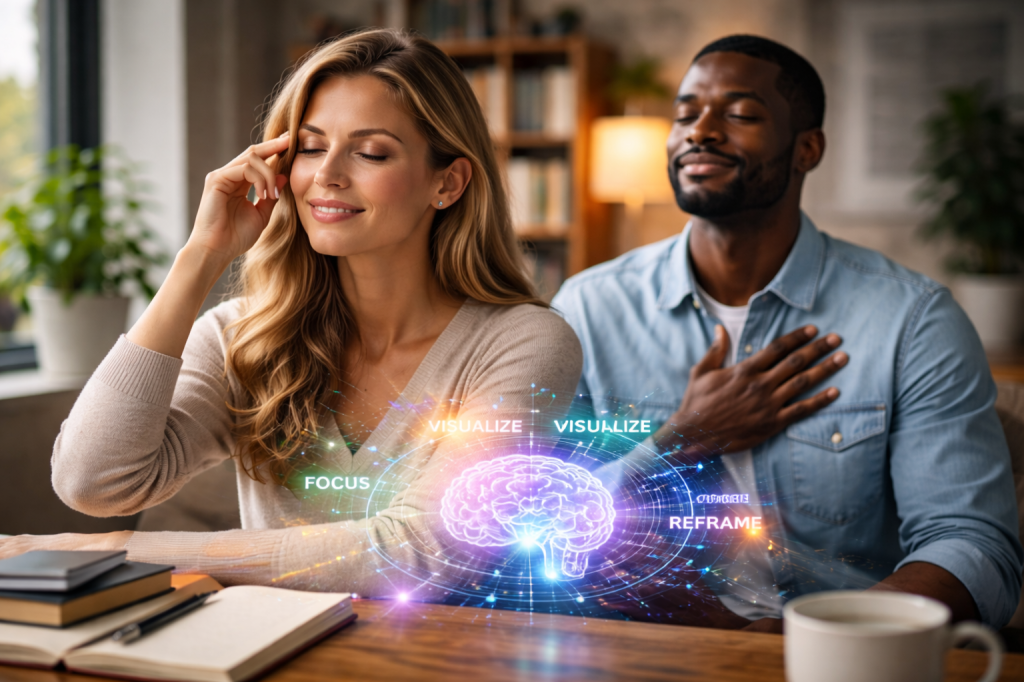
Neuro-Linguistic Programming, commonly known as NLP, explores how language, thought patterns, and behavior interact to shape human experience. At its core, NLP suggests that small shifts in perception and communication can produce immediate changes in emotional states and responses.
One instantly usable NLP technique is anchoring. Anchoring involves associating a specific physical action, word, or image with a desired emotional state. By consciously recalling a confident or calm moment and pairing it with a gesture, individuals can later activate that state on demand.
Reframing is another foundational NLP tool that can be applied immediately. This technique involves changing the meaning assigned to a situation rather than the situation itself. By asking what else an experience could represent or what lesson it offers, emotional responses often shift rapidly.
Mirroring and matching are interpersonal NLP techniques that improve rapport. Subtly aligning posture, tone, or pacing with another person can create a sense of psychological safety and connection. When people feel understood, communication becomes more fluid and effective.
Language patterns play a critical role in NLP. Simply changing from absolute language such as “always” or “never” to more flexible phrasing like “sometimes” or “so far” can reduce internal pressure and open space for growth and problem-solving.
Visualization is an NLP strategy that engages the brain’s sensory systems. By vividly imagining a successful outcome using sight, sound, and feeling, individuals prime their nervous system for confidence and preparedness. The brain often responds to imagined success similarly to real experience.
The swish pattern is a rapid NLP technique designed to interrupt unwanted habits or thoughts. It works by replacing a negative mental image with a compelling positive one in quick succession, weakening the old association and strengthening a new, empowering response.
State management is central to NLP practice. Instead of asking why one feels a certain way, NLP focuses on how to shift states. Simple actions such as changing posture, breathing rhythm, or focus can immediately alter emotional energy.
Meta-cognition, or thinking about thinking, is another NLP-aligned skill. Becoming aware of internal dialogue allows individuals to challenge unhelpful narratives and consciously replace them with constructive language.
NLP emphasizes sensory awareness through representational systems. Paying attention to whether one thinks primarily in images, sounds, or feelings can enhance communication and self-understanding. Adjusting language to match these systems increases clarity and impact.
Future pacing is an NLP technique that mentally rehearses desired behaviors in upcoming situations. By imagining oneself responding calmly or confidently in advance, the brain becomes familiar with the behavior, making it easier to execute when the moment arrives.
Chunking is a cognitive NLP strategy that manages overwhelm. Breaking large goals into smaller, achievable steps reduces resistance and increases motivation. Conversely, chunking up helps individuals reconnect with purpose by seeing the bigger picture.
Pattern interruption is a fast NLP tool for shifting emotional states. Doing something unexpected, such as changing physical position or altering speech tempo, disrupts automatic reactions and creates space for conscious choice.
NLP also teaches precision in questioning. Asking better questions, such as “What specifically do I want instead?” directs attention toward solutions rather than problems, influencing both mindset and behavior instantly.
Submodalities refer to the fine details of mental imagery, such as brightness, size, or distance. Changing these qualities can dramatically alter emotional intensity. For example, shrinking or dimming a distressing image often reduces its emotional charge.
Rapport with oneself is just as important as rapport with others. NLP encourages aligning values, beliefs, and actions to reduce internal conflict. When inner communication improves, external behavior often follows.
NLP techniques can be particularly effective in moments of anxiety or self-doubt. Redirecting attention, shifting language, or adjusting body posture can calm the nervous system within minutes, restoring a sense of control.
Critics note that NLP varies in empirical support, yet many techniques align with established cognitive-behavioral and psychological principles. Its practical appeal lies in its accessibility and immediate applicability.
Ethical use of NLP is essential. Techniques designed to enhance communication and self-regulation should never be used to manipulate or coerce. Responsible practice prioritizes consent, authenticity, and personal growth.
Ultimately, NLP offers a toolkit rather than a doctrine. The techniques that work best are those applied with self-awareness, intention, and consistency. Small shifts in language, focus, and behavior can create meaningful changes in daily life.
References
Bandler, R., & Grinder, J. (1975). The structure of magic I: A book about language and therapy. Science and Behavior Books.
Dilts, R. (1990). Changing belief systems with NLP. Meta Publications.
Dilts, R., Grinder, J., Bandler, R., DeLozier, J., & Cameron-Bandler, L. (1980). Neuro-Linguistic Programming: The study of the structure of subjective experience. Meta Publications.
Kahneman, D. (2011). Thinking, fast and slow. Farrar, Straus and Giroux.
Linder-Pelz, S., & Hall, L. M. (2007). The empirical case for NLP. NLP World.
Tosey, P., & Mathison, J. (2010). Neuro-linguistic programming as an innovation in education and teaching. The Curriculum Journal, 21(4), 433–456.
Colorism has long shaped social, economic, and psychological realities within the global Black and Brown diaspora. But today, the battlefield has shifted into a new arena: technology. Algorithmic colorism refers to the ways digital systems — from social media filters to AI beauty ranking tools to facial recognition — reinforce, re-normalize, and amplify historic hierarchies based on skin tone. This phenomenon merges old prejudice with modern power, cloaking racial bias in the seeming objectivity of data and mathematics.
Historically, colorism was expressed through colonial power structures, slavery, caste systems, and Western beauty standards that privileged fair-skinned individuals. Digital technology, instead of dismantling these hierarchies, frequently embeds them deeper. The algorithm becomes the new overseer — sorting, elevating, suppressing, and shaping perceptions of beauty and humanity. What was once plantation logic now exists as platform logic.
Social media platforms reward certain facial types and color tones. Lighter skin often receives more visibility, engagement, and algorithmic boosting, while darker skin tones are frequently filtered out, shadow-suppressed, or made to appear lighter via “beauty” filters. These filters normalize Eurocentric features — slender noses, lighter skin, narrower jawlines — subtly training young users to internalize standards that privilege whiteness and proximity to whiteness.
Facial recognition systems also demonstrate measurable racial bias, particularly against dark-skinned women. MIT researcher Joy Buolamwini famously revealed that some systems misclassified darker-skinned women up to 35% more frequently than lighter-skinned men. In essence, the darker the skin, the less “visible” the person in digital systems. Invisibility becomes digital erasure — an electronic version of saying “you do not exist” or “you do not belong.”
This bias affects how people experience everyday life. From phone cameras that fail to recognize darker faces to auto-tagging tools misidentifying Black individuals as threats, algorithmic colorism has real-world consequences. It shapes hiring software, law enforcement databases, beauty industry AI, and academic proctoring tools that cannot detect the faces of darker-skinned test-takers. Prejudice becomes code.
Beauty, historically shaped by white supremacy and colonial order, is now shaped by machine learning. AI “beauty scoring” systems — often trained on databases of overwhelmingly white faces — routinely rank lighter-skinned individuals higher. In turn, these systems feed back into social media feedback loops, determining who is labeled “beautiful,” who gets platform attention, and who is pushed to the margins.
Colorism intersects with desirability politics. Young users internalize digital reinforcement, believing that lightness equals attractiveness and darker tones equal less value. As a result, algorithmic systems become silent teachers — instructing generations to view beauty through a skewed, Eurocentric lens. Thus, algorithmic colorism does not just reflect bias; it manufactures it.
Even within communities of color, digital platforms multiply existing color hierarchies. “Brown-skinned” and “yellow-bone” filters flood platforms, enabling the synthetic lightening of melanin and the idealization of mixed-race aesthetics. While dark skin remains celebrated in certain empowering artistic and cultural circles, algorithms often work counter to this empowerment, drowning out dark-skinned beauty under the weight of digital preference.
For the entertainment industry, algorithmic bias determines who is cast, whose music goes viral, and whose aesthetic the machine recognizes as marketable. Lighter-skinned artists often benefit from platform amplification. Meanwhile, darker-skinned artists — especially women — battle invisibility, tokenism, and algorithmic suppression. Technology becomes a gatekeeper and taste-maker.
This digital inequity extends to product design. Filters created primarily for lighter skin produce distortions on darker tones. Lighting and photography technologies in devices often privilege lighter subjects. Developers’ unconscious biases surface in pixels and code, shaping cultural preferences without public debate or consent. Invisibility becomes system design.
Algorithmic colorism also reinforces patriarchal beauty hierarchies. Women bear disproportionate burden as beauty-focused systems magnify color bias in dating algorithms, social media ranking, and digital marketplaces for modeling and branding. Dark-skinned women once again endure dual oppression — racism layered with colorism, now automated.
But resistance rises. Scholars, technologists, and activists call for algorithmic transparency, diverse coding teams, and ethical AI design. Movements centering melanin — from #MelaninMagic to #Unbothered — challenge the narrative. Yet resistance alone cannot match corporate scale; regulation, equity engineering, and truthful representation must follow.
The biblical warning in Psalm 82:2–4 resonates: “How long will ye judge unjustly, and accept the persons of the wicked? Defend the poor and fatherless: do justice to the afflicted and needy.” Injustice coded into digital systems becomes modern oppression requiring moral response, not just technological fixes.
True equity demands confronting the myth of algorithmic neutrality. Algorithms inherit human prejudice unless intentionally purified. Diversity in technology leadership is not cosmetic — it is mandatory for fairness. Ethical coding becomes civil rights work. Data justice becomes a spiritual and social mandate.
The next era of discrimination will not always wear white robes or badges. It will live in lines of code, camera lenses, and AI systems deciding who is visible, desirable, and worthy. The battleground is digital; the stakes are human. Society must choose whether technology reflects our worst biases or our highest ideals.
At stake is more than beauty — it is belonging, self-worth, and humanity’s reflection back to itself. Algorithmic colorism reveals a truth: systems are not neutral. They either liberate or oppress. The fight for melanin dignity continues — not only in streets and classrooms, but in servers, datasets, and screens shaping the modern soul.
Artificial intelligence must evolve beyond artificial bias. The future must honor melanin, not erase it. Beauty must expand beyond filters and code. And the digital world must reflect the full spectrum of humanity — in truth, not distortion.
The Digital Plantation
Colorism—the preferential treatment of lighter-skinned individuals within the same racial or ethnic group—has been a pervasive feature of Black history, tracing back to slavery, colonial hierarchies, and social stratification (Hunter, 2007). In contemporary society, this prejudice has evolved into digital forms, embedded within artificial intelligence, social media algorithms, and beauty standards. These manifestations continue to reinforce oppressive narratives that devalue darker-skinned Black individuals while elevating Eurocentric features.
Theologically, colorism mirrors the human tendency toward superficial judgment condemned in Scripture. The King James Version warns against favoritism: “My brethren, have not the faith of our Lord Jesus Christ, the Lord of glory, with respect of persons” (James 2:1, KJV). Similarly, the Apocrypha highlights the spiritual danger of human vanity and superficial valuation: “For the wickedness of man is great upon the earth” (Wisdom of Solomon 14:12, Apocrypha). Understanding the historical roots of colorism allows for meaningful reflection on both spiritual and societal dimensions of human prejudice.
Historical Roots of Colorism
1. Pre-Colonial African Societies
In many pre-colonial African societies, beauty and social status were complexly coded through hair, skin tone, and body adornment rather than strict hierarchies privileging lighter skin. However, as European colonial powers advanced, notions of skin tone became intertwined with proximity to power, wealth, and survival, laying the foundation for systemic colorism (Harris, 2015).
2. Slavery and the Plantation Hierarchy
During the transatlantic slave trade, slaveholders leveraged colorism as a tool of division. Mixed-race children of European slave owners and enslaved African women were often granted preferential treatment, lighter work duties, and social advantages (Hunter, 2007). This stratification fostered internalized oppression and a hierarchy privileging lighter skin that persisted long after emancipation.
3. Post-Emancipation and Media Representation
Colorism intensified in the 20th century through media, film, and advertising, which predominantly celebrated lighter-skinned Black individuals (Russell, Wilson, & Hall, 2016). The rise of Hollywood, beauty pageants, and commercialized ideals codified skin-tone biases that informed social mobility and cultural capital.
The Digital Plantation: AI and Modern Colorism
The metaphor of “The Digital Plantation” captures how contemporary technology—AI algorithms, facial recognition, and social media filters—perpetuates historical biases. AI systems trained on Eurocentric datasets tend to misclassify, underrepresent, or render invisible darker-skinned individuals (Buolamwini & Gebru, 2018). This represents a digital reincarnation of the same hierarchical systems that defined plantations, enforcing standards of beauty, intelligence, and value based on skin tone.
Visual Concept: The Digital Plantation
Foreground: Diverse Black individuals of varying skin tones interacting with smartphones and screens, some celebrated, some obscured by digital shadows.
Background: A plantation-like grid subtly overlaid with algorithmic code, symbolizing surveillance, ranking, and control.
Lighting: Warm golden light highlights lighter-skinned figures while darker-skinned figures sit in subtle shadow, representing algorithmic bias.
Symbolism: Broken chains and floating pixels suggest the potential for liberation from both historical and digital oppression.
Scriptural Reflection
Colorism and AI bias can be seen as modern manifestations of humanity’s spiritual blindness to equality and divine worth. The Scriptures provide moral guidance:
James 2:1 (KJV): Condemns favoritism based on appearance.
Wisdom of Solomon 14:12 (Apocrypha): Warns against the corruption of judgment by superficial values.
Genesis 1:27 (KJV): Affirms that all humans are made in God’s image, irrespective of skin tone.
From a theological perspective, resisting algorithmic colorism is not only a social imperative but a spiritual one, emphasizing justice, discernment, and honoring God’s creation.
Historical Timeline of Colorism → AI
Era
Manifestation
Evidence & Scripture Integration
Pre-1500s
Cultural beauty diversity in Africa
Highlighted by ethnographic studies (Harris, 2015)
“Owe no man any thing, but to love one another” (Rom 13:8, KJV)
1900s
Hollywood, advertisements, colorism in media
Social stratification codified, mirrors James 2:1 warnings
2000s
Social media, digital beauty filters
Algorithmic reinforcement of bias, e.g., Buolamwini & Gebru (2018)
2020s
AI and facial recognition
Modern “Digital Plantation” reflecting historical hierarchies
Conclusion
Colorism, historically rooted in slavery and colonialism, persists today in digital landscapes through biased algorithms and representation systems. Addressing these inequities requires historical understanding, technical interventions in AI, and a theological commitment to justice and equality. Scripture, both canonical and apocryphal, provides a moral framework condemning favoritism and promoting the inherent dignity of every human being. The concept of the Digital Plantation visualizes these ongoing struggles, connecting past and present while advocating for liberation in both spiritual and technological realms.
References
Buolamwini, J., & Gebru, T. (2018). Gender shades: Intersectional accuracy disparities in commercial gender classification. Proceedings of Machine Learning Research, 81, 1–15.
Harris, A. P. (2015). Skin tone stratification and social inequality: Historical and contemporary perspectives. Oxford University Press.
Hunter, M. (2007). The persistent problem of colorism: Skin tone, status, and inequality. Sociology Compass, 1(1), 237–254.
Russell, K., Wilson, M., & Hall, R. (2016). The color complex: The politics of skin color in a new millennium. Anchor Books.
Where faith, history, and truth illuminate the Black experience.



 THE BROWN GIRL DILEMMA