
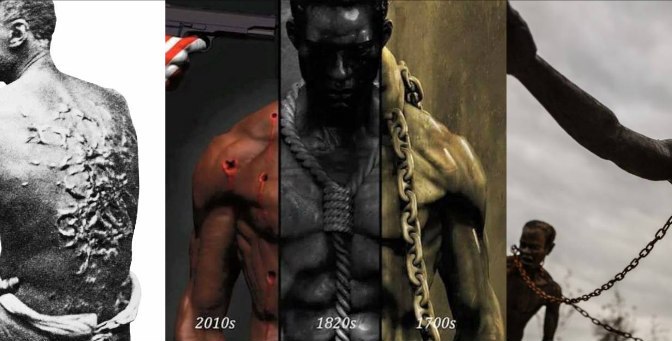
As indicated by the didactic systems of this world, the Negroes were brought to the Americas by slave ships in 1619 were beaten, raped, murdered and forced to work as slaves on plantations for 400 + years with poor living conditions, no rights or pay. They cried. They prayed. They obeyed. The cries of the slaves were heard by our God so he raised up – President Abraham Lincoln – who signed the Emancipation Proclamation in 1863 which freed the slaves. This action pissed off the white nationalists that felt compelled to ensure that we were still enslaved to the system. They passed the Jim Crow laws for segregation. Then later that was demolished by the civil rights movement in the sixties. We became “Black and Proud” Then in 2008, a black senator from Chicago “Barack Obama” became the first black president of the United States. Did anything really change?
 |
| This photograph is the property of its respective owner. |
WHO DO THEY SAY WE ARE?
And thou shalt become an astonishment, a proverb, and a byword, among all nations whither the Lord shall lead thee. Deuteronomy 28:37 KJV
NIGGERS * SPICS *COONS * DARKIES * BLACK * UGLY * MULATTOS *FEEBLE MINDED * UNFIT * IMBECILES * IMMORAL * CRIMINAL * CATTLE * SLAVES NEGROES * AFRO THIS OR THAT *MONKIES * SAVAGES * COLORED *JUNGLE BUNNIES * DIRT *JIGABOOS * ANIMALS *WET BACKS * SPOOKS *SAMBOO * ASIATIC BLACK MIXED * BIRACIAL* MULTIRACIAL * BURNT And so forth… Code words used to establish slavery.
1619-1834 Slaves
1834-1892 Coons/Colored
1892-1934 Niggers/Niggas
1934-1970 Boy/Africans
1970-1983 Afro Americans
1983-2002 Black Americans
2002-2016 African Americans
We exist under the myriad complexities of slavery even today
🌐 Slavery: Origins, Transformations & Enduring Legacy
🌍 1. The Global Scope of Slavery
Key nations involved in transatlantic slavery included 🇵🇹 Portugal, 🇪🇸 Spain, 🇬🇧 Great Britain, 🇫🇷 France, 🇳🇱 Netherlands, 🇩🇰 Denmark, 🇺🇸 the United States, and 🇧🇷 Brazil. These nations forcibly transported over 12.5 million Africans to the Americas between the 16th and 19th centuries; approximately 1.8 million perished during the Middle Passage due to disease, starvation, or abuse (Transatlantic Slave Trade database; Colonialism background) Wikipedia.
🚢 2. The Middle Passage & Auction Blocks
Enslaved Africans were chained in unsanitary, overcrowded ships; an estimated 15–20% died en route. Survivors endured auctions in which families were torn apart, inspected like livestock, and sold to plantation owners (Guardian report on slave ship excavation) .
📜 3. The “Why” Behind Slavery
Slavery emerged from the economic imperative of colonial powers seeking cheap labor for labor-intensive industries like sugar, cotton, tobacco, and mining. Race-based justification was fabricated through “scientific racism” and mythologies of White supremacist hierarchy. Slavery offered enormous profits, shaping the economic foundations of Western empires (UN, ILO, and colonial histories) .
📚 4. Multigenerational Impact on Black Communities
Slavery’s lasting effects include systemic inequality across wealth, health, education, and incarceration:
Wealth: Black households in the U.S. have approximately 10–12× less median wealth than White households, a disparity rooted in generations of discriminatory policies and denied opportunities (NumberAnalytics; Pew) Wikipedia+9Number Analytics+9Monthly Review+9.
Health: Counties with formerly high slave populations now have lower life expectancy for Black residents, even when controlling for current health access and behaviors (Reece, 2022) cola.utexas.edu.
Incarceration and Justice: Black individuals are heavily overrepresented in prison, and disproportionately subject to police violence (National Council of Churches; Pew data) nationalcouncilofchurches.us.
🧬 5. Colorism, the Willie Lynch Myth & Internal Division
Enslavers often favored lighter‑skinned individuals as house staff, while darker‑skinned people were relegated to labor in the fields.
The widely-circulated Willie Lynch Letter—which outlines racial division tactics—is considered a forgery, but it reflects how colorism was used to divide enslaved populations. Modern studies confirm that lighter-skinned Black individuals are often afforded social and economic privilege (Hochschild & Weaver, 2007) Number Analytics+14SpringerOpen+14National Alliance to End Homelessness+14.
😱 6. Physical and Psychological Terror
Public torture methods—such as chaining Black men behind horses, sexual violence, and humiliation—were tools of terror. Infants born of rape were frequently killed or sold; mythic accounts claim some were fed to alligators in captivity in the Deep South (historical anecdotal reports).
📜 7. Slavery and Scripture
Slavery within biblical prophecy is referenced in Deuteronomy 28 and Baruch 4:6 (Apocrypha)—warnings that disobedience can result in exile and bondage. These texts have been interpreted to parallel the exile and forced dispersal of Africans during the transatlantic slave trade .
🕊️ 8. Emancipation & Its Limits
In 1863, President Abraham Lincoln’s Emancipation Proclamation declared freedom for enslaved people in Confederate-held territories. While symbolic, it did not end slavery in Union border states nor guarantee civil rights—these required the 13th, 14th, and 15th Amendments and persistent activism .
🔄 9. Evolution into Modern Slavery
Although chattel slavery was abolished globally, modern slavery persists in the form of human trafficking, debt bondage, forced labor, and sexual exploitation. Today there are an estimated 27.6 million forced laborers globally, with forced labor generating $236 billion in illicit profits annually (ILO, modern slavery reports) AP News+1BBC+1.
🚔 10. Racism in Policing & Public Violence
Systemic racial bias continues in policing. The murder of George Floyd in 2020—and similar cases involving Breonna Taylor, Ahmaud Arbery, and others—reflect a long lineage of state-sanctioned violence. In 2021, Black Americans accounted for 27% of police killings despite being 13% of the population (police violence datasets) .
🧠 11. Psychological & Social Ramifications
Historians and sociologists posit that enduring trauma from slavery has negatively impacted self-perception, psychological health, and community identity among Black people. As stated in Post-Traumatic Slave Syndrome by Dr. Joy DeGruy, the intergenerational effects must be addressed holistically nationalcouncilofchurches.us.
🖋️ Quote to Frame the Discussion:
“Race is not a biological reality but a social creation—a powerful illusion that has justified the enslavement and marginalization of generations.”
— Audrey Smedley & Brian Smedley, 2007
📌 Summary Table
Theme Key Points Origins of Slavery Economic incentives, colonial expansion, racial hierarchy Psychological Legacy Trauma, colorism, internalized inferiority Structural Continuation Income gap, health disparities, policing and incarceration Modern Manifestations Human trafficking, forced labor, systemic racism
🧪 Why It Matters for Today
Understanding slavery and its modern permutations is essential to recognizing and dismantling systemic racism. Its legacy remains deeply embedded in global institutions, justice systems, economic outcomes, and cultural perceptions. Only through unmasking the roots of these structures—including race as illusion—can meaningful progress toward equity be possible.
🌍 Global Scope of Slavery & Racism
🇵🇹 Portugal, 🇬🇧 Britain, 🇫🇷 France, 🇪🇸 Spain, 🇳🇱 Netherlands, 🇩🇰 Denmark, 🇺🇸 United States, 🇧🇷 Brazil — these nations transported approximately 12.5 million Africans across the Atlantic from the 16th to the 19th century, with around 1.8 million perishing en route Let Africa Speak+2Wikipedia+2Wikipedia+2.
🚢 The Middle Passage & Mortality
Enslaved Africans endured horrific conditions aboard slave ships, shackled and overcrowded.
An estimated 15–20% died from disease, starvation, or abuse before even reaching auction blocks Lowcountry Digital History Initiative+2The Guardian+2Academia+2.
At auctions, enslaved families were separated, stripped of identity, inspected as livestock, and sold to the highest bidder, cementing their status as property.
💡 Defining Race and Racism
“Race is a social tool—an illusion crafted to categorize, divide, and suppress.”
The biological concept of race has no scientific basis—traits like melanin vary independently of behavior or intelligence. Racism is the ideology stemming from this illusion, elevating one “race” while oppressing others. It thrives because people unaware of their heritage often believe and perpetuate its false narratives.
⚖️ Biblical Context: Deuteronomy 28
Scripture warns that disobedience to the Most High can lead to national punishment and exile—“Ye were sold to the nations… delivered unto the enemies” (Baruch 4:6). In Christian thought, some interpret this as linking Israelite exile to the African diaspora.
🧬 Colorism & Internal Hierarchies
Lighter-skinned Black individuals were often given “privileged” roles—house servants vs. field workers.
The purported Willie Lynch Letter describes how slaveowners sought to exploit color and age divisions—though historians widely agree it is a forgery Jim Crow Museum+7Wikipedia+7Academia+7.
Today, colorism continues to impact self-esteem and social mobility within communities Academia+4Academia+4Jim Crow Museum+4.
👶 Interracial Births & Infant Cruelty
Enslaved women who were raped often bore mixed-race children—many killed or sold off early to conceal lineage.
Reports persist—though scarce—of atrocities including feeding infants to alligators, a testament to dehumanization.
🐎 Violence & Torture By Enslavers
Black men were publicly tortured—pulled behind horses, castrated, or subjected to rape and humiliation—to maintain white dominance .
🧬 Early Slavery Origins & Geographies
Chattel slavery dates as far back as ancient Mesopotamia but became global with Muslim North African and Ottoman enslavement of Europeans and Africans.
Transatlantic slavery began in the 1400s, with Portugal leading, followed by Spain, Britain, France, and the Netherlands .
🇺🇸 The Emancipation Proclamation
On January 1, 1863, President Lincoln declared all enslaved people in Confederate territories “forever free.” However, the proclamation didn’t end slavery in Union states or guarantee full civil rights—those came later with the 13th, 14th, and 15th Amendments.
⚠️ Fallacies About Slavery & Social Media’s Role
Fallacies: Claims that slavery was not brutal or that Black people benefited economically are misleading.
Social media often spreads revisionist narratives, minimizing atrocities or asserting false equivalencies.
🧪 Modern Echoes: Police Violence
The racist roots of slavery persist today in police brutality. The murder of George Floyd in 2020, where an officer kneeled on his neck for nearly nine minutes, captured global attention. Black Americans accounted for about 27% of fatal police shootings in 2021 Let Africa Speak+1Academia+1—highlighting systemic racism.
📝 What Is Slavery?
Slavery: chattel bondage where humans are owned as property. It began in organized societies seeking labor (e.g., Mesopotamia, Africa) and evolved into a global race-based exploitation system in the Atlantic world.
📚 References
Britannica. (n.d.). Transatlantic Slave Trade timeline Let Africa Speakbritannica.com+1Wikipedia+1.
Slave Voyages. (n.d.). Trans-Atlantic Slave Trade database Wikipedia+4slavevoyages.org+4Wikipedia+4.
Wikipedia. William Lynch speech (forgery context) Academia+3Wikipedia+3Jim Crow Museum+3.
Wikipedia. Trans-Saharan Slave Trade Wikipedia.
Guardian. (2024, Oct 16). Diving 18th-century slave ship wreck The Guardian.
Wikipedia. Triangular trade apnews.com+4Wikipedia+4Lowcountry Digital History Initiative+4.
Wikipedia. Atrocities in Congo Free State (Leopold II context) Academia+2Open Knowledge Brasil+2Wikipedia+2.
 THE BROWN GIRL DILEMMA