
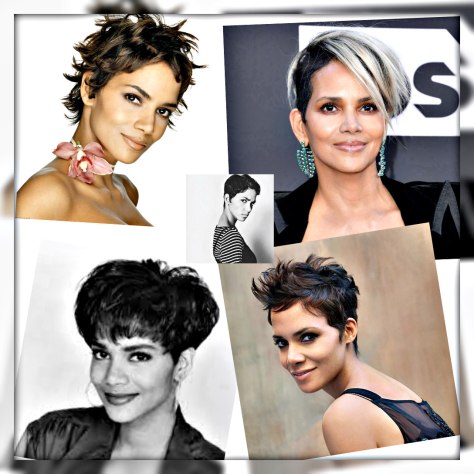
Halle Berry’s short hair became one of the most iconic beauty statements in Hollywood history. When she first cut her hair into a sleek pixie style in the early 1990s, the move was seen as daring—especially for a Black woman in an industry that often equated femininity with long, flowing hair. Yet what many saw as risky, Halle turned into revolutionary. Her cropped cut became her signature, accentuating her delicate bone structure, radiant eyes, and magnetic smile. Instead of hiding behind hair, she revealed her true essence—unapologetically bold, elegant, and self-possessed.
The short haircut elevated Halle Berry from merely “beautiful” to unforgettable. It transformed her from another up-and-coming actress into a cultural trendsetter. Stylists, fashion editors, and women around the world took notice. The look wasn’t just stylish; it was empowering. Berry’s pixie cut challenged Eurocentric ideals of beauty, asserting that femininity and sensuality come from confidence, not conformity. Her look became synonymous with modern sophistication—graceful yet fierce, delicate yet powerful.
Berry has often spoken about how that decision affected her career and self-image. In interviews, she shared that cutting her hair was an act of liberation. It wasn’t for a role, a magazine shoot, or an image change—it was personal. She wanted to feel free of the societal expectations that dictated how women, particularly Black women, “should” look. “When I cut my hair short, I felt like my true self finally emerged,” Berry once said. “It was about letting go of other people’s ideas of me and stepping fully into my own.”
Hollywood initially resisted the look. Studio executives and casting directors doubted her ability to play romantic leads or glamorous roles with such a daring cut. But Berry proved them wrong. With her short hair, she landed major roles in Boomerang, The Flintstones, and Bulworth, where her beauty and confidence captivated audiences. The haircut became part of her allure—a declaration of independence and authenticity that set her apart from her peers.
The short style also helped Halle connect more deeply with fans. Many women, particularly Black women, saw her as a trailblazer who redefined beauty standards. Her pixie cut became a symbol of self-acceptance and self-love. In an era when straightened or weaved hair was considered the professional norm, Berry showed that natural beauty and minimalism could be equally stunning.
Her short hair even shaped her roles. When she portrayed Dorothy Dandridge in Introducing Dorothy Dandridge (1999), the cropped look emphasized her expressive face, bringing emotional depth to the screen. In Monster’s Ball (2001), it underscored the vulnerability and strength of her character. The hairstyle wasn’t just aesthetic—it was a visual metaphor for authenticity and resilience.
Berry’s pixie cut became a cultural phenomenon, inspiring countless imitations and tributes in magazines, salons, and fashion runways. Essence, Vogue, and People all hailed her as a style icon. In 2004, she told InStyle magazine, “I think women are more powerful when we are comfortable in our own skin, when we can look in the mirror and love ourselves without hiding behind anything.” Her hair was the outward reflection of that inner truth.
Beyond fashion, the haircut symbolized Berry’s transition from Hollywood starlet to Hollywood legend. It became part of her brand—a visual shorthand for confidence, individuality, and strength. Even as she’s grown older, Berry continues to wear her hair short, demonstrating that beauty evolves with age but never fades.
In interviews, she has revealed that keeping her hair short also contributes to her health and wellness philosophy. She embraces simplicity—using natural products, staying hydrated, eating clean, and focusing on mental peace. The freedom of short hair mirrors the freedom she seeks in her lifestyle: uncluttered, intentional, and true to herself.
Today, Halle Berry’s short hair remains as iconic as ever. It represents far more than style—it’s a symbol of empowerment, authenticity, and the beauty of embracing who you truly are. Through it, she changed the conversation about what it means to be a beautiful woman, proving that confidence is the real crown. Her pixie cut wasn’t just a trend; it was a cultural statement—one that continues to inspire women across generations to stand tall, love themselves, and shine from the inside out.
References
- Essence Magazine. (2023). Halle Berry Reflects on Her Iconic Pixie Cut and Self-Liberation.
- InStyle. (2004). Halle Berry on Beauty, Confidence, and Short Hair Empowerment.
- Vogue. (2022). The History of Halle Berry’s Hair: From Pageant Queen to Hollywood Icon.
- People Magazine. (2019). Halle Berry’s Timeless Beauty Secrets and the Power of Simplicity.
- The Holy Bible, King James Version (KJV). 1 Peter 3:3-4 – “Whose adorning let it not be that outward adorning of plaiting the hair… but let it be the hidden man of the heart.”
 THE BROWN GIRL DILEMMA