
Black Minds, Divergent Paths in the Battle for Black America’s Future.
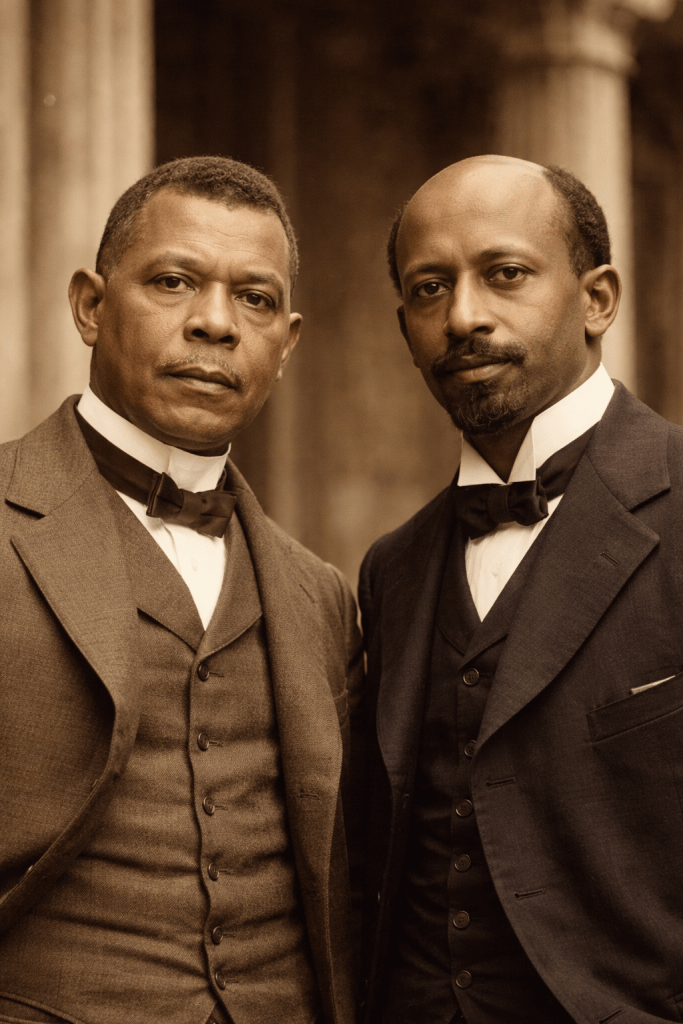
n the long and embattled arc of Black intellectual history, two towering figures emerged at the turn of the twentieth century whose visions would shape the destiny of African Americans for generations: Booker T. Washington and W. E. B. Du Bois. Though contemporaries, their philosophies diverged sharply, reflecting contrasting strategies for racial uplift during the nadir of American race relations. Together, they represent not merely disagreement but the dynamic intellectual tension that propelled Black progress forward.
Booker T. Washington was born into slavery in 1856 in Franklin County, Virginia. Emancipated as a child, he rose from bondage to become one of the most influential Black leaders of his era. His early life of poverty, labor, and illiteracy instilled in him a profound belief in discipline, industrial education, and economic self-sufficiency as the pathway to racial advancement. His autobiography, Up from Slavery, became a testament to perseverance and pragmatism.
Washington’s greatest institutional achievement was the founding of the Tuskegee Institute in Alabama in 1881. There, he emphasized vocational training—carpentry, agriculture, mechanics, domestic science—arguing that economic strength would earn Black Americans respect in a hostile white supremacist society. He believed that dignity could be constructed through labor and ownership, brick by brick.
His philosophy was crystallized in the 1895 Atlanta Exposition Address, often called the “Atlanta Compromise.” In that speech, Washington suggested that Black Americans should temporarily accept segregation and disenfranchisement while focusing on economic development. “Cast down your bucket where you are,” he urged, advocating cooperation with Southern whites in economic matters while avoiding direct agitation for civil rights.
In contrast stood W.E.B. Du Bois, born free in Great Barrington, Massachusetts, in 1868. Du Bois was the first African American to earn a Ph.D. from Harvard University. A scholar of extraordinary brilliance, he mastered history, sociology, economics, and classical studies. His intellect was widely regarded as unmatched among his contemporaries, earning him recognition as one of the greatest thinkers of the twentieth century.
Du Bois rejected Washington’s accommodationist stance. In his seminal work, The Souls of Black Folk, he critiqued what he perceived as Washington’s surrender of political rights. Du Bois introduced the concept of “double consciousness,” describing the psychological tension experienced by African Americans who must navigate a world that views them through the lens of prejudice.
Where Washington championed industrial education, Du Bois advocated for the “Talented Tenth”—the cultivation of a Black intellectual elite who would lead the race toward equality through higher education and political activism. He believed classical education, not merely vocational training, was essential for full citizenship and leadership.
Their disagreement was not simply personal but ideological. Washington emphasized economic gradualism; Du Bois demanded immediate civil rights. Washington sought alliances with white philanthropists and political leaders; Du Bois challenged the very structures of white supremacy. Washington operated behind the scenes, often wielding quiet influence; Du Bois engaged publicly and polemically.
In 1905, Du Bois helped found the Niagara Movement, a precursor to the NAACP, established in 1909. Through this organization, Du Bois became editor of The Crisis, a powerful publication that advocated for anti-lynching legislation, voting rights, and racial justice. His activism laid the groundwork for the modern Civil Rights Movement.
Washington’s influence, however, was equally formidable. He advised U.S. presidents and built networks of Black businesses, schools, and farmers throughout the South. Under his leadership, Tuskegee became a model of Black institutional autonomy. He believed that land ownership, craftsmanship, and financial literacy would fortify Black communities against economic exploitation.
Intellectually, both men were formidable, though in different ways. Washington possessed strategic intelligence and organizational genius. Du Bois embodied scholarly brilliance and philosophical depth. One was a master tactician of survival within oppression; the other a prophetic critic of injustice.
Their views on race also diverged. Washington, shaped by enslavement and Reconstruction’s violent collapse, viewed racial uplift as a long-term project requiring patience and economic stability. Du Bois, shaped by Northern education and exposure to global thought, viewed race as a social construct weaponized by power, demanding immediate dismantling.
Lineage and regional upbringing deeply influenced their perspectives. Washington’s Southern roots, born enslaved, forged a realism rooted in survival. Du Bois, of mixed African and European ancestry, raised in a relatively integrated Northern town, approached race with analytical detachment and global awareness. He later embraced Pan-Africanism, organizing international congresses that connected African diasporic struggles worldwide.
Both men were historically identified and socially classified as Black in the United States, but their ancestry backgrounds were different.
Booker T. Washington was born into slavery in Virginia in 1856. His mother, Jane, was an enslaved African woman. His father was a white man, widely believed to have been a neighboring plantation owner, though Washington never knew him. This means Washington was of mixed African and European ancestry biologically. However, under the racial caste system of the United States—particularly the “one-drop rule”—he was legally and socially defined as Black. Washington identified fully with the Black community and devoted his life to its advancement.
W. E. B. Du Bois was also of mixed ancestry. Born free in Massachusetts in 1868, Du Bois had African, French Huguenot, Dutch, and possibly Native American lineage. He openly acknowledged his multiracial heritage in his autobiographical writings. Despite his partial European ancestry and relatively lighter complexion, Du Bois was socially classified as Black and experienced racial discrimination. He strongly identified as a member of the African American community and became one of its foremost intellectual defenders.
It is important to understand that in 19th- and early 20th-century America, racial identity was not determined by ancestry percentages but by social classification and power structures. The legal doctrine of hypodescent—commonly known as the one-drop rule—assigned anyone with known African ancestry to the Black racial category regardless of admixture.
Genetically speaking, most African Americans descend from a mixture of West and Central African populations with varying degrees of European ancestry due to the history of slavery. Historically speaking, both Washington and Du Bois were Black men operating within and against a racially stratified society that did not recognize “mixed” as a protected or separate political identity.
Du Bois in particular wrestled intellectually with questions of race, ancestry, and identity. In The Souls of Black Folk, he emphasized the social construction of race and the psychological burden imposed upon Black Americans by white supremacy. His mixed heritage did not dilute his commitment to Pan-African solidarity; rather, it sharpened his critique of racial hierarchy.
In summary: biologically, both men had mixed ancestry. Socially, legally, culturally, and politically, they were Black men in America—and they embraced that identity in their scholarship and activism.
Despite their clashes, both men sought the elevation of Black people. Washington feared that agitation would provoke violent backlash. Du Bois feared that silence would entrench permanent subordination. Each perceived the dangers of his time differently, and each responded according to his convictions.
The early twentieth century proved that both strategies held merit. Economic institutions built under Washington provided material foundations for Black communities. Legal activism spearheaded by Du Bois and the NAACP led to landmark challenges to segregation, culminating in victories such as Brown v. Board of Education.
Washington died in 1915, while Du Bois lived until 1963, dying in Ghana on the eve of the March on Washington. Their lifespans bracketed the transformation from Reconstruction’s failure to the threshold of the Civil Rights Movement’s triumphs. History would vindicate aspects of both visions.
Du Bois eventually shifted toward socialism and Pan-African nationalism, critiquing capitalism as a global racial hierarchy. Washington remained committed to American industrial capitalism as a vehicle for Black prosperity. Their economic philosophies reveal deeper tensions about integration, autonomy, and systemic change.
The intellectual rivalry between Washington and Du Bois was not a weakness within Black leadership but a sign of intellectual vitality. Black America was not monolithic; it wrestled with strategy, ethics, and survival in real time. Their debates forced the nation to confront uncomfortable truths about democracy and citizenship.
Today, their legacies continue to shape discussions about education, economic empowerment, protest, and respectability politics. Contemporary debates over vocational training versus liberal arts education echo their arguments. The balance between institutional building and public protest remains central to social justice movements.
To ask who was “smarter” misses the deeper truth. Washington possessed practical genius; Du Bois embodied scholarly brilliance. Intelligence manifested differently in each man, yet both altered the trajectory of history. One built institutions; the other built consciousness.
In the final analysis, Booker T. Washington and W.E.B. Du Bois were not opposites so much as complementary forces within a larger struggle for Black liberation. One carved pathways within the system; the other challenged the system itself. Together, they expanded the intellectual and moral horizons of America, proving that Black thought in the early twentieth century was not only resilient but revolutionary.
References
Du Bois, W. E. B. (1903). The souls of Black folk. A. C. McClurg & Co.
Du Bois, W. E. B. (1968). The autobiography of W. E. B. Du Bois: A soliloquy on viewing my life from the last decade of its first century. International Publishers. (Original work published 1968)
Foner, E. (1988). Reconstruction: America’s unfinished revolution, 1863–1877. Harper & Row.
Harlan, L. R. (1972). Booker T. Washington: The making of a Black leader, 1856–1901. Oxford University Press.
Harlan, L. R. (1983). Booker T. Washington: The wizard of Tuskegee, 1901–1915. Oxford University Press.
Lewis, D. L. (1993). W. E. B. Du Bois: Biography of a race, 1868–1919. Henry Holt.
Lewis, D. L. (2000). W. E. B. Du Bois: The fight for equality and the American century, 1919–1963. Henry Holt.
Logan, R. W. (1954). The betrayal of the Negro: From Rutherford B. Hayes to Woodrow Wilson. Collier Books.
Meier, A. (1963). Negro thought in America, 1880–1915: Racial ideologies in the age of Booker T. Washington. University of Michigan Press.
Washington, B. T. (1901). Up from slavery. Doubleday, Page & Company.
Washington, B. T. (1895). The Atlanta Exposition Address. In L. R. Harlan (Ed.), The Booker T. Washington papers (Vol. 3). University of Illinois Press.
Woodward, C. V. (1955). The strange career of Jim Crow. Oxford University Press.


 THE BROWN GIRL DILEMMA