
Every day, the human spirit stands in a hallway of decision—one door leads to fear and hiding, the other to prayer and spiritual battle.
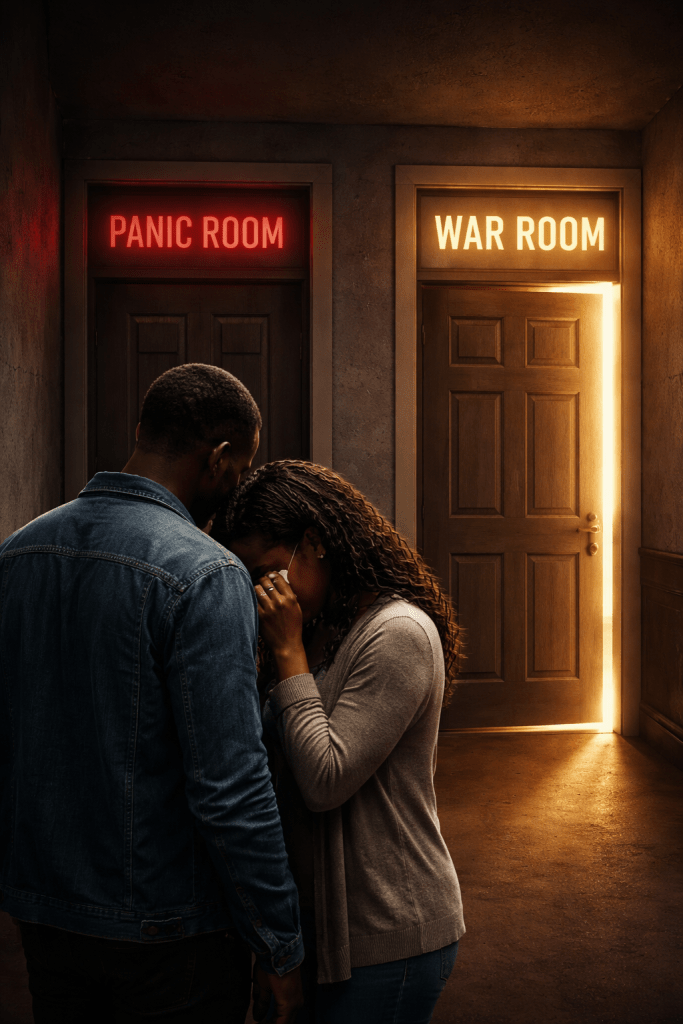
Life often presents itself as a quiet hallway with two doors. The setting is not always visible to the eyes, yet it exists in the interior landscape of the mind and spirit. On one side stands a door labeled the Panic Room. On the other side rests the door to the War Room. Every day, consciously or unconsciously, individuals choose which door they will enter. The choice is not merely emotional but deeply spiritual, reflecting whether a person will surrender to fear or rise in prayerful resistance.
The Panic Room is built from accumulated anxieties. Its walls are constructed from past disappointments, financial worries, relational failures, and the lingering echoes of traumatic experiences. Once inside, the air grows heavy with thoughts such as I cannot handle this, life is too difficult, or nothing will ever change. It is a place designed for hiding rather than healing, for survival rather than transformation.
Fear is often persuasive because it masquerades as protection. The Panic Room promises temporary safety from overwhelming circumstances. Individuals retreat there when the pressures of life seem unbearable—economic instability, broken relationships, health concerns, or uncertainty about the future. In this chamber of dread, the mind rehearses worst-case scenarios, replaying them until anxiety becomes normalized.
Yet the Panic Room rarely offers true refuge. Instead, it traps individuals in cycles of overthinking and emotional paralysis. Problems are magnified, hope diminishes, and darkness settles into the corners of the soul. Fear convinces people that hiding is wisdom when in reality, it is spiritual stagnation.
Psychologically, fear activates survival mechanisms within the brain. Scholars of stress and cognition explain that repeated exposure to perceived threats can trigger chronic anxiety responses (McEwen, 2007). When individuals remain mentally confined within their Panic Rooms, their thoughts begin to revolve around crisis rather than solutions, reinforcing helplessness.
This room is filled with the voices of doubt. One voice says the economy is collapsing and survival is uncertain. Another whispers that relationships will always end in betrayal. Yet another warns that the future holds only disappointment. These voices feed despair until individuals become convinced that darkness is their permanent dwelling place.
In contrast, the War Room stands across the hallway as a radically different environment. This room is not designed for hiding but for spiritual confrontation. Its walls are covered not with fear but with written prayers, declarations of faith, and reminders of divine promises. Within this sacred space, individuals prepare themselves for the battles of life.
The War Room is a metaphor for intentional prayer and spiritual discipline. Instead of retreating from problems, believers enter this room to face them through communion with God. Prayer transforms panic into strategy and anxiety into spiritual focus.
Within the War Room, faith becomes an active force. Scriptures, affirmations, and prayers are placed upon the walls as reminders that spiritual authority exists beyond human weakness. The atmosphere is one of hope rather than despair, expectation rather than defeat.
The Bible repeatedly encourages believers to confront fear through prayer. In Philippians 4:6–7, the apostle Paul instructs believers to present their requests to God rather than surrender to anxiety. Prayer becomes the doorway through which divine peace enters the troubled mind.
Similarly, the War Room embodies the principle of spiritual warfare. The New Testament describes believers as participants in a spiritual struggle against unseen forces of darkness. In Ephesians 6:12, Paul the Apostle explains that the true battle is not merely physical but spiritual in nature.
Prayer in this room is not passive. It is strategic, intentional, and persistent. Individuals bring their fears before God and replace them with declarations of trust. Economic fears become prayers for provision. Relationship struggles become petitions for wisdom and healing.
Over time, the War Room becomes a place of clarity. Instead of magnifying problems, it magnifies divine sovereignty. Fear loses its grip when faith begins to dominate the narrative of the mind.
Psychologists have also observed the stabilizing effects of prayer and meditation on emotional health. Studies suggest that spiritual practices can reduce stress and improve psychological resilience (Koenig, 2012). In this sense, the War Room is both a spiritual and psychological refuge.
The difference between the two rooms is profound. The Panic Room amplifies problems, while the War Room amplifies possibilities. One encourages hiding while the other encourages spiritual engagement. One breeds anxiety while the other cultivates peace.
Importantly, the hallway between the two rooms represents a daily choice. Life constantly places individuals at this intersection. When adversity arises, the question becomes whether one will retreat into fear or rise into prayer.
Many people unintentionally live inside their Panic Rooms for years. They accept anxiety as a permanent condition rather than recognizing the open door to spiritual empowerment. Yet the War Room remains available to anyone willing to step inside.
Faith does not eliminate challenges, but it changes the posture with which individuals face them. Instead of asking, “How will I survive this?” the believer begins to ask, “How will God work through this?”
Peace eventually fills the War Room because prayer invites divine presence. Fear loses its authority where trust resides. What once felt overwhelming becomes manageable through spiritual perspective.
Ultimately, life presents two doors every day. One leads to panic, isolation, and despair. The other leads to prayer, courage, and spiritual victory. The hallway remains the same, but the choice of room determines the atmosphere of the soul.
The profound truth is that individuals choose their rooms daily. Fear invites them into hiding, but faith invites them into battle. The Panic Room may feel familiar, yet the War Room holds the power to transform fear into peace.
References
Koenig, H. G. (2012). Religion, spirituality, and health: The research and clinical implications. ISRN Psychiatry. https://doi.org/10.5402/2012/278730
McEwen, B. S. (2007). Physiology and neurobiology of stress and adaptation. Physiological Reviews, 87(3), 873–904.
The Holy Bible, King James Version. (1769/2017). Cambridge University Press.

 THE BROWN GIRL DILEMMA