Category Archives: economics

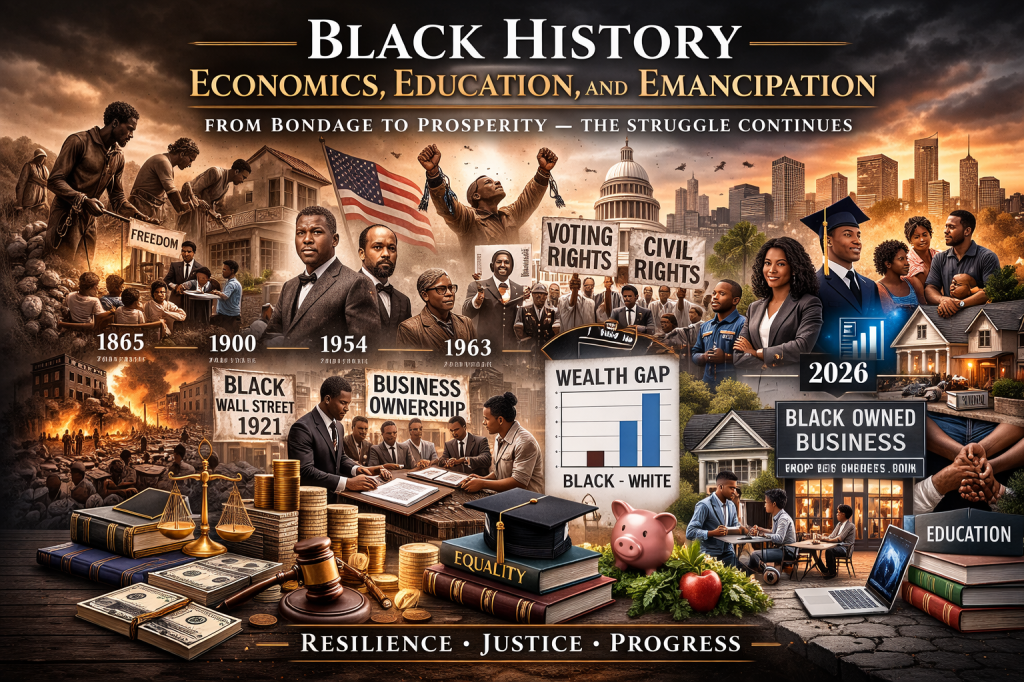
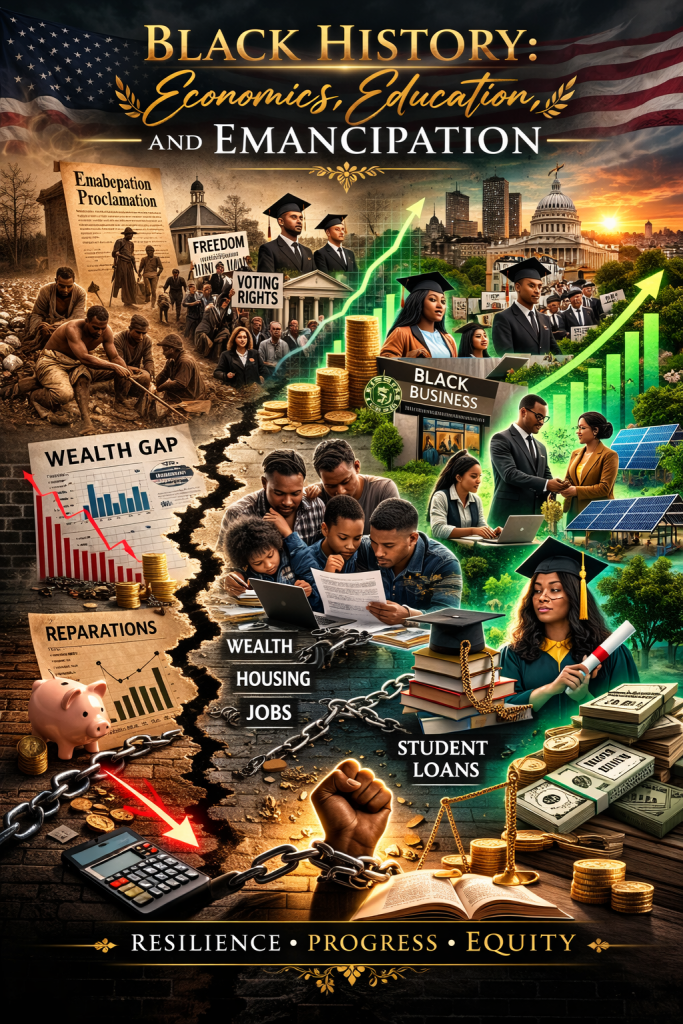
Black History: Economics, Education, and Emancipation.

Black history in the United States is not merely a litany of events; it is the story of a people’s persistent struggle for dignity, self-determination, and economic justice. From the systemic deprivations of slavery to the present day, the economic condition of Black Americans has been profoundly shaped by centuries of exclusion, exploitation, and resistance (McKinsey & Company, 2025). The interplay of economic opportunity, access to education, and emancipation has defined both individual lives and collective possibilities.

The legacy of slavery and Reconstruction laid the groundwork for persistent racial inequalities. Even at the formal end of slavery in 1865, Black Americans held virtually no wealth; over a century and a half later, that gap persists. Black households possess only a small fraction of national wealth compared with White households, illustrating how historical racial injustice still translates into economic precarity (LendingTree, 2026; Brookings Institution, 2024).

Structural discrimination continues to influence economic outcomes through labor markets that systematically disadvantage Black workers. Black Americans are overrepresented in lower-wage occupations and underrepresented in higher-paying managerial and professional roles, reinforcing income inequality (McKinsey & Company, 2019). This occupational segregation, rooted in historical discrimination, limits economic mobility and widens the wealth gap across generations.

Education has long been touted as a pathway to economic advancement, yet disparities in educational access and outcomes persist. Predominantly Black school districts receive significantly less funding than predominantly White districts, perpetuating cycles of unequal opportunity and limiting access to high-quality schooling (Black Wall Street Organization, 2025). In this context, education becomes not simply a means of individual uplift but a battleground for equity.

Higher education, while expanding enrollment for Black students over recent decades, also exposes students to disproportionate levels of debt. Black college graduates carry higher student loan burdens than their White counterparts, constraining their capacity to accumulate wealth through homeownership, savings, and investments (Black Wall Street Organization, 2025). Thus, the very institution that promises empowerment can become another vector of economic strain.

Despite the barriers, African Americans have demonstrated remarkable resilience. Historic models of Black economic self-help—mutual aid societies, Black-owned banks, business collectives, and cooperative enterprises—reflect a long tradition of economic self-determination. Yet these efforts have often faced hostile responses, from discriminatory lending practices to overt violence, as in the destruction of Black Wall Street in 1921 (Black Wall Street Organization, 2025).

Homeownership remains a key indicator of wealth building in America, yet the Black homeownership rate lags significantly behind that of White Americans, reflecting a century of housing discrimination and unequal access to mortgage capital (Washington Post, 2026). Even when Black families do own homes, properties often appraise for lower values due to enduring patterns of segregation and appraisal bias, further limiting generational wealth accumulation.

As of recent data, Black homeownership stands well below the rate for White families, and median wages for Black workers are substantially lower across industries. Black workers commonly earn about 70 percent of what White workers earn in comparable sectors, underscoring persistent wage disparities (LendingTree, 2026). These gaps are not accidental; they reflect longstanding structural inequities embedded in the economy.

Economic Data Tables: Black–White Disparities (2025–2026)

Median Household Income & Wealth

IndicatorBlack HouseholdsWhite HouseholdsSource
Median Household Income (2024)~$56,020~$88,010LendingTree (2026)
Median Household Wealth (% of U.S. total)~3.4%~83.5%LendingTree (2026)
Racial Wealth Ratio (White : Black)~8:1ZipDo (2026)
Median Wealth (Black vs White)~$24,100 vs $188,200ZipDo (2026)

Employment & Labor Market Disparities

IndicatorBlack WorkersWhite WorkersSource
Unemployment Rate (Q3, 2025)~7.8%~3.8%LendingTree (2026)
Black Unemployment (Nov 2025 spike)8.3%Reuters (2025)
Earnings Gap (Median wages)~70–75% of White wages100%WorldMetrics (2026)

Homeownership & Wealth Building

IndicatorBlack HouseholdsWhite HouseholdsSource
Homeownership Rate (2026)~43.6%~70.3%Washington Post (2026)
Homeownership Gap (Historical Persistence)Negligible improvement over decadesWashington Post (2026)
Access to Favorable Mortgage TermsHigher denial & biasLower denialLendingTree (2026)

These data illustrate several core structural truths:

  • Persistent Racial Wealth Gap: Black households hold a disproportionately small share of U.S. total wealth (about 3.4%), even though Black Americans represent ~13–14% of the population. Meanwhile, White households control over 80% of the national wealth. Economic inequality is thus not only about income but also about historical asset accumulation and generational transfer of wealth.
  • Income Inequality Across Sectors: Black workers earn approximately 70–75 cents for every dollar earned by White workers across major sectors, with the gap widening in higher‑paying occupations.
  • Employment Barriers: The unemployment rate for Black Americans in late 2025 and early 2026 was more than double the national rate, a persistent pattern indicating structural labor market discrimination and vulnerability during economic contractions.
  • Homeownership & Wealth Building: Black homeownership remains far below White rates, with only about 44% of Black households owning homes — a primary vehicle for middle‑class wealth — compared with around 70% of White households. Appraisal bias, mortgage denial disparities, and historical segregation play significant roles in this enduring gap

The wealth gap also manifests in broader national terms: White Americans hold the vast majority of U.S. wealth, while Black Americans hold only a small sliver despite representing a significant portion of the population (LendingTree, 2026). This imbalance illustrates how historical exclusion has compounded over time, making wealth accumulation a generational challenge.

In the labor market of 2025–2026, the unemployment rate for Black Americans has risen disproportionately higher than the national average, signaling troubling economic trends that scholars and civil rights analysts describe as a “Black recession.” Black unemployment climbed to levels nearly double those of White workers amid broader economic slowdown and policy reversals that eroded programs designed to address racial inequality (State of the Dream Report, 2026).

Economic policy and labor market shifts have gutted diversity and inclusion initiatives in federal agencies, removing support mechanisms that previously helped mitigate racial disparities in employment. As a result, Black workers have borne the brunt of federal job cuts, particularly Black women, who historically are overrepresented in public sector employment (State of the Dream Report, 2026).

The racial wealth gap is not simply an issue of income but of cumulative assets: investments, property equity, business ownership, and inheritance. White families disproportionately benefit from stock market gains and home equity appreciation, while Black families have historically had limited access to these primary vehicles of wealth growth (Investopedia, 2025). This structural imbalance inhibits intergenerational economic security.

The persistence of these disparities challenges the myth that formal emancipation was sufficient to equalize economic outcomes. Rather, emancipation began a long struggle against structural barriers that have constrained Black economic agency. This ongoing reality reveals that legal freedom without equitable economic opportunity remains incomplete.
Economic suffering among Black Americans in 2026 highlights the continuing legacy of these structural inequalities. Rising unemployment, growing wealth concentration among white households, and barriers to capital for Black entrepreneurs all point to an economy in which racial disparities remain entrenched. Scholars argue that the effects of these disparities are so profound that closing the racial wealth gap could significantly benefit the U.S. economy as a whole (McKinsey & Company, 2019).

Educational disparities remain deeply intertwined with economic outcomes. Black students often attend schools with fewer resources, lower teacher salaries, and less access to advanced coursework, hindering academic achievement and future earnings potential. These inequities underscore how education and economic status are mutually reinforcing.

At the same time, economic inequality among Black communities intersects with health, housing, and social stability. The lack of access to quality healthcare increases medical expenses and economic vulnerability, and housing instability remains a persistent threat for families with limited economic resources (Black Wall Street Organization, 2025).

Yet, in spite of systemic barriers, Black economic empowerment initiatives continue to evolve. Black-owned businesses, though smaller and less capitalized than their White counterparts, represent a significant force for community development. Support for entrepreneurship and access to capital remain key strategies for building Black economic resilience (Black Wall Street Organization, 2025).

Historically and in the present day, education has served as both a means of empowerment and a site of struggle. The promise of education as a path to economic freedom remains contested, as disparities in funding, access, and outcomes continue to shape life chances for Black Americans.

To confront the entrenched economic disparities of 2026 and beyond, scholars and policy advocates emphasize the need for structural reforms that address labor market discrimination, broaden access to capital, and ensure equitable educational opportunity. Without such reforms, the legacy of racial economic inequality will persist, limiting the full realization of emancipation.

In sum, Black history—rooted in economics, education, and emancipation—is a testament to both the enduring injustice of systemic exclusion and the persistent struggle for full economic citizenship. The story of Black America’s economic journey reveals deep structural challenges but also the resilience and ingenuity that have propelled this nation toward a more inclusive future.


References

Brookings Institution. (2024). Black wealth is increasing, but so is the racial wealth gap. Retrieved from https://www.brookings.edu/articles/black-wealth-is-increasing-but-so-is-the-racial-wealth-gap/

LendingTree. (2026). Snapshots of Black and White disparities in income, wealth, and employment. Retrieved from https://www.lendingtree.com/debt-consolidation/black-and-white-disparities-study/

McKinsey & Company. (2019). The economic state of Black America: What is and what could be. Retrieved from https://www.mckinsey.com/featured-insights/diversity-and-inclusion/the-economic-state-of-black-america-what-is-and-what-could-be

State of the Dream Report. (2026). From regression to signs of a Black recession. The EDU Ledger. Retrieved from https://www.theeduledger.com/demographics/african-american/article/15815124/state-of-the-dream-2026-from-regression-to-signs-of-a-black-recession

The Washington Post. (2026). Why does Black homeownership lag White ownership in every major city? Retrieved from https://www.washingtonpost.com/business/2026/02/21/black-homeownership-singletary/

The Economics of Beauty Bias

Physical appearance has long influenced social and economic outcomes, but the intersection of beauty and economics extends beyond superficial preference. Scholars have demonstrated that “beauty bias” affects employment, wages, promotions, and even perceptions of competence. Those who conform more closely to socially sanctioned standards of attractiveness often receive tangible economic advantages, while those who do not face systemic disadvantages. Thus, beauty is not merely aesthetic — it functions as a form of social capital with measurable economic consequences.

Studies in labor economics have consistently identified a “beauty premium,” wherein attractive individuals earn higher wages and experience faster career advancement than their less conventionally attractive peers. This phenomenon transcends gender, though its magnitude is often greater for women due to historical gendered expectations and the commodification of female appearance. Employers’ implicit biases reinforce these disparities, translating societal beauty norms into financial outcomes.

The mechanisms behind beauty bias are multifaceted. Cognitive psychology suggests that physical attractiveness triggers a “halo effect,” where positive traits are inferred from appearance. Attractive individuals are often perceived as more competent, trustworthy, and socially adept. These perceptions influence hiring decisions, client relations, and peer evaluations, creating a feedback loop in which beauty becomes both a signal and a form of economic leverage.

Beauty bias is also intertwined with race and ethnicity. Historical and contemporary standards have privileged Eurocentric features, marginalizing people of color and reinforcing structural inequalities. For Black women, this manifests as compounded discrimination: societal devaluation of darker skin, hair texture, or features intersects with gendered expectations, limiting access to economic opportunities while amplifying pressure to conform to dominant ideals.

The media and advertising industries exacerbate economic disparities tied to appearance. Representation in fashion, television, and corporate imagery often favors specific beauty standards, signaling which appearances are socially desirable and economically valuable. This systemic visibility shapes consumer behavior, career aspirations, and self-perception, further reinforcing the economic advantages of beauty.

In addition to income effects, beauty bias influences access to professional networks, mentorship, and career capital. Attractive individuals are more likely to receive invitations to key social and professional spaces, creating opportunities for skill development, sponsorship, and advancement. Conversely, those who diverge from conventional standards may face subtle exclusion, limiting both tangible and intangible resources that drive career success.

The consequences of beauty bias extend beyond the individual, affecting societal efficiency and equity. Organizations that reward appearance over merit risk underutilize talent, reducing productivity and innovation. Furthermore, beauty-based economic stratification perpetuates social hierarchies, reinforcing inequality across race, class, and gender lines. Addressing this bias is therefore not only a moral imperative but also an economic one.

Policy interventions and organizational strategies can mitigate beauty bias. Blind hiring processes, diversity training, and structured evaluation criteria reduce the influence of appearance in decision-making. Similarly, promoting diverse representations of beauty challenges cultural norms and expands the range of socially and economically valued appearances, reducing systemic inequities.

From a theoretical standpoint, beauty bias illustrates the intersection of sociology, economics, and psychology. It demonstrates how social constructs translate into material outcomes and highlights the embeddedness of cultural values within economic systems. Appearance, in this framework, is both symbolic and instrumental: a social signal with quantifiable consequences.

Ultimately, the economics of beauty bias reveals the pervasive power of appearance in shaping opportunity, wealth, and social mobility. Recognizing and addressing these dynamics is critical for creating equitable systems in which merit, skill, and character — rather than conformity to aesthetic ideals — determine success. Beauty, as a form of economic capital, must be understood not as personal preference but as a structural force with measurable consequences.


References

Hamermesh, D. S., & Biddle, J. E. (1994). Beauty and the labor market. American Economic Review, 84(5), 1174–1194.

Kelley, H. H. (1973). The processes of causal attribution. American Psychological Association.

Langlois, J. H., Kalakanis, L., Rubenstein, A. J., Larson, A., Hallam, M., & Smoot, M. (2000). Maxims or myths of beauty? A meta-analytic and theoretical review. Psychological Bulletin, 126(3), 390–423.

Moss, P., & Tilly, C. (2001). Stories employers tell: Race, skill, and hiring in America. Russell Sage Foundation.

Stavins, R., & Hamermesh, D. (2017). Gender, attractiveness, and labor market outcomes: Cross-country evidence. Journal of Economic Behavior & Organization, 140, 232–252.

Wolf, N. (1991). The beauty myth: How images of beauty are used against women. HarperCollins.

Fiske, S. T., Cuddy, A. J. C., & Glick, P. (2007). Universal dimensions of social cognition: Warmth and competence. Trends in Cognitive Sciences, 11(2), 77–83.

Black History: Black Millionaires They Tried to Erase from History.

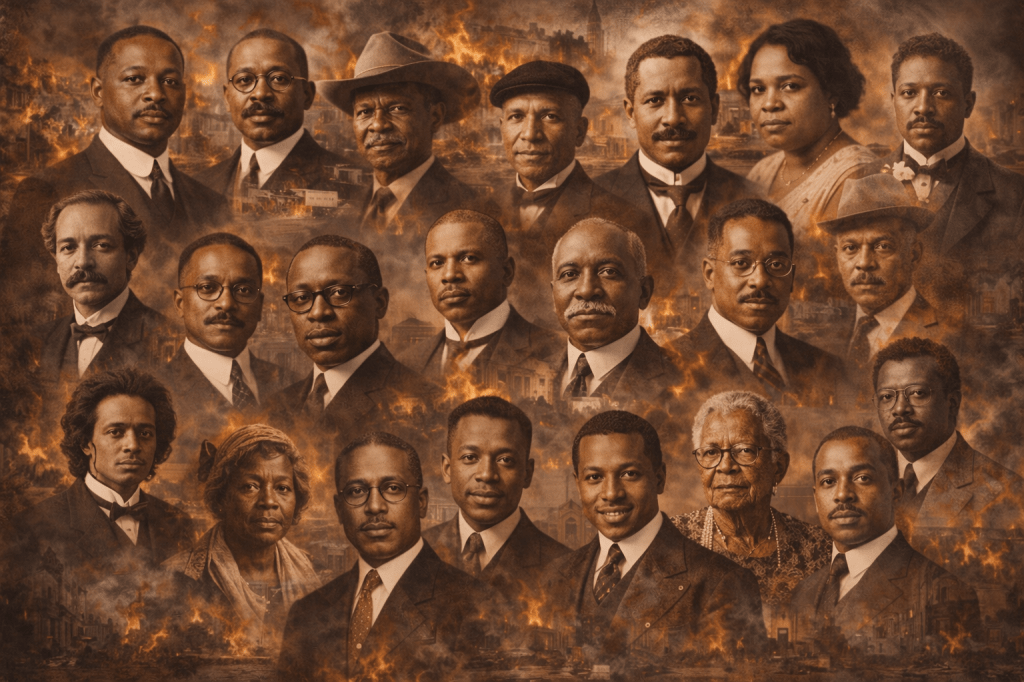
In early 20th‑century America, Black entrepreneurs in segregated communities defied racism by generating unprecedented wealth. These men and women built thriving businesses, owned property, and created entire economic ecosystems — only to have their legacies diminished, erased, or violently destroyed by systemic racism and white supremacist violence.

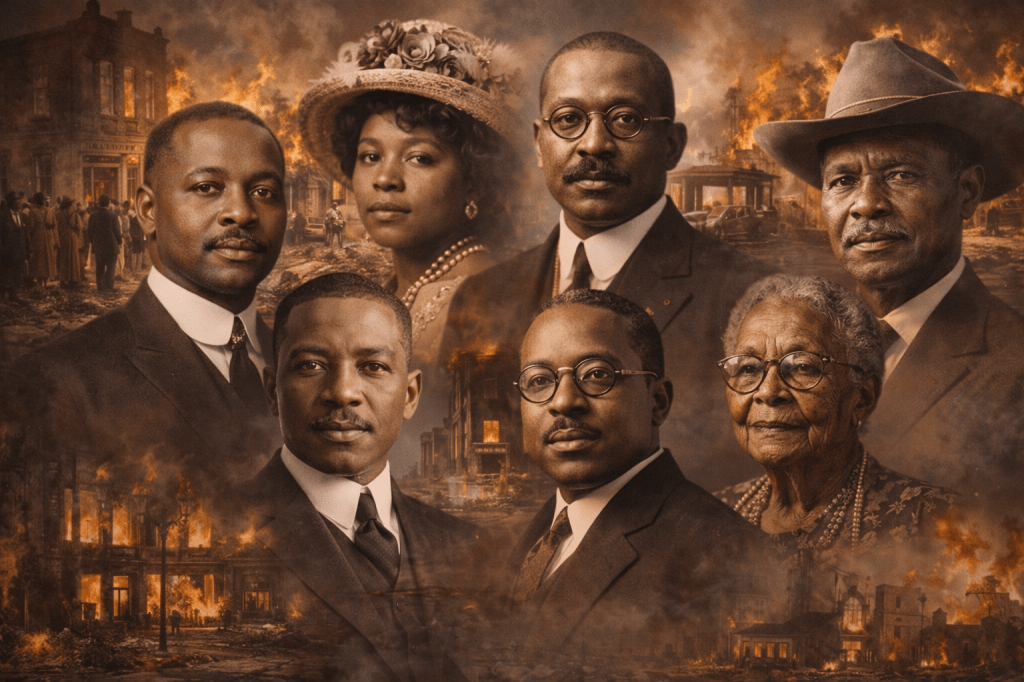
In Tulsa, Oklahoma, the Greenwood district — known as “Black Wall Street” — was one of the most remarkable examples of Black prosperity in American history. Founded by visionary Black businessmen and professionals, Greenwood became a symbol of independence, economic self‑sufficiency, and community resilience.

Among Greenwood’s earliest millionaires was O.W. Gurley, a real‑estate developer and entrepreneur. Born to formerly enslaved parents in Alabama, Gurley moved to Tulsa and purchased land designated for Black ownership. He built hotels, apartment buildings, a grocery store, and sponsored other local businesses, accumulating an estimated net worth that translated into the millions in today’s dollars.

Gurley’s success helped inspire others to invest in Greenwood. J.B. Stradford, another eminent figure, was the son of an emancipated slave who became a lawyer, real‑estate magnate, and hotelier. His crowning achievement was the Stradford Hotel, the largest Black‑owned hotel in the United States at the time. It offered luxury services equal to those in white Tulsa and hosted a thriving social life, attracting wealthy travelers and local elites.

John and Loula Williams were another Black power couple in Greenwood. They owned multiple businesses — including the Dreamland Theatre, a confectionary, and a rooming house — and became among the wealthiest Black residents. Loula was a partner in these ventures, showing how women also played central roles in building Black wealth.

Greenwood was far more than a collection of storefronts: it had its own bank, schools, hospital, newspaper, and even private transportation networks, all built and operated by Black entrepreneurs. The Tulsa Star, founded by A.J. Smitherman, became a prominent voice advocating civil rights, economic empowerment, and community solidarity.

Despite this economic miracle, Greenwood was targeted by white supremacists fearful of Black success. From May 31 to June 1, 1921, a white mob attacked the district in what is now known as the Tulsa Race Massacre, burning businesses, homes, and churches to the ground. Up to 300 Black residents were killed and roughly 1,200 homes destroyed. This coordinated assault erased generational wealth in a matter of hours.

The destruction of Greenwood exemplifies how racial violence was used to prevent Black Americans from maintaining wealth and influence. Millionaires like Gurley and Stradford lost everything; there was no restitution for survivors or descendants for decades. Their stories, once widely known locally, faded from mainstream historical memory.

Beyond Tulsa, there were other Black millionaires whose achievements were overshadowed or forgotten due to systemic racism. Jake Simmons Jr., an oilman from Oklahoma, became one of the most successful Black oil entrepreneurs in the mid‑20th century, partnering with major petroleum companies and opening opportunities in Africa’s energy sector. His rise showcased Black leadership in the global industry, yet his legacy remains underrecognized.

Black businesspeople in areas outside Tulsa also built considerable wealth during Jim Crow. In many segregated towns and cities, Black physicians, lawyers, educators, and merchants created thriving practices serving Black customers, generating stable incomes and propelling local economies. However, many were omitted from national business histories, minimized by the dominant narrative.

Black Millionaires Who Were Erased or Forgotten

  1. O.W. Gurley – Real estate developer and founder of Greenwood, Tulsa (“Black Wall Street”). Built hotels, grocery stores, and a thriving Black community before the Tulsa Race Massacre destroyed his fortune.
  2. J.B. Stradford – Lawyer and entrepreneur; owner of the Stradford Hotel, the largest Black-owned hotel in the U.S. before 1921. Lost property in the Tulsa Race Massacre.
  3. John and Loula Williams – Business power couple in Greenwood, owning multiple enterprises including theaters, confectionaries, and rooming houses.
  4. A.J. Smitherman – Publisher of the Tulsa Star, the influential newspaper in Greenwood that advocated Black economic empowerment and civil rights.
  5. Jake Simmons Jr. – Oklahoma oil tycoon and international businessman; instrumental in opening opportunities in Africa’s oil sector.
  6. Moses Austin – Early 19th-century businessman who invested in land and local enterprises; lesser-known due to records focusing on white counterparts.
  7. Paul Cuffe – African American entrepreneur and shipowner in the late 18th and early 19th centuries; financed Black migration to Sierra Leone and traded globally.
  8. Madam C.J. Walker – First female self-made millionaire in America through haircare and beauty products; her story was overshadowed for decades despite her philanthropy.
  9. Robert Reed Church – Memphis real estate mogul; accumulated wealth through investments and urban development in the post-Civil War South.
  10. Anthony Overton – Entrepreneur and publisher; owned the Overton Hygienic Company and the Chicago Bee newspaper.
  11. Alonzo Herndon – Founder of Atlanta Life Insurance Company; born enslaved and became one of the wealthiest Black men in the U.S.
  12. Norbert Rillieux – Inventor and businessman; revolutionized sugar refining and built wealth that was largely unrecognized in mainstream history.
  13. John H. Johnson – Founder of Johnson Publishing Company (Ebony, Jet); a 20th-century millionaire whose financial influence in media is often underappreciated.
  14. Viola Fletcher – Survivor and symbolic figure of Tulsa’s Greenwood, representing families who had generational wealth destroyed in the massacre.
  15. Samuel Coleridge-Taylor (U.S. connections) – Composer and businessman in music ventures; recognized in Europe but often omitted from U.S. economic history discussions.
  16. Mary Ellen Pleasant – Wealthy Black entrepreneur and philanthropist in San Francisco during the 19th century; aided civil rights causes but was historically obscured.
  17. Madison Jones – Oil and landowner in the early 20th century; wealth erased through discriminatory policies and lack of historical recognition.
  18. John Merrick – Founder of North Carolina Mutual Life Insurance Company; amassed wealth but is often only recognized regionally.
  19. Robert W. Johnson – Entrepreneur in early 1900s Chicago; built wealth in real estate and business before being written out of mainstream histories.
  20. Frederick McGhee – Lawyer and businessman; helped build economic infrastructure for Black communities in Minneapolis but largely forgotten in national narratives.

The erasure of these figures was not accidental. Throughout U.S. history, Black success has been met with legislative discrimination, economic exclusion, violence, and historical suppression. After the massacre, Greenwood’s rebuilt community prospered again for decades — only to be dismantled a second time in the mid‑20th century through “urban renewal” projects and highway construction that obliterated much of the neighborhood.

The consequences of this erasure persist. Without preservation and education about these Black millionaires, their contributions are excluded from textbooks, newspapers, and national consciousness. This has furthered false narratives that Black communities did not achieve economic success prior to the Civil Rights Movement.

Historians and activists today work to recover these stories, ensuring that Gurley, Stradford, the Williamses, Simmons, and many more are acknowledged as pioneers of Black wealth in America. Their legacy demonstrates profound resilience and innovation under adversity.

Black Wall Street’s destruction also disrupted generational wealth transfer; properties and businesses never regained their pre‑1921 value, and families were denied inheritance opportunities that could have sustained future prosperity.

In recent years, Tulsa has taken steps to confront its history. Reparations efforts, educational initiatives, and public memorialization aim to restore recognition for Greenwood’s lost entrepreneurs and honor survivors like Viola Fletcher, who testified about the massacre’s enduring impact.

The story of these Black millionaires is a reminder that racial oppression targeted not only individual lives but collective economic power. Their erasure from history reflects broader social resistance to acknowledging Black achievement.

Engaging with these histories allows for a more accurate understanding of American capitalism, one that includes both Black contributions and the violence used to undermine them.

Recognizing Black millionaires lost to history also challenges contemporary narratives about wealth, race, and opportunity, showing clearly that Black success was possible — and existed — long before today’s conversations about equity and inclusion.

These narratives also inspire modern generations of Black entrepreneurs, emphasizing the importance of legacy, community investment, and perseverance despite systemic barriers.

Understanding the erased histories of Black millionaires is vital not only for historical accuracy but for framing present discussions about wealth inequality, reparations, and racial justice in the United States.


References

National Geographic Society. (n.d.). Before the Tulsa Race Massacre, Black business was booming in Greenwood. National Geographic. https://www.nationalgeographic.com/history/history-magazine/article/before-tulsa-race-massacre-black-business-booming-greenwood

History.com Editors. (n.d.). 9 Entrepreneurs Who Helped Build Tulsa’s “Black Wall Street”. HISTORY. https://www.history.com/articles/black-wall-street-tulsa-visionaries

CNBC. (2020). What Is “Black Wall Street”? History of the community and its massacre. CNBC. https://www.cnbc.com/2020/07/04/what-is-black-wall-street-history-of-the-community-and-its-massacre.html

ABC7 New York. (n.d.). Tulsa Race Massacre: Story behind Black Wall Street destroyed by racist mob. https://abc7ny.com/tulsa-race-massacre-1921-black-wall-street-greenwood/10707747

Wikipedia contributors. (n.d.). Greenwood District, Tulsa. Wikipedia. https://en.wikipedia.org/wiki/Greenwood_District%2C_Tulsa

Wikipedia contributors. (n.d.). Jake Simmons. Wikipedia. https://en.wikipedia.org/wiki/Jake_Simmons

Wikipedia contributors. (n.d.). Viola Fletcher. Wikipedia. https://en.wikipedia.org/wiki/Viola_Fletcher

From Sharecropping to Stock Markets: Redefining Black Economic Power Through Land Ownership, Financial Literacy, and Housing Justice.

Photo by Anna Nekrashevich on Pexels.com

The trajectory of Black economic empowerment in America has been profoundly shaped by historical and contemporary policies that have systematically marginalized African American communities. From the exploitative practices of sharecropping to the discriminatory housing policies of redlining, these structural inequities have hindered wealth accumulation and economic mobility for Black families. This essay explores the evolution of Black economic experiences, emphasizing the pivotal roles of land ownership, financial literacy, and equitable housing policies in dismantling the persistent chains of poverty.


The Legacy of Sharecropping

Following the Civil War, many formerly enslaved African Americans entered into sharecropping agreements, a system that ostensibly offered economic independence but often resulted in perpetual indebtedness. Sharecroppers typically lacked access to credit and were forced to purchase supplies from landowners at inflated prices, trapping them in cycles of debt and poverty. This system effectively replaced slavery with a form of economic exploitation that deprived Black families of the opportunity to accumulate wealth and assets.


Redlining and Housing Discrimination

In the 1930s, the federal government, through the Home Owners’ Loan Corporation (HOLC), implemented redlining practices that systematically denied mortgage loans to residents of predominantly Black neighborhoods. These areas were deemed “hazardous” due to racial composition, leading to disinvestment and the stifling of economic growth. Despite the Fair Housing Act of 1968, the legacy of redlining persists, with many formerly redlined neighborhoods continuing to experience lower property values and limited access to financial resources.


The Importance of Land Ownership

Land ownership has historically been a cornerstone of wealth accumulation in America. For Black families, acquiring land has been both a symbol of freedom and a means of economic stability. However, discriminatory practices such as land theft, legal barriers, and lack of access to capital have impeded Black ownership. Efforts to reclaim and preserve Black-owned land are crucial in reversing historical injustices and fostering economic independence within the community.


Financial Literacy as Liberation

Financial literacy is an essential tool for economic empowerment. Understanding financial principles, such as budgeting, investing, and credit management, equips individuals to make informed decisions that can lead to wealth accumulation. Initiatives aimed at enhancing financial literacy within Black communities are vital in breaking the cycles of poverty and fostering long-term economic stability.


The Role of Black-Owned Banks

Black-owned banks have played a significant role in providing financial services to underserved communities. By offering loans, credit, and financial education, these institutions have been instrumental in supporting Black entrepreneurship and homeownership. Strengthening and expanding Black-owned banks can enhance economic opportunities and contribute to the dismantling of systemic financial inequities.


Healthcare Inequities and Economic Impact

Access to quality healthcare is a fundamental aspect of economic well-being. However, Black communities often face disparities in healthcare access and outcomes, stemming from factors such as economic instability, discrimination, and lack of insurance. Addressing these healthcare inequities is essential for improving the overall economic health of Black families and communities.


Educational Disparities and Economic Mobility

Education serves as a pathway to economic mobility. Yet, Black students frequently encounter disparities in educational resources, quality, and outcomes. These educational inequities limit career opportunities and perpetuate cycles of poverty. Reforming educational systems to ensure equitable access and quality education is critical for fostering economic advancement in Black communities.


The Interconnection of Housing, Wealth, and Health

The intersections of housing, wealth, and health are profound. Stable and affordable housing contributes to better health outcomes and economic stability. Conversely, housing instability can lead to poor health and economic insecurity. Policies that promote affordable housing and address housing discrimination are vital in improving the economic and health prospects of Black families.


Policy Recommendations for Economic Equity

To address the systemic barriers hindering Black economic empowerment, comprehensive policy reforms are necessary. These should include:

  • Implementing reparations programs to compensate for historical injustices.
  • Enforcing fair housing laws to eliminate discriminatory practices.
  • Investing in education and workforce development to enhance economic opportunities.
  • Supporting Black-owned businesses and financial institutions to foster community wealth.

Conclusion

The journey from sharecropping to stock markets reflects the resilience and determination of Black Americans in the face of systemic oppression. By prioritizing land ownership, financial literacy, and equitable housing policies, society can work towards dismantling the enduring legacies of economic injustice. Empowering Black communities economically is not only a matter of rectifying historical wrongs but also of building a more equitable and prosperous future for all.


References

  • “Homeownership, Racial Segregation, and Policies for Racial Wealth Equity.” Brookings Institution. [link]
  • “Systemic Inequality: Displacement, Exclusion, and Segregation.” Center for American Progress. [link]
  • “How Sharecropping Robbed Black Americans of Generational Wealth.” Medium. [link]
  • “Racism, Inequality, and Health Care for African Americans.” The Century Foundation. [link]
  • “The Widening Racial Wealth Divide.” The New Yorker. [link]

Black Economics: The Legacy of Black Economics & Excellence.

This photograph is the property of its respective owners. No copyright infringement intended.

Black economics is deeply intertwined with the history, resilience, and ingenuity of Black communities worldwide. From the era of enslavement to the present, Black individuals have consistently demonstrated resourcefulness and entrepreneurial spirit, often in the face of systemic oppression (Wilson, 2012).

The legacy of Black excellence is rooted in survival. During slavery, enslaved Africans developed economic skills, such as agriculture, carpentry, and trade, which allowed them to generate personal wealth and support their communities under oppressive conditions (Berlin, 2003).

Following emancipation, Black communities sought economic autonomy through the establishment of businesses, banks, and cooperative enterprises. This era saw the rise of Black Wall Streets, with Tulsa’s Greenwood District being the most notable example, showcasing a thriving economy built entirely by Black hands (Harris, 2002).

Despite violent disruptions and discriminatory policies, Black entrepreneurs continued to innovate. Figures like Madam C.J. Walker, the first female self-made millionaire in America, demonstrated that economic success could serve as a platform for empowerment and societal change (Snyder, 1989).

Education has consistently been a cornerstone of Black economic advancement. Historically, Black communities prioritized schools, literacy, and vocational training as tools to break cycles of poverty and build generational wealth (Anderson, 1988).

Black excellence in economics is not confined to the United States. Across Africa and the Caribbean, Black-owned enterprises and cooperative movements have contributed significantly to regional economic growth, reinforcing the global nature of Black entrepreneurial achievement (Agyeman, 2015).

Modern Black businesses encompass a wide spectrum—from fashion and entertainment to technology and finance. These ventures demonstrate innovation and cultural influence while creating employment opportunities within and beyond Black communities (Brown & Dancy, 2018).

Black women have played a pivotal role in this economic legacy. Entrepreneurs like Oprah Winfrey and Rihanna have leveraged creativity and business acumen to build billion-dollar enterprises, inspiring future generations to pursue financial independence (Hooks, 2000).

The historical challenges Black entrepreneurs face are significant, including systemic racism, redlining, limited access to capital, and discriminatory banking practices. Yet, resilience and community solidarity have enabled many to thrive despite these barriers (Oliver, 2006).

Community-based economic strategies, such as mutual aid societies, credit unions, and co-ops, have historically fortified Black communities. These initiatives fostered financial literacy, collective wealth, and intergenerational support, laying the foundation for sustainable growth (Gills, 2009).

Black excellence is also reflected in professional achievement and leadership. Black economists, financiers, and business leaders have challenged stereotypes, influencing policy and demonstrating that economic mastery is not bound by race (Herring & Henderson, 2012).

Cultural entrepreneurship—where art, music, and media are monetized—has created pathways for wealth that simultaneously celebrate Black heritage. Hip-hop, for instance, became both a cultural and economic phenomenon, exemplifying the fusion of creativity and business (Chang, 2005).

Philanthropy remains a critical aspect of Black economic legacy. Historically, successful Black entrepreneurs have reinvested in their communities, funding education, healthcare, and social programs, thus reinforcing cycles of empowerment (Darity & Hamilton, 2012).

The Black economic experience highlights the importance of generational wealth. Building assets, investing in property, and developing financial literacy are critical strategies that sustain Black families and communities over time (Shapiro, 2004).

Modern initiatives, such as Black-owned banks and venture capital funds, aim to address historic inequities by providing capital and resources to underserved Black entrepreneurs, reflecting a continued commitment to economic excellence (Brown & Dancy, 2018).

Education, mentorship, and networking remain vital for sustaining Black economic growth. Programs that connect emerging entrepreneurs with experienced leaders cultivate both skills and confidence, ensuring the next generation carries forward the legacy of excellence (Agyeman, 2015).

Despite systemic barriers, Black communities continue to innovate. Technology startups, e-commerce platforms, and creative industries are areas where Black excellence is visible, challenging conventional economic paradigms and asserting influence in global markets (Harris, 2002).

Black economic thought also intersects with activism. Advocates for reparations, equitable lending practices, and fair labor policies aim to dismantle structures that inhibit Black wealth accumulation, reinforcing that economic empowerment is inseparable from social justice (Darity & Hamilton, 2012).

The legacy of Black excellence in economics is not solely measured in dollars. It is measured in resilience, knowledge, cultural influence, and the ability to transform adversity into opportunity. This holistic perspective underscores the enduring power of Black economic agency (Wilson, 2012).

Ultimately, celebrating Black economics is a recognition of a legacy forged through ingenuity, perseverance, and vision. It is a testament to the capacity of Black communities to create wealth, sustain culture, and inspire future generations toward both economic and personal excellence (Hooks, 2000).


References

Agyeman, J. (2015). Black entrepreneurship in Africa: Strategies for sustainable growth. Routledge.

Anderson, J. D. (1988). The education of Blacks in the South, 1860–1935. University of North Carolina Press.

Berlin, I. (2003). Generations of captivity: A history of African-American slaves. Harvard University Press.

Brown, D. L., & Dancy, T. E. (2018). Economic empowerment in Black communities. Journal of Black Studies, 49(2), 134–152.

Chang, J. (2005). Can’t stop won’t stop: A history of the hip-hop generation. St. Martin’s Press.

Darity, W., & Hamilton, D. (2012). African Americans and the wealth gap: Social justice and reparations. Palgrave Macmillan.

Gills, J. (2009). Cooperative economics and the Black community: Historical perspectives. Journal of Pan African Studies, 3(1), 55–73.

Harris, L. (2002). Black Wall Street: The rise and fall of Greenwood, Tulsa. University of Oklahoma Press.

Herring, C., & Henderson, L. (2012). Skin deep: How race and complexion matter in the workplace. Annual Review of Sociology, 38, 353–374.

Hooks, B. (2000). Where we stand: Class matters. Routledge.

Oliver, M. L. (2006). Black wealth/white wealth: A new perspective on racial inequality. Routledge.

Shapiro, T. (2004). The hidden cost of being African American: How wealth perpetuates inequality. Oxford University Press.

Wilson, W. J. (2012). The truly disadvantaged: The inner city, the underclass, and public policy. University of Chicago Press.

Black Dollars, White Walls: The Fight for Economic Independence.

Photo by Tima Miroshnichenko on Pexels.com

The question of where Black dollars go has long troubled scholars, activists, and community leaders. Despite the vast buying power of African Americans, much of this wealth leaves Black communities almost as soon as it arrives. This leakage of economic resources reflects a cycle of dependency and disinvestment, where Black neighborhoods fail to benefit from the very money generated by their own residents. The fight for economic independence is, therefore, not merely financial but deeply tied to cultural survival, social justice, and community sustainability.

Black buying power in the United States has been steadily growing. According to Nielsen (2019), African Americans represent over $1.4 trillion in annual consumer spending—a figure that rivals the GDP of entire nations. Yet, this immense purchasing capacity has not translated into generational wealth or flourishing Black-owned economies. Instead, dollars are disproportionately spent in industries and corporations owned by non-Black entities, creating what scholars call an “economic drain.” Money circulates in Black neighborhoods for less than 6 hours, compared to 20 days in Jewish communities and nearly a month in Asian communities (Anderson, 2017).

The historical roots of this phenomenon lie in systemic exclusion. For decades, redlining, discriminatory lending, and racial zoning laws prevented Black entrepreneurs from establishing businesses in their own neighborhoods. Meanwhile, white-owned corporations and retailers infiltrated Black communities, extracting profits without reinvesting in local infrastructure. This pattern continues today: major grocery chains, clothing brands, and fast-food corporations dominate in urban areas, yet the profits return to suburban headquarters, leaving Black neighborhoods underdeveloped.

Spending patterns also reflect cultural and social dynamics. Studies indicate that African Americans allocate significant portions of their income to consumer goods such as apparel, footwear, entertainment, and fast food (Nielsen, 2019). For example, Black consumers spend $1.2 billion annually on soft drinks, $1.1 billion on beauty products, and billions more on luxury fashion brands that do little to support Black communities. These spending patterns often reflect aspirational consumption shaped by systemic deprivation and media representations of success, rather than long-term investment strategies.

Psychologically, this aligns with theories of conspicuous consumption and compensatory behavior. When systemic racism limits access to wealth and status, individuals may turn to visible markers of success—designer clothes, expensive cars, and branded goods—to assert dignity and identity (Veblen, 1899/2009). Amos Wilson (1998) argued that consumerism among Black people is not simply personal choice but the result of psychological conditioning designed to keep wealth flowing outward from Black neighborhoods. This cycle perpetuates dependence on external economies rather than fostering internal growth.

The Bible offers wisdom on this matter. Proverbs 21:20 (KJV) declares, “There is treasure to be desired and oil in the dwelling of the wise; but a foolish man spendeth it up.” Scripture warns against reckless consumption and advocates for stewardship, saving, and community provision. Black neighborhoods, continually drained of wealth, exemplify what occurs when consumption outpaces investment. The failure to build collective economic foundations has left generations vulnerable to exploitation and economic instability.

Solutions to this crisis must prioritize intentional economic strategies. First, supporting Black-owned businesses ensures that money circulates within the community, creating jobs and building local wealth. Initiatives such as cooperative economics, inspired by the Kwanzaa principle of Ujamaa, promote collective financial growth. Second, financial literacy education can equip individuals with tools for saving, investing, and building generational wealth. Finally, institutional reform in banking and lending must dismantle barriers that restrict Black entrepreneurs from accessing capital.

Examples of success illustrate what is possible. The Greenwood District of Tulsa, Oklahoma—famously known as “Black Wall Street”—demonstrated the power of circulating Black dollars locally. Before its destruction in 1921, dollars in Greenwood circulated for months, building banks, theaters, hospitals, and schools owned by African Americans (Franklin, 1997). Contemporary movements such as “Buy Black” campaigns and the development of digital Black-owned marketplaces signal a revival of these strategies for the 21st century.

Ultimately, the fight for economic independence requires more than individual choices; it demands collective discipline and structural transformation. Black dollars must be redirected from white walls—corporate headquarters and multinational brands—toward the rebuilding of Black neighborhoods. Economic sovereignty cannot be separated from political power, cultural preservation, and community uplift. Only when Black money circulates where it is most needed will the community break free from cycles of dependency and step fully into the vision of self-determination and prosperity.


References

Anderson, C. (2017). PowerNomics: The national plan to empower Black America. PowerNomics Corporation of America.

Franklin, J. H. (1997). From slavery to freedom: A history of African Americans (7th ed.). Knopf.

King James Bible. (1769/2017). The Holy Bible, King James Version. Cambridge University Press. (Original work published 1611).

Nielsen. (2019). It’s in the bag: Black consumers’ path to purchase. Nielsen Company.

Veblen, T. (2009). The theory of the leisure class. Oxford University Press. (Original work published 1899).

Wilson, A. (1998). Blueprint for Black power: A moral, political, and economic imperative for the twenty-first century. Afrikan World InfoSystems.

Building Economic Legacy

A Comprehensive Guide to Entrepreneurship, Business Structures, and Wealth Creation for Black Entrepreneurs.

Photo by Tom Fisk on Pexels.com

The pursuit of economic independence has long been recognized as a pathway to freedom, stability, and generational wealth. For African Americans, entrepreneurship holds the potential to counter historical economic exclusion and build lasting community assets. However, starting a business requires more than ambition—it demands strategic planning, legal knowledge, and financial literacy. This essay explores the steps to start a business, the distinctions between entrepreneurship and business ownership, the formation of legal entities such as LLCs and C-Corporations, business credit development, and the importance of structures such as trusts for long-term protection.


I. Understanding Entrepreneurship vs. Business Ownership

Although often used interchangeably, entrepreneurship and business ownership are distinct. Entrepreneurship is the process of identifying, developing, and bringing a new idea, product, or service to market—often involving innovation and risk-taking (Drucker, 1985). Business ownership, in contrast, may involve operating an established business model without necessarily creating something new (Scarborough & Cornwall, 2018). An entrepreneur may be a business owner, but not all business owners are entrepreneurs.

  • Entrepreneurship = Innovation + Risk + Vision.
  • Business Ownership = Management + Profitability + Stability.

For Black entrepreneurs, understanding this distinction is key in determining whether the goal is to disrupt industries with new ideas or to operate a sustainable, income-generating business.


II. What It Takes to Start a Business

Starting a business requires several key steps:

  1. Concept Development – Defining the value proposition and target market.
  2. Market Research – Studying competitors, industry trends, and customer needs (Kotler & Keller, 2016).
  3. Business Planning – Creating a written plan with goals, budgets, and operational strategies.
  4. Legal Structure Selection – Choosing the appropriate entity (LLC, C-Corp, S-Corp, sole proprietorship).
  5. Funding – Securing startup capital through personal savings, loans, grants, or investors.
  6. Compliance – Registering the business, obtaining licenses, and meeting regulatory requirements.
  7. Marketing and Sales – Building a brand and generating revenue streams.

III. Forming an LLC vs. C-Corporation

Limited Liability Company (LLC)

  • Flexible structure, minimal formalities, and pass-through taxation.
  • Best for small-to-medium businesses or those seeking asset protection with simplified operations (IRS, 2024).
  • Owners (members) are not personally liable for debts.
  • Can hold assets such as real estate, intellectual property, and multiple business ventures under one LLC.

C-Corporation

  • Separate legal entity with potential for unlimited shareholders.
  • Subject to corporate tax and shareholder tax (double taxation).
  • Attracts investors more easily, often used by high-growth startups seeking venture capital (Romano, 2017).
  • Greater administrative complexity but better suited for large-scale growth.

Which is Better?
For a first-time Black entrepreneur, an LLC may be more cost-effective and easier to manage. However, for scaling nationally or going public, a C-Corp provides more funding opportunities.


IV. Obtaining an Employer Identification Number (EIN)

The EIN is a unique nine-digit number issued by the IRS to identify a business for tax purposes. It is essential for:

  • Opening a business bank account.
  • Filing taxes.
  • Applying for business credit and loans.
  • Hiring employees.

V. Building Business Credit

Business credit separates personal and business finances, protecting personal assets and increasing funding options. Steps to build business credit include:

  1. Register the business with an EIN.
  2. Open a business bank account.
  3. Establish trade lines with vendors.
  4. Obtain a D-U-N-S Number from Dun & Bradstreet.
  5. Pay bills on time to build a positive payment history (Anderson, 2021).

VI. Should You Rent a Building?

Renting a commercial space can enhance credibility, provide a customer-facing location, and separate business from personal life. However, virtual offices or shared workspaces can reduce overhead costs, especially during the early stages. The decision depends on the business model, budget, and customer interaction needs.


VII. Trusts and Asset Protection

For entrepreneurs building generational wealth, forming a trust can protect business assets, reduce estate taxes, and ensure that ownership passes smoothly to heirs (Madoff, 2010). An LLC can be owned by a trust, offering maximum privacy and protection.


VIII. Supporting Black Men in Business

Black male entrepreneurs face systemic barriers such as limited access to startup capital, lower approval rates for loans, and discriminatory lending practices (Fairlie, 2020). Solutions include:

  • Accessing minority business grants.
  • Joining Black business associations.
  • Networking with other Black entrepreneurs for mentorship.
  • Leveraging government programs like the SBA 8(a) Business Development Program.

Conclusion

Starting a business is both a legal and strategic process that demands careful planning, proper entity formation, and disciplined financial management. For Black entrepreneurs, especially men navigating systemic economic disparities, choosing the right structure—whether an LLC or C-Corp—alongside building business credit and considering asset protection through trusts, is essential to creating generational wealth. As Proverbs 13:22 (KJV) states, “A good man leaveth an inheritance to his children’s children.” Strategic business building is one of the most effective ways to fulfill that biblical mandate.


References

Anderson, R. (2021). Business credit decoded. Business Credit Solutions.
Drucker, P. F. (1985). Innovation and entrepreneurship. Harper & Row.
Fairlie, R. W. (2020). Racial inequality in business ownership and performance. Small Business Economics, 55(3), 611–631.
IRS. (2024). Limited liability company (LLC). Internal Revenue Service.
Kotler, P., & Keller, K. L. (2016). Marketing management (15th ed.). Pearson.
Madoff, R. D. (2010). Immortality and the law: The rising power of the American dead. Yale University Press.
Romano, R. (2017). The advantages and disadvantages of incorporating. Journal of Corporation Law, 42(3), 423–450.
Scarborough, N. M., & Cornwall, J. R. (2018). Essentials of entrepreneurship and small business management. Pearson.