
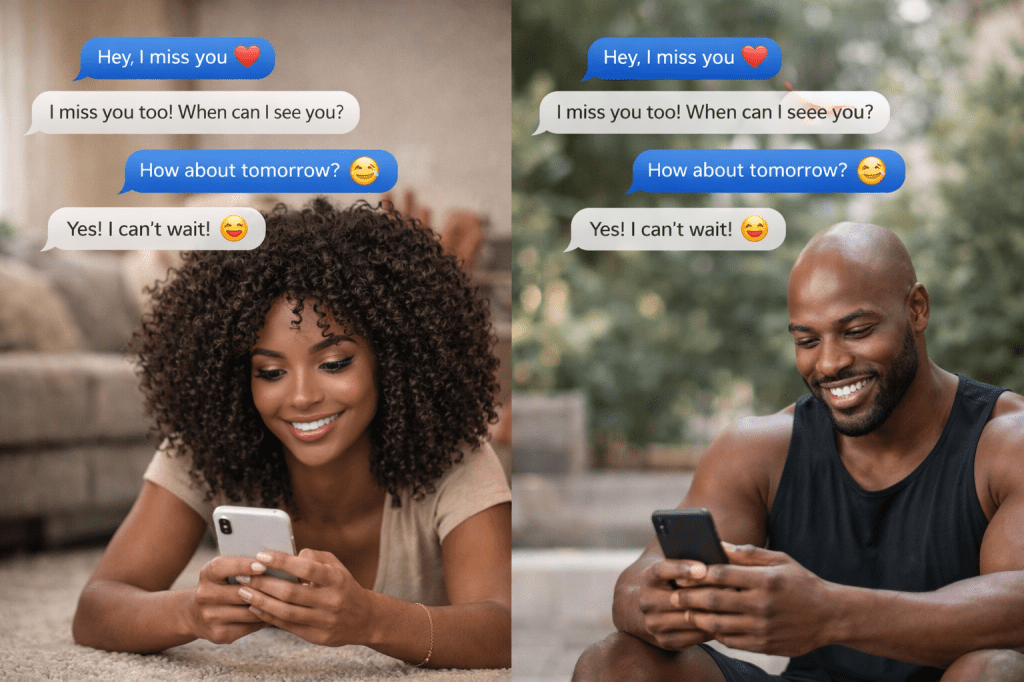
Texting has become one of the most dominant forms of communication in modern romantic relationships. What once required handwritten letters or phone calls is now compressed into short digital messages, emojis, and voice notes. Despite its simplicity, texting carries deep psychological implications for how people experience love, attachment, validation, conflict, and emotional security. From a psychological perspective, texting is not merely about exchanging information; it is about regulating intimacy, managing expectations, and negotiating emotional bonds in a digital environment.
At its core, texting activates fundamental human needs for connection and belonging. According to attachment theory, individuals seek emotional reassurance from romantic partners, especially during periods of uncertainty or distance (Bowlby, 1988). Text messages serve as micro-signals of availability, care, and commitment. A simple “Good morning” or “Thinking about you” can function as an attachment cue, reinforcing emotional safety and relational stability.
In relationships, texting often becomes a primary way of expressing affection. For women, psychological research suggests that consistent emotional communication—affirmation, reassurance, and verbal appreciation—plays a major role in perceived relational satisfaction (Reis & Shaver, 1988). Messages that validate feelings, express admiration, and communicate presence (“I appreciate you,” “I’m proud of you,” “How are you feeling today?”) tend to strengthen emotional intimacy.
For men, expressions of love through texting often benefit from clarity, respect, and appreciation. Research on male communication styles shows that men often value affirmation of competence, loyalty, and trust (Levant & Richmond, 2007). Texts such as “I trust you,” “I admire your discipline,” or “I feel safe with you” reinforce emotional bonding while respecting masculine identity needs.
The psychology of “what to say” in texting revolves around emotional intelligence. Emotionally intelligent communication involves empathy, attunement, and timing (Goleman, 1995). Healthy texting includes active listening, emotional responsiveness, and supportive language. This means acknowledging feelings rather than dismissing them, asking open-ended questions, and avoiding defensive or passive-aggressive replies.
Equally important is “what not to say.” Psychologically harmful texting includes sarcasm, ambiguous silence, emotional manipulation, guilt-tripping, and excessive criticism. Studies on digital conflict show that negative emotional tone in texting escalates misunderstandings more than face-to-face communication due to lack of vocal cues and body language (Walther, 2011). Texting is a poor medium for intense conflict because emotional nuance is easily misinterpreted.
One of the most common questions in relationships is: Should you text right away? The answer depends less on “rules” and more on attachment style and emotional regulation. Securely attached individuals tend to respond naturally, without overanalyzing response times. Anxiously attached individuals may over-text or panic over delayed replies, while avoidant individuals may withdraw or delay communication (Hazan & Shaver, 1987).
From a psychological standpoint, healthy texting is not about playing games or appearing unavailable. It is about emotional consistency. Responding in a timely but balanced manner communicates interest without desperation. Emotional security is built not through speed, but through reliability and authenticity.
Texting etiquette in relationships involves boundaries, respect, and intentionality. Proper etiquette includes not using texting as a substitute for serious conversations, not ghosting, not using silence as punishment, and not oversharing during emotional dysregulation. Texting should support the relationship, not replace emotional presence.

Another key psychological dimension is the role of dopamine and validation. Every incoming message triggers small dopamine responses in the brain, reinforcing emotional dependence and reward-seeking behavior (Montag et al., 2019). This explains why people become emotionally attached to texting patterns and feel anxiety when communication decreases.
However, over-reliance on texting can lead to emotional illusion. Psychologists warn that digital intimacy can create a false sense of closeness without deep relational substance (Turkle, 2011). Real intimacy still requires voice, presence, vulnerability, and shared lived experiences. Texting should complement emotional connection, not replace it.
Healthy couples use texting as a tool for emotional maintenance rather than emotional control. They send messages of encouragement, prayer, humor, and daily check-ins. These micro-interactions accumulate into long-term relational trust and emotional safety.
In romantic psychology, “love languages” also influence texting behavior. Individuals whose primary love language is words of affirmation tend to place greater emotional weight on text messages, while those oriented toward quality time or physical touch may find texting emotionally insufficient (Chapman, 1992). Understanding each other’s emotional needs prevents misinterpretation of texting habits.
Spiritual and moral frameworks also influence texting ethics. In faith-based psychology, communication should reflect honesty, patience, self-control, and emotional responsibility (Proverbs 15:1; Ephesians 4:29). Texting becomes not just relational, but ethical—an extension of character and integrity.
In conflict situations, psychologically healthy texting avoids emotional flooding. Research shows that emotionally aroused individuals process information less rationally and are more likely to misinterpret tone (Gottman, 1999). This is why emotionally mature couples delay texting during conflict and resume communication after emotional regulation.
Another psychological principle is mirroring. People unconsciously adapt their texting frequency and tone to match their partner’s style (Chartrand & Bargh, 1999). When one partner consistently invests more emotional energy through texting, relational imbalance may emerge, leading to emotional fatigue or resentment.
From a gender psychology perspective, women often interpret texting frequency as emotional investment, while men may view it as logistical communication. This difference can cause misalignment unless expectations are openly discussed (Tannen, 1990).
Digital Intimacy, Sexual Boundaries, and Purity in a Hypersexual Culture
One of the most critical yet often neglected aspects of the psychology of texting is the issue of sexual boundaries, particularly the normalization of sending nude or sexually explicit images. From a psychological perspective, “sexting” creates a false sense of intimacy that can bypass emotional safety, spiritual discernment, and long-term relational responsibility. While it may feel empowering or romantic in the moment, research shows that sharing explicit images increases vulnerability to emotional harm, exploitation, regret, anxiety, and loss of self-respect (Drouin et al., 2013).
Neuroscientifically, sexting activates the same dopamine-reward pathways associated with impulsivity and short-term gratification. This makes individuals more likely to make decisions based on arousal rather than wisdom, discernment, or emotional maturity (Montag et al., 2019). In many cases, what is framed as “confidence” is actually a form of digital validation-seeking rooted in insecurity and attachment anxiety.
Psychologically, sending nude images can disrupt healthy attachment by replacing emotional bonding with sexual performance. Instead of building trust, communication becomes centered on appearance, desirability, and erotic validation. This often leads to objectification—where a person is valued more for their body than their character, soul, or emotional depth (Fredrickson & Roberts, 1997).
From a relational standpoint, sexting also carries irreversible risks. Once an image is sent, control is lost. It can be saved, shared, manipulated, leaked, or weaponized, even within relationships that once felt safe. Studies show that digital sexual content is a leading contributor to post-breakup harassment, revenge behavior, and long-term psychological distress (Walker & Sleath, 2017).
From a spiritual and theological perspective, the call to purity is not rooted in shame, but in dignity, self-respect, and divine identity. Scripture emphasizes that the body is sacred and not meant to be commodified for temporary pleasure or external validation:
“Know ye not that your body is the temple of the Holy Ghost which is in you… and ye are not your own?” (1 Corinthians 6:19, KJV).
Purity in digital communication means refusing to reduce oneself or others to sexual images. It means honoring emotional and spiritual intimacy over visual exposure. It means understanding that love is demonstrated through patience, consistency, respect, and covenant—not through nudity or erotic access.
In biblical psychology, love is defined by self-control, discipline, and reverence for God:
“For this is the will of God, even your sanctification, that ye should abstain from fornication.” (1 Thessalonians 4:3, KJV)
Sexting before marriage mirrors the same psychological dynamics as physical fornication—it creates emotional bonding without covenant, intimacy without protection, and vulnerability without responsibility. Both psychology and theology converge on the same truth: premature sexual exposure leads to emotional fragmentation, attachment confusion, and spiritual disconnection.
For those seeking emotionally healthy and God-centered relationships, proper texting etiquette includes refusing sexual images, avoiding explicit conversations, and establishing clear digital boundaries. Instead of sending bodies, couples are encouraged to send prayers, encouragement, affirmations, and words of emotional presence.
A man who truly loves a woman does not ask for access to her body; he protects her dignity. A woman who values herself does not market her body for attention; she preserves her worth. In psychological terms, this reflects secure attachment and high self-esteem. In spiritual terms, it reflects obedience, holiness, and identity in God.
Ultimately, staying pure in a digital age is not about repression—it is about alignment. Alignment between emotional health, psychological wisdom, and divine purpose. Texting becomes a tool for building character, trust, and spiritual intimacy rather than lust, impulsivity, and emotional exploitation.
Ultimately, the psychology of texting reveals that communication is not about quantity, but quality. Secure love is expressed through emotional clarity, not constant messaging. Healthy texting nurtures peace, trust, and emotional presence rather than anxiety, dependency, or control.
Texting, when used wisely, becomes a modern form of communication—a digital extension of emotional intelligence, spiritual character, and psychological maturity. It reflects how individuals love, form attachments, regulate emotions, and treat others’ hearts in an age when intimacy is mediated by screens.
References
Bowlby, J. (1988). A secure base: Parent-child attachment and healthy human development. Basic Books.
Chapman, G. (1992). The five love languages: How to express heartfelt commitment to your mate. Northfield Publishing.
Chartrand, T. L., & Bargh, J. A. (1999). The chameleon effect: The perception–behavior link and social interaction. Journal of Personality and Social Psychology, 76(6), 893–910. https://doi.org/10.1037/0022-3514.76.6.893
Drouin, M., Vogel, K. N., Surbey, A., & Stills, J. R. (2013). Let’s talk about sexting, baby: Computer-mediated sexual behaviors among young adults. Computers in Human Behavior, 29(5), A25–A30. https://doi.org/10.1016/j.chb.2012.12.030
Fredrickson, B. L., & Roberts, T. A. (1997). Objectification theory: Toward understanding women’s lived experiences and mental health risks. Psychology of Women Quarterly, 21(2), 173–206. https://doi.org/10.1111/j.1471-6402.1997.tb00108.x
Goleman, D. (1995). Emotional intelligence. Bantam Books.
Gottman, J. M. (1999). The marriage clinic: A scientifically based marital therapy. W. W. Norton.
Hazan, C., & Shaver, P. R. (1987). Romantic love conceptualized as an attachment process. Journal of Personality and Social Psychology, 52(3), 511–524. https://doi.org/10.1037/0022-3514.52.3.511
Levant, R. F., & Richmond, K. (2007). A review of research on masculinity ideologies using the Male Role Norms Inventory. The Journal of Men’s Studies, 15(2), 130–146.
Montag, C., Lachmann, B., Herrlich, M., & Zweig, K. (2019). Addictive features of social media/messenger platforms and freemium games against the background of psychological and economic theories. International Journal of Environmental Research and Public Health, 16(14), 2612.
Reis, H. T., & Shaver, P. (1988). Intimacy as an interpersonal process. In S. Duck (Ed.), Handbook of personal relationships (pp. 367–389). Wiley.
Tannen, D. (1990). You just don’t understand: Women and men in conversation. Ballantine Books.
Turkle, S. (2011). Alone together: Why we expect more from technology and less from each other. Basic Books.
The Holy Bible, King James Version. (1611/2017). Cambridge University Press.
Walker, K., & Sleath, E. (2017). A systematic review of the current knowledge regarding revenge pornography and non-consensual sharing of sexually explicit media. Aggression and Violent Behavior, 36, 9–24. https://doi.org/10.1016/j.avb.2017.06.010

 THE BROWN GIRL DILEMMA