Category Archives: Christ

The Bible Series: The Kiss – Betrayal, Destiny, and the Fulfillment of Prophecy

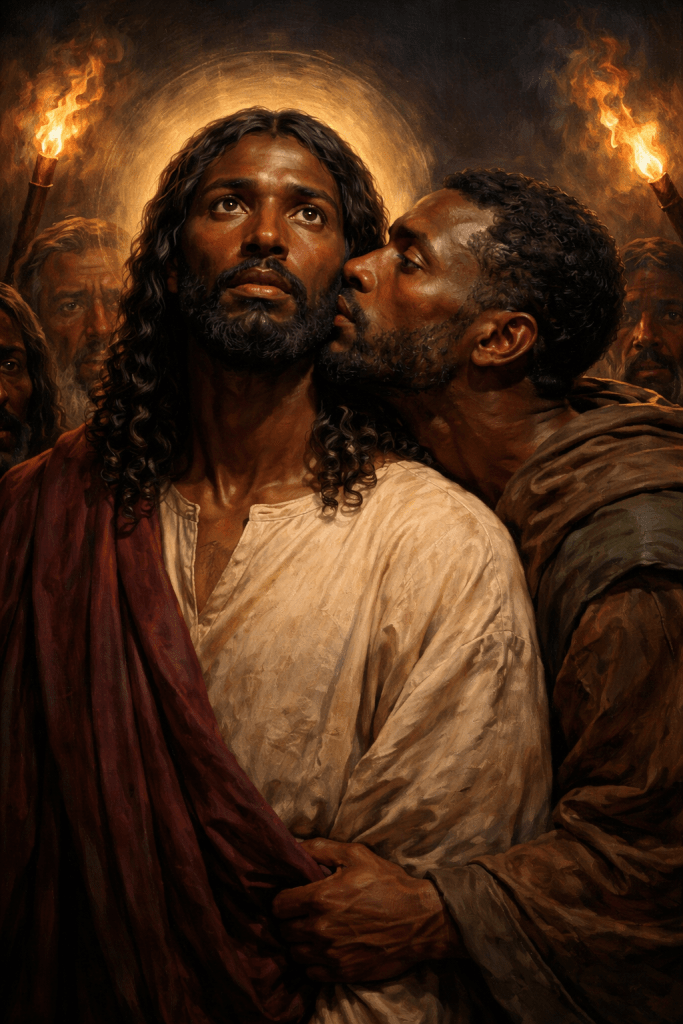
The moment commonly known as “the kiss of betrayal” is one of the most dramatic and spiritually significant events recorded in the New Testament. In the Gospels, the disciple Judas Iscariot identifies Jesus to the arresting authorities with a kiss on the cheek in the Garden of Gethsemane. This act, described in the Gospel of Matthew 26:47–50 and the Gospel of Luke 22:47–48, transformed a gesture of affection and respect into a symbol of treachery. The event has since become an enduring metaphor for betrayal carried out under the appearance of friendship.

Judas Iscariot was one of the original twelve disciples chosen personally by Jesus. The twelve apostles represented the foundational leadership of the early Christian movement, entrusted with spreading Christ’s teachings. According to the Gospel of Mark 3:13–19, Judas was called just like the others—Peter, James, John, and the rest—and he traveled with Jesus during His ministry. Judas witnessed miracles, heard Christ’s teachings, and participated in the communal life of the disciples.

Despite his privileged position, the Gospels portray Judas as having a conflicted character. In the Gospel of John 12:4–6, he is described as the keeper of the disciples’ money bag and is accused of stealing from it. This detail suggests that Judas struggled with greed and personal ambition, weaknesses that eventually contributed to his betrayal. His role among the disciples was therefore paradoxical: a trusted follower who secretly harbored moral corruption.

The betrayal begins to take shape during the final days of Jesus’ ministry in Jerusalem. Religious authorities viewed Jesus as a political and theological threat. His growing influence among the people alarmed the leaders of the temple, who feared unrest and Roman intervention. According to the Gospel of Matthew 26:14–16, Judas approached the chief priests and asked what they would give him if he delivered Jesus to them.

The priests agreed to pay Judas thirty pieces of silver. This amount, referenced in the Gospel of Matthew 26:15, carries symbolic significance because it echoes the prophecy found in the Book of Zechariah 11:12–13, where thirty pieces of silver is the price placed on a shepherd rejected by his people. In ancient Israelite law, this sum also corresponded to the compensation paid for a slave accidentally killed (Exodus 21:32). Thus, the price reflects both prophetic fulfillment and the tragic undervaluation of Christ.

The Gospel writers also emphasize the spiritual dimension behind Judas’s decision. In the Gospel of Luke 22:3, it is written that “Satan entered into Judas.” This phrase suggests that Judas’s betrayal was not merely a human act of greed but part of a larger spiritual conflict between divine purpose and demonic influence. The narrative frames Judas as someone who opened himself to evil through his choices.

Similarly, the Gospel of John 13:27 recounts that after receiving bread from Jesus at the Last Supper, Satan entered Judas again, prompting Jesus to say, “What thou doest, do quickly.” This passage illustrates the tension between human free will and divine foreknowledge. Jesus knew the betrayal was imminent and allowed it to unfold according to the plan that would ultimately lead to redemption.

The betrayal itself occurs in the Garden of Gethsemane shortly after the Last Supper. Judas leads a crowd of soldiers and temple officials to the place where Jesus had gone to pray. To identify Him in the darkness, Judas tells the authorities that the man he greets with a kiss is the one they should arrest. This signal transforms an intimate greeting into an act of deception.

When Judas approaches Jesus, he greets Him respectfully and kisses Him on the cheek. According to the Gospel of Matthew 26:49, he says, “Hail, Rabbi.” Jesus responds with calm awareness, asking, “Friend, wherefore art thou come?” The response reveals both sorrow and understanding. In the Gospel of Luke 22:48, Jesus asks, “Judas, betrayest thou the Son of man with a kiss?”

The kiss, therefore, becomes symbolic of betrayal disguised as loyalty. In the ancient Mediterranean world, a kiss was a sign of respect between a disciple and a teacher. By using this gesture as a signal to arrest Jesus, Judas weaponized trust. The act represents the tragedy of intimate betrayal—being harmed by someone within one’s own circle.

The question of why Judas betrayed Jesus has been debated for centuries by theologians and historians. Some scholars argue that greed motivated him, as suggested by the payment of silver. Others believe he may have been disillusioned with Jesus, expecting a political messiah who would overthrow Roman rule. When Jesus instead spoke of sacrifice and the spiritual kingdom, Judas may have turned against Him.

Another interpretation suggests that Judas attempted to force Jesus to reveal His power. Some scholars speculate that Judas believed arresting Jesus would provoke Him to demonstrate divine authority and establish His kingdom. If this theory holds, Judas’s betrayal may have been rooted in misunderstanding rather than pure malice.

Theologically, Judas also plays a role within the framework of prophecy and divine purpose. Jesus’ betrayal was foretold in passages such as the Book of Psalms 41:9, which says, “Mine own familiar friend… hath lifted up his heel against me.” Early Believers interpreted this as a prophetic foreshadowing of Judas’s actions.

Because of these prophecies, some theologians argue that Judas fulfilled a role necessary for the events leading to the crucifixion. Without the betrayal, Jesus might not have been arrested in the manner described in the Gospels. From this perspective, Judas’s actions became part of the unfolding plan for redemption.

However, the presence of divine purpose does not eliminate personal responsibility. Christian theology generally holds that Judas acted out of his own choices and desires. His betrayal demonstrates how human weakness can align with darker spiritual forces, resulting in tragic consequences.

After Jesus was condemned, Judas experienced deep remorse. According to the Gospel of Matthew 27:3–5, he returned the thirty pieces of silver to the priests, confessing that he had betrayed innocent blood. The priests refused responsibility, leaving Judas overwhelmed by guilt.

Judas then threw the silver into the temple and left. The Gospel account states that he went away and hanged himself. This tragic end illustrates the destructive weight of guilt and the devastating consequences of betrayal.

The chief priests later used the returned money to purchase a field known as the “Field of Blood.” This event again aligns with the prophecy in Zechariah 11:13 and contributes to the narrative symbolism surrounding Judas’s actions.

Despite his betrayal, the story of Judas serves as a cautionary lesson within Biblical teaching. It demonstrates how proximity to truth does not guarantee faithfulness. Judas walked with Jesus, witnessed miracles, and heard divine teaching, yet still chose betrayal.

The message behind the story of Judas and the kiss is therefore multifaceted. It warns against greed, hypocrisy, and spiritual vulnerability. It also emphasizes the sovereignty of God, showing that even acts of betrayal cannot ultimately thwart divine purpose.

Finally, the betrayal leads directly to Jesus’ crucifixion and resurrection, which form the foundation of the followers of Christ. What appeared to be a moment of darkness ultimately became part of the narrative of redemption. The kiss of betrayal, therefore, stands as both a symbol of human treachery and a turning point in the story of salvation.


References

Bauckham, R. (2015). Jesus: A very short introduction. Oxford University Press.

Brown, R. E. (1994). The death of the Messiah: From Gethsemane to the grave. Yale University Press.

Ehrman, B. D. (2014). How Jesus became God. HarperOne.

The Holy Bible, King James Version. (1769/2017). Cambridge University Press.

Wright, N. T. (2012). How God became king: The forgotten story of the Gospels. HarperOne.
An Introduction to Biblical Doctrine

Biblical doctrine refers to the organized teaching of the essential truths found in Scripture. The word doctrine simply means “teaching,” and in a biblical sense, it represents what God has revealed about Himself, humanity, sin, salvation, and righteous living. Doctrine is not meant to be abstract theology for scholars only, but practical truth meant to shape belief, character, and daily life.

At the center of biblical doctrine is the authority of Scripture. The Bible presents itself as divinely inspired and profitable for teaching, correction, and instruction in righteousness (2 Timothy 3:16, KJV). This establishes doctrine not as human opinion, but as divine revelation. Without Scripture as the foundation, doctrine becomes subjective and disconnected from God’s will.

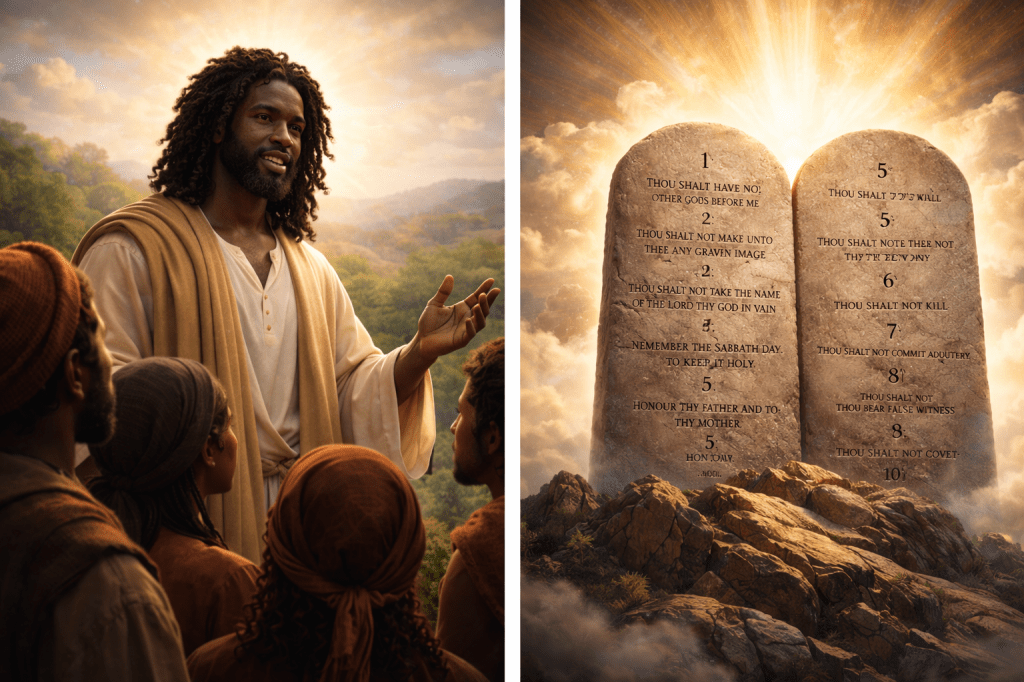
One of the most foundational elements of biblical doctrine is the Law, particularly the Ten Commandments given to Moses. These commandments reveal God’s moral standard and define righteousness in practical terms. They address humanity’s relationship with God (the first four commandments) and humanity’s relationship with others (the remaining six), forming the ethical backbone of biblical faith (Exodus 20, KJV).

However, the commandments were never meant to function as a means of salvation. Rather, they expose sin and reveal humanity’s need for grace. Paul explains in Romans 3:20 (KJV) that by the law comes the knowledge of sin. The law diagnoses the condition, but it cannot cure it. This prepares the theological stage for the role of Jesus Christ.

Jesus did not abolish the commandments but fulfilled them. In Matthew 5:17 (KJV), He states clearly that He came not to destroy the law, but to fulfill it. This fulfillment was not merely legal but spiritual. Jesus internalized the law, moving righteousness from external obedience to internal transformation of the heart.

This internalization is most clearly seen in Jesus’ teachings known as the Beatitudes. Found in Matthew 5:3–12 (KJV), the Beatitudes describe the spiritual attitudes that characterize true followers of Christ: humility, meekness, mercy, purity of heart, hunger for righteousness, and peacemaking. Unlike the commandments, which are framed as prohibitions, the Beatitudes are framed as blessings.

The commandments define what righteousness looks like in action, while the Beatitudes define what righteousness looks like in spirit. The law says, “Do not murder,” but Jesus says anger in the heart is also sin. The law says, “Do not commit adultery,” but Jesus says lustful thoughts are equally condemnable (Matthew 5, KJV). This demonstrates that biblical doctrine is not about behavior management but heart transformation.

In biblical theology, Jesus is the embodiment of doctrine. He is not only the teacher of truth but the truth itself (John 14:6, KJV). Doctrine is therefore not merely a system of beliefs but a person-centered reality. To know doctrine is to know Christ, and to follow doctrine is to imitate His character.

The commandments reveal God’s holiness, while the Beatitudes reveal God’s nature. Together, they form a complete picture of biblical righteousness: external obedience grounded in internal humility. The law governs actions, while the Beatitudes govern attitudes. One addresses what we do; the other addresses who we are.

Biblical doctrine ultimately leads to transformation, not information. James warns that hearing the word without doing it produces self-deception (James 1:22, KJV). True doctrine produces repentance, obedience, love, and spiritual maturity. It is not designed to inflate knowledge, but to conform believers into the image of Christ.

In conclusion, biblical doctrine is the theological framework through which God reveals truth, defines righteousness, and restores humanity. The commandments establish moral law, while the Beatitudes establish spiritual character. Together, they show that God desires not only righteous behavior, but righteous hearts. Doctrine, therefore, is not about religion—it is about transformation into divine likeness.


References

Holy Bible (King James Version). (2017). Thomas Nelson.

Grudem, W. (1994). Systematic theology: An introduction to biblical doctrine. Zondervan.

Erickson, M. J. (2013). Christian theology (3rd ed.). Baker Academic.

Stott, J. (2012). The message of the Sermon on the Mount. InterVarsity Press.

Wright, N. T. (2010). After you believe: Why Christian character matters. HarperOne.

We are Dust with his Breath

In the beginning of creation, humanity is introduced not as an accident of nature but as a deliberate act of divine intention. Scripture teaches that God formed man from the dust of the ground and breathed into his nostrils the breath of life, and man became a living soul (Genesis 2:7, KJV). This verse establishes a foundational theological truth: without the breath of God, humanity remains lifeless matter, no different from the soil beneath our feet.

The imagery of dust is deeply symbolic. Dust represents human fragility, limitation, and mortality. It reminds us that no matter how advanced civilization becomes, humanity remains dependent on divine power for existence. The breath of God transforms dust into life, meaning that human dignity does not originate from intellect, wealth, or status, but from divine impartation (Psalm 103:14).

The breath of life is not merely biological respiration; it is spiritual animation. In Hebrew, the word for breath, ruach, also means spirit or wind, indicating that life itself is sustained by the Spirit of God. This suggests that humanity is not self-sustaining but continuously upheld by divine presence (Ezekiel 37:5).

Without God’s breath, human existence loses its sacred meaning. Modern society often elevates human autonomy and self-sufficiency, yet scripture consistently reminds us that life is borrowed, not owned. Every heartbeat and breath testifies to divine mercy rather than human control (Acts 17:25).

The Most High God of Israel is portrayed throughout scripture as the giver and sustainer of life. He is not distant from creation but intimately involved in its continuation. Job acknowledges this truth when he declares that the Spirit of God has made him and the breath of the Almighty gives him life (Job 33:4).

To cherish the Creator is to recognize the source of one’s existence. Gratitude becomes a spiritual posture when one understands that life is a divine gift rather than a human achievement. Worship, therefore, is not ritualistic obligation but an acknowledgment of existential dependence (Psalm 150:6).

Human pride often blinds people to this reality. Scientific advancement has led many to believe that life can be explained without God, yet even science cannot produce consciousness from nothing. The mystery of life still points back to divine origin rather than mechanical causation (Collins, 2006).

In biblical theology, breath is also associated with renewal and restoration. In the valley of dry bones, God commands breath to enter lifeless bodies, and they rise again, symbolizing spiritual revival and national restoration (Ezekiel 37:9–10). This narrative reinforces that without divine breath, there is no resurrection, no hope, and no future.

The breath of God also signifies moral responsibility. If life comes from God, then life belongs to God. Humanity is therefore accountable to divine standards, not self-created ethics. This challenges modern individualism, which promotes self-definition without divine authority (Romans 14:7–8).

To say “we are dust without His breath” is to affirm human humility. It dismantles the illusion of self-made identity and replaces it with sacred dependency. Even kings and empires return to dust, but God’s breath remains eternal (Ecclesiastes 12:7).

The Most High is not merely a creator but a sustainer. He does not abandon what He forms. Scripture portrays God as continually involved in the world, sustaining all things by His word and power (Hebrews 1:3). Life is not a past miracle but an ongoing one.

Cherishing the Creator involves living in awareness of divine presence. It transforms daily life into a sacred experience. Eating, breathing, thinking, and loving become acts of worship when viewed through the lens of divine origin (Colossians 3:17).

The concept of breath also connects to divine communication. God’s breath produces His word, and His word produces life. The same God who breathed into Adam later breathed scripture into prophets and apostles, making His word living and powerful (2 Timothy 3:16).

From a theological perspective, denying God as the source of life leads to spiritual alienation. When humanity forgets its Creator, it begins to worship creation, self, and materialism. This reversal of order results in moral decay and existential emptiness (Romans 1:21–25).

The breath of God also represents divine intimacy. Unlike other creatures, humanity receives life through direct divine interaction. God does not speak humans into existence; He breathes into them, suggesting relational closeness rather than distant creation (Brueggemann, 2010).

Life therefore carries sacred responsibility. If God’s breath animates humanity, then every human life possesses inherent worth, regardless of race, class, or ability. This foundation supports biblical human dignity and justice (Genesis 1:27).

The Most High God of Israel reveals Himself not only as powerful but as compassionate. He breathes life into fragile dust and remains patient with human failure. His mercy sustains those who constantly fall short of divine perfection (Lamentations 3:22–23).

Even death in scripture does not represent divine abandonment. The return of breath to God signifies transition, not annihilation. The soul returns to its source, awaiting divine judgment and restoration (Ecclesiastes 12:7).

In this sense, breath becomes eschatological. It points beyond physical life to eternal reality. God’s breath does not merely create time-bound existence but prepares humanity for everlasting communion (John 20:22).

Ultimately, the statement “we are dust without His breath” is not a message of despair but of sacred truth. It reminds humanity that life is not meaningless, accidental, or random. Life is divine, purposeful, and sustained by the Most High God of Israel.

To cherish the Creator is to live in reverence, humility, and gratitude. Every breath becomes a testimony of divine mercy, and every moment becomes an opportunity to acknowledge the One who turns dust into living souls.


References

Brueggemann, W. (2010). Genesis: Interpretation: A Bible commentary for teaching and preaching. Westminster John Knox Press.

Collins, F. S. (2006). The language of God: A scientist presents evidence for belief. Free Press.

The Holy Bible, King James Version. (1611/2017). Cambridge University Press.

Wright, N. T. (2012). How God became king: The forgotten story of the Gospels. HarperOne.

Walton, J. H. (2009). The lost world of Genesis one: Ancient cosmology and the origins debate. InterVarsity Press.

Divine Court: The Laws of Heaven and the Judgments of Earth.

Photo by Summer Stock on Pexels.com

In every realm of existence—visible and invisible—there is order. The universe itself is not governed by chaos, but by a hierarchy of divine authority. Scripture reveals that God sits as the Supreme Judge, presiding over a heavenly court that governs all creation. “God standeth in the congregation of the mighty; he judgeth among the gods” (Psalm 82:1, KJV). While humanity debates justice in earthly courts, heaven operates on eternal law, where truth cannot be bribed, hidden, or manipulated.

The Divine Court is not metaphorical; it is a spiritual reality. Every act, word, and thought carries spiritual weight, recorded as testimony in the unseen realm. “For God shall bring every work into judgment, with every secret thing, whether it be good, or whether it be evil” (Ecclesiastes 12:14, KJV). Unlike human courts, where corruption and partiality prevail, divine justice is pure and absolute.

Heaven’s courtroom operates through divine order: the Father as Judge, Christ as Advocate, the Holy Spirit as Witness, and angels as ministering officers of the law. Satan, whose name literally means “the accuser,” functions as the prosecutor, presenting charges against humanity. Job’s trial offers one of the clearest depictions of this heavenly process—Satan appearing before God to question the righteousness of a man (Job 1:6–12). This court was not held on earth, but in the spiritual realm, revealing that every life is subject to divine review.

In this celestial tribunal, righteousness serves as the legal currency. Faith, obedience, and repentance are admissible evidence of justification. When Jesus died on the cross, He became both substitute and attorney—our Advocate before the Father. “If any man sin, we have an advocate with the Father, Jesus Christ the righteous” (1 John 2:1, KJV). The blood of Christ serves as eternal testimony that the debt of sin has been paid in full.

Human courts deal with evidence and argument; divine court deals with truth and intention. God does not merely judge what we do, but why we do it. “Man looketh on the outward appearance, but the Lord looketh on the heart” (1 Samuel 16:7, KJV). This truth is both comforting and convicting, for while the world may misjudge our motives, heaven sees them clearly.

The laws of heaven transcend the temporal codes of men. While civil law regulates behavior, divine law reforms character. Earthly systems punish outward crime, but God’s justice transforms inward nature. “For the word of God is quick, and powerful, and sharper than any two-edged sword… and is a discerner of the thoughts and intents of the heart” (Hebrews 4:12, KJV).

Every soul will one day stand before the Great White Throne, where the ultimate judgment will occur. “And I saw the dead, small and great, stand before God; and the books were opened” (Revelation 20:12, KJV). These “books” are spiritual records—documents of deeds, decisions, and destinies. Nothing escapes divine documentation. Heaven’s justice is comprehensive and eternal.

Psychologically, this awareness corresponds to the human conscience—the inner court of moral awareness where guilt, repentance, and restoration take place. The conscience is not self-created; it is the echo of the divine courtroom within the human soul. When we experience conviction, it is the Holy Spirit testifying to the truth. “When he is come, he will reprove the world of sin, and of righteousness, and of judgment” (John 16:8, KJV).

Divine justice is restorative, not merely punitive. God’s goal is not condemnation but correction. “For whom the Lord loveth he chasteneth, and scourgeth every son whom he receiveth” (Hebrews 12:6, KJV). Discipline is divine mercy in motion—a verdict meant to restore alignment, not destroy relationship. When heaven convicts, it is always for redemption.

The courts of Earth often fail because they lack moral purity. But the divine court operates without flaw. It is not swayed by wealth, influence, or race. “He shall judge the world with righteousness, and the people with his truth” (Psalm 96:13, KJV). Every injustice ignored by men will eventually face divine arbitration. History’s silence will be shattered by heaven’s gavel.

In the realm of intercession, prayer operates as legal petition. Jesus instructed, “What things soever ye desire, when ye pray, believe that ye receive them, and ye shall have them” (Mark 11:24, KJV). Prayer is not mere speech—it is a legal presentation before heaven’s court. When prayers align with divine statutes, heaven enforces them. Faith becomes evidence; Scripture becomes precedent.

Spiritual warfare is often a courtroom battle, not just a battlefield struggle. The adversary accuses, presenting claims of sin or disobedience to deny blessings or delay destinies. Yet repentance vacates those charges. “If we confess our sins, he is faithful and just to forgive us our sins” (1 John 1:9, KJV). Confession clears the legal ground, allowing divine favor to flow unhindered.

Heavenly verdicts manifest on earth through divine timing. Justice may seem delayed, but it is never denied. “Though it tarry, wait for it; because it will surely come, it will not tarry” (Habakkuk 2:3, KJV). The divine court does not move on human schedules; it operates according to eternal wisdom. Every decision is perfectly timed for both justice and mercy to be revealed.

The Psalms are filled with courtroom language—appeals, judgments, and vindications. David frequently petitioned God as Judge, crying out, “Judge me, O Lord, for I have walked in mine integrity” (Psalm 26:1, KJV). Such prayers were not complaints but legal declarations of innocence and calls for divine intervention. David understood that vindication belongs to God alone.

Every believer has spiritual standing in heaven’s court. “Let us therefore come boldly unto the throne of grace” (Hebrews 4:16, KJV). This boldness is not arrogance—it’s legal confidence. When aligned with Christ, we approach not as defendants but as redeemed heirs. Through His blood, our record is expunged, and our case eternally settled.

The laws of heaven also operate in the collective dimension. Nations, churches, and families stand before divine review. When systems oppress, when leaders exploit, when people forsake truth, divine court intervenes. God told Israel, “I will plead with you face to face” (Ezekiel 20:35, KJV). Spiritual legislation ensures that no structure—however powerful—can escape divine audit.

In psychology, moral accountability brings healing through acknowledgment. In theology, divine accountability brings salvation through repentance. The courtroom imagery of heaven teaches that confession is not humiliation—it is liberation. To admit guilt before God is to invoke grace.

Justice, in its truest form, is the revelation of divine balance. Mercy and judgment are not enemies; they are co-laborers. The cross is where they kissed. “Mercy and truth are met together; righteousness and peace have kissed each other” (Psalm 85:10, KJV). At Calvary, the gavel of judgment struck the heart of mercy, and salvation was legislated forever.

The Divine Court reminds us that justice, though delayed on earth, is guaranteed in heaven. Every wrong shall be righted, every tear accounted for, and every truth vindicated. The Judge of all the earth will indeed do right (Genesis 18:25). To live in awareness of this court is to walk in reverence, righteousness, and rest—knowing that the final verdict belongs to God alone.

References

  • The Holy Bible, King James Version (KJV)
  • Wright, N. T. (2010). After You Believe: Why Christian Character Matters. HarperOne.
  • McMinn, M. R. (2011). Psychology, Theology, and Spirituality in Christian Counseling. Tyndale House.
  • Lewis, C. S. (1943). The Abolition of Man. HarperOne.
  • Frangipane, F. (1992). The Three Battlegrounds: An In-Depth View of the Three Arenas of Spiritual Warfare. Arrow Publications.

The Bible Series: What was the false Christianity used to control enslaved people?

During the transatlantic slave trade and the centuries of bondage that followed, enslavers in the Americas constructed a false version of Christianity designed to pacify, manipulate, and dominate African people. This was not true biblical faith but a political weapon deliberately engineered to uphold racial hierarchy, economic exploitation, and social control. Enslaved Africans quickly recognized that the Christianity of the slave master contradicted both Scripture and the spirit of the God of justice, yet this distorted theology was imposed on them through law, violence, and psychological manipulation.

The “Slave Bible”: Christianity Rewritten for Control

Slaveholders created an edited version of Scripture often called The Slave Bible (published in 1807 by the Society for the Conversion of Negro Slaves). This Bible omitted as much as 90% of the Old Testament and 50% of the New Testament.

Removed sections included:

  • The Exodus story
  • Passages about freedom and liberation
  • Scriptures against oppression
  • Texts about God judging unjust rulers
  • Lines affirming Israel’s identity, dignity, and divine purpose

Left in were:

  • Scriptures about obedience
  • Passages about servants submitting to masters
  • Verses promoting patience in suffering

It was a theological tool of psychological enslavement.


White Supremacist Christian Doctrine

Slaveholders used a twisted theology that claimed:

  • Africans were “cursed” (misusing the Curse of Ham)
  • Slavery was God’s will
  • Whites were divinely ordained rulers
  • Black people were naturally inferior
  • Saving souls was more important than saving bodies
  • Obedience to the master = obedience to God

This doctrine had no biblical basis, but it was taught to justify kidnapping, rape, brutality, terror, and forced labor.


Enslavement Suppressed the Real Biblical Themes

The enslavers intentionally hid the Bible’s central themes:

  • Liberation (Exodus, Isaiah, Luke 4:18)
  • God’s anger at oppression
  • Justice and righteousness
  • Equality of all people
  • Condemnation of kidnapping (Exodus 21:16)
  • Prophecy about Israel going into slavery (Deuteronomy 28)

Enslaved Africans quickly realized the true Bible was a book of freedom, not submission.


Christianity Was Used as Propaganda

White preachers delivered sermons tailored to slaves:

  • “Be obedient to your masters.”
  • “God wants you to accept your place.”
  • “Heaven will reward you for your suffering.”
  • “Do not question authority.”

This version of Christianity served plantations—not God.


Enslaved People Were Forbidden to Read

Slaveowners passed laws making it illegal for Africans to:

  • Read the Bible
  • Learn to read or write
  • Gather for worship without white oversight
  • Preach freely

Why?

Because the true Bible inspires:

  • liberation
  • identity
  • dignity
  • resistance to injustice
  • divine worthiness

Slaveholders knew the real Scriptures would destroy the slave system.


The Creation of the “Missionary Slave Church”

Enslavers established controlled churches with:

  • White pastors
  • Supervised sermons
  • Carefully selected verses
  • No teaching about Exodus or justice
  • No Hebrew identity
  • No African dignity

This church preached loyalty to the plantation rather than loyalty to God.


The Real Christianity of the Enslaved Was Different

The enslaved Africans created their own underground faith traditions:

  • Secret prayer meetings (“hush harbors”)
  • Spirit-led worship
  • Use of coded spirituals
  • Identification with ancient Israel
  • Reading the full Bible in secret
  • Hope of divine justice and liberation

They saw themselves as the children of Israel in bondage.


Misuse of Paul’s Letters

Slaveholders twisted Paul’s letters about servants in the Roman household system and applied them to chattel slavery, which is fundamentally different.

Biblically:

  • Chattel slavery is condemned.
  • Kidnapping is punishable by death.
  • God liberates oppressed people.
  • Masters and servants in Scripture were not racial, hereditary, or lifelong bondage.

Slaveowners selectively misinterpreted Scripture to protect their wealth.


The Curse of Ham: The Biggest Lie

Enslavers falsely taught that Africans were descendants of Ham and “cursed to be slaves.”
This lie:

  • is not in the Bible
  • misquotes Genesis
  • was created in the Middle Ages to justify racism
  • became a tool of colonial oppression

Biblically, the curse was on Canaan—not all African people.


Why Did Slaveholders Need This False Christianity?

Because true Christianity:

  • condemns slavery
  • empowers the oppressed
  • reveals the humanity of all people
  • uplifts the poor
  • demands justice
  • has a God who destroys oppressive empires (Egypt, Babylon, Assyria, Rome)

False Christianity was the only way to maintain slavery’s brutality while pretending to be righteous.


It Was Christianity Without Christ

It lacked:

  • love
  • justice
  • mercy
  • repentance
  • righteousness
  • truth
  • liberation

It was a political religion masquerading as faith.


The Real Bible Was a Threat to Slavery

Once enslaved Africans encountered the full Scriptures, many identified more with Moses than with Paul, and more with Israel than with Rome.

This realization fueled:

  • rebellions
  • escapes
  • abolitionist movements
  • The formation of independent Black churches

The real gospel is a gospel of freedom.


The false Christianity used to control enslaved people was:

  • a colonial weapon
  • a manipulated theology
  • a stripped-down Bible
  • a slave-owner-approved religion
  • a tool of white supremacy
  • a distortion of Scripture
  • completely opposed to true biblical teaching

The enslaved were given a religion of obedience, while they discovered a God of liberation.

The heart of this false Christianity lay in its selective use of Scripture. Slaveowners removed or rewrote large portions of the Bible to eliminate themes of liberation, divine justice, and human dignity. The infamous “Slave Bible,” published in 1807, cut out nearly all references to freedom, rebellion, and God’s judgment of oppressive rulers. What remained were verses emphasizing obedience, submission, and quiet suffering. This intentional mutilation of the Word of God reveals how deeply slave societies feared the truth of Scripture.

Another core component of this false faith was the misinterpretation of key biblical passages. Enslavers twisted Paul’s instructions to servants—directed at Roman household servants, not enslaved Africans—to justify racial slavery. They also weaponized the so-called Curse of Ham, falsely teaching that African people were destined by God to be slaves. This was a complete distortion of Genesis, where the curse was placed on Canaan, not on Ham, and certainly not on an entire continent of people. Such teachings served the interests of white supremacy, not the teachings of Christ.

To maintain control, slaveholders created highly monitored “plantation churches.” In these spaces, white preachers delivered sermons promoting obedience and reinforcing racial hierarchy. Enslaved people were forbidden to gather independently for worship or to read Scripture for themselves. Laws were enacted across the South prohibiting Black literacy, because the master class understood that an educated believer—armed with the full truth of the Bible—posed a threat to the entire slave system.

This corrupted Christianity also taught enslaved Africans that their suffering was divinely ordained and that they should accept their earthly bondage in exchange for heavenly reward. Such doctrine had no biblical foundation and directly contradicted the character of a God who liberates His people from oppression, from Egypt to Babylon. By promising spiritual salvation while denying physical freedom, enslavers created a theology that separated the soul from the body, ensuring Black labor remained controlled while white consciences remained untroubled.

Yet enslaved Africans discerned the difference between the slave master’s religion and the liberating God of Scripture. In secret gatherings known as “hush harbors,” they forged a true and living Christianity rooted in Exodus, the prophets, the Psalms, and the teachings of Jesus. These clandestine meetings were spaces of healing, communal strength, and spiritual resistance. They prayed for deliverance, sang coded spirituals, and interpreted Scripture through the lens of their lived suffering, affirming a God who hears the cries of the oppressed.

One of the most striking differences between enslaved people’s faith and the enslavers’ religion was the identification with Ancient Israel. Enslaved Africans saw themselves in the story of Moses and the Hebrews—people chosen, persecuted, and promised deliverance by the Most High. This connection was not accidental; it emerged from both spiritual intuition and cultural memory. The master’s Christianity feared this narrative because it empowered enslaved people to see themselves as a sacred people, not property.

The false Christianity of the slaveholder was a Christianity of control, not conversion. Its purpose was not salvation but subjugation. The gospel presented to enslaved people required no repentance from the enslaver, no justice, no righteousness, no love for neighbor. It fabricated a God who blessed the whip, sanctioned the auction block, and smiled upon exploitation. Such a God was an idol created in the image of white supremacy, not the God of Abraham, Isaac, and Jacob.

This enslaver religion also functioned as a political tool. It stabilized the economic foundation of the South by training enslaved people to be compliant, fearful, and psychologically dependent. The message was clear: disobedience to the master meant disobedience to God. This spiritual intimidation reinforced the legal and physical terror already used to maintain slavery.

Despite this oppressive system, enslaved Africans consistently resisted. They sought out the full Bible, interpreted Scripture on their own terms, and cultivated a theology of liberation centuries before formal emancipation. Their understanding of God was holistic—addressing body, spirit, community, and collective freedom. This real Christianity fueled rebellions, escapes, and abolitionist movements, demonstrating the power of faith when aligned with truth.

The false Christianity of slavery also had long-lasting effects. It helped build structures of racism within American churches that persist today. Segregated congregations, discriminatory theology, and racial bias in religious institutions can all be traced back to the slaveholder’s version of faith. This legacy demands honest reckoning and structural repentance from modern Christianity.

Theologically, the Christianity used to control enslaved people was heretical. It denied the prophetic tradition, ignored Christ’s teachings about justice, and contradicted the biblical command to free the oppressed. It rewrote Scripture to accommodate human cruelty. By transforming the Bible into a plantation manual, enslavers positioned themselves not as followers of Christ but as manipulators of His Word.

Enslaved people, however, preserved the truth. Their Christianity was closer to the biblical narrative than the faith preached by their captors. They understood God as deliverer, protector, and judge of unjust nations. Their spirituals, prayers, and testimonies proclaimed a theology of hope in the face of terror, dignity in the face of dehumanization, and destiny in the face of denial.

This distinction between the master’s religion and the enslaved people’s faith became central to the moral authority of Black churches after emancipation. The Black church emerged as a center of community empowerment, civil rights activism, and spiritual resilience precisely because its roots were grounded in liberation, not oppression.

The enslavers’ Christianity was an empire-serving religion, aligned with power rather than truth. It rejected the biblical mandate to “proclaim liberty to the captives” and comfort the brokenhearted. It silenced the prophets and crucified Christ, who stood with the marginalized. Enslaved Africans recognized this and refused to accept a God who endorsed their suffering.

In the end, the false Christianity used to enslave Black people was a counterfeit gospel—one designed to erase identity, suppress resistance, and perpetuate injustice. Yet the enslaved uncovered the true God beneath the lies, reading between the lines, trusting their own spiritual intuition, and embracing a faith that affirmed their humanity and promised their freedom.

This powerful distinction—between a religion of domination and a faith of liberation—continues to shape the spiritual landscape of Black communities today. The legacy of true Christianity, preserved by the enslaved, is a testament to resilience, revelation, and the unbreakable connection between divine truth and human freedom.

References
Blight, D. W. (2018). Frederick Douglass: Prophet of freedom. Simon & Schuster.
Cone, J. H. (2011). The cross and the lynching tree. Orbis Books.
Gomez, M. A. (1998). Exchanging our country marks: The transformation of African identities in the colonial and antebellum South. University of North Carolina Press.
Horsley, R. A. (2003). Jesus and empire: The kingdom of God and the new world disorder. Fortress Press.
Raboteau, A. J. (2004). Slave religion: The “invisible institution” in the antebellum South. Oxford University Press.
Williams, D. (1993). Theology and the Black experience. Fortress Press.

Who are you in Christ? #Chosen

This photograph is the property of its respective owner. No copyright infringement intended.

Your identity in Christ is the foundation of your spiritual journey, your purpose, your relationships, and the way you stand in a world that constantly pressures you to conform. Scripture teaches that true purpose is not found in people, material things, or validation from society, but in God alone. When you know who you are in Christ, you walk with confidence, clarity, and divine authority.

Knowing who you are in Christ begins with understanding that you were created intentionally and fearfully by God. Psalm 139:14 (KJV) declares, “I will praise thee; for I am fearfully and wonderfully made.” This truth applies to both women and men, reminding every soul that identity is rooted in divine craftsmanship, not culture’s opinions.

The world constantly tries to define identity through trends, status, money, and performance, but God defines you by His love, His calling, and His Word. Romans 12:2 (KJV) warns believers, “And be not conformed to this world: but be ye transformed by the renewing of your mind.” Transformation begins when you stop letting people shape you and allow God to renew you.

Identity truly begins when you receive Christ as Lord and Savior. According to 2 Corinthians 5:17 (KJV), “If any man be in Christ, he is a new creature.” In Christ, your past no longer has power to label you; you are recreated through grace.

Women in Christ are called daughters of the King—chosen, valuable, cherished, and empowered by God. Galatians 3:26 (KJV) affirms, “For ye are all the children of God by faith in Christ Jesus.” This means your worth is not up for debate; it is determined by God Himself.

Men in Christ are called sons of God—leaders in character, protectors of righteousness, and carriers of spiritual authority. Psalm 1 describes the blessed man who delights in God’s Word and prospers in his purpose. Strength in Christ is defined by spiritual obedience, not worldly dominance.

The purpose for both women and men begins with one clear instruction: “But seek ye first the kingdom of God, and his righteousness” (Matthew 6:33, KJV). True purpose is not found through ambition, comparison, or validation, but through seeking God first and trusting His guidance.

As you seek God, He reveals your identity, gifts, and calling. Ephesians 2:10 (KJV) declares that you are God’s workmanship, created for good works He prepared for you. Purpose is not random—it is woven into your spiritual DNA.

Being in Christ also means breaking free from people-pleasing. Galatians 1:10 (KJV) challenges every believer with the question, “Do I seek to please men? … I should not be the servant of Christ.” Living for applause traps you; living for Christ frees you.

Women often face immense pressure to conform to beauty standards, social expectations, and external validation. Proverbs 31:30 (KJV) reminds us that “favour is deceitful, and beauty is vain: but a woman that feareth the LORD, she shall be praised.” God honors character over cosmetics.

Men face pressure to appear strong, successful, and unshakable, but true strength comes from God. Joshua 1:9 (KJV) says, “Be strong and of a good courage… for the LORD thy God is with thee.” Strength in Christ is rooted in presence, not performance.

Your identity is not to impress people, but to reflect Christ. Matthew 5:16 (KJV) encourages believers, “Let your light so shine before men.” Your light is your God-given character, integrity, and obedience—not your status.

Identity in Christ means living free from condemnation. Romans 8:1 (KJV) teaches, “There is therefore now no condemnation to them which are in Christ Jesus.” Your identity is not defined by guilt but by grace.

When you know who you are in Christ, your relationships become healthier because you are not seeking completion in another person. You understand 1 John 4:19 (KJV): “We love him, because he first loved us.” God’s love stabilizes your heart.

A woman in Christ walks with dignity, strength, wisdom, and purpose. She embodies the faith of Mary, the courage of Esther, the leadership of Deborah, and the grace of the virtuous woman. Her identity flows from God, not culture.

A man in Christ walks in humility, leadership, prayer, compassion, and spiritual insight. Christ is his model—John 13 shows the Messiah washing feet, demonstrating that leadership is shown through service.

When you walk in your God-given identity, you detach from worldly validation. Colossians 3:2 (KJV) teaches, “Set your affection on things above, not on things on the earth.” You begin to crave purpose instead of popularity and righteousness instead of recognition.

God often allows challenges to strengthen your identity. Ephesians 6:10–11 (KJV) instructs believers to put on the whole armor of God. Identity becomes your armor—your confidence, your clarity, and your spiritual authority.

Walking in Christ brings peace that people cannot give. John 14:27 (KJV) says, “My peace I give unto you.” When you stop performing for others, peace settles into your spirit.

Daily fellowship with God—through prayer, Scripture, worship, and obedience—keeps your purpose aligned. Psalm 37:23 (KJV) confirms that “the steps of a good man are ordered by the LORD.” Purpose is revealed step by step, not rushed by pressure.

Ultimately, in Christ you are chosen, forgiven, loved, strengthened, and called. Your purpose is to glorify God, to reflect His character, and to walk boldly in your divine identity. When you seek God first, you no longer need to conform, impress, or perform. Your identity becomes anchored in the One who created you, redeemed you, and called you for such a time as this.

References (KJV)
Psalm 139:14
Romans 12:2
2 Corinthians 5:17
Galatians 3:26
Psalm 1
Matthew 6:33
Ephesians 2:10
Galatians 1:10
Proverbs 31:30
Joshua 1:9
Matthew 5:16
Romans 8:1
1 John 4:19
Colossians 3:2
Ephesians 6:10–11
John 14:27
Psalm 37:23