
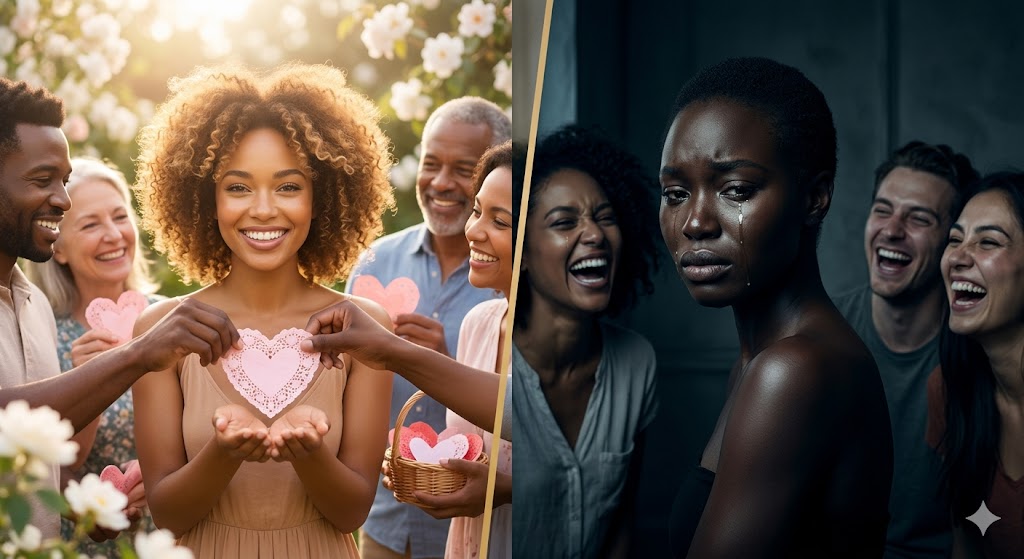
Colorism, a deeply embedded social hierarchy privileging lighter skin over darker tones within the same racial group, remains one of the most insidious legacies of colonialism and slavery. It operates not only as a cultural preference but as a structural system that shapes opportunity, identity, and human worth.
The phrase “lighter the love, darker the struggle” encapsulates a painful reality: proximity to whiteness often determines the degree of acceptance, affection, and advantage one receives in society. This dynamic is neither accidental nor modern—it is historically constructed and socially reinforced.
During the era of slavery in the Americas, lighter-skinned enslaved individuals—often the offspring of enslaved women and white enslavers—were frequently assigned domestic labor, while darker-skinned individuals endured harsher field conditions. This division created an early hierarchy based on skin tone that would persist long after emancipation (Hunter, 2007).
The continuation of this hierarchy can be seen in the post-slavery period through practices such as the “paper bag test,” where individuals were judged based on whether their skin tone was lighter than a brown paper bag. Such practices reinforced exclusion even within Black communities (Russell, Wilson, & Hall, 1992).
In contemporary society, colorism manifests in beauty standards that favor lighter skin, straighter hair, and Eurocentric features. These standards are perpetuated by global media, fashion industries, and advertising campaigns, shaping perceptions of desirability and worth.
Public figures like Lupita Nyong’o have spoken openly about their experiences with colorism, highlighting the emotional toll of growing up in a world that often devalues darker skin. Her narrative underscores the internal and external battles faced by many dark-skinned individuals.
Similarly, Viola Davis has addressed the limited opportunities available to dark-skinned actresses, pointing to systemic barriers that extend beyond individual talent or merit.
Colorism also plays a significant role in romantic relationships, where lighter-skinned individuals are often perceived as more desirable partners. Studies suggest that these preferences are influenced by internalized biases shaped by historical and cultural conditioning (Banks, 2000).
Within families, colorism can create divisions, with lighter-skinned children sometimes receiving preferential treatment. These early experiences contribute to long-term psychological effects, including self-esteem issues and identity conflicts (Thompson & Keith, 2001).
Economically, lighter-skinned individuals often experience measurable advantages. Research indicates that they tend to have higher levels of education, increased earning potential, and greater occupational mobility compared to their darker-skinned counterparts (Goldsmith, Hamilton, & Darity, 2007).
The concept of implicit bias helps explain how colorism persists even among individuals who consciously reject racist ideologies. These unconscious preferences influence decisions in hiring, promotion, and social interactions (Greenwald & Krieger, 2006).
Colorism is not limited to the United States; it is a global phenomenon affecting communities across Africa, Asia, Latin America, and the Caribbean. In many regions, skin-lightening products remain a billion-dollar industry, reflecting the widespread desire to conform to lighter beauty ideals.
The psychological burden of colorism is profound. Darker-skinned individuals often report feelings of invisibility, rejection, and the need to overcompensate to gain recognition and respect. This chronic stress can have lasting mental health implications.
Media representation continues to reinforce these disparities by disproportionately showcasing lighter-skinned individuals in leading roles, romantic storylines, and positions of success. This lack of representation shapes societal expectations and individual aspirations.
Despite these challenges, there has been a growing movement to celebrate dark skin and challenge colorist ideologies. Campaigns, literature, and social media movements are reclaiming narratives and affirming the beauty and worth of all skin tones.
Education plays a crucial role in dismantling colorism. By understanding its historical roots and contemporary manifestations, individuals and institutions can begin to challenge the biases that sustain it.
Faith-based perspectives also offer a counter-narrative, emphasizing the inherent value and divine creation of all people regardless of physical appearance. Scriptures remind believers that worth is not determined by outward appearance but by the heart (1 Samuel 16:7, KJV).
Addressing colorism requires intentional action at both individual and systemic levels. This includes challenging personal biases, advocating for inclusive representation, and implementing equitable policies in workplaces and institutions.
Community dialogue is essential in healing the divisions caused by colorism. Open conversations can foster understanding, accountability, and collective growth.
Ultimately, dismantling colorism is about restoring dignity and equity. It requires a rejection of hierarchical thinking and an embrace of diversity in its fullest expression.
“Lighter the love, darker the struggle” is not just a phrase—it is a call to awareness, justice, and transformation. By confronting this reality, society can move closer to a future where love, opportunity, and respect are not determined by the shade of one’s skin.
References
Banks, I. (2000). Hair matters: Beauty, power, and Black women’s consciousness. New York University Press.
Goldsmith, A. H., Hamilton, D., & Darity, W. (2007). From dark to light: Skin color and wages among African Americans. Journal of Human Resources, 42(4), 701–738.
Greenwald, A. G., & Krieger, L. H. (2006). Implicit bias: Scientific foundations. California Law Review, 94(4), 945–967.
Hunter, M. (2007). The persistent problem of colorism: Skin tone, status, and inequality. Sociology Compass, 1(1), 237–254.
Russell, K., Wilson, M., & Hall, R. (1992). The color complex: The politics of skin color among African Americans. Harcourt Brace Jovanovich.
Thompson, M. S., & Keith, V. M. (2001). The blacker the berry: Gender, skin tone, self-esteem, and self-efficacy. Gender & Society, 15(3), 336–357.
Discover more from THE BROWN GIRL DILEMMA
Subscribe to get the latest posts sent to your email.
 THE BROWN GIRL DILEMMA