
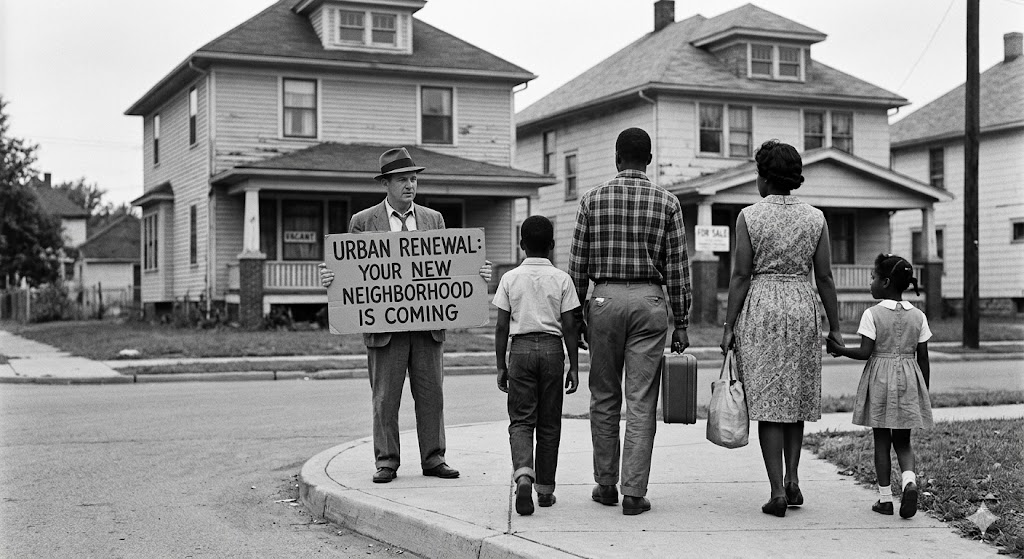
Urban renewal was a federal policy initiative in the United States during the mid-twentieth century that aimed to modernize cities by removing what officials labeled “blighted” neighborhoods and replacing them with new infrastructure, commercial developments, and highways. While the program was publicly framed as a strategy for economic progress and modernization, it disproportionately targeted Black communities. Critics, civil rights leaders, and historians began referring to the program as “Negro Removal” because of the widespread displacement of Black residents and the destruction of thriving Black neighborhoods.
Urban renewal programs were largely facilitated through the Housing Act of 1949, which provided federal funding to cities to acquire and redevelop urban land. Local governments were given authority to identify neighborhoods deemed deteriorated and to clear those areas for redevelopment projects. In practice, many of the communities targeted for demolition were predominantly Black neighborhoods with long-established social, cultural, and economic networks.
Cities such as Detroit, Atlanta, New Orleans, and St. Louis experienced significant displacement under urban renewal initiatives. Entire districts were demolished to make way for highways, sports arenas, government buildings, and private development projects. Although officials often promised that displaced residents would receive improved housing opportunities, many families were forced into overcrowded and segregated neighborhoods with limited economic resources.
One of the most famous examples of urban renewal’s destructive impact occurred in the Black community of Black Bottom neighborhood. Once a vibrant cultural and economic hub, Black Bottom was home to businesses, churches, jazz clubs, and thousands of residents. In the 1950s and 1960s, much of the neighborhood was demolished to construct freeways and urban development projects, displacing large numbers of Black families.
Urban renewal often worked in tandem with another discriminatory housing practice known as blockbusting. Blockbusting was a tactic used by real estate agents who deliberately spread fear among white homeowners by warning them that Black families were moving into their neighborhoods. Realtors suggested that property values would rapidly decline once Black residents arrived, encouraging white homeowners to sell their homes quickly—often at below-market prices.
After purchasing these homes cheaply, speculators resold them to Black families at significantly inflated prices. This practice accelerated racial turnover in neighborhoods while generating enormous profits for real estate investors. The racial panic associated with blockbusting contributed to widespread “white flight,” the migration of white residents from urban areas to suburban communities.
White flight dramatically reshaped the demographic structure of American cities. As white families moved to suburbs, they often gained access to federally backed mortgages and improved public services. Meanwhile, Black residents left behind in urban areas experienced declining tax bases, underfunded schools, and limited economic investment.
Highway construction played a major role in the displacement of Black communities during the twentieth century. Federal infrastructure programs, particularly those associated with the Federal-Aid Highway Act of 1956, funded the construction of interstate highways that frequently cut through minority neighborhoods. Planners often chose these locations because they were politically easier to acquire and faced less organized resistance.
The construction of highways destroyed thousands of homes, businesses, and community institutions within Black neighborhoods. These infrastructure projects divided communities physically and socially, making it more difficult for residents to maintain economic and cultural networks.
In cities such as Miami, Los Angeles, and Nashville, major highways were built directly through historically Black districts. These projects disrupted thriving commercial corridors and displaced thousands of residents who often received inadequate compensation for their lost property.
The consequences of these policies extended far beyond housing displacement. The destruction of Black neighborhoods also dismantled locally owned businesses, professional networks, and cultural institutions that had sustained Black economic independence.
School district zoning also reinforced segregation patterns created by housing discrimination and urban renewal. Because public school boundaries are often determined by residential neighborhoods, segregated housing patterns translated directly into segregated educational systems.
School district zoning inequality meant that children living in historically Black neighborhoods were often assigned to underfunded schools with fewer educational resources. Meanwhile, suburban districts—often populated primarily by white families—benefited from higher property tax revenues and stronger funding structures.
These educational disparities created long-term consequences for social mobility. Students attending underfunded schools frequently faced larger class sizes, fewer advanced academic programs, and limited access to college preparatory resources.
Another system that reinforced racial control following the abolition of slavery was convict leasing. Convict leasing emerged in the late nineteenth century when Southern states began leasing incarcerated individuals to private businesses for labor.
Under this system, prisoners—many of whom were Black men—were forced to work in mines, farms, railroads, and industrial operations. Historians often describe convict leasing as a form of re-enslavement because prisoners were subjected to harsh labor conditions without pay.
The convict leasing system disproportionately targeted Black men through discriminatory policing and legal practices. Minor offenses such as vagrancy or loitering were frequently used to arrest Black individuals, who were then sentenced to forced labor under leasing agreements.
Unlike traditional slavery, convict leasing allowed states to profit from incarcerated labor while avoiding the responsibility of maintaining prisoners’ welfare. Private companies that leased prisoners often subjected them to brutal conditions, leading to high rates of injury and death.
Although convict leasing formally declined in the early twentieth century, many scholars argue that elements of this system persist through modern prison labor practices and mass incarceration patterns.
The combined effects of urban renewal, blockbusting, highway construction, school zoning inequality, and convict leasing reveal how multiple systems worked together to reinforce racial inequality in American society. These policies were not isolated incidents but interconnected mechanisms that shaped housing patterns, economic opportunities, and educational access.
Understanding these historical practices helps explain the persistence of racial disparities in wealth, housing, and education today. The destruction of Black neighborhoods and the exclusion of Black families from economic opportunities contributed to the racial wealth gap that continues to exist in the United States.
Today, scholars and policymakers increasingly examine these policies as examples of structural racism embedded within public institutions. By studying these historical patterns, researchers hope to develop strategies that promote more equitable housing, education, and economic systems.
Ultimately, the history of urban renewal and related practices demonstrates how policies intended to modernize cities often produced lasting harm for marginalized communities. The legacy of these decisions continues to influence the social and economic landscape of American cities today.
References
Alexander, M. (2012). The new Jim Crow: Mass incarceration in the age of colorblindness. New York: The New Press.
Foner, E. (1988). Reconstruction: America’s unfinished revolution, 1863–1877. New York: Harper & Row.
Hirsch, A. R. (1983). Making the second ghetto: Race and housing in Chicago 1940–1960. Chicago: University of Chicago Press.
Jackson, K. T. (1985). Crabgrass frontier: The suburbanization of the United States. Oxford University Press.
Rothstein, R. (2017). The color of law: A forgotten history of how our government segregated America. Liveright Publishing.
Sugrue, T. J. (2014). The origins of the urban crisis: Race and inequality in postwar Detroit. Princeton University Press.
Blackmon, D. A. (2008). Slavery by another name: The re-enslavement of Black Americans from the Civil War to World War II. Anchor Books.
U.S. Department of Housing and Urban Development. (2023). History of housing discrimination and segregation in the United States.
Wilson, W. J. (2012). The truly disadvantaged: The inner city, the underclass, and public policy. University of Chicago Press.
Discover more from THE BROWN GIRL DILEMMA
Subscribe to get the latest posts sent to your email.
 THE BROWN GIRL DILEMMA