
Jim Crow laws were a system of legalized racial segregation in the United States, primarily in the South, which lasted from the late 19th century until the mid-1960s. These laws enforced the notion that Black Americans were inferior to whites, systematically restricting their access to public spaces, education, voting rights, and economic opportunity. The name “Jim Crow” itself originated from a racist minstrel show character, highlighting the deeply dehumanizing cultural underpinnings of the system.
The origins of Jim Crow can be traced to the post-Reconstruction era, when Southern states sought to maintain white supremacy after the abolition of slavery. Despite the promises of freedom under the 13th, 14th, and 15th Amendments, white elites implemented laws and practices designed to limit Black advancement, ensuring that social, political, and economic power remained concentrated in white hands.
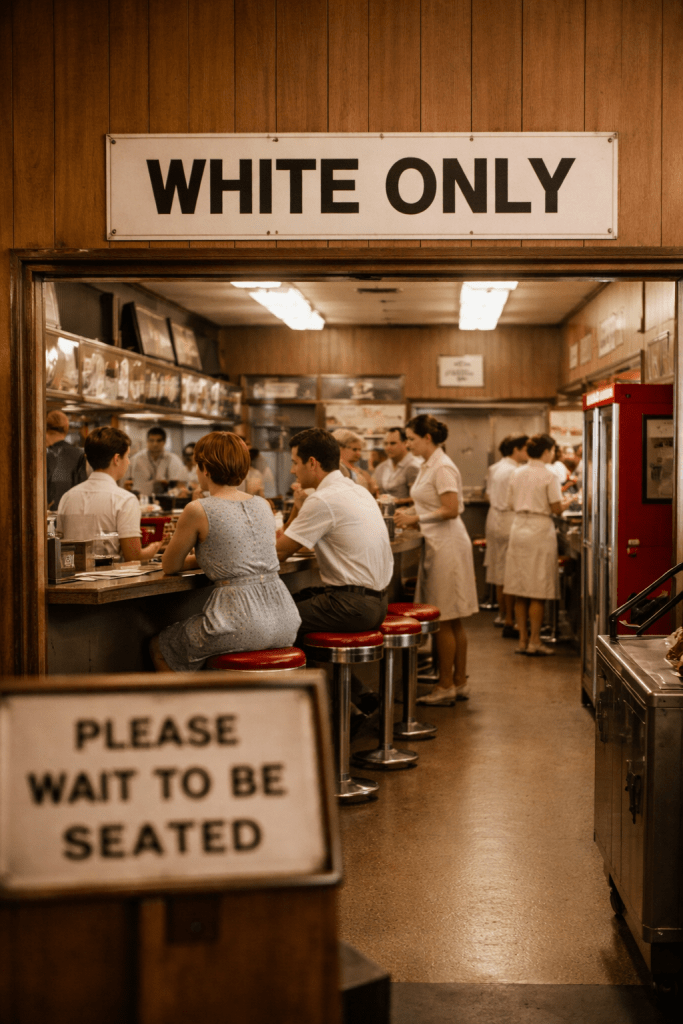
A “White Only” sign in a restaurant during the 1960s was a stark and visible symbol of Jim Crow segregation in the United States. Such signs were legally enforced in many Southern states, designating public spaces—restaurants, theaters, restrooms, water fountains, and more—where Black Americans were either denied entry entirely or relegated to inferior facilities.
These signs were not merely about seating; they reinforced a racial hierarchy, signaling that Black people were considered second-class citizens, unworthy of equal service or treatment. They were part of a broader system designed to maintain white supremacy socially, economically, and politically.
The presence of “White Only” signs had profound psychological and social effects. They dehumanized Black Americans, normalizing exclusion and instilling fear and shame. They also reinforced cultural prejudices in white communities, teaching white patrons that segregation was natural and morally acceptable.
Many Black Americans resisted these injustices through civil rights activism. Sit-ins at “White Only” lunch counters, such as the Greensboro sit-ins in 1960, challenged segregation directly, exposing the cruelty of the system and helping to galvanize national support for desegregation.
Legally, such signs were rendered unenforceable with the passage of the Civil Rights Act of 1964, which outlawed segregation in public accommodations. The removal of these signs symbolized the end of legal segregation, though the social and economic legacies of this discrimination persisted.
In short, a “White Only” sign in a 1960s restaurant was more than a notice—it was a tool of systemic oppression, a daily reminder of racial injustice, and a target for courageous activism in the fight for civil rights.
Under Jim Crow, public facilities were segregated, including schools, transportation, restrooms, restaurants, and theaters. Black citizens were forced into inferior accommodations, often with drastically fewer resources. This system reinforced the message that Black lives were less valuable and less deserving of dignity and opportunity.
Education for Black children under Jim Crow was deliberately underfunded. Schools were overcrowded, lacked textbooks and supplies, and were often housed in dilapidated buildings. This educational inequality limited social mobility, trapping generations of Black Americans in cycles of poverty and exclusion.
Voting rights were systematically restricted through measures such as literacy tests, poll taxes, and grandfather clauses. These tactics effectively disenfranchised most Black citizens in the South, silencing their political voices and denying them the ability to influence policies that affected their communities.
The economic effects of Jim Crow were devastating. Black workers were often relegated to low-paying, unstable jobs while being denied access to higher-paying, skilled labor opportunities. Sharecropping, tenant farming, and discriminatory hiring practices perpetuated economic dependency and vulnerability.
Segregation extended into healthcare, where Black patients faced limited access to hospitals, clinics, and trained physicians. Facilities for Black individuals were often under-resourced, and medical experimentation sometimes targeted Black communities without consent, reflecting the deeply embedded racial prejudice of the era.
Housing discrimination was another major consequence. Redlining and racially restrictive covenants prevented Black families from purchasing homes in certain neighborhoods. This not only limited wealth accumulation but also reinforced social segregation and concentrated poverty.
The legal system was complicit in maintaining Jim Crow. Black Americans were disproportionately targeted, arrested, and harshly sentenced, while white perpetrators often received lenient treatment. Courts upheld segregation and discriminatory laws, cementing structural racism in law and practice.
Social norms under Jim Crow reinforced the ideology of white superiority. Black individuals were subject to constant surveillance, harassment, and intimidation. Even minor perceived infractions of social etiquette could result in violent punishment, including lynching, which was often public and unpunished.
Lynching became a tool of terror used to enforce racial hierarchy. Thousands of Black men and women were murdered or brutally attacked for resisting oppression or simply existing outside the boundaries imposed by white supremacists. These acts were meant to instill fear and reinforce the perceived dominance of whites.
Jim Crow also affected the psychological well-being of Black communities. Continuous exposure to discrimination, exclusion, and violence created trauma that transcended generations. Black individuals internalized societal messages of inferiority, impacting self-esteem, mental health, and aspirations.
Resistance to Jim Crow took many forms. Organizations like the NAACP worked through legal challenges, advocacy, and education to dismantle segregation. Grassroots activism, boycotts, and acts of civil disobedience highlighted the courage and resilience of Black communities under oppression.
The Civil Rights Movement of the 1950s and 1960s directly confronted the injustices of Jim Crow. Landmark legislation, including the Civil Rights Act of 1964 and the Voting Rights Act of 1965, legally ended segregation and restored voting rights. However, the legacy of these laws persists in systemic inequalities and social attitudes.
Jim Crow fostered prejudice not only through law but also through cultural reinforcement. Media, literature, and everyday social interactions perpetuated stereotypes of Black inferiority, laziness, and criminality, creating a society that normalized racial hierarchy.
Racial prejudice under Jim Crow was enforced through both fear and ideology. Black Americans were taught to accept a subordinate status, while whites were socialized to view dominance as natural and justified. This dual reinforcement maintained systemic oppression for decades.
Family life was disrupted by Jim Crow. Economic constraints, restricted mobility, and threats of violence affected Black households, limiting opportunities for generational wealth and stability. Despite this, Black families often cultivated strong networks of support, faith, and community resilience.
Jim Crow shaped urban and rural landscapes. Segregated neighborhoods, schools, and institutions created spatial boundaries that reinforced inequality and restricted access to resources. These patterns of segregation continue to affect cities today.
The legacy of Jim Crow is evident in contemporary racial disparities. Disproportionate incarceration, educational inequities, and wealth gaps trace their roots to the structures and prejudices entrenched during this era. Understanding Jim Crow is essential to addressing these ongoing injustices.
Ultimately, Jim Crow represents the deliberate manipulation of law, culture, and social norms to maintain racial hierarchy. Its effects were profound, extending beyond the immediate physical restrictions to shape generational experiences of Black Americans. The struggle against Jim Crow is a testament to the resilience, courage, and enduring pursuit of justice by Black communities.
References
Woodward, C. V. (2002). The strange career of Jim Crow. Oxford University Press.
Litwack, L. F. (2009). Trouble in mind: Black southerners in the age of Jim Crow. Vintage.
Anderson, J. D. (1988). The education of Blacks in the South, 1860–1935. University of North Carolina Press.
Du Bois, W. E. B. (1935). Black reconstruction in America. Free Press.
Perman, M. (2001). Struggle for mastery: Disfranchisement in the South, 1888–1908. University of North Carolina Press.
Tolnay, S. E., & Beck, E. M. (1995). A festival of violence: An analysis of Southern lynchings, 1882–1930. University of Illinois Press.
Foner, E. (2011). Reconstruction: America’s unfinished revolution, 1863–1877. Harper Perennial.
Discover more from THE BROWN GIRL DILEMMA
Subscribe to get the latest posts sent to your email.
 THE BROWN GIRL DILEMMA