
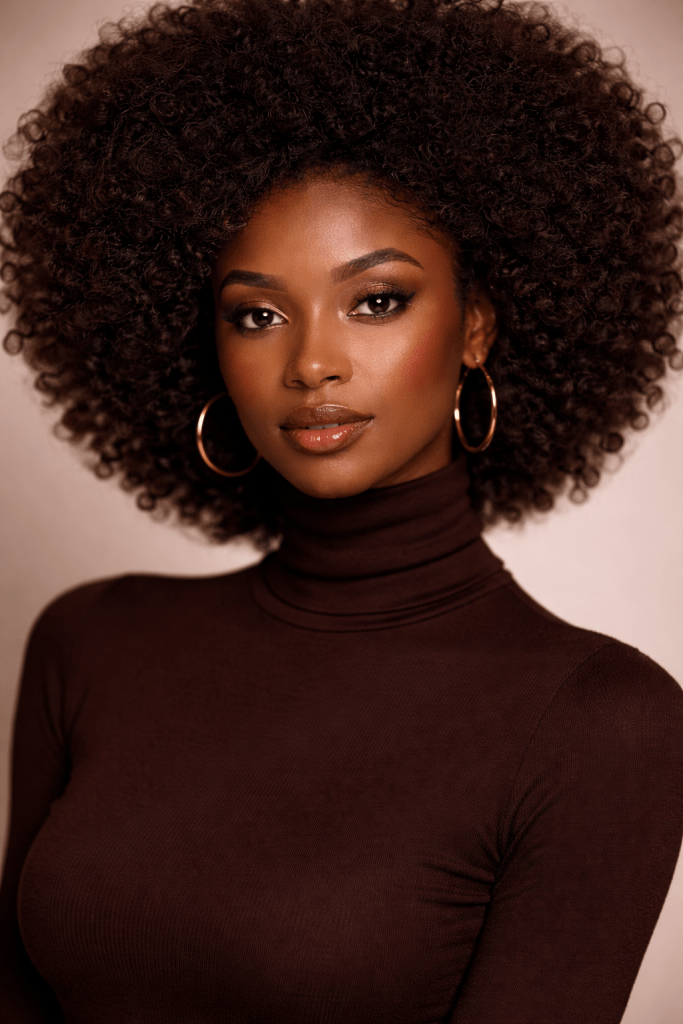
Black hair has long functioned as a cultural archive in Africa, encoding information about lineage, spirituality, marital status, age, occupation, and wealth. Across the continent, hair was never merely aesthetic; it was social language. Intricate braiding, sculptural coiffures, and the use of oils, beads, shells, gold thread, and cowries communicated rank and prosperity, situating the individual within a complex web of kinship and economy.
In many West and Central African societies, the care and styling of hair signified time, labor, and communal investment. Hairstyles that took hours or days to complete demonstrated access to leisure, skilled labor, and social networks—markers of wealth in precolonial economies where time itself was a resource. Hair thus operated as visible capital, reflecting one’s position within agrarian, mercantile, or royal systems.
Among the Yoruba, hair (irun) was closely associated with ori, the spiritual head believed to house destiny. Elaborate hairstyles accompanied rites of passage and royal ceremonies, underscoring hair’s sacred dimension. To damage or desecrate the hair was to threaten both social standing and spiritual integrity, a concept widely shared across African cosmologies.
In Wolof, Mandé, Akan, and Fulani cultures, hairstyles distinguished nobility from commoners and free people from the enslaved. Certain styles were restricted to royal households or warrior classes, while others marked griots, healers, or married women. Hair was a regulated symbol, reinforcing social order and economic hierarchy without written law.
Wealth in Africa was not only material but relational. Hairstyles often incorporated trade goods—beads from trans-Saharan routes, gold dust from Akan fields, or indigo-dyed threads—linking hair to continental and global commerce. These adornments made the head a site of economic display and interregional exchange.
Gendered meanings of hair further reflected socioeconomic status. Women’s hair often communicated fertility, marital eligibility, and household stability, while men’s hair could signify age-grade, military readiness, or priestly calling. In both cases, hair connected the body to productive and reproductive labor essential to wealth creation.
The violent rupture of the transatlantic slave trade deliberately targeted these meanings. Upon capture, African men, women, and children were often forcibly shaved. This act was not incidental hygiene; it was a calculated assault on identity, dignity, and memory. Shaving erased tribal markers, spiritual protections, and visible signs of status, rendering captives symbolically “blank.”
European slave traders justified head-shaving as a means to control lice and disease, yet the practice also facilitated commodification. Stripped of recognizable cultural signifiers, enslaved Africans were transformed into fungible labor units. The removal of hair assisted in breaking communal bonds and accelerating psychological disorientation.
On the auction block, shaved heads standardized bodies for sale. Without hairstyles to indicate nobility, skill, or ethnic origin, buyers assessed Africans primarily by age, musculature, and perceived productivity. The economics of slavery demanded depersonalization, and hair—once a ledger of social wealth—became an obstacle to profit.
The plantation regime extended this logic. Enslaved Africans were denied time, tools, and autonomy to care for their hair according to tradition. Scarcity of oils, combs, and communal grooming spaces disrupted cultural continuity. Over time, coerced neglect was weaponized as evidence of supposed African inferiority.
Colonial ideologies later pathologized African hair textures, labeling them “woolly” or “unkempt” in contrast to European norms. These racial hierarchies mapped aesthetics onto economics, positioning straight hair as “professional” and kinky hair as “primitive,” a legacy that persisted into post-emancipation labor markets.
After emancipation, hair became a site of survival. Many Black people altered or concealed natural hair to access employment and safety within white-dominated economies. Straightening practices, while often framed as assimilation, were pragmatic responses to structural exclusion rooted in slavery’s visual economy.
Despite this, African-descended communities preserved hair knowledge through oral tradition and innovation. Braiding patterns carried maps, kinship codes, and resistance strategies during enslavement, while post-slavery styles became acts of reclamation. Hair quietly remembered what history tried to erase.
In the twentieth century, Pan-Africanism and Black liberation movements explicitly reclaimed natural hair as political economy. Afros and locs rejected Eurocentric beauty standards and asserted continuity with African heritage, reframing hair as cultural wealth rather than liability.
Contemporary Africa and the diaspora continue to negotiate hair within global capitalism. The multibillion-dollar hair industry—often dominated by non-Black ownership—extracts value from Black bodies while stigmatizing natural textures. This paradox mirrors earlier patterns of exploitation, albeit in modern form.
Yet natural hair movements challenge this imbalance by re-centering African aesthetics as assets. Locally sourced shea butter, palm oil, and traditional grooming practices reconnect hair to indigenous economies and ecological knowledge, echoing precolonial systems of value.
Hair discrimination laws emerging in the United States and elsewhere acknowledge that hair-based bias is a civil rights issue, not mere preference. These policies implicitly recognize that hair has always been tied to access, labor, and economic mobility—just as it was during slavery.
Understanding the history of Black hair reveals slavery as not only a system of forced labor but of cultural theft. The shaving of African heads was an opening move in a broader project to sever people from their wealth—material, spiritual, and social.
To study Black hair is to study African political economy, cosmology, and resistance. It is a reminder that what grows from the head once carried nations, and that reclaiming it is an act of historical repair.
Today, as African and diasporic communities reassert control over their hair, they also reclaim narratives of wealth and worth long denied. In this sense, Black hair remains what it has always been: a crown, once shorn, now rising again.
References
Byrd, A. D., & Tharps, L. L. (2014). Hair story: Untangling the roots of Black hair in America. St. Martin’s Press.
Gomez, M. A. (1998). Exchanging our country marks: The transformation of African identities in the colonial and antebellum South. University of North Carolina Press.
Herskovits, M. J. (1958). The myth of the Negro past. Beacon Press.
Lovejoy, P. E. (2012). Transformations in slavery: A history of slavery in Africa (3rd ed.). Cambridge University Press. https://doi.org/10.1017/CBO9781139030116
Patton, T. O. (2006). Hey girl, am I more than my hair?: African American women and their struggles with beauty, body image, and hair. NWSA Journal, 18(2), 24–51. https://doi.org/10.2979/NWS.2006.18.2.24
Raboteau, A. J. (2004). Slave religion: The “invisible institution” in the antebellum South. Oxford University Press.
Sieber, R., & Herreman, F. (Eds.). (2000). Hair in African art and culture. Museum for African Art / Prestel.
Thornton, J. (1998). Africa and Africans in the making of the Atlantic world, 1400–1800 (2nd ed.). Cambridge University Press. https://doi.org/10.1017/CBO9780511583749
Discover more from THE BROWN GIRL DILEMMA
Subscribe to get the latest posts sent to your email.
 THE BROWN GIRL DILEMMA