
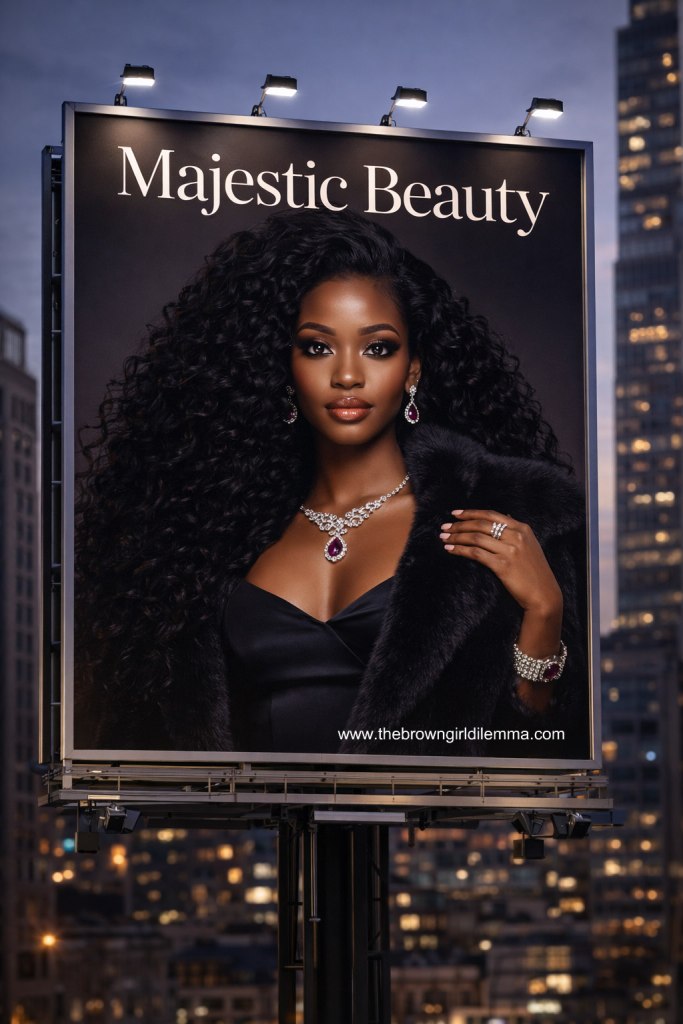
Black beauty has long existed as a site of contradiction—celebrated for its cultural power while simultaneously exploited for profit. The commodification of Black beauty refers to the process by which Black bodies, features, aesthetics, and cultural expressions are transformed into marketable assets, often detached from the people and histories that created them. This process operates within racial capitalism, where value is extracted from Blackness while Black lives remain devalued.
Historically, Black beauty was framed as inferior under slavery and colonialism. African features were caricatured, exoticized, or erased to justify domination. At the same time, Black women’s bodies were exploited for labor, reproduction, and spectacle. This duality—dehumanization alongside consumption—laid the foundation for modern beauty industries.
In contemporary culture, Black beauty is increasingly visible yet still controlled. Dark skin, full lips, thick bodies, and textured hair are celebrated when separated from Black people themselves. These traits are often deemed fashionable only after being filtered through non-Black bodies, granting profit and praise without the burden of racial stigma.
The global beauty industry profits enormously from Black consumers while promoting standards that marginalize them. Skin-lightening products, relaxers, and cosmetic procedures reinforce the idea that Black features require modification to be acceptable. Even “inclusive” marketing often reproduces hierarchy by privileging lighter skin and Eurocentric features.
Social media has accelerated commodification by turning Black beauty into content. Influencers monetize aesthetics through visibility, sponsorships, and algorithms that reward conformity to dominant standards. Authenticity becomes a brand, and self-expression becomes labor. Black beauty is no longer simply lived; it is performed for consumption.
Colorism remains a central mechanism in this economy. Lighter-skinned Black women are disproportionately chosen as brand ambassadors, romantic leads, and beauty icons. Darker-skinned women, when included, are often exoticized or tokenized, reinforcing a tiered system of value within Blackness itself.
The commodification of Black beauty also distorts self-perception. When worth is measured through market response—likes, sales, attention—identity becomes unstable. Beauty becomes something to manage, maintain, and monetize rather than an inherent expression of self and ancestry.
Gender intensifies these dynamics. Black women bear the heaviest burden of beauty commodification, facing both hypervisibility and erasure. They are expected to embody strength, sexuality, and resilience while remaining palatable to consumer markets that profit from their image.
Resistance emerges through reclamation. Natural hair movements, Afrocentric fashion, and Black-owned beauty brands challenge extraction by centering cultural ownership and self-definition. These movements insist that Black beauty is not a trend but a lineage.
Yet even resistance risks co-optation. Once profitable, counter-aesthetics are often absorbed into mainstream markets, stripped of political meaning. This cycle reveals the limits of representation without structural change.
True liberation requires decoupling Black beauty from market value. Visibility alone is insufficient if it serves consumption rather than dignity. Beauty must be allowed to exist without being sold.
The commodification of Black beauty ultimately reflects a deeper moral failure: a society willing to profit from Black aesthetics while refusing full respect for Black humanity. Undoing this contradiction demands ethical consumption, cultural accountability, and collective self-affirmation.
References
Banks, I. (2000). Hair matters: Beauty, power, and Black women’s consciousness. NYU Press.
Collins, P. H. (2004). Black sexual politics: African Americans, gender, and the new racism. Routledge.
Crenshaw, K. (1991). Mapping the margins: Intersectionality, identity politics, and violence against women of color. Stanford Law Review, 43(6), 1241–1299.
Hunter, M. (2007). The persistent problem of colorism: Skin tone, status, and inequality. Sociology Compass, 1(1), 237–254.
hooks, b. (1992). Black looks: Race and representation. South End Press.
Roberts, D. (1997). Killing the Black body: Race, reproduction, and the meaning of liberty. Pantheon Books.
Tate, S. A. (2015). Black beauty: Aesthetics, stylization, politics. Ashgate.
Discover more from THE BROWN GIRL DILEMMA
Subscribe to get the latest posts sent to your email.
 THE BROWN GIRL DILEMMA