
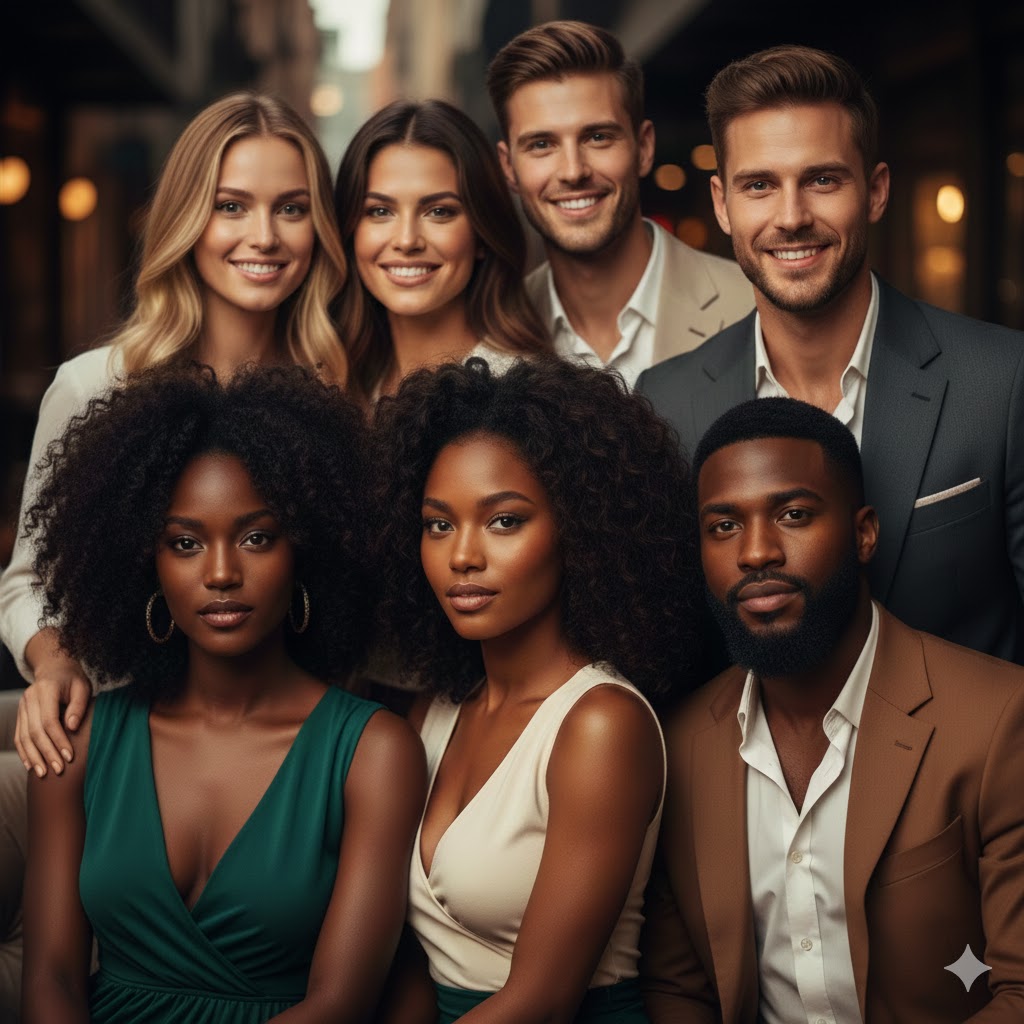
Beauty is more than an aesthetic trait; it functions as a powerful social currency that confers unearned advantages, often referred to as “faces of favor.” Those who align with culturally valorized standards of appearance—symmetry, clear skin, proportional features, and often Eurocentric traits—are perceived as more competent, trustworthy, and morally upright. These perceptions influence opportunities in education, employment, relationships, and social networks, granting the physically attractive privileges invisible to those judged less favorably.
Psychological research demonstrates that attractiveness shapes perception through the halo effect, a cognitive bias in which one positive characteristic—such as beauty—is generalized to other unrelated qualities. Dion, Berscheid, and Walster (1972) first documented this phenomenon, showing that attractive individuals are often assumed to possess intelligence, kindness, and integrity. Eagly et al. (1991) later confirmed that these assumptions are pervasive and unconscious, illustrating how appearances can distort social judgment.
Sociologically, beauty operates as a form of capital. Bourdieu (1986) identified multiple forms of capital—social, cultural, and economic—that confer power and influence. Aesthetic capital, or the advantages derived from physical attractiveness, functions similarly. Individuals with aesthetic capital receive preferential treatment from peers, authority figures, and institutions, creating a feedback loop of opportunity and recognition.
Economically, attractive individuals frequently benefit from higher wages, faster promotions, and greater professional visibility. Hamermesh (2011) notes that employers are influenced by appearance when assessing competence, often rewarding those whose physical presence aligns with socially constructed ideals. Conversely, unattractive individuals face subtle penalties: overlooked for leadership, questioned in credibility, and dismissed in social or professional contexts.
Race and colorism further complicate the distribution of aesthetic favor. Hunter (2007) highlights that lighter skin tones, often associated with European features, are disproportionately privileged in social, economic, and cultural contexts. Within and across racial groups, these biases reinforce hierarchies of beauty that intersect with gender and class, shaping who is seen, heard, and valued.
Women are especially impacted by faces of favor. Societal expectations tie female worth to physical appearance, creating an environment where attractiveness determines access to social capital and perceived morality. Attractive women often gain visibility and influence, yet they may also experience objectification, sexualization, and scrutiny. Unattractive women, on the other hand, risk invisibility, exclusion, and marginalization, reinforcing systemic inequities.
Men, while less scrutinized for beauty in some contexts, also experience the effects of appearance-based privilege. Attractiveness affects perceptions of leadership, charisma, and authority, influencing social and professional success. Those who deviate from masculine beauty norms may encounter bias, further demonstrating that faces of favor extend across genders, though with differing social consequences.
The media reinforces and amplifies these biases. Advertising, television, film, and social media platforms normalize narrow standards of beauty, rewarding conformity and marginalizing diversity. Images of attractive individuals dominate public consciousness, shaping cognitive associations between beauty, competence, and virtue. In contrast, those who do not conform remain underrepresented or depicted negatively, perpetuating social invisibility.
Colorism intensifies the hierarchy of favor, particularly within communities of color. Lighter-skinned individuals often receive more recognition, resources, and social mobility, while darker-skinned peers encounter compounded disadvantage. This aesthetic discrimination not only affects social interaction but also contributes to internalized bias, psychological stress, and diminished self-worth.
The halo effect, combined with societal conditioning, produces pervasive moral and social assumptions. Attractive individuals are more likely to be forgiven for transgressions, while less attractive individuals face harsher judgment for identical behavior. This unequal treatment reflects not merit but perception, creating systemic inequity rooted in appearance.
Educational environments are not immune. Teachers may unknowingly favor attractive students in participation, grading, and mentorship opportunities, conferring early social advantages. These biases accumulate over time, shaping career trajectories, social networks, and confidence levels. The long-term consequences of aesthetic favor are therefore both cumulative and structural.
Social networks themselves reinforce faces of favor. Attractive individuals are more likely to be included in social circles, gain influential connections, and receive mentorship, perpetuating cycles of advantage. Those outside these visual norms may be excluded, limiting access to social capital essential for personal and professional development.
In professional contexts, aesthetic privilege operates subtly yet decisively. Employers often equate visual appeal with professionalism, charisma, and capability. Even in roles where appearance is irrelevant to skill, the perception of favor influences hiring, promotion, and evaluation, producing inequitable outcomes that persist regardless of qualifications or performance.
Beauty intersects with wealth and class, further consolidating advantage. Those with resources can access grooming, cosmetic enhancement, and fashion that reinforce socially valued appearances. Consequently, faces of favor are not merely natural traits; they are cultivated and socially mediated, reflecting and perpetuating broader systems of inequality.
Psychologically, the social rewards of attractiveness contribute to increased confidence, assertiveness, and social influence. Conversely, those denied aesthetic favor experience social anxiety, self-doubt, and diminished social agency. These effects highlight how beauty functions not only as perception but as a structural determinant of life outcomes.
Cultural narratives often equate beauty with morality and goodness, perpetuating the notion that attractive individuals are inherently deserving of success. This myth reinforces aesthetic privilege and obscures the role of systemic advantage, creating moral and social illusions about merit and character.
Ethically, the unequal distribution of aesthetic privilege raises questions about justice and fairness. When appearance determines opportunity, recognition, and treatment, society implicitly sanctions discrimination. Such inequities are socially tolerated precisely because attractiveness is perceived as desirable, masking the structural and ethical harm inflicted upon the unattractive.
Historically, aesthetic favoritism intersects with race, class, and gender to reinforce societal hierarchies. Eurocentric features, lighter skin tones, and conventionally attractive facial symmetry have been associated with power, purity, and virtue, while deviation from these ideals often results in marginalization and punishment. Faces of favor are thus inseparable from broader systems of social stratification.
From a biblical perspective, these dynamics stand in contrast to divine valuation. Scripture repeatedly emphasizes that true worth is found in character, heart, and covenantal obedience rather than external appearance. In 1 Samuel 16:7, God reminds Samuel that “man looketh on the outward appearance, but the LORD looketh on the heart,” highlighting the danger of conflating visibility with virtue.
In conclusion, faces of favor reveal the profound influence of physical appearance on human perception, opportunity, and judgment. Beauty functions as both a social lubricant and a structural advantage, conferring privileges often invisible to those who benefit. Understanding the mechanisms, implications, and inequities associated with aesthetic favor is essential to cultivating fairness, equity, and recognition of intrinsic human value beyond appearance.
References
Anderson, T. L., Grunert, C., Katz, A., & Lovascio, S. (2010). Aesthetic capital: A research review on beauty perks and penalties. Sociology Compass, 4(8), 564–575.
Bourdieu, P. (1986). The forms of capital. In J. Richardson (Ed.), Handbook of theory and research for the sociology of education (pp. 241–258). Greenwood Press.
Dion, K., Berscheid, E., & Walster, E. (1972). What is beautiful is good. Journal of Personality and Social Psychology, 24(3), 285–290.
Eagly, A. H., Ashmore, R. D., Makhijani, M. G., & Longo, L. C. (1991). What is beautiful is good, but… Psychological Bulletin, 110(1), 109–128.
Feingold, A. (1992). Good-looking people are not what we think. Psychological Bulletin, 111(2), 304–341.
Hamermesh, D. S. (2011). Beauty pays: Why attractive people are more successful. Princeton University Press.
Hunter, M. (2007). The persistent problem of colorism. Sociology Compass, 1(1), 237–254.
Langlois, J. H., et al. (2000). Maxims or myths of beauty? Psychological Bulletin, 126(3), 390–423.
Rhode, D. L. (2010). The beauty bias: The injustice of appearance in life and law. Oxford University Press.
Webster, M., & Driskell, J. E. (1983). Beauty as status. American Journal of Sociology, 89(1), 140–165.
Wilson, T. D. (2002). Strangers to ourselves: Discovering the adaptive unconscious. Harvard University Press.
Discover more from THE BROWN GIRL DILEMMA
Subscribe to get the latest posts sent to your email.
 THE BROWN GIRL DILEMMA