
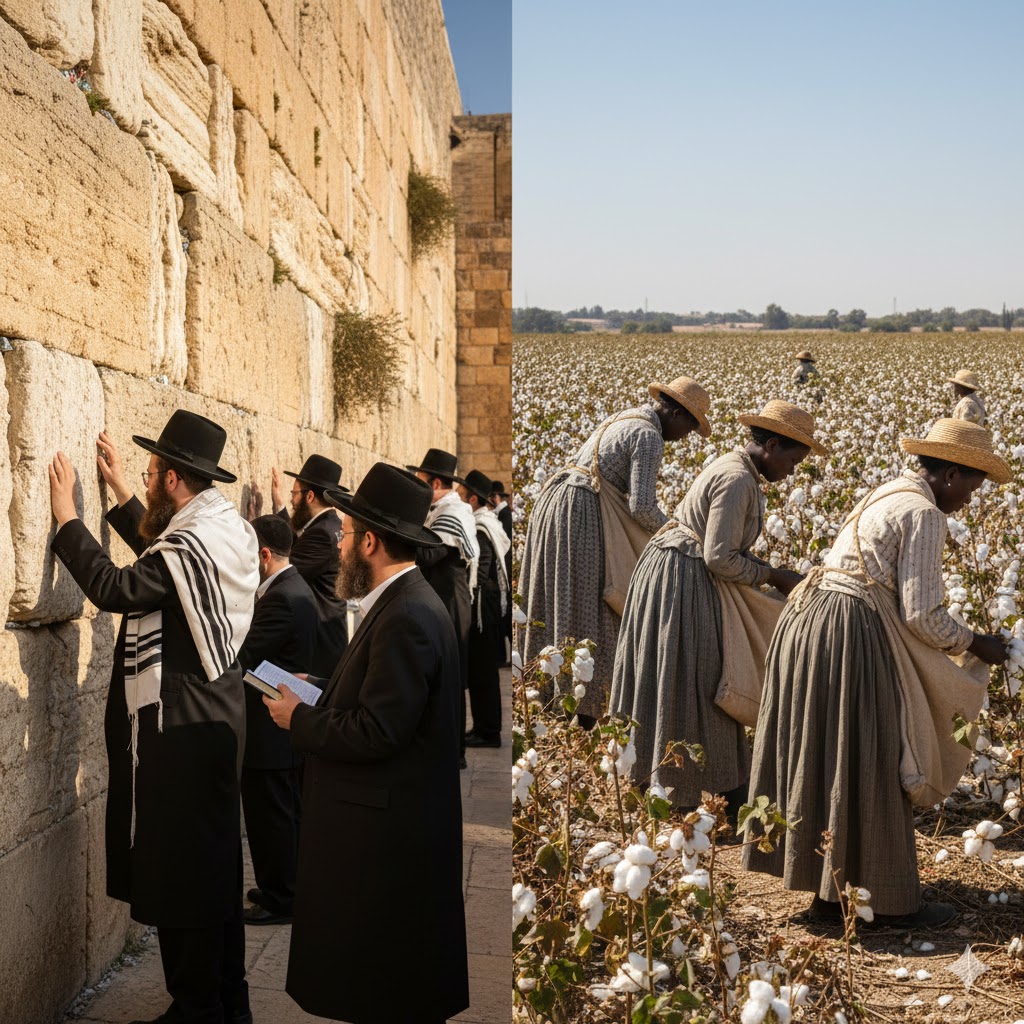
Modern Zionism, as a political ideology, emerged in the late nineteenth century as a movement seeking to establish a Jewish homeland in the ancient land of Palestine. While its cultural and religious motivations often point to biblical narratives, the modern political project was shaped far more by European nationalism, colonial power structures, and the trauma of antisemitism than by any verifiable lineage-linked claim to ancient Israelites. The idea that European Jews, particularly Ashkenazim, are the direct descendants of the biblical Hebrews has been widely debated by historians, geneticists, and sociologists, raising serious questions about the authenticity of the core claim that modern Zionism rests upon.
White supremacy and modern Zionism intersect where racial hierarchy, colonial power, and political domination converge. Modern Zionism emerged in a European colonial era, shaped by Western racial ideologies that positioned European identity—whether Christian or Jewish—as superior to non-European peoples. Although Zionism presented itself as a liberation movement, it often adopted the logic and structures of white supremacy: land seizure, racial stratification, and the belief that a European-descended population had a divine or historical right to rule over an indigenous non-European population. This framing aligned Zionism with broader colonial projects, treating Palestinians as inferior, primitive, or expendable, thereby justifying displacement, segregation, and militarized control.
White supremacy also reinforces modern Zionism through geopolitical alliances. Western nations—rooted in histories of racial hierarchy—have long supported Israel as a strategic extension of their own political power, often valuing a European-aligned state over the rights of Middle Eastern or African populations. In this dynamic, Palestinians are racialized as threats, savages, or terrorists, while Israeli identity—particularly Ashkenazi identity—is coded as Western, civilized, and deserving of protection. Thus, white supremacy operates not merely as personal prejudice but as a global structure that elevates one group’s claim to land and power while systematically dehumanizing and dispossessing another.
Biblically: Zion is a Place, Not a People
In Scripture, Zion first referred to a location:
- Originally: The ancient fortress David captured (2 Samuel 5:7).
- Later: Jerusalem as a whole.
- Symbolically: The dwelling place of God, the seat of His rule, and the future center of His restored kingdom.
Zion was never originally an ethnic label—it was the sacred mountain-city where God chose to place His name.
Spiritually: Zion = God’s Chosen People Who Keep His Covenant
While Zion is a place, Scripture also uses it symbolically to describe:
- The people who obey God.
- The remnant who remain faithful.
- Those who keep His covenant and walk in His statutes.
Examples:
“These people have I formed for myself” (Isaiah 43:21).
“Out of Zion shall go forth the law” (Isaiah 2:3).
“The Lord loveth the gates of Zion more than all the dwellings of Jacob” (Psalm 87:2).
This means Zion is both a location and a covenant community.
Historically: Zion Referred to the Israelites, Not Europeans
Before the modern political movement of Zionism:
- Zion = the land of Israel
- Zion = the ancient Israelites, a Semitic Afro-Asiatic people
- Zion = Jerusalem’s holy center
Zion was intimately tied to the original Hebrew people, not to converts, settlers, or later European identities.
In Hebraic Black Scholarship: Zion Refers to the Scattered True Israelites
Many scholars, theologians, and researchers argue that:
- The true descendants of ancient Israel are predominantly found among the peoples who endured the transatlantic slave trade.
- Zion, therefore, symbolizes the scattered, oppressed, covenant people described in Deuteronomy 28.
- These communities often maintained spiritual memory, oral tradition, and cultural markers that align with biblical Israel.
Thus, in this theological worldview:
- Zion = the children of Israel scattered to the four corners of the earth.
- Zion = the people God will gather again (Isaiah 11:11–12).
- Zion = those who bear the covenant signs, not political claims.
Politically: Modern Zionism Redefined “Zion”
Modern political Zionism (late 1800s) shifted the meaning:
- It turned Zion into a European nationalist project.
- It claimed Ashkenazi Jews—often of mixed or European origin—were the rightful “Zion.”
- It used ancient biblical language to justify a modern state-building effort.
This political redefinition does not match biblical, genetic, or historical lineage.
So—Who Is the Real Zion?
Biblically
Zion = The holy mountain and the people who keep God’s covenant.
Historically
Zion = The original Israelites of the ancient Near East.
Spiritually
Zion = God’s faithful remnant.
Prophetically (Isaiah, Jeremiah, Revelation)
Zion = The scattered children of Israel, whom God will regather at the end.
According to many Black Hebraic scholars
Zion = The descendants of the lost tribes found in the African diaspora, especially those taken into slavery—those whose history matches the curses and prophecies of Deuteronomy 28.
The real Zion is not a political state, a modern ideology, or a European nationalist project.
The real Zion is the covenant people of God—those descended from ancient Israel and those who remain faithful to His commandments.
One of the primary arguments supporting Zionism is the belief in a continuous, unbroken ethnic and genealogical connection between today’s Jewish populations and ancient Israelites. However, numerous scholars argue that Jewish identity across history has not been a single, pure genetic line, but an evolving, diverse, and often converted population. Groups such as the Ashkenazi, Sephardi, Mizrahi, Ethiopian Beta Israel, and others have distinct origins, many of which do not trace exclusively to ancient Judea.
Ashkenazi populations, who form the majority of global Jewry and historically shaped Zionist leadership, have been shown in many genetic studies to possess strong European admixture. Some research posits that a significant portion of their ancestry is linked to the Khazar Empire, a medieval Turkic people who converted to Judaism between the 8th and 10th centuries. This possibility undermines the idea that all modern Jews are “returning” to a land to which they share direct bloodline ties.
Furthermore, the cultural Judaism practiced across Europe evolved separately from the Hebraic practices of the ancient Israelites. The Yiddish language, for example, developed from Middle High German, Slavic, and Hebrew elements—demonstrating an identity shaped by Europe rather than the Middle East. The constructed narrative of a singular Jewish lineage has been used politically to justify territorial claims, often overshadowing the nuanced and diverse history of Jewish communities.
Modern Zionism also relies on the interpretation that biblical promises apply directly to modern political entities. This conflation of ancient religious texts with contemporary geopolitics is highly contested. Many theologians and scholars argue that biblical covenants were spiritual in nature and never intended to justify political conquest or displacement. The attempt to merge scripture with nationalism turns a theological dialogue into a political weapon.
A major critique of Zionism is its reliance on selective historical memory. While the movement highlights episodes of Jewish presence in ancient Israel, it minimizes or erases the continuous presence of Palestinian Arabs—Muslims, Christians, and Jews—who lived in the region for centuries. Prior to Zionist settlement, Palestine was a multiethnic and multireligious society with its own traditions, governance, and identity.
The claim of “a land without a people for a people without a land,” widely circulated by early Zionists, has been thoroughly discredited. Palestine was far from empty; it was home to thriving agricultural villages, bustling towns, and established families who traced their lineage in the land for generations. To claim otherwise is to rewrite history.
European powers played a major role in shaping and validating Zionism, not because of ancestral truths, but because of colonial interests. The Balfour Declaration of 1917 promised a “national home for the Jewish people” in Palestine without consulting its indigenous Arab population, revealing how Zionism functioned within British imperial strategy rather than ancient heritage.
The displacement of over 700,000 Palestinians in 1948—known as the Nakba—demonstrates the real-world consequences of building a nation-state on a contested historical claim. Entire villages were depopulated or destroyed to make room for a modern Zionist state. For Palestinians, the narrative of ancestral return became, in practice, an instrument of dispossession.
Many Jewish scholars have also criticized the racialized ideology embedded in Zionism. The notion of a chosen lineage returning to its promissory homeland can inadvertently elevate one ethnic identity over others. Such exclusionary nationalism clashes with Jewish ethical teachings that emphasize justice, compassion, and the protection of the oppressed.
Additionally, modern genetic research on Middle Eastern populations shows that Palestinians, Bedouins, Samaritans, and other Levantine groups share strong genetic ties to the ancient Israelites. Ironically, many Palestinians may be more genetically linked to the people of the Bible than some populations claiming ancestral return.
Modern Zionism’s most controversial claim is that ancient biblical texts justify contemporary political borders. Sacred texts, however, are theological documents—not land deeds. Many religious scholars argue that Zionism’s use of scripture is a misinterpretation that conflates divine promise with political entitlement.
The belief that all Jewish people originated from a single geographic and ethnic source has been rejected by numerous anthropologists. Jewish identity historically spread through conversion, intermarriage, and cultural assimilation, forming what scholars call a “religio-ethnic tapestry” rather than a singular bloodline.
The modern State of Israel’s identity politics also raise questions about who qualifies as a Jew and who does not. The constant debates over conversion standards, matrilineal descent, and “who is Jewish enough” reveal internal recognition that lineage claims are not as straightforward as political rhetoric suggests.
For many critics, the foundational claim of Zionism functions less as a historical truth and more as a political myth—one that legitimizes land acquisition and nation-building at the expense of another people’s ancestral rights. In this way, Zionism resembles other nationalist movements that reframe or romanticize history to construct a unified ethnic identity.
This does not negate the real suffering of Jewish communities throughout history, nor does it diminish their right to safety. But it does raise critical questions about how historical narratives are used to justify territorial claims, warfare, settlement expansion, and apartheid-like conditions for the Palestinian population.
The ongoing conflict in the region is inseparable from the foundational narrative that modern Zionism promotes. When a political ideology depends on a singular interpretation of ancient identity, it becomes resistant to dialogue, compromise, and historical truth. Critical examination is necessary to understand how mistaken historical claims have shaped decades of violence and displacement.
Many Jewish voices, including rabbis, historians, and activists, have warned that the misuse of ancestry risks corrupting Jewish values and causing harm in the name of heritage. They argue that the true essence of Jewish identity lies in ethics, community, and spirituality—not in territorial entitlement rooted in questionable genealogy.
Ultimately, the claim that modern Zionism is built on ancient, exclusive bloodline ties to the land of Palestine is not supported by the weight of historical, genetic, or anthropological evidence. Rather, modern Zionism is a political project shaped by European nationalism, colonial alliances, and collective trauma.
Understanding this distinction is essential for meaningful dialogue, justice, and reconciliation. When we separate myth from historical reality, we gain clarity about the roots of the conflict and the paths toward a future not driven by racialized claims, but by human dignity and mutual recognition.
References
Belfer, E. (2018). Nationalism and the politics of ancient claims. Oxford University Press.
Elhaik, E. (2013). The missing link of Jewish European ancestry: Investigating the Khazar hypothesis. Genome Biology and Evolution, 5(1), 61–74.
Khalidi, R. (2020). The hundred years’ war on Palestine. Metropolitan Books.
Pappé, I. (2006). The ethnic cleansing of Palestine. Oneworld.
Sand, S. (2009). The invention of the Jewish people. Verso Books.
Tolan, S. (2020). The biblical claim and the politics of memory. Cambridge University Press.
Discover more from THE BROWN GIRL DILEMMA
Subscribe to get the latest posts sent to your email.
 THE BROWN GIRL DILEMMA