
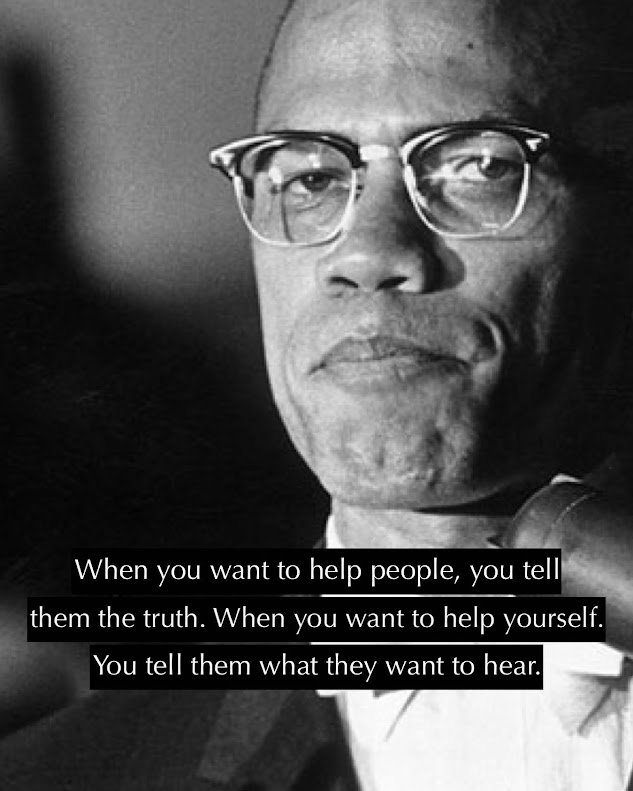
Malcolm X occupies a singular place in the global liberation narrative. More than an activist or orator, he was a psychological architect of Black consciousness—one who shattered internalized inferiority, challenged systems of domination, and reconstructed Black identity on the pillars of knowledge, discipline, dignity, and divine self-worth. His message was not merely political but deeply psychological and spiritual: liberation begins in the mind before it manifests in the world.
Malcolm X understood that oppression functions through psychological mechanisms long before chains or laws are imposed. Colonialism and slavery inflicted wounds on Black identity, systematically eroding self-perception and community cohesion. As he stated, “The greatest mistake of the movement has been trying to organize a sleeping people around specific goals. You have to wake the people up first.” Awakening—not appeasement—was his mission. His emphasis on mental elevation reflected a core truth of liberation psychology: freedom is impossible when the oppressed unconsciously adopt the worldview of their oppressor (Fanon, 1952).
Through teachings rooted in historical reclamation, religious discipline, and moral rectitude, Malcolm X sought to reconstruct the Black psyche. He insisted that Black people must unlearn inferiority, reclaim ancestral dignity, and reject white supremacist valuations of humanity. To him, Black liberation required a sacred internal covenant: “Who taught you to hate yourself?” This question was not rhetorical—it was psychological surgery, cutting away mental chains forged by centuries of dehumanization.
Malcolm X’s philosophy aligns with the principles of Afrocentric psychology, which asserts that healing begins when Black people see themselves as agents of divine and historical purpose (Nobles, 1986). He created a mirror for Black people to witness their brilliance, history, and potential. By redefining self-perception, he disrupted the neurological imprint of oppression. Identity became resistance; pride became political armor.
Self-defense in Malcolm X’s framework extended beyond physical protection. It was also emotional, intellectual, and spiritual defense against systems that distort Black humanity. He believed the oppressed should not tolerate violence, humiliation, or psychological manipulation. His doctrine of self-respect—“We are nonviolent with people who are nonviolent with us”—restored psychological agency. The right to dignity was not negotiable.
Malcolm X’s stance on separation versus integration reflected deeper psychological logic. He opposed integration not out of hatred, but as resistance against internal assimilation into a hostile system. Integration without empowerment, he warned, reinforces dependency and preserves structural dominance. True liberation required building, not begging; creating institutions rooted in Black values, not blending into systems built to erase them.
His later years, shaped by pilgrimage and expanded global consciousness, marked a psychological evolution rather than contradiction. Experiencing a multiracial brotherhood of faith during Hajj led him to condemn racism universally. Yet he never abandoned the psychological duty to uplift Black people. Global human brotherhood remained conditional on justice and equality. His transformation did not soften his message—it broadened its moral and spiritual reach.
Malcolm X challenged Black people to embrace intellectual rigor. He was a student of history, law, sociology, geopolitics, and scripture. He believed literacy and knowledge were weapons, echoing the biblical call to renewal of the mind (Romans 12:2). His discipline—prayer, study, dietary structure, moral constraint—modeled psychological sovereignty. Liberation was not chaos; it was ordered growth.
His advocacy for the protection and elevation of Black women was revolutionary psychological intervention. “The most disrespected person in America is the Black woman.” In affirming her worth, he restored the psychological core of Black family and nationhood. He recognized that no people rise without honoring their mothers, daughters, and sisters.
Malcolm X understood that fear of the oppressor maintains oppression. He believed courage—spiritual, intellectual, communal—breaks generational trauma. His life demonstrated that proximity to oppression does not determine destiny—consciousness does. He did not merely preach freedom; he embodied the psychological evolution required for it.
In the end, Malcolm X was martyred not only for challenging white supremacy but for awakening a sleeping people. His legacy endures because he taught that liberation is not granted—it is claimed. It begins with truth, expands through knowledge, matures in discipline, and manifests in unity and divine conviction.
To study Malcolm X through the lens of psychology is to recognize that his revolution was internal before it was external. He gave Black people back their minds, their names, their dignity, and their sacred understanding of self. His legacy remains a clarion call: liberation begins when the oppressed believe they are worthy of freedom, capable of power, and destined for greatness.
References
Fanon, F. (1952). Black Skin, White Masks. Grove Press.
Nobles, W. (1986). African Psychology: Toward Its Reclamation, Reascension and Revitalization. Black Family Institute.
Discover more from THE BROWN GIRL DILEMMA
Subscribe to get the latest posts sent to your email.
 THE BROWN GIRL DILEMMA