
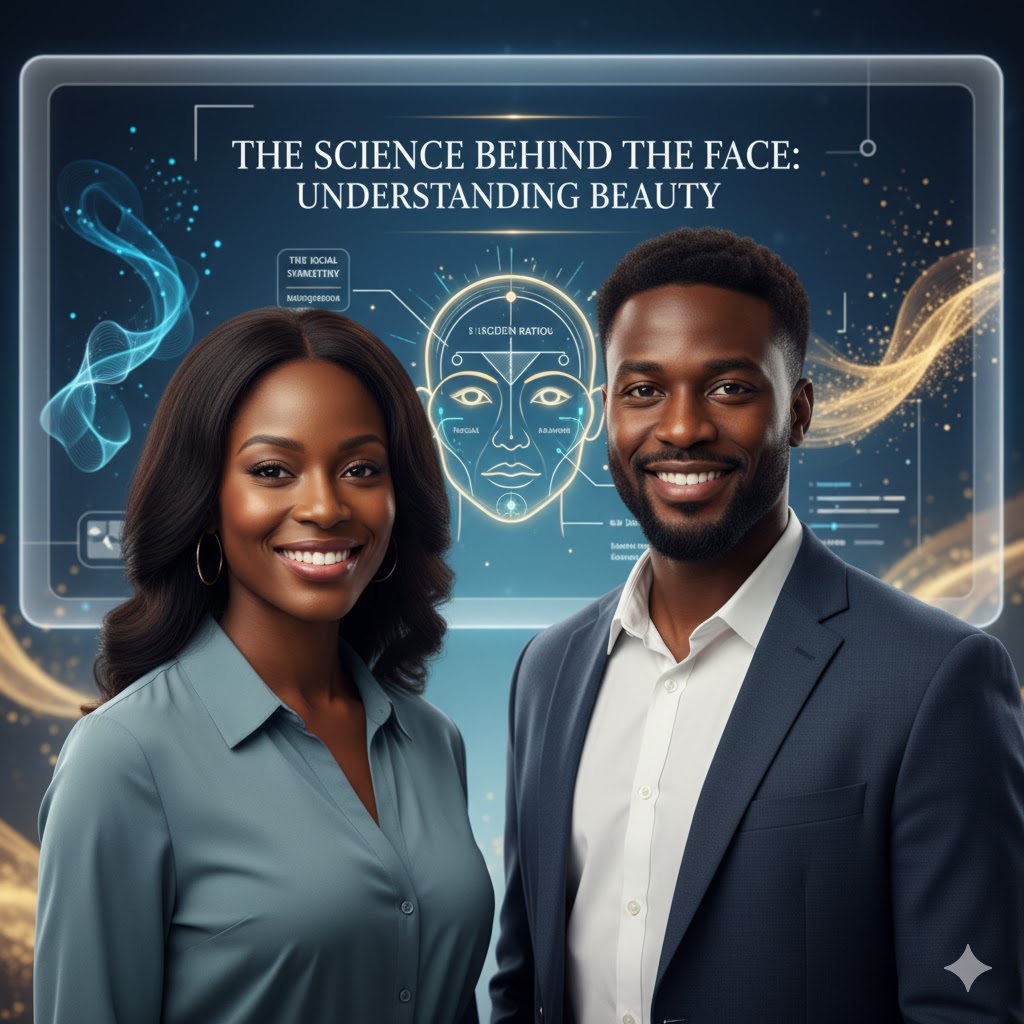
Human fascination with beauty is universal, transcending cultures and centuries. The human face, as the most expressive and recognizable feature, has been the subject of both scientific study and artistic admiration. While societal standards influence perceptions of attractiveness, research in psychology, anatomy, and genetics reveals measurable factors that shape our judgments of beauty. Faith reminds us, however, that every face reflects God’s divine design.
1. Symmetry and Attraction
Facial symmetry is one of the most robust predictors of perceived attractiveness. Symmetrical faces are often rated as healthier, more balanced, and more appealing. Evolutionary psychology suggests that symmetry signals genetic fitness and developmental stability (Rhodes, 2006).
2. The Golden Ratio
The “golden ratio” (Phi, approximately 1.618) defines proportional relationships considered aesthetically pleasing. Applied to facial features, the distance between the eyes, the width of the nose, and the placement of the lips often reflect this ratio. Cultures unconsciously prefer faces that approximate these proportions.
3. Skin Tone and Texture
Even, clear skin signals health and youth, which are universally attractive traits. Cultural perceptions of skin tone are shaped by historical and social factors, often resulting in colorism. While lighter or more uniform skin may be preferred in some societies, all skin tones reflect the divine image of God (Psalm 139:14).
4. Hormonal Influences
Facial features often reflect hormonal markers of fertility and vitality. High cheekbones, a defined jawline, and full lips may indicate estrogen levels in women, while strong jawlines and brow ridges suggest testosterone in men. These cues are subconsciously interpreted as indicators of reproductive health.
5. Age and Youthfulness
Youthful features—smooth skin, full lips, and bright eyes—are often rated as more attractive. Research suggests this preference is linked to evolutionary drives, but spiritually, youthfulness is not the only measure of beauty. Wisdom and grace, as cultivated over time, reflect God’s design.
6. Facial Expression and Microexpressions
Beauty extends beyond physical features. Emotional expression, such as smiling or engaging eyes, enhances attractiveness. Microexpressions convey kindness, warmth, and empathy, making a face appear more appealing. Faith affirms that inner beauty radiates outward (1 Peter 3:3-4).
7. Cultural Influences
Beauty standards vary widely across cultures and epochs. Media and fashion often amplify narrow ideals, frequently favoring Eurocentric features. However, cultural diversity demonstrates that beauty is multifaceted, and global studies highlight varying preferences in facial features and expressions.
8. Colorism and Social Bias
Skin tone preferences can influence social outcomes, including dating, employment, and representation in media. Colorism, a form of bias privileging lighter skin within the same ethnic group, perpetuates inequality. Scientific understanding can help dismantle these prejudices while affirming the divine worth of all skin tones.
9. Facial Proportions and Cognitive Perception
The human brain evaluates faces holistically, integrating symmetry, proportion, and feature spacing. Neuroscience shows that certain facial ratios trigger reward pathways in the brain, creating a sense of visual pleasure.
10. Genetics and Heredity
Genetic inheritance plays a significant role in facial structure and features. Traits such as eye shape, nose width, and cheekbone prominence are influenced by ancestry. Recognizing this highlights the diversity of beauty and its roots in God’s creation.
11. The Role of Health Indicators
Perceived beauty often correlates with visible health markers: skin clarity, hair quality, and eye brightness. These indicators are evolutionarily significant but also remind us that self-care reflects stewardship of God’s gift of the body.
12. Symmetry vs. Individuality
While symmetry is appealing, perfectly symmetrical faces are rare. Unique features—freckles, dimples, and small asymmetries—often contribute to perceived attractiveness, demonstrating that God’s creativity celebrates individuality.
13. Psychological Effects of Beauty
Physical attractiveness influences social perception, confidence, and interpersonal outcomes. People often associate beauty with positive traits such as intelligence and kindness, though these assumptions are not always accurate. Awareness of these biases allows for more equitable social interactions.
14. Media, Technology, and Altered Perceptions
Social media, photography, and filters can distort beauty standards, creating unrealistic expectations. While science studies human perception, faith reminds us that true beauty is not defined by comparison but by alignment with God’s image.
15. Inner Beauty and Spirituality
Psychological research confirms that inner qualities—kindness, empathy, and integrity—significantly enhance perceived attractiveness. Scripture emphasizes that God values the heart over outward appearance (1 Samuel 16:7).
16. Cross-Cultural Variation
Studies across continents show differing preferences for features such as nose width, eye shape, and lip fullness. These variations underscore that beauty is not absolute but interpreted through cultural, social, and psychological lenses.
17. Beauty Across the Lifespan
While youth is often idealized, beauty in maturity reflects wisdom, experience, and grace. Aging gracefully embodies a different form of aesthetic appeal, aligned with spiritual depth.
18. Overcoming Bias Through Awareness
Understanding the science of beauty empowers individuals to challenge stereotypes, reduce lookism, and appreciate diversity. Faith-based perspectives reinforce that all people are made in God’s image, deserving honor and respect.
19. Integrating Science and Faith
Scientific insights explain perception, symmetry, and preference, but faith affirms intrinsic value. Beauty is not merely external; it integrates moral character, spiritual integrity, and divine design.
20. Conclusion
The science behind the face reveals measurable aspects of beauty: symmetry, proportion, skin quality, and expression. Yet, true beauty transcends these factors, rooted in the divine blueprint and reflected in the soul. Recognizing both the scientific and spiritual dimensions of beauty allows us to appreciate God’s creation fully. Every face—unique, fearfully, and wonderfully made—is a testament to His glory (Psalm 139:14).
References
- Hunter, M. L. (2007). The persistent problem of colorism: Skin tone, status, and inequality. Sociology Compass, 1(1), 237–254. https://doi.org/10.1111/j.1751-9020.2007.00006.x
- Rhodes, G. (2006). The evolutionary psychology of facial beauty. Annual Review of Psychology, 57(1), 199–226. https://doi.org/10.1146/annurev.psych.57.102904.190208
- Russell-Cole, K., Wilson, M., & Hall, R. E. (2013). The color complex: The politics of skin color among African Americans. Anchor Books.
- Psalm 139:14 (KJV).
- 1 Peter 3:3-4 (KJV).
- 1 Samuel 16:7 (KJV).
Discover more from THE BROWN GIRL DILEMMA
Subscribe to get the latest posts sent to your email.
 THE BROWN GIRL DILEMMA