
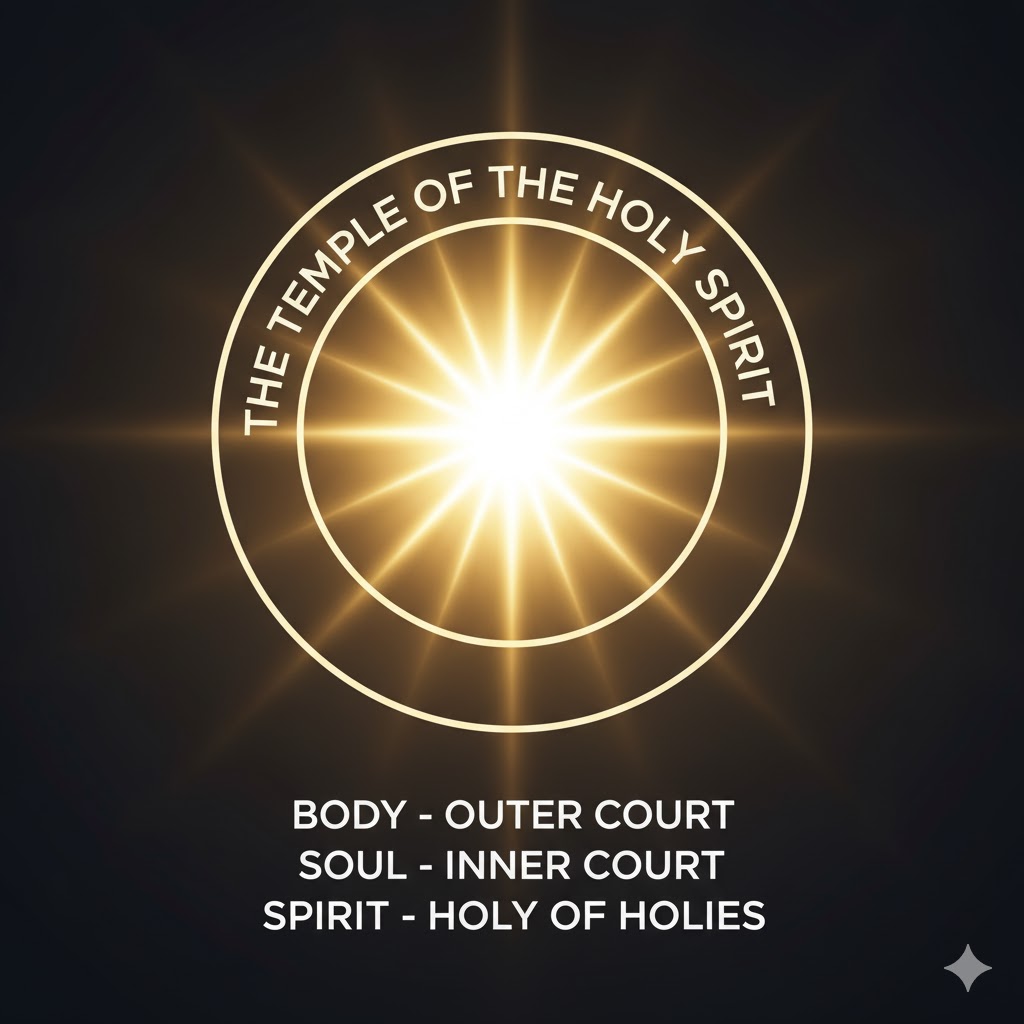
The Temple of the Holy Spirit
(1 Corinthians 6:19–20 KJV)
“What? know ye not that your body is the temple of the Holy Ghost which is in you, which ye have of God, and ye are not your own?”
The human being is a sacred temple composed of three divine courts—the body (outer court), the soul (inner court), and the spirit (Holy of Holies). Each has spiritual “gates” that must be guarded, purified, and dedicated to God.
🕊 Holy Spirit Gates (The Holy of Holies)
The dwelling place of the presence of God; where communion, revelation, and transformation occur.
- Truth Gate – The Spirit of truth guides believers into all understanding.
- John 16:13: “When he, the Spirit of truth, is come, he will guide you into all truth.”
- This gate opens discernment and alignment with God’s Word, rejecting deception.
- Revelation Gate – Unlocks divine mysteries and heavenly insight.
- Ephesians 1:17: “That the God of our Lord Jesus Christ… may give unto you the spirit of wisdom and revelation in the knowledge of him.”
- When open, this gate allows divine secrets to be revealed to the heart.
- Intuition Gate – The inner knowing that transcends logic.
- 1 John 2:27: “Ye need not that any man teach you… the same anointing teacheth you of all things.”
- The Spirit communicates through an inner sense or divine impression.
- Prayer Gate – Connects heaven and earth through constant communion.
- 1 Thessalonians 5:17: “Pray without ceasing.”
- This gate fuels spiritual life, keeping the fire of the altar burning within.
- Reverence Gate – Produces humility and awe before God’s holiness.
- Psalm 111:10: “The fear of the LORD is the beginning of wisdom.”
- Reverence guards against pride, keeping the temple pure and submissive.
- Faith Gate – The doorway to the supernatural.
- Hebrews 11:6: “Without faith it is impossible to please him.”
- Faith activates miracles and allows the believer to walk in divine authority.
- Hope Gate – Sustains endurance through trials.
- Romans 15:13: “Now the God of hope fill you with all joy and peace in believing.”
- Hope keeps the spirit alive and focused on God’s promises.
- Worship Gate – The highest expression of divine intimacy.
- John 4:24: “God is a Spirit: and they that worship him must worship him in spirit and in truth.”
- Worship sanctifies the atmosphere of the spirit, aligning the believer with heaven.
- Fear of God Gate – Protects from sin and awakens holiness.
- Proverbs 14:27: “The fear of the LORD is a fountain of life, to depart from the snares of death.”
- This gate anchors reverence, obedience, and purity in the believer’s spirit.
💠 Soul Gates (The Inner Court)
The seat of the mind, will, and emotions—where choices are made and spiritual warfare often occurs.
- Conscience Gate – The moral compass of the soul.
- Romans 9:1: “My conscience also bearing me witness in the Holy Ghost.”
- When pure, it warns against sin; when seared, it allows moral confusion.
- Reason Gate – The faculty of understanding and interpretation.
- Proverbs 3:5–6: “Trust in the LORD… and lean not unto thine own understanding.”
- This gate must be submitted to divine wisdom rather than worldly logic.
- Imagination Gate – The creative and visionary center of the soul.
- Genesis 6:5: “Every imagination of the thoughts of his heart was only evil continually.”
- When sanctified, imagination allows believers to visualize God’s glory and promises.
- Mind Gate – Governs thoughts, memory, and meditation.
- Romans 12:2: “Be ye transformed by the renewing of your mind.”
- A renewed mind brings the soul into harmony with the will of God.
- Will Gate – The power of choice and surrender.
- Deuteronomy 30:19: “Choose life, that both thou and thy seed may live.”
- This gate determines whether one obeys God or yields to the flesh.
- Emotions Gate – The realm of feelings and affections.
- Proverbs 4:23: “Keep thy heart with all diligence; for out of it are the issues of life.”
- Emotions must be ruled by the Spirit, not by circumstance.
- Choices Gate – Where decisions shape destiny.
- Joshua 24:15: “Choose you this day whom ye will serve.”
- Every choice opens or closes access to spiritual blessings.
- Will (as Dominion Gate) – Represents alignment of human will with divine purpose.
- Luke 22:42: “Not my will, but thine, be done.”
- This final gate in the soul ensures complete surrender to God’s plan.
🕯 Body Gates (The Outer Court)
The physical realm that interacts with the world—where obedience, discipline, and holiness must govern.
- Flesh Gate – Represents the fallen nature that seeks its own desires.
- Galatians 5:17: “The flesh lusteth against the Spirit.”
- The believer must crucify the flesh daily to keep the temple pure.
- Touch Gate – The sense of contact and intimacy.
- 2 Corinthians 6:17: “Touch not the unclean thing; and I will receive you.”
- This gate calls for purity and discernment in physical and spiritual connections.
- Taste Gate – Governs appetite, both physical and spiritual.
- Psalm 34:8: “O taste and see that the LORD is good.”
- Discipline in what one consumes symbolizes satisfaction in God, not excess.
- Smell Gate – Symbolic of spiritual discernment and worship.
- Ephesians 5:2: “A sweet smelling savour.”
- The anointing oil and incense of worship in the Old Testament mirror this gate’s holiness.
- Sight Gate – Controls vision and perception.
- Job 31:1: “I made a covenant with mine eyes.”
- What one watches or observes either sanctifies or corrupts the heart.
- Hearing Gate – Governs what influences faith and belief.
- Romans 10:17: “Faith cometh by hearing, and hearing by the word of God.”
- The ears determine what teachings, music, or words shape the soul.
When the Holy Spirit Gates are active, the believer walks in revelation and divine connection.
When the Soul Gates are renewed, the believer’s emotions, mind, and will align with truth.
When the Body Gates are disciplined, the believer’s actions reflect holiness.
Together, these gates form the Temple of the Holy Spirit—a living, breathing sanctuary through which God manifests His glory.
1 Thessalonians 5:23 (KJV): “And the very God of peace sanctify you wholly; and I pray God your whole spirit and soul and body be preserved blameless unto the coming of our Lord Jesus Christ.”
The human being is a divine masterpiece crafted in the image of God, designed to be a dwelling place for His presence. According to 1 Corinthians 6:19 (KJV), “What? know ye not that your body is the temple of the Holy Ghost which is in you, which ye have of God, and ye are not your own?” This scripture establishes a sacred truth: the human body, soul, and spirit are not merely biological or emotional structures, but holy vessels that mirror the very order of God’s tabernacle.
In the Old Testament, the temple of God had three parts: the outer court, the inner court, and the Holy of Holies. Each part symbolically represents a dimension of our being—the body, the soul, and the spirit. The outer court corresponds to the body, the inner court to the soul, and the Holy of Holies to the spirit. This divine structure reveals that true worship begins within, from the spirit, moving outward to influence the soul and body.
The body is the outer court, the physical representation of the inner life. It interacts with the world through five gates—touch, taste, smell, sight, and hearing. These gates determine what enters and exits, affecting the purity of the temple. 1 Corinthians 9:27 (KJV) says, “But I keep under my body, and bring it into subjection,” reminding believers that the flesh must be disciplined so it does not corrupt what is sacred.
The gate of sight determines vision—what one allows the eyes to behold. Job made a covenant with his eyes (Job 31:1), understanding that the eyes can either glorify God or lead one into temptation. Similarly, the gate of hearing must be guarded, for “faith cometh by hearing” (Romans 10:17), and what we listen to shapes belief and action.
The gate of taste influences appetite and desire. Proverbs 23:2 warns against overindulgence, teaching self-control in what one consumes. The touch gate represents intimacy and connection, reminding believers to “touch not the unclean thing” (2 Corinthians 6:17). Finally, the gate of smell connects to discernment—sensing what is holy versus profane, for in Exodus 30, God gave Moses instructions for the holy anointing oil, a sweet fragrance representing divine worship.
Beyond the body lies the soul, the inner court of human existence. The soul is where thoughts, emotions, and decisions are born. It is the seat of the mind, will, and emotions—the realm where spiritual battles occur. In Luke 21:19, Christ declares, “In your patience possess ye your souls.” This means the believer must govern the soul with divine wisdom and endurance.
The mind gate processes reasoning, imagination, and memory. Romans 12:2 instructs, “Be ye transformed by the renewing of your mind,” because the mind must be renewed daily through Scripture and prayer. The imagination gate, when sanctified, allows believers to envision God’s promises; but when corrupted, it becomes a tool of deception (Genesis 6:5).
The will gate represents choice—the power to obey or disobey. Deuteronomy 30:19 declares, “I have set before you life and death… therefore choose life.” The will determines which voice—God’s or the flesh’s—governs the temple. The emotion gate is deeply tied to worship, for God desires hearts that love Him sincerely. Proverbs 4:23 (KJV) says, “Keep thy heart with all diligence; for out of it are the issues of life.”
The conscience acts as a moral compass, bearing witness with the Spirit to what is right or wrong (Romans 9:1). When the conscience is purified by the blood of Christ, the soul becomes a place of peace and discernment. But if defiled, it leads to confusion and spiritual blindness (Titus 1:15).
The reason gate is where understanding is formed. Proverbs 3:5-6 (KJV) teaches, “Trust in the LORD with all thine heart; and lean not unto thine own understanding.” Reason must be submitted to revelation; for human wisdom alone cannot grasp divine truth.
The deepest part of the human temple is the spirit, the Holy of Holies. Here, communion with God occurs through the indwelling of the Holy Spirit. The spirit has its own gates—faith, reverence, prayer, revelation, intuition, worship, and the fear of God—each essential for divine connection.
The faith gate activates the believer’s trust in God. Hebrews 11:6 declares, “Without faith it is impossible to please Him.” The prayer gate keeps communication open between heaven and earth (1 Thessalonians 5:17). Prayer maintains the fire of the altar within the Holy of Holies, where God’s glory abides.
The revelation gate opens divine mysteries to those who seek truth. Ephesians 1:17 speaks of “the spirit of wisdom and revelation in the knowledge of Him.” The intuition gate allows one to perceive spiritual truths without human logic; it is the inner knowing that comes from the Spirit of God (1 John 2:27).
The reverence gate reflects holy respect and submission before the Lord. Psalm 111:10 declares, “The fear of the LORD is the beginning of wisdom.” Reverence keeps the spirit humble and the heart tender toward God.
The worship gate is the ultimate purpose of the temple—to glorify the Creator. John 4:24 reminds, “God is a Spirit: and they that worship him must worship him in spirit and in truth.” Worship purifies the temple and aligns every gate with heaven’s harmony.
Finally, the fear of God gate establishes holiness. Proverbs 14:27 declares, “The fear of the LORD is a fountain of life.” When this gate is open, sin cannot dominate, and the believer becomes a living sanctuary of divine power.
Thus, the temple of the Holy Spirit is a complete structure—body, soul, and spirit working together in divine order. When every gate is consecrated, the believer lives in alignment with heaven, walking as a vessel of light in a dark world.
The restoration of this temple begins with repentance and ends with transformation. Romans 8:11 declares that the Spirit that raised Jesus from the dead will quicken our mortal bodies. This quickening power renews the entire being, sanctifying each court and gate for God’s use.
Ultimately, the believer’s goal is not mere moral purity, but divine habitation. When the body, soul, and spirit operate in harmony under the authority of the Holy Spirit, heaven finds expression on earth. As Paul writes in 1 Thessalonians 5:23, “And the very God of peace sanctify you wholly; and I pray God your whole spirit and soul and body be preserved blameless unto the coming of our Lord Jesus Christ.”
References
1 Corinthians 6:19–20; Romans 12:1–2; Proverbs 4:23; 1 Thessalonians 5:23; John 4:24; Hebrews 11:6; Deuteronomy 30:19; Psalm 111:10; Ephesians 1:17; Romans 8:11 (KJV).
Discover more from THE BROWN GIRL DILEMMA
Subscribe to get the latest posts sent to your email.
 THE BROWN GIRL DILEMMA