
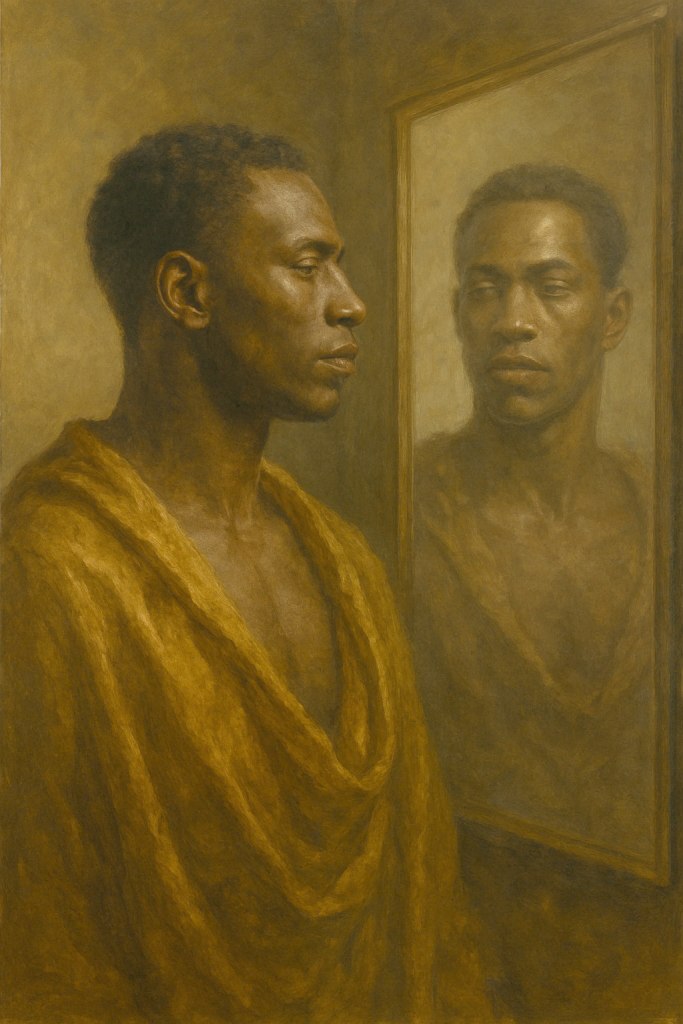
The story of Black masculinity is one of both suffering and sublimity—of men whose beauty has been distorted by oppression yet refined by endurance. From the chains of slavery to the boardrooms of modern society, the image of the Black man has continually evolved, reflecting a history of resistance, resilience, and redemption. The beauty of his strength lies not in brute force but in the spiritual, intellectual, and emotional fortitude that has allowed him to survive centuries of dehumanization.
To understand Black masculinity, one must look into the mirror of history, where reflection becomes revelation. The first distortion appeared under colonialism, when European powers constructed false hierarchies of humanity. The Black man was cast as savage, incapable of reason or refinement, his physical strength seen as both his value and his curse (Fanon, 1952). Yet beneath these imposed identities existed a sacred masculinity shaped by ancient African civilizations—nations that valued wisdom, artistry, and spirituality as measures of true manhood.
In precolonial Africa, masculinity was integrative, not dominating. Kings, warriors, and priests carried the dual duty of protection and provision with humility before the divine. Empires like Mali and Kush celebrated male beauty as divine order, where strength was married to grace, and leadership to love. Such conceptions were violently disrupted by the slave trade, which turned the Black male body into an economic commodity rather than a sacred vessel (Gomez, 1998).
The transatlantic slave trade fractured identity and redefined manhood under bondage. The Black man’s physical strength was exploited for labor, while his emotional expression was suppressed to prevent rebellion. In these conditions, strength became survival. Yet even in the most brutal systems, enslaved men found ways to redefine masculinity—through song, brotherhood, and faith. Their resilience was a spiritual act of resistance, preserving fragments of humanity within an inhumane world (Franklin & Moss, 2000).
The Reconstruction era offered a fleeting glimpse of restored dignity. Freed Black men sought to build families, own land, and educate themselves, embodying the beauty of responsibility and renewal. But white supremacist backlash sought to reimpose dominance, inventing myths like the “Black brute” stereotype to criminalize strength and reassert racial hierarchy (Alexander, 2010). Even today, this narrative persists through media caricatures that equate Black masculinity with danger rather than discipline.
Yet throughout history, the Black man’s image has also been self-reclaimed. The Harlem Renaissance redefined masculine beauty through art, intellect, and poise. Figures like Langston Hughes, Duke Ellington, and Alain Locke offered new models of manhood that combined confidence with creativity. Their aesthetic grace challenged America’s obsession with fear-based masculinity, celebrating a balance of strength and sensitivity (Huggins, 2007).
The Civil Rights Movement further revealed the moral beauty of Black masculinity. Men like Martin Luther King Jr. and Malcolm X embodied courage rooted in conviction, using moral authority as a weapon stronger than any sword. Their leadership showed that real power flows not from domination but from disciplined love—a love that demands justice. Their public images, often demonized, actually reflected divine fortitude in human form.
In this mirror of history, one also sees the emotional cost of constant resilience. The Black man has often been denied the right to be vulnerable, to express pain without judgment. Society’s expectation of hypermasculinity has become both armor and prison. Yet, when he allows his authentic emotions to emerge, his humanity shines. This emotional transparency reclaims beauty from the battlefield of survival.
The modern Black man stands at a crossroads—torn between ancestral wisdom and contemporary pressure. While Western society continues to commodify and caricature his body, he is learning to define himself anew: as lover, father, thinker, and spiritual being. The rise of movements like “Black Men Heal” and “Brotherhood Circles” mark a cultural shift toward holistic manhood rooted in wellness and self-awareness (Akbar, 1996).
Physical beauty has always been central to the mythologizing of Black masculinity. From the statuesque athletes to the stoic revolutionaries, his physique evokes awe and envy. Yet, to reduce him to mere muscle is to miss the poetry in his posture—the story written in his skin. His form carries ancestral memory; his eyes hold a depth forged by generations of endurance. His beauty is not performance but persistence.
In the arts, new visual and literary movements seek to restore balance to the image of the Black man. Photographers like Gordon Parks and painters like Kehinde Wiley reimagine him with royal dignity—no longer subject but sovereign. These representations undo centuries of degradation and invite viewers to see what history tried to conceal: that the Black man is both warrior and work of art.
Spiritually, the Black man’s strength is mirrored in his faith journey. From the spirituals of the fields to the sermons of the pulpit, he has drawn divine power from affliction. His relationship with God has always been intimate, rooted in the belief that suffering births purpose. As scripture declares, “My strength is made perfect in weakness” (2 Corinthians 12:9, KJV). His beauty lies in this paradox—the capacity to endure without hardening his heart.
The legacy of fatherhood also reveals the beauty of strength. Despite systemic attempts to dismantle the Black family, many men have restored their lineage through love and guidance. Their nurturing presence redefines masculinity not as dominance but stewardship. To lead a household with patience and principle is one of the highest forms of strength.
The psychological struggle of the Black man cannot be separated from his social context. The trauma of racial profiling, economic exclusion, and intergenerational pain continues to shape self-image. Yet, healing begins when he sees himself not through the lens of oppression but reflection—when he recognizes his worth as created, not constructed. Therapy, faith, and community serve as mirrors that restore the vision blurred by history’s distortion.
Education and artistry have always been liberating forces for the Black man. The intellectual elegance of W. E. B. Du Bois, the musical mastery of Miles Davis, and the poetic boldness of Tupac Shakur represent beauty expressed through brilliance. Knowledge and creativity become new forms of strength—unseen but transformative.
Black masculinity today exists in many forms: the activist, the artist, the scholar, the father, the dreamer. Each expression expands the definition of beauty and strength. No longer confined to Eurocentric ideals or media stereotypes, these men reflect a truth as old as Africa itself—that strength is not oppression, but the ability to stand with grace under fire.
When the Black man looks in the mirror of history, he sees scars—but he also sees survival. He sees the reflection of kings, prophets, laborers, and poets. He sees divine design where others saw degradation. The mirror becomes a portal of remembrance, not regret.
The beauty of strength in Black masculinity, therefore, is both ancient and evolving. It is found in the quiet moments as much as in the heroic ones. It is not just a reflection of what was, but a prophecy of what will be: the restoration of dignity, the reconciliation of power and peace. In that reflection, the Black man finally beholds himself—not as the world has seen him, but as God has made him.
References (APA 7th Edition)
Akbar, N. (1996). Breaking the chains of psychological slavery. Mind Productions.
Alexander, M. (2010). The new Jim Crow: Mass incarceration in the age of colorblindness. The New Press.
Fanon, F. (1952). Black skin, white masks. Grove Press.
Franklin, J. H., & Moss, A. A. (2000). From slavery to freedom: A history of African Americans. McGraw-Hill.
Gomez, M. A. (1998). Exchanging our country marks: The transformation of African identities in the colonial and antebellum South. University of North Carolina Press.
Huggins, N. I. (2007). Harlem Renaissance. Oxford University Press.
The Holy Bible, King James Version. (1611/2017). King James Bible Online. https://www.kingjamesbibleonline.org/
Discover more from THE BROWN GIRL DILEMMA
Subscribe to get the latest posts sent to your email.
 THE BROWN GIRL DILEMMA