
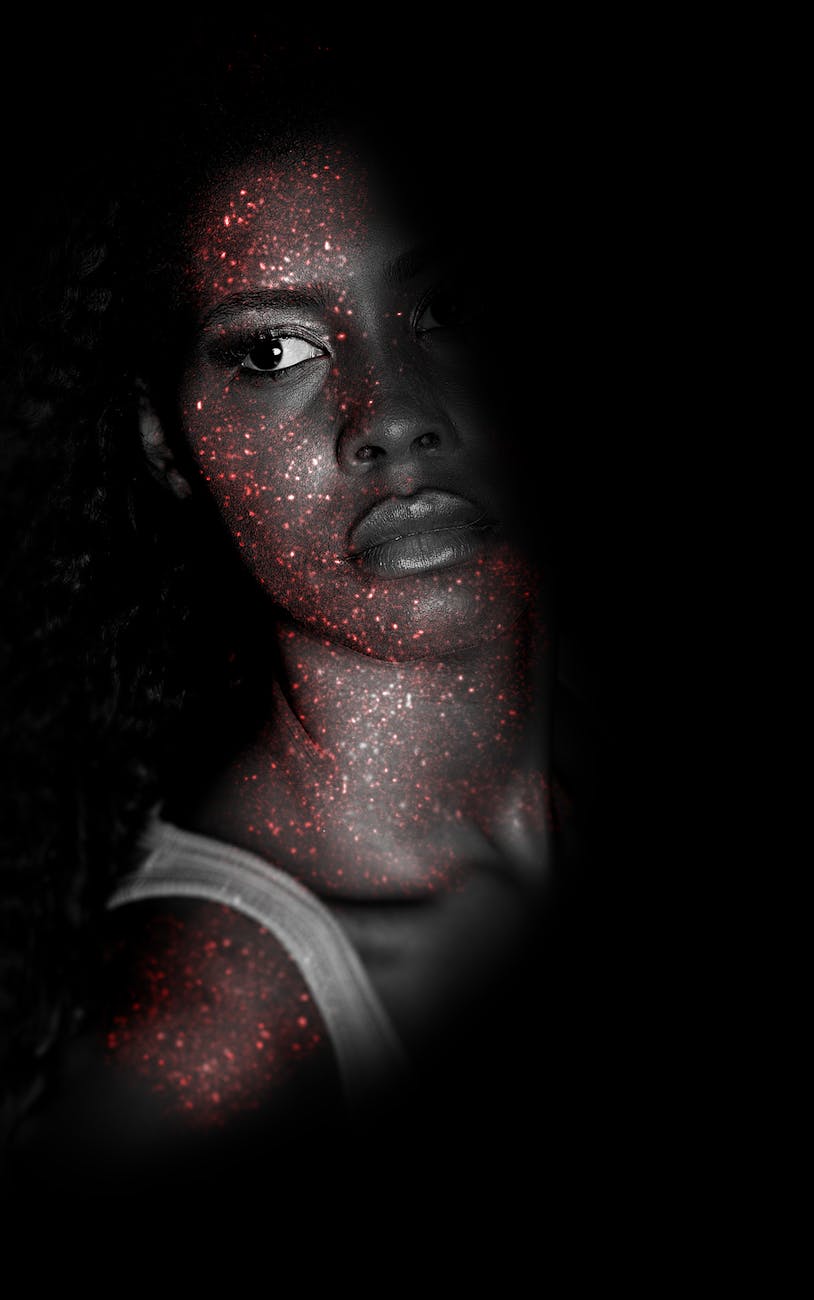
Black beauty is a phenomenon that transcends aesthetics, reaching into the realms of biology, psychology, culture, and spirituality. To unveil its radiance is to uncover the evolutionary genius of African traits, the resilience of a people who have endured systemic oppression, and the redefinition of beauty as an act of resistance. Far from being superficial, Black beauty embodies survival, identity, and the sacred dignity of heritage.
From a biological perspective, the features most associated with Black beauty—melanin-rich skin, coiled hair textures, and distinctive facial structures—carry deep evolutionary significance. Dark skin, rich in eumelanin, evolved as protection against harmful ultraviolet rays, while preserving vital nutrients like folate necessary for reproduction (Jablonski & Chaplin, 2010). Similarly, coiled hair functions as a natural insulator, protecting the scalp from heat while aiding in cooling, a design of resilience rooted in Africa’s climate (Robins, 2009). These features reveal that beauty is more than appearance—it is a story of adaptation and survival.
Psychology offers another lens into Black beauty. For centuries, Eurocentric ideals distorted global standards, leading to colorism and the devaluation of African features (Hunter, 2007). Internalized racism caused many to struggle with self-esteem, as seen in studies where Black children favored white dolls over Black dolls. Yet resilience emerged through movements such as “Black is Beautiful,” which reshaped psychological frameworks by affirming melanin, natural hair, and cultural aesthetics (Byrd & Tharps, 2014). In this way, beauty became a psychological anchor of identity and empowerment.
Culturally, representation plays a powerful role in shaping perceptions of beauty. Historically, Black women and men were excluded from mainstream imagery or reduced to stereotypes. However, pioneers like Cicely Tyson and Angela Davis disrupted these patterns by embracing natural styles that carried political meaning. In the modern era, global icons such as Lupita Nyong’o and Rihanna’s Fenty Beauty have expanded definitions of beauty, affirming darker complexions and diverse aesthetics as not only acceptable but aspirational (Tate, 2009). Representation thus transforms beauty from exclusion to celebration.
Black beauty is also inseparable from the politics of survival. During slavery, African women braided hair not only for style but also as cultural memory and, at times, as coded maps for escape (Byrd & Tharps, 2014). Beauty, in this context, was not frivolous but functional, a tool of survival and cultural preservation. This historical resilience underscores that beauty for Black communities is never just cosmetic—it is intertwined with dignity, memory, and liberation.
Spiritually, beauty is rooted in values deeper than appearance. The Bible teaches that true beauty lies within: “Whose adorning let it not be that outward adorning…but the hidden man of the heart” (1 Peter 3:3–4, KJV). For Black people, whose external beauty was often devalued by oppressive systems, inner radiance and spiritual strength became central to survival. Thus, Black beauty is not only seen in skin and hair, but also in character, resilience, and unwavering faith.
In contemporary society, Black aesthetics influence global fashion, music, and art. From natural hairstyles to melanin-positive campaigns, African-descended communities are reclaiming and redefining beauty on their own terms. Yet challenges remain, as colorism and Eurocentric bias persist in media and industries (Patton, 2006). Still, the global celebration of melanin and the mainstreaming of diverse beauty standards signal progress toward broader acceptance.
Ultimately, the science behind Black beauty reveals a truth greater than aesthetics: beauty is resilience, adaptation, and radiance born of struggle and survival. It is biological brilliance, psychological strength, cultural memory, and spiritual dignity combined. To unveil this radiance is to affirm that Black beauty is not only valid—it is foundational to humanity, a sacred testimony to the power of survival, identity, and divine design.
References
- Byrd, A., & Tharps, L. (2014). Hair story: Untangling the roots of Black hair in America. St. Martin’s Press.
- Hunter, M. (2007). The persistent problem of colorism: Skin tone, status, and inequality. Sociology Compass, 1(1), 237–254.
- Jablonski, N. G., & Chaplin, G. (2010). Human skin pigmentation as an adaptation to UV radiation. Proceedings of the National Academy of Sciences, 107(Suppl 2), 8962–8968.
- Patton, T. O. (2006). Hey girl, am I more than my hair? African American women and their struggles with beauty, body image, and hair. NWSA Journal, 18(2), 24–51.
- Robins, A. H. (2009). Biological perspectives on human pigmentation. Cambridge University Press.
- Tate, S. A. (2009). Black beauty: Aesthetics, stylization, politics. Ashgate.
Discover more from THE BROWN GIRL DILEMMA
Subscribe to get the latest posts sent to your email.
 THE BROWN GIRL DILEMMA