
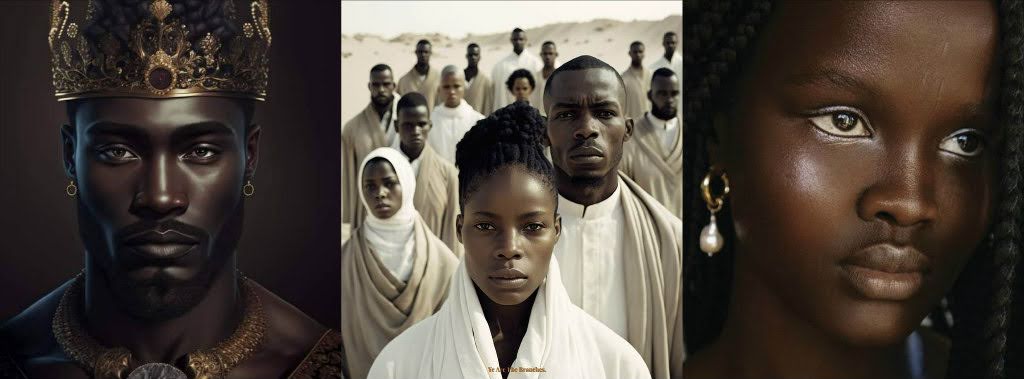
For centuries, the presence of Black people in the Bible has been minimized or obscured through Eurocentric interpretations of Scripture. Yet, the King James Version (KJV) and the Apocrypha contain numerous references to African nations, dark-skinned peoples, and the true identity of the children of Israel. These connections reveal that Black people were not only present but central to the biblical narrative.
Cush, Ham, and the African Lineage
The Bible traces much of the African world back to Ham, the son of Noah. Genesis 10 (the Table of Nations) records: “And the sons of Ham; Cush, and Mizraim, and Phut, and Canaan” (Genesis 10:6, KJV).
- Cush refers to Ethiopia (modern Sudan/Ethiopia).
- Mizraim refers to Egypt (Kemet).
- Phut refers to Libya/North Africa.
- Canaan refers to the land that Israel later inhabited.
This genealogy directly places Africans at the root of early civilization, showing that people of dark skin were present in the earliest biblical times.
The Israelites and Their Appearance
Many hidden scriptures reveal the physical appearance of Israel. Contrary to the Eurocentric depictions, the Bible describes Israel as a people of dark skin.
- Jeremiah 8:21 (KJV): “For the hurt of the daughter of my people am I hurt; I am black; astonishment hath taken hold on me.”
- Lamentations 5:10 (KJV): “Our skin was black like an oven because of the terrible famine.”
- Song of Solomon 1:5-6 (KJV): “I am black, but comely, O ye daughters of Jerusalem, as the tents of Kedar, as the curtains of Solomon. Look not upon me, because I am black…”
These passages show that Israelite figures, including prophets and kings, were described with dark skin, connecting them to African and Afro-Asiatic peoples.
Egypt, Ethiopia, and Black Royalty
The Bible honors Ethiopia and Egypt as powerful nations:
- Amos 9:7 (KJV): “Are ye not as children of the Ethiopians unto me, O children of Israel?” – God directly compares Israel to Ethiopians, emphasizing their shared heritage.
- Jeremiah 13:23 (KJV): “Can the Ethiopian change his skin, or the leopard his spots?” – highlighting the natural dark complexion of Africans.
- Acts 8:27 (KJV): The Ethiopian eunuch, a royal servant of Candace, queen of Ethiopia, was one of the first Gentiles baptized, showing Africa’s early role in the spread of the Gospel.
The Apocrypha and Hidden Identity
The Apocrypha, often removed from modern Bibles, holds more insight into the suffering and scattering of Israel.
- 2 Esdras 6:54-56 (Apocrypha): Describes Israel as God’s chosen people above all nations, though later scattered.
- 2 Esdras 13:40-45 (Apocrypha): Describes the migration of the ten tribes of Israel into distant lands—interpreted by many as part of the scattering into Africa and eventually the Americas during slavery.
- Baruch 2:29-30 (Apocrypha): “If ye will not hear my voice, surely this very great multitude shall be turned into a small number among the nations, where I will scatter them.”
This aligns with Deuteronomy 28, where curses were placed upon Israel for disobedience, including being taken on ships into slavery:
- “And the LORD shall bring thee into Egypt again with ships… and there ye shall be sold unto your enemies for bondmen and bondwomen, and no man shall buy you” (Deuteronomy 28:68, KJV).
This prophecy eerily parallels the Transatlantic Slave Trade, where millions of Africans—descendants of Israel—were sold into bondage.
The Revelation of Christ’s Image
One of the most concealed truths involves the description of Christ Himself:
- Revelation 1:14-15 (KJV):“His head and his hairs were white like wool, as white as snow; and his eyes were as a flame of fire; and his feet like unto fine brass, as if they burned in a furnace.”
- Hair like wool = texture associated with Black people.
- Feet like burned brass = a dark, brown/black complexion.
This description directly challenges Eurocentric images of a pale-skinned Christ.
Conclusion
The Bible contains profound truths about Black people that were long hidden through translation bias, colonialism, and Eurocentric theology. From the line of Ham and Cush to the descriptions of Israel’s skin color, from the curses of Deuteronomy 28 to the Apocryphal accounts of scattering, the evidence shows that Black people are deeply woven into the story of Scripture. The hidden truth is that the people of the Bible were not European, but Afro-Asiatic—people of color, many of whom would be recognized today as Black.
References
- Holy Bible, King James Version.
- The Apocrypha (2 Esdras, Baruch, Ecclesiasticus).
- Ben-Jochannan, Y. (1993). African Origins of the Major Western Religions. Baltimore: Black Classic Press.
- Windsor, R. (1969). From Babylon to Timbuktu: A History of Ancient Black Races Including the Black Hebrews. Atlanta: Windsor’s Golden Series.
Discover more from THE BROWN GIRL DILEMMA
Subscribe to get the latest posts sent to your email.
 THE BROWN GIRL DILEMMA