
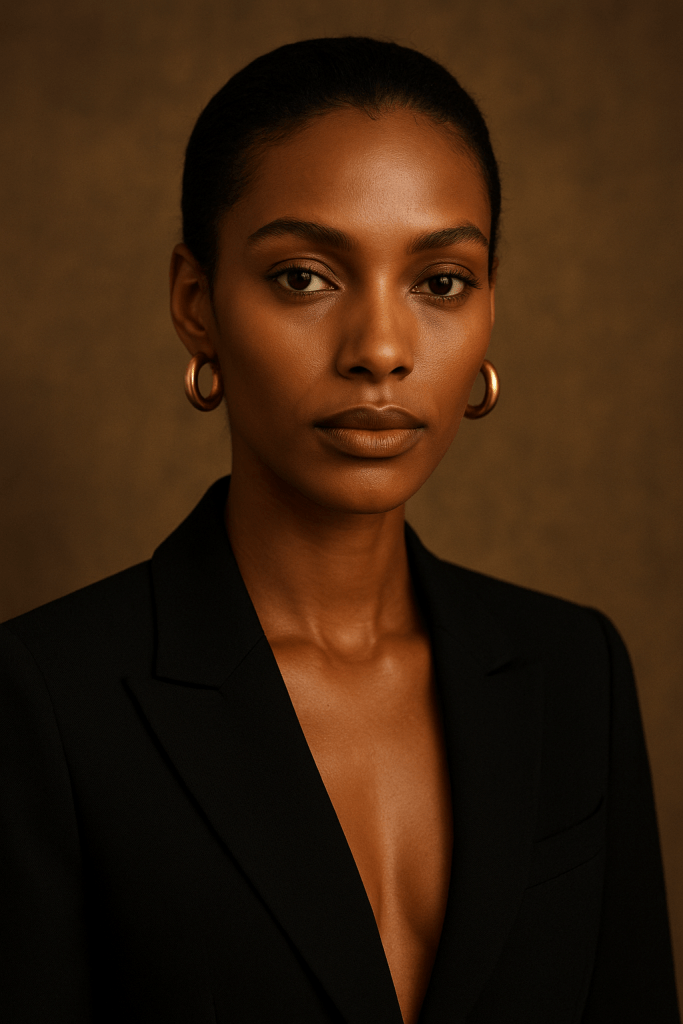
She was born in the Montmartre district of Paris, where cobblestone streets met the scent of espresso and rain. Her name was Jacqueline-Noire Duval, the daughter of a Senegalese mother and a Haitian father who met while studying at the Sorbonne. Her complexion—a soft, golden-brown tone that Parisians often likened to mocha—became both her blessing and her burden. In a city obsessed with pale beauty, Jacqueline was the shade that stopped people mid-sentence.
Jacqueline’s early life was steeped in contradictions. In her neighborhood, she was admired for her elegance and poise, but at school, she was reminded of her “difference.” Teachers often called her “exotic,” as though her presence required explanation. By age sixteen, she was scouted by a modeling agency while buying croissants for her mother. Her face—symmetric, luminous, and softly angular—embodied what designers described as “global beauty.”
Her first major show was for a French couture house known for its obsession with porcelain-skinned muses. Yet, when she walked the runway, the room fell silent—not out of disapproval but awe. Her skin shimmered under the lights, reflecting gold and bronze like liquid sunlight. Critics wrote that her beauty “transcended race,” an odd compliment that erased the very identity that defined her.
Jacqueline’s mocha complexion became her passport to elite spaces, but it also revealed the hierarchy within them. She was often the only Black woman cast—and even then, she was the lightest of her peers. Darker-skinned models whispered about the unspoken rule: brown sells, black doesn’t. Jacqueline felt the weight of their stares, knowing her success sometimes represented their exclusion.
In interviews, she was asked about her heritage more than her craft. Photographers marveled at how her skin “absorbed light,” makeup artists praised her “versatility,” and brands marketed her as the “future of inclusive beauty.” Yet inclusion, she soon realized, was conditional—defined by proximity to whiteness.
One afternoon in Milan, while preparing for a luxury campaign, she overheard two casting directors debating her look.
“She’s perfect,” one said, “just enough melanin to look exotic, but not too dark for Europe.”
That sentence followed her for years—a quiet wound that no amount of fame could conceal.
Jacqueline’s fame grew rapidly. She became the face of luxury perfumes, international editorials, and global beauty campaigns. Her skin tone became its own brand—a signature shade between caramel and honey. Magazines called it “the perfect brown,” a phrase that haunted her. What did perfection mean in a world that preferred her shade to others like her?
Back home in Paris, she began using her platform to discuss colorism in the fashion industry. “You love my color,” she once said during a televised interview, “but not my people.” The statement went viral. Some praised her courage; others accused her of ingratitude. She knew that her beauty was both celebrated and commodified—a paradox she could no longer ignore.
Jacqueline’s story echoed the broader dynamics of global colorism. Studies show that lighter-skinned models receive more booking opportunities and higher pay than their darker counterparts (Russell, 2010). The industry’s visual economy rewards “palatable diversity”—beauty that feels accessible to Eurocentric sensibilities while maintaining the illusion of inclusion (Hunter, 2011).
But Jacqueline was more than her hue. Off-camera, she was a philosopher of her own identity. She wrote essays on melanin, self-love, and the politics of beauty. Her journals—featured here in The Shade Diaries—explored how colonial beauty standards continue to shape modern desirability. “My skin is not a compromise,” she said. “It is a continuum.”
In one entry, she recounted walking through Dakar for the first time. Children called her “toubab,” a word for foreigner. For the first time, her skin made her an outsider, not an idol. It was a moment of awakening—proof that privilege and alienation often coexist in the same shade.
She began mentoring young models across Africa and the Caribbean, emphasizing pride in all tones. Her agency in Paris became the first to feature models exclusively from the African diaspora, showcasing the full range of melanin. “We are not gradients of worth,” she told them. “We are galaxies of gold.”
Despite her advocacy, the fashion world’s obsession with her tone persisted. She was often labeled “the ideal Black beauty,” a term she rejected. “Beauty,” she told a magazine, “should not be defined by contrast to whiteness.”
Jacqueline’s private life mirrored her professional contradictions. She dated a French art critic who adored her for her “bronze glow” but avoided conversations about race. When their relationship ended, she realized he had loved her aesthetic, not her essence.
In time, Jacqueline became a symbol of both aspiration and awareness. Her success forced the industry to confront its biases, even as it continued to profit from them. When she appeared on the cover of a magazine beneath the headline “The Future Face of Beauty,” she insisted the caption read: “All Shades Deserve Space.”
Her legacy grew beyond modeling. She launched a foundation providing scholarships for young artists of color, focusing on those who faced discrimination based on skin tone. “My skin opened doors,” she said at its inauguration. “Now I open them for others.”
Years later, during a reflective interview, she said, “The world called my color mocha. Maybe that’s fitting. I am warmth and bitterness, strength and sweetness—an acquired taste that lingers.”
Jacqueline-Noire Duval’s story reveals how beauty can be both liberation and limitation. Her skin became her stage, but her voice became her revolution. Through her journey, she exposed an industry addicted to shade hierarchies and taught the world that no tone is superior—only silenced or celebrated.
In her final interview with the author of The Shade Diaries (www.thebrowngirldilemma.com), she said: “I have learned that every complexion carries history, every hue has truth. My color does not make me special—it makes me seen. And that, after all, is the beginning of change.”
References
Hunter, M. L. (2011). Buying racial capital: Skin tone, class, and beauty in the global marketplace. Sociology Compass, 5(1), 75–92.
Russell, K. (2010). The Color Complex: The Politics of Skin Color Among African Americans. Anchor Books.
Walker, A. (1983). In Search of Our Mothers’ Gardens: Womanist Prose. Harcourt Brace Jovanovich.
 THE BROWN GIRL DILEMMA