
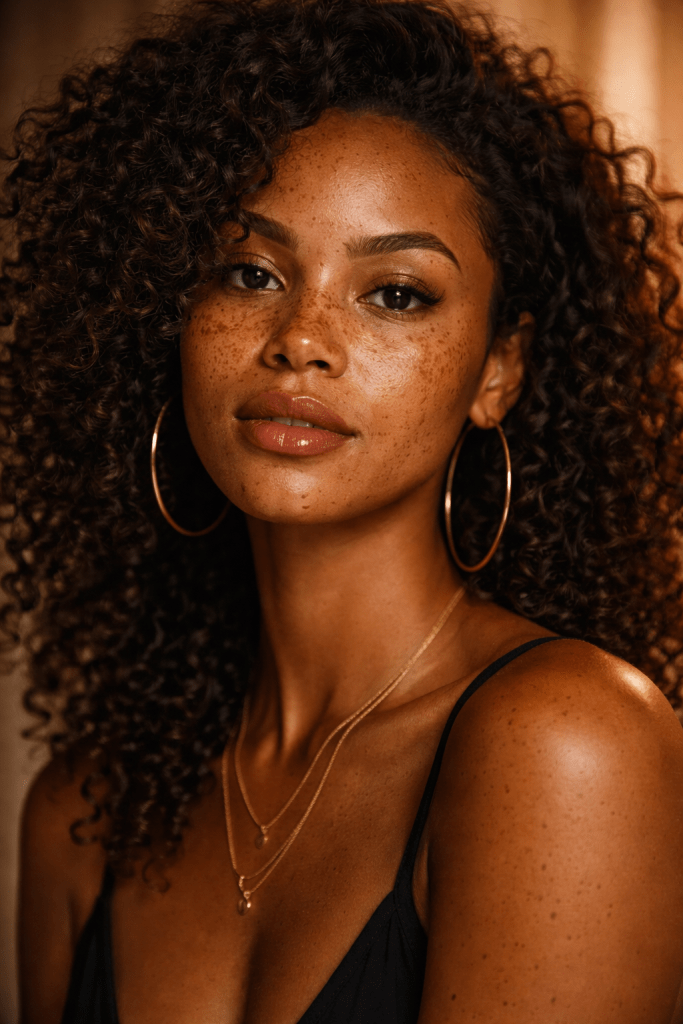
The semiotics of Black beauty begins with the understanding that beauty is not merely an aesthetic category but a system of signs, meanings, and cultural codes. Within semiotic theory, beauty operates as a language—one that communicates values, hierarchies, power relations, and historical memory. Black beauty, in particular, has functioned as a contested sign within Western modernity, simultaneously hyper-visible and marginalized, fetishized and erased. To analyze Black beauty semiotically is to examine how Black bodies, features, and aesthetics have been encoded, decoded, and re-signified across history.
In classical semiotics, Ferdinand de Saussure distinguished between the signifier (the form of the sign) and the signified (the concept it represents). Applied to Black beauty, the signifier may include dark skin, Afro-textured hair, full lips, broad noses, and curvilinear bodies, while the signified has historically been shaped by colonial ideology, racial hierarchy, and Eurocentric aesthetic standards. These physical features were not interpreted neutrally but loaded with meanings such as primitiveness, hypersexuality, exoticism, or inferiority. Thus, Black beauty became a distorted sign within the colonial visual grammar.
Colonialism produced what Frantz Fanon described as a racialized visual order in which Black bodies were rendered objects of surveillance and symbolic domination. In this system, beauty was weaponized as a tool of power, with whiteness positioned as the universal aesthetic norm. Blackness was defined in opposition to this norm, creating what semioticians would call a binary structure: beautiful versus ugly, civilized versus primitive, pure versus excessive. Black beauty was not simply excluded from the category of beauty; it was actively re-coded as its opposite.
Roland Barthes’ concept of myth is especially useful here. Myths transform cultural constructs into naturalized truths. The myth of beauty in Western society presents whiteness as neutral and universal while presenting Blackness as deviation. Over time, this myth became embedded in media, advertising, fashion, film, and even scientific discourse. Beauty standards ceased to appear ideological and instead appeared “natural,” obscuring their historical and political origins.
Black women’s bodies, in particular, have functioned as semiotic battlegrounds. From the exhibition of Sarah Baartman in the nineteenth century to contemporary hypersexualized representations in popular culture, Black femininity has been encoded through signs of excess—too sexual, too loud, too visible, too much. These representations operate as what Stuart Hall called regimes of representation, systems that fix meaning through repetition. The Black woman becomes a sign that circulates independently of her humanity.
Yet semiotics is not only about domination; it is also about resistance and re-signification. Black beauty has undergone profound symbolic transformation through cultural movements such as the Harlem Renaissance, the Black Arts Movement, Afrofuturism, and contemporary digital Black feminism. These movements challenge dominant sign systems by producing alternative visual codes—natural hair, dark skin celebration, Afrocentric fashion, and non-Eurocentric facial aesthetics. Here, Black beauty becomes a counter-sign, disrupting inherited meanings.
The politics of hair provides one of the clearest examples of semiotic struggle. Afro-textured hair has historically been encoded as unprofessional, wild, or undesirable, while straight hair has been associated with respectability and beauty. However, the natural hair movement re-signifies Afro-textured hair as a symbol of authenticity, resistance, and self-definition. Hair becomes a political sign, not merely a cosmetic choice.
Skin tone operates similarly within what scholars describe as colorism. Lighter skin has been historically coded as more beautiful due to proximity to whiteness, while darker skin has been marked as undesirable. This semiotic hierarchy is internalized within Black communities themselves, revealing how colonial sign systems reproduce themselves psychologically. Black beauty thus exists within a complex internal semiotics, where oppression is not only external but also internalized.
Media plays a central role in the production and circulation of beauty signs. Film, fashion, social media, and advertising function as symbolic machines that teach society what to desire and what to devalue. When Black women are underrepresented or represented through stereotypes, the sign of Black beauty becomes constrained, flattened, and commodified. Representation is not simply about visibility but about the range of meanings allowed to exist.
Digital culture has introduced new semiotic possibilities. Platforms such as Instagram, TikTok, and YouTube allow Black women to become producers of their own visual narratives rather than passive objects of representation. The rise of Black influencers, models, and artists creates decentralized beauty codes that challenge traditional gatekeepers. Semiotically, this represents a shift from imposed meaning to negotiated meaning.
The concept of the gaze is central to understanding Black beauty. Laura Mulvey’s theory of the male gaze can be extended to what many scholars call the white gaze—a visual framework through which Black bodies are interpreted and judged. Black beauty under the white gaze becomes spectacle rather than subject. However, the emergence of what is termed the Black female gaze reclaims visual authority, allowing Black women to define beauty on their own terms.
From a psychological perspective, beauty functions as symbolic capital. Pierre Bourdieu argued that symbolic capital produces social power through recognition and legitimacy. When Black beauty is denied legitimacy, Black women are denied access to certain forms of social mobility, desirability, and validation. Thus, beauty is not trivial; it is structurally linked to inequality.
Semiotically, Black beauty also intersects with spirituality. In many African cosmologies, beauty is not separated from morality, ancestry, or divine order. Physical appearance reflects harmony, balance, and spiritual alignment. This contrasts sharply with Western aesthetics, which prioritize surface over substance. Reclaiming Afrocentric aesthetics therefore represents not just cultural pride but epistemological resistance.
Fashion becomes another site of symbolic struggle. Historically, Black fashion was either appropriated or marginalized, yet contemporary Black designers and models are redefining aesthetic language globally. Clothing, hairstyles, and body presentation operate as visual texts through which Black identity is communicated. Fashion becomes semiotic activism.
Black beauty also functions as memory. It carries ancestral traces, historical trauma, and collective survival. The body itself becomes an archive, storing cultural meaning beyond written language. Semiotically, the Black body is a living sign, shaped by slavery, colonialism, migration, and resistance.
The commodification of Black beauty introduces further complexity. While Black aesthetics increasingly dominate popular culture, they are often consumed without acknowledging Black humanity. This produces what bell hooks called “eating the other,” where difference becomes a marketable aesthetic rather than a site of ethical engagement. Black beauty becomes profitable but not liberating.
At the level of language, even the word “beautiful” is semiotically loaded. To call Black women beautiful may appear affirming, yet it risks reinforcing the same system that requires validation from external authority. True semiotic liberation requires not merely inclusion within dominant categories but transformation of the categories themselves.
Thus, the semiotics of Black beauty is ultimately about power over meaning. Who gets to define beauty? Who controls the image? Who benefits from the sign? These are not aesthetic questions but political ones. Beauty operates as a symbolic economy, distributing value unevenly across racial and gendered lines.
Black beauty, when re-signified, becomes epistemological. It produces knowledge about the self, the body, and the world. It challenges Western philosophy’s separation of mind and body by asserting the body as a site of intelligence, history, and meaning. The Black woman becomes not an object of theory but a producer of theory.
In this sense, Black beauty is not simply visual; it is discursive. It speaks. It argues. It remembers. It resists. It transforms the semiotic field itself, expanding what beauty can mean and who gets to embody it.
Ultimately, the semiotics of Black beauty reveals that beauty is never innocent. It is a language shaped by history, power, and ideology. Yet within that language lies the possibility of rewriting the code. Black beauty, when claimed as self-authored meaning, becomes not a sign of exclusion but a symbol of cultural sovereignty.
References
Barthes, R. (1972). Mythologies. Hill and Wang.
Bourdieu, P. (1984). Distinction: A social critique of the judgement of taste. Harvard University Press.
Fanon, F. (1967). Black skin, white masks. Grove Press.
Hall, S. (1997). Representation: Cultural representations and signifying practices. Sage.
hooks, b. (1992). Black looks: Race and representation. South End Press.
Mulvey, L. (1975). Visual pleasure and narrative cinema. Screen, 16(3), 6–18.
Saussure, F. de. (2011). Course in general linguistics. Columbia University Press.
Tate, S. A. (2015). Black beauty: Aesthetics, stylization, politics. Routledge.
Weheliye, A. G. (2014). Habeas viscus: Racializing assemblages, biopolitics, and Black feminist theories of the human. Duke University Press.
Craig, M. L. (2002). Ain’t I a beauty queen? Black women, beauty, and the politics of race. Oxford University Press.
 THE BROWN GIRL DILEMMA