
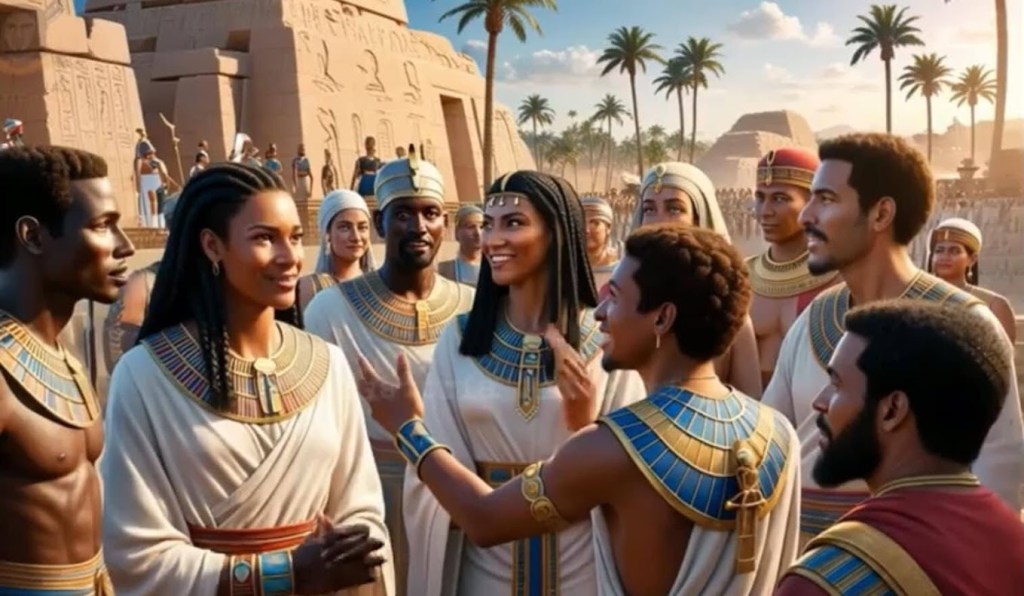
In the Bible, Egypt (Hebrew: Mitzrayim) is often used symbolically as the place of bondage, suffering, and enslavement for the children of Israel. Literally, it refers to the land where Israel was enslaved under Pharaoh until God delivered them through Moses (Exodus 12–14). However, later biblical writers often used “Egypt” metaphorically to represent any place of oppression and captivity.
For example, Deuteronomy 28:68 (KJV) says:
“And the Lord shall bring thee into Egypt again with ships, by the way whereof I spake unto thee, thou shalt see it no more again: and there ye shall be sold unto your enemies for bondmen and bondwomen, and no man shall buy you.”
This prophecy has been interpreted by many, especially within Black Hebraic and Israelite circles, as pointing not just to literal Egypt, but to a second bondage — one involving ships, mass enslavement, and dispersal. The transatlantic slave trade is often connected to this verse because millions of Africans were taken in slave ships and sold across the Americas.
Babylon: Symbol of Captivity
Babylon, on the other hand, represents a different type of bondage in Scripture. The historical Babylon was where Judah was exiled after the Babylonian conquest (2 Kings 25). Spiritually, Babylon is often used in the Bible as a symbol of worldly power, idolatry, and moral corruption. In Revelation, “Mystery Babylon” is described as a global power that seduces nations and persecutes the saints (Revelation 17–18).
Thus, Babylon often symbolizes spiritual captivity — being under the influence of a corrupt, ungodly world system — while Egypt often symbolizes physical captivity and hard labor.
Egypt and Babylon in Prophecy
Isaiah 52:4 (KJV) says:
“Thus saith the Lord God, My people went down aforetime into Egypt to sojourn there; and the Assyrian oppressed them without cause.”
This shows that God saw Egypt and later oppressors as part of the same narrative: foreign domination of His people.
Revelation 11:8 (KJV) offers a fascinating connection:
“And their dead bodies shall lie in the street of the great city, which spiritually is called Sodom and Egypt, where also our Lord was crucified.”
Here, Egypt is used spiritually to describe a future place of bondage. Some interpreters suggest that the modern systems of oppression, mass incarceration, debt slavery, and economic exploitation are a type of spiritual Egypt — a continuation of that same cycle of bondage.
Egypt vs. Babylon: A Biblical Comparison
| Aspect | Egypt (Mitzrayim) | Babylon |
|---|---|---|
| Meaning | “Mitzrayim” in Hebrew means “narrow place, straits” — a place of confinement. | “Babel/Babylon” means “confusion by mixing” — a place of spiritual corruption. |
| Historical Role | Physical place of slavery where Israel was held in bondage under Pharaoh (Exodus 1–14). | Ancient empire that conquered Judah and exiled its people (2 Kings 25). |
| Symbolism | Represents physical captivity, forced labor, oppression, and hardship. | Represents spiritual captivity, idolatry, worldliness, and moral decay. |
| Key Scripture | Exodus 20:2 – “I am the LORD thy God, which have brought thee out of the land of Egypt, out of the house of bondage.” | Revelation 17–18 – “Mystery, Babylon the Great, the Mother of Harlots and Abominations of the Earth.” |
| Prophetic Meaning | In Deuteronomy 28:68, Egypt can symbolize a future return to bondage, often linked to slavery via ships (transatlantic slave trade). | In Revelation, Babylon is seen as a future or present global system of economic and spiritual oppression. |
| Form of Bondage | Physical — slavery, chains, forced labor, economic exploitation (sharecropping, prison labor). | Spiritual — false religion, cultural indoctrination, economic control, moral confusion. |
| Modern Parallels | Debt slavery, mass incarceration, racial oppression, systemic poverty. | Consumerism, secularism, media manipulation, moral compromise. |
| End-Times Role | Represents the final “house of bondage” from which God’s people must be delivered (Deut. 30:3). | Represents the world empire God will judge before the Kingdom is restored (Rev. 18:2–4). |
| Call to Action | Exodus 3:10 – “Come now therefore, and I will send thee unto Pharaoh, that thou mayest bring forth my people…” (Deliverance from oppression). | Revelation 18:4 – “Come out of her, my people, that ye be not partakers of her sins…” (Separation from spiritual corruption). |
This chart makes it clear that Egypt = physical bondage and Babylon = spiritual/worldly bondage — and that both still exist in different forms today.
Hebraic-Israelite Perspective
Many teachers in the Israelite movement equate Egypt in Deuteronomy 28 with America (or the West in general), viewing it as the modern “house of bondage.” Similarly, they sometimes equate America with “Mystery Babylon” in Revelation, because it is seen as a dominant empire that exports culture, idolatry, and economic exploitation worldwide.
From this view, Egypt = the condition of physical bondage, while Babylon = the system of spiritual, economic, and cultural captivity. Together, they describe both the external and internal struggles of the children of Israel in the modern era.
Summary
- Egypt (Mitzrayim) = The house of bondage (Exodus 20:2), symbolizing physical slavery and hard labor.
- Babylon = Spiritual captivity, idolatry, and global oppression, as seen in Revelation’s “Mystery Babylon.”
- Today’s world can be seen as both Egypt (economic bondage through debt, wage slavery, mass incarceration) and Babylon (spiritual and cultural enslavement through media, moral decay, and false worship).
In short, Egypt in prophecy represents the condition of oppression, and Babylon represents the system of oppression. They overlap in meaning — both point to captivity, but one is physical and one is spiritual.
References
Biblical References
- Exodus 1–14 – Narrative of Israel’s bondage in Egypt and deliverance through Moses.
- Exodus 20:2 (KJV) – “I am the LORD thy God, which have brought thee out of the land of Egypt, out of the house of bondage.”
- Deuteronomy 28:68 (KJV) – Prophecy of returning to Egypt “again with ships.”
- Isaiah 52:4 (KJV) – Mentions Israel’s oppression in Egypt and by Assyria.
- 2 Kings 25 – Historical account of Judah’s exile to Babylon.
- Jeremiah 50:8 (KJV) – “Remove out of the midst of Babylon, and go forth out of the land of the Chaldeans.”
- Revelation 11:8 (KJV) – Describes the “great city… spiritually called Sodom and Egypt.”
- Revelation 17–18 (KJV) – Prophecy concerning Mystery Babylon and her final destruction.
- Revelation 18:4 (KJV) – “Come out of her, my people, that ye be not partakers of her sins…”
Scholarly & Theological Sources
- Assmann, J. (1997). Moses the Egyptian: The memory of Egypt in Western monotheism. Harvard University Press.
- Collins, J. J. (2016). The Bible after Babel: Historical criticism in a postmodern age. Eerdmans.
- Hayes, J. H., & Holladay, C. R. (2007). Biblical exegesis: A beginner’s handbook (3rd ed.). Westminster John Knox Press.
- Keener, C. S. (2014). Revelation (NIV Application Commentary). Zondervan.
- Wright, N. T. (2012). How God became King: The forgotten story of the Gospels. HarperOne.
- Walton, J. H. (2006). Ancient Near Eastern thought and the Old Testament. Baker Academic.
 THE BROWN GIRL DILEMMA