
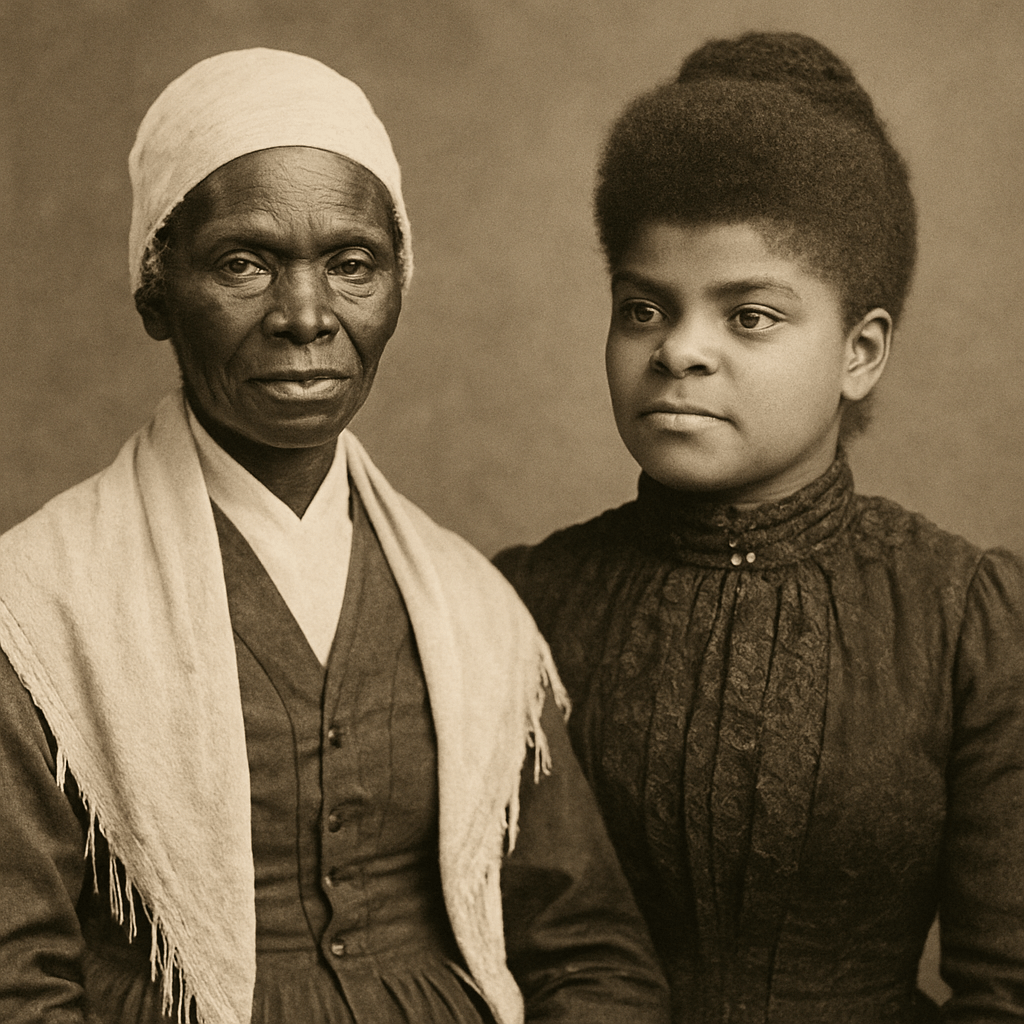
Sojourner Truth and Ida B. Wells stand as two towering figures in the long arc of Black resistance, each shaped by the wounds of enslavement and the fire of righteous indignation. Though they lived in different generations, their lives intersected through a shared mandate: to speak truth in the face of terror, to defend the dignity of Black people, and to challenge a nation built on contradictions. Their voices became instruments of liberation, courageously confronting the systems that sought to silence them.
Sojourner Truth, born into slavery in 1797 in Ulster County, New York, came into the world as Isabella Baumfree. Her earliest memories were of being owned, sold, and separated from her family—experiences that seared into her consciousness the cruelty of American slavery. Yet she carried within her an unbreakable faith, a spiritual assurance that God had called her to something greater. Her escape from slavery in 1826 marked the beginning of a life mission grounded in preaching, abolition, womanhood, and divine justice.
Her transition from Isabella Baumfree to Sojourner Truth in 1843 signified a spiritual rebirth and a public declaration of purpose. She believed she was commissioned by God to “travel up and down the land” to testify against slavery and advocate for the rights of Black people and women. Her now-famous speech, “Ain’t I a Woman?”, delivered in 1851, challenged racial and gender hierarchies with striking clarity. Though often misquoted, the heart of the message remains a masterwork of intersectional truth spoken long before the term existed.
Sojourner Truth’s activism extended far beyond oratory. She recruited Black troops during the Civil War, advocated for land grants for freedmen, and confronted federal leaders with fearless determination. Her life encapsulated the struggle of a woman surviving slavery, reclaiming her name, and resisting systems that attempted to diminish her humanity. She became a mother of five children, though the brutalities of slavery tore them apart; her fight to regain her son Peter through the courts made her one of the first Black women to successfully challenge a white man in court.
Ida B. Wells, born into slavery in 1862 in Holly Springs, Mississippi, entered the world during the final throes of enslavement. Her parents, James and Elizabeth Wells, valued education deeply and helped establish a school for freed people after Emancipation. Their early influence shaped Ida’s intellectual discipline, but tragedy struck when both parents died during a yellow fever epidemic. At just sixteen, Ida stepped into adulthood as caretaker for her siblings, forging a resilience that would define her future.
Wells became a teacher and later a journalist, using her pen as a weapon against racial violence. Her investigative reporting on lynching remains one of the most significant journalistic contributions in American history. At a time when newspapers routinely justified mob violence, she documented the truth: that lynching was not the result of alleged crimes but a tool of racial terror and economic control. Her groundbreaking pamphlets, such as “Southern Horrors” and “The Red Record,” exposed the hypocrisy of America’s moral claims.
Her boldness came with enormous risk. In 1892, after her friends were lynched in Memphis, she wrote articles condemning the mob. White supremacists destroyed her newspaper office and threatened her life, forcing her to flee to Chicago. Yet even in exile, she refused silence. She traveled internationally, speaking in Britain and Scotland, rallying global outrage against racial violence in America. Her advocacy extended to women’s suffrage, civil rights, and the founding of the NAACP.
Ida B. Wells also lived a rich personal life. In 1895, she married attorney Ferdinand L. Barnett, and together they raised a blended family of six children. Wells balanced motherhood and activism with remarkable efficiency, often taking her infants along to speaking engagements. Her life defied the stereotype that Black women had to choose between public leadership and domestic life.
Where Sojourner Truth fought through the vernacular tradition of preaching and testimony, Wells engaged through print culture and political organizing. Both methods struck deeply at the structural injustices of their eras. Together, their contributions showcase the evolution of Black resistance—from the spiritual abolitionist rhetoric of the antebellum period to the empirical, investigative strategies of the post-Reconstruction era.
Sojourner Truth’s legacy in abolition and women’s rights left an enduring imprint on national consciousness. Her presence forced both abolitionists and suffragists to confront their own racial biases. She preached self-reliance, faith, and the sacredness of Black womanhood at a time when society offered no such validation. Her portrait, sold to fund her activism, famously bore the caption, “I sell the shadow to support the substance,” a profound commentary on self-determination.
Ida B. Wells’ legacy lives in her fearless reporting and organizing. She opened America’s eyes to the brutality of lynching, forcing the nation to reckon with its lies. Her activism laid foundational work that later movements—civil rights, women’s rights, and anti-racism campaigns—built upon. She exemplified what it meant to confront power without apology.
The Underground Railroad, though more closely associated with Tubman, also forms part of the larger backdrop against which Sojourner Truth lived. While Truth was not a conductor in the same formal sense, she provided aid, fellowship, and advocacy for freedom seekers. Her spiritual authority and abolitionist networks contributed significantly to the broader anti-slavery movement. Wells, emerging in a later era, chronicled the legacies of such movements while challenging new forms of racial oppression.
Both women were deeply rooted in spiritual conviction. Truth, shaped by charismatic religion and visions, understood her calling as divinely orchestrated. Wells, raised by devout parents, grounded her activism in moral responsibility and Christian duty. Their faith fueled their courage, their willingness to confront unjust laws, and their unwavering belief in the dignity of their people.
In the realm of education, Sojourner Truth had no formal schooling; slavery denied her literacy. Yet she leveraged her oratory, her memory, and her God-given insight to become one of the most iconic public speakers of the century. Wells, by contrast, received a formal education and became a teacher before entering journalism, using writing as her battlefield. Both approaches illuminate the diverse intellectual traditions within Black womanhood.
Their stories reveal the breadth of Black resistance—from the spiritual mother who walked out of slavery guided by divine intuition to the investigative journalist who fought systemic violence armed with facts and documentation. Each woman carved a distinct path yet arrived at a shared destination: truth-telling as liberation.
In examining their lives, we find a blueprint for modern activism. Truth teaches the power of testimony, the necessity of faith, and the courage to speak even when the world refuses to listen. Wells teaches the power of data, documentation, and organized political pressure. Together, they form a powerful dialectic—spirit and strategy, revelation and research.
Their names are etched into the annals of American memory not because the nation freely honored them but because they demanded recognition. They confronted systems designed to erase them, subvert them, or diminish their voices. Yet they persisted, creating narratives that outlived those who tried to silence them.
Today, the lives of Sojourner Truth and Ida B. Wells remain essential reading in the story of Black freedom. Their legacy informs contemporary movements for justice, from racial equity to gender rights. They bear witness to the fact that Black women have always stood at the forefront of the fight for liberation.
Ultimately, their stories remind us that freedom is never given—it is fought for. Truth and Wells fought with every tool available to them: speeches, testimonies, lawsuits, pamphlets, journalism, and relentless courage. And because of them, generations inherited a more truthful account of America and a more hopeful vision for the future.
They carved their names into history with faith, fire, and unyielding truth. And though the Slave Files record centuries of pain, it is women like Sojourner Truth and Ida B. Wells who illuminate the path of deliverance. Their legacy stands as a permanent reminder that no system of oppression can silence a voice committed to liberation.
References
Andrews, W. L. (2020). African American biography: Collective lives of resistance. Oxford University Press.
Giddings, P. (2008). Ida: A sword among lions. Amistad.
McMurray, S. (2014). Sojourner Truth: A life, a symbol. W. W. Norton.
Washington, B. T. (2019). The legacy of Black abolitionists. Beacon Press.
Wells, I. B. (1892). Southern horrors: Lynch law in all its phases. New York Age.
Wells, I. B. (1895). The red record. New York Age.
Yellin, J. F. (1996). Women and sisters: The struggle for African American liberation. Harvard University Press.
 THE BROWN GIRL DILEMMA