
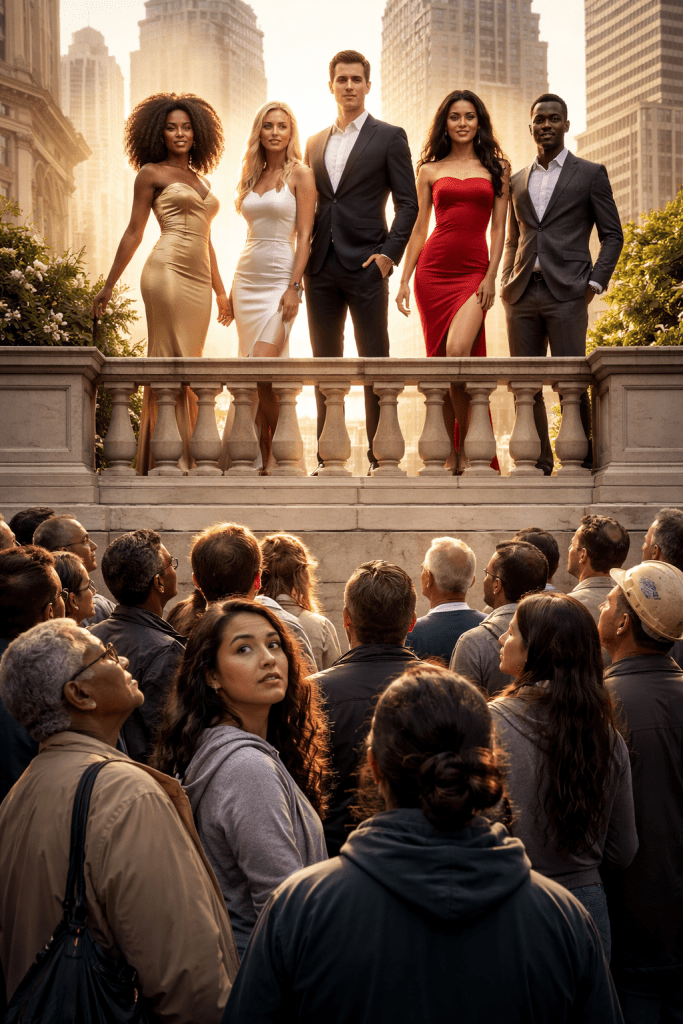
Beauty capital refers to the social, economic, and cultural advantages accrued through physical attractiveness and aesthetic presentation. In contemporary societies, appearance operates as a form of symbolic currency, shaping access to opportunities, resources, and social mobility. Much like economic capital or educational capital, beauty capital can be accumulated, invested in, and exchanged for tangible rewards such as employment, romantic partnerships, and social recognition.
The concept of beauty capital is rooted in Pierre Bourdieu’s broader theory of capital, particularly cultural and symbolic capital. Bourdieu argued that individuals possess varying forms of capital that structure social hierarchies and reproduce inequality. Beauty capital functions similarly by conferring legitimacy, desirability, and perceived competence upon those who embody dominant aesthetic norms.
Social stratification emerges when beauty becomes unevenly distributed and socially rewarded. Individuals deemed attractive by prevailing standards are more likely to receive positive evaluations, higher wages, and greater social trust. Conversely, those who fall outside these standards often face discrimination, marginalization, and reduced life chances, reinforcing existing class, racial, and gender hierarchies.
Empirical research consistently demonstrates the “beauty premium” in labor markets. Attractive individuals are more likely to be hired, promoted, and earn higher salaries than their less attractive counterparts, even when controlling for education and experience. This phenomenon highlights how beauty operates as an invisible credential that shapes professional success.
Gender plays a critical role in the accumulation and valuation of beauty capital. Women, in particular, experience intense social pressure to conform to aesthetic ideals, often investing significant time and financial resources into appearance. This labor is frequently unpaid and normalized, yet it directly influences women’s access to social power and economic security.
Race further complicates the distribution of beauty capital. Eurocentric beauty standards—such as light skin, straight hair, and narrow facial features—privilege whiteness and marginalize non-white bodies. Black, Indigenous, and other racialized groups are systematically excluded from dominant aesthetic hierarchies, resulting in racialized forms of beauty stratification.
Colorism functions as a specific mechanism within racial stratification, privileging lighter skin tones over darker ones within the same racial group. Studies show that lighter-skinned individuals often experience higher incomes, better educational outcomes, and greater media representation. Beauty capital thus becomes a vehicle through which internalized racial hierarchies are reproduced.
Media institutions play a central role in constructing and maintaining beauty norms. Advertising, film, fashion, and social media continuously circulate narrow representations of attractiveness, shaping collective perceptions of value and desirability. These images do not merely reflect reality; they actively produce social expectations and exclusions.
The rise of digital culture has intensified the commodification of beauty. Social media platforms reward aesthetic performance through likes, followers, and sponsorships, transforming beauty into measurable economic capital. Influencer culture exemplifies how attractiveness can be directly monetized, blurring the boundaries between personal identity and market value.
Cosmetic industries thrive within this system, profiting from social insecurity and aspirational aesthetics. Beauty products, cosmetic surgery, and wellness regimes promise social mobility through bodily transformation. However, access to these resources is class-based, reinforcing the idea that beauty itself is stratified by wealth.
Beauty capital also intersects with sexuality and romantic markets. Attractive individuals are often perceived as more desirable partners and experience greater choice in intimate relationships. This dynamic influences marriage patterns, dating economies, and even psychological well-being, as attractiveness becomes tied to self-worth and relational power.
Psychological research demonstrates that attractive individuals benefit from the “halo effect,” wherein physical beauty is unconsciously associated with intelligence, kindness, and moral virtue. This cognitive bias results in systematic advantages across social interactions, from classroom settings to courtroom decisions.
In educational contexts, beauty capital shapes teacher expectations and peer relationships. Attractive students are more likely to receive positive attention, higher evaluations, and leadership opportunities. These micro-level interactions accumulate over time, producing long-term differences in confidence, achievement, and social integration.
The body thus becomes a site of social investment, discipline, and control. Michel Foucault’s notion of biopower helps explain how bodies are regulated through cultural norms, surveillance, and self-policing. Beauty standards function as disciplinary mechanisms that encourage individuals to internalize external expectations.
From a feminist perspective, beauty capital represents both constraint and resource. While women can leverage beauty for social mobility, they remain trapped within systems that objectify and commodify their bodies. Beauty becomes a double-edged sword: empowering in certain contexts, yet structurally exploitative.
Intersectional theory reveals that beauty capital cannot be analyzed in isolation from race, class, gender, and disability. For example, disabled bodies are often excluded from aesthetic economies altogether, rendering them socially invisible. Beauty norms thus reinforce ableism alongside other forms of inequality.
In religious and philosophical traditions, beauty has often been associated with moral virtue or divine order. However, modern consumer culture reframes beauty as marketable property rather than spiritual essence. This shift transforms aesthetics into a tool of capitalism rather than transcendence.
Historically, beauty ideals have shifted alongside political and economic systems. What is considered attractive in one era often reflects the dominant class structure of that time. Thinness, for instance, once symbolized poverty but now signifies discipline and elite self-control.
Resistance movements challenge dominant beauty norms by celebrating marginalized bodies and redefining aesthetic value. The natural hair movement, body positivity campaigns, and Afrocentric fashion all represent efforts to reclaim beauty as a site of cultural affirmation rather than oppression.
Ultimately, beauty capital operates as a powerful yet under-theorized mechanism of social stratification. By rewarding certain bodies and devaluing others, societies reproduce inequality through aesthetic hierarchies. Understanding beauty as capital reveals how deeply embedded appearance is within systems of power, identity, and social mobility.
References
Anderson, T. L., Grunert, C., Katz, A., & Lovascio, S. (2010). Aesthetic capital: A research review on beauty perks and penalties. Sociology Compass, 4(8), 564–575. https://doi.org/10.1111/j.1751-9020.2010.00312.x
Bourdieu, P. (1984). Distinction: A social critique of the judgement of taste. Harvard University Press.
Crenshaw, K. (1989). Demarginalizing the intersection of race and sex. University of Chicago Legal Forum, 1989(1), 139–167.
Eagly, A. H., Ashmore, R. D., Makhijani, M. G., & Longo, L. C. (1991). What is beautiful is good, but… A meta-analytic review of research on the physical attractiveness stereotype. Psychological Bulletin, 110(1), 109–128. https://doi.org/10.1037/0033-2909.110.1.109
Foucault, M. (1977). Discipline and punish: The birth of the prison. Pantheon Books.
Hamermesh, D. S. (2011). Beauty pays: Why attractive people are more successful. Princeton University Press.
Hunter, M. (2007). The persistent problem of colorism. Sociology Compass, 1(1), 237–254. https://doi.org/10.1111/j.1751-9020.2007.00006.x
Mulvey, L. (1975). Visual pleasure and narrative cinema. Screen, 16(3), 6–18. https://doi.org/10.1093/screen/16.3.6
Negrón-Muntaner, F. (2014). The beauty of the real: What Hollywood can learn from contemporary Latin American cinema. Rutgers University Press.
Wolf, N. (1991). The beauty myth: How images of beauty are used against women. HarperCollins.
 THE BROWN GIRL DILEMMA