
Tag Archives: social media

How to Become a Brand Ambassador?

Photo by Godisable Jacob on Pexels.com

In today’s digital marketplace, brand ambassadors have become essential in shaping consumer perceptions and driving brand loyalty. A brand ambassador is an individual who represents, endorses, and promotes a company’s products or services, often leveraging personal influence to increase visibility and trust (Keller, 2013). With the rise of social media, ambassadors have become a central marketing strategy, bridging the gap between businesses and consumers through authentic representation.

Understanding the Role of a Brand Ambassador

A brand ambassador is more than a spokesperson—they embody the values, image, and culture of a brand. Ambassadors often create content, attend events, and interact with communities to increase brand awareness and credibility (Freberg, Graham, McGaughey, & Freberg, 2011). Unlike traditional advertising, ambassadors provide relatable and humanized promotion, which enhances consumer trust.

Step-by-Step Guide: How to Become a Brand Ambassador

1. Define Your Personal Brand

  • Identify your niche (fashion, fitness, beauty, tech, lifestyle, etc.).
  • Highlight your unique values, personality, and style.
  • Keep your message consistent across all platforms.

📌 Tip: Ask yourself—what do I want to be known for?


2. Build and Strengthen Your Online Presence

  • Choose 1–2 main platforms (Instagram, TikTok, YouTube, LinkedIn).
  • Post high-quality content consistently (photos, videos, reels, blogs).
  • Engage with your audience—reply to comments, start conversations, run polls.

📌 Tip: Engagement rate matters more than follower count.


3. Create Authentic Content

  • Share lifestyle posts that naturally include your favorite brands.
  • Tell stories instead of just advertising—authenticity builds trust.
  • Showcase your creativity (unboxings, tutorials, “day in the life,” reviews).

📌 Tip: Brands notice when you already support them without being paid.


4. Grow Your Network

  • Tag brands in your posts.
  • Use hashtags strategically.
  • Collaborate with other influencers or ambassadors.
  • Attend local events, trade shows, and networking opportunities.

📌 Tip: Relationships matter—brands scout through social engagement.


5. Reach Out to Brands

  • Create a professional media kit (bio, audience demographics, engagement stats, sample posts).
  • Send polite pitches to brands you love.
  • Sign up for influencer/ambassador platforms like AspireIQ, BrandSnob, or Influenster.

📌 Tip: Start with smaller or local brands before approaching global ones.


6. Be Professional and Reliable

  • Meet deadlines for sponsored posts.
  • Follow brand guidelines (logos, hashtags, tag requirements).
  • Stay respectful and ethical online—brands look for positive reputations.

📌 Tip: Treat this like a job, not just free products.


7. Measure and Show Results

  • Track engagement (likes, shares, saves, comments, link clicks).
  • Share insights with brands to prove your value.
  • Use analytics tools (Instagram Insights, TikTok Analytics, Google Analytics).

📌 Tip: Brands are more likely to rehire ambassadors who show measurable results.


8. Stay Authentic and Evolve

  • Never promote products you don’t believe in—audiences can sense inauthenticity.
  • Keep learning new marketing trends.
  • Grow with your audience and diversify your content.

📌 Tip: Authentic ambassadors get the longest partnerships.


Quick Checklist:

  • Personal brand defined
  • Social media optimized
  • Consistent, authentic content
  • Active networking and collaborations
  • Professional media kit created
  • Pitches sent to brands
  • Track results and improve
  • Long-term authenticity maintained

Building a Strong Personal Brand

The first step toward becoming a brand ambassador is cultivating a strong personal brand. Personal branding involves crafting a consistent and authentic identity that highlights one’s unique strengths, style, and values (Montoya & Vandehey, 2002). Individuals must showcase professionalism, creativity, and relatability across their platforms, as companies often seek ambassadors whose personal image aligns with their brand’s mission.

Developing an Online Presence

A strong online presence is crucial. Social media platforms such as Instagram, TikTok, and YouTube serve as vital spaces for showcasing content, growing an audience, and demonstrating influence (Djafarova & Trofimenko, 2019). Engagement is more valuable than sheer follower count, as brands look for ambassadors who can foster genuine connections with audiences. Consistency in posting, storytelling, and interaction helps build credibility and visibility.

Networking and Brand Partnerships

Networking plays a critical role in becoming a brand ambassador. Attending industry events, engaging with companies online, and collaborating with other influencers can open doors to partnerships. Many brands scout potential ambassadors by monitoring individuals who already support and promote their products authentically (Schau & Gilly, 2003). Thus, aspiring ambassadors should organically incorporate their favorite brands into content before seeking official partnerships.

Brand Ambassador vs. Spokesmodel

1. Definition & Role

  • Brand Ambassador
    • A long-term representative who embodies the brand’s values and lifestyle.
    • Promotes the brand across multiple platforms (social media, events, personal networks).
    • Focuses on building relationships and creating authentic engagement.
  • Spokesmodel
    • A hired face or personality used in advertisements, campaigns, or promotional events.
    • Represents the brand in a professional, sometimes short-term contract.
    • Focuses on appearance, presentation, and scripted brand messaging.

2. Relationship with the Brand

  • Brand Ambassador → Often has an ongoing partnership. They become part of the brand identity and may use the product in daily life.
  • Spokesmodel → Usually hired for specific campaigns, commercials, or events. The relationship is transactional and tied to image/appearance.

3. Marketing Approach

  • Brand Ambassador → Relies on authenticity, word-of-mouth marketing, and personal influence. Often leverages social media to connect with followers.
  • Spokesmodel → Relies on visual appeal, professionalism, and advertising campaigns (TV, print, digital).

4. Skills & Requirements

  • Brand Ambassador
    • Strong social media presence.
    • Relatable personality and communication skills.
    • Ability to engage communities and foster trust.
  • Spokesmodel
    • Photogenic and camera-ready presence.
    • Modeling or public speaking skills.
    • Ability to represent the brand’s desired look and voice.

5. Example

  • Brand Ambassador → Serena Williams partnering with Nike not only to model apparel but to embody strength, resilience, and excellence in women’s sports.
  • Spokesmodel → Tyra Banks modeling for CoverGirl ads—serving as the face of a beauty campaign without ongoing lifestyle integration.

In short:

  • A brand ambassador promotes a brand authentically and long-term, often through lifestyle and social media influence.
  • A spokesmodel is a professional “face” of the brand for ads or campaigns, usually short-term and more image-focused.

Professionalism and Longevity

Sustaining a career as a brand ambassador requires professionalism, reliability, and adaptability. Ambassadors must meet deadlines, maintain ethical standards, and continuously evolve with trends in digital marketing (Khamis, Ang, & Welling, 2017). Those who maintain authenticity while delivering measurable impact often establish long-term relationships with companies, enhancing both personal and brand credibility.

Conclusion

Becoming a brand ambassador is a journey that requires authenticity, consistency, and professionalism. By building a strong personal brand, developing a digital presence, and fostering genuine relationships with both audiences and companies, individuals can position themselves as valuable assets in today’s marketing landscape. As businesses increasingly rely on personal influence over traditional advertising, opportunities for aspiring ambassadors continue to expand.


References

  • Djafarova, E., & Trofimenko, O. (2019). ‘Instafamous’–credibility and self-presentation of micro-celebrities on social media. Information, Communication & Society, 22(10), 1432-1446.
  • Freberg, K., Graham, K., McGaughey, K., & Freberg, L. A. (2011). Who are the social media influencers? A study of public perceptions of personality. Public Relations Review, 37(1), 90-92.
  • Keller, K. L. (2013). Strategic Brand Management: Building, Measuring, and Managing Brand Equity. Pearson.
  • Khamis, S., Ang, L., & Welling, R. (2017). Self-branding, ‘micro-celebrity’ and the rise of Social Media Influencers. Celebrity Studies, 8(2), 191-208.
  • Montoya, P., & Vandehey, T. (2002). The Brand Called You: Make Your Business Stand Out in a Crowded Marketplace. McGraw Hill.
  • Schau, H. J., & Gilly, M. C. (2003). We are what we post? Self‐presentation in personal web space. Journal of Consumer Research, 30(3), 385-404.

Affiliate Marketing 101: Strategies, Tips, and Tools to Earn Online.

Affiliate marketing is a performance-based marketing strategy where you promote someone else’s products or services and earn a commission for each sale or action generated through your unique referral link. Essentially, you act as a middleman connecting the product with the customer.

It benefits three parties:

  1. The Merchant: Gains more sales or leads without upfront marketing costs.
  2. The Affiliate (You): Earns a commission for driving traffic or sales.
  3. The Customer: Finds products through trusted recommendations.

In today’s digital world, affiliate marketing has emerged as one of the most popular ways to earn income online. At its core, affiliate marketing is a performance-based strategy where individuals, known as affiliates, promote products or services and earn a commission for every sale, click, or action generated through their unique referral links. It creates a win-win scenario: merchants increase their sales without upfront costs, affiliates earn money by promoting products, and customers gain access to trusted recommendations. For those looking to build a sustainable online income, understanding the fundamentals of affiliate marketing is essential.

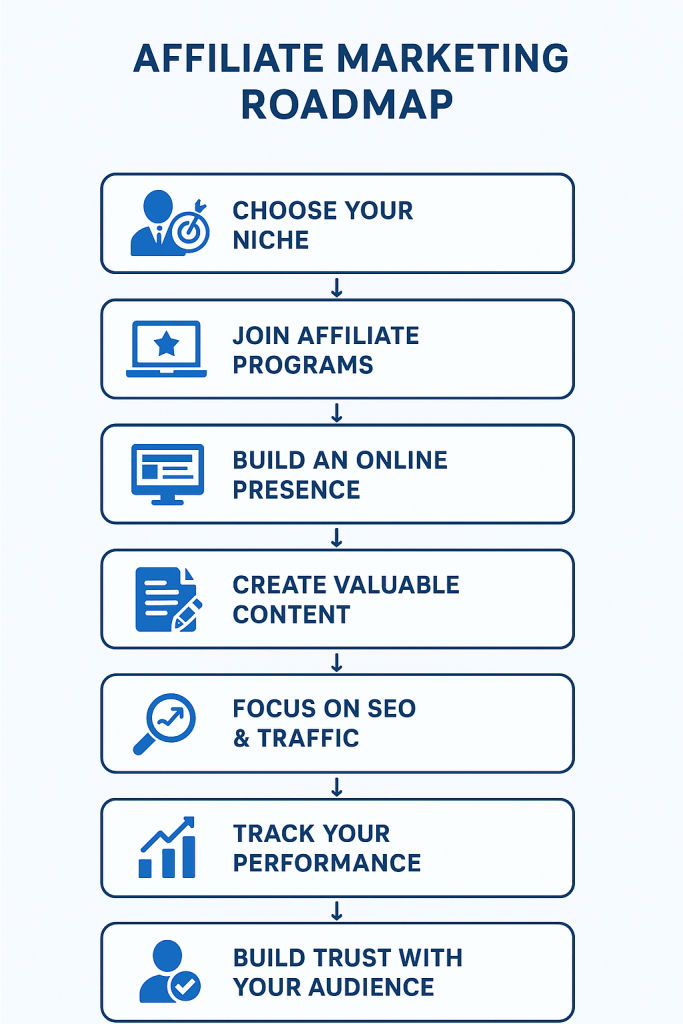
The first step to getting started in affiliate marketing is choosing a niche. A niche is a specific area of interest or industry, such as beauty, fitness, technology, travel, or personal finance. By focusing on a niche, affiliates can build authority and trust with their audience, ensuring that promotions resonate effectively. Once a niche is selected, the next step is to join reputable affiliate programs. Popular networks include Amazon Associates, ShareASale, CJ Affiliate, ClickBank, and Rakuten Marketing. Each platform offers unique benefits, from a wide variety of products to higher commission rates on digital goods, making it possible for affiliates to choose programs that align with their niche and audience.

Choose Your Niche:
Focus on a specific industry or topic you are passionate about, such as beauty, fitness, finance, tech, or travel. A clear niche builds trust and authority with your audience.

Select Affiliate Programs/Companies:
Start with reputable companies and networks. Popular options include:

  • Amazon Associates – Easy to join; wide range of products.
  • ShareASale – Thousands of merchants in various niches.
  • CJ Affiliate (Commission Junction) – High-quality brands and reliable tracking.
  • ClickBank – Digital products, often higher commissions.
  • Rakuten Marketing – Big brands and global reach.

Build an Online Presence:
You’ll need a platform to promote products:

  • Blog or Website: SEO content drives organic traffic.
  • Social Media: Instagram, TikTok, or Pinterest for visual promotions.
  • YouTube: Tutorials and reviews can be highly effective.
  • Email Marketing: Build a subscriber list for recurring promotions.

Affiliate Marketing Tips & Tricks: Quick-Start Guide

1. Choose Your Niche Wisely

  • Pick a topic you are passionate about.
  • Focus on a specific audience to build authority.

2. Join Reputable Affiliate Programs

  • Amazon Associates – Wide variety of products.
  • ClickBank – High commissions on digital products.
  • ShareASale / CJ Affiliate / Rakuten – Access to quality brands.

3. Build an Online Presence

  • Start a blog, YouTube channel, or social media profile.
  • Use email lists to reach your audience directly.

4. Create Valuable Content

  • Tutorials, reviews, comparison guides, and “how-to” articles.
  • Incorporate affiliate links naturally—don’t force them.

5. Focus on SEO & Traffic

  • Optimize your website for search engines to attract organic visitors.
  • Use paid ads strategically for faster results.

6. Track Your Performance

  • Use analytics to monitor clicks, conversions, and top-performing products.
  • Adjust strategies based on what works best.

7. Build Trust with Your Audience

  • Be honest about affiliate links.
  • Share genuine experiences and product recommendations.

8. Diversify & Scale

  • Join multiple affiliate programs to avoid relying on one source.
  • Reinvent and expand your content to reach more audiences.

9. Be Patient & Consistent

  • Earnings grow over time with effort, testing, and optimization.
  • Focus on quality and value rather than quick profits.

10. Learn from Successful Affiliates

  • Follow top affiliates in your niche.
  • Study strategies that consistently convert traffic into sales.

Building a strong online presence is crucial for affiliate marketing success. Affiliates can leverage blogs, websites, social media platforms, YouTube channels, and email marketing to reach potential customers. Content marketing, such as product reviews, tutorials, comparison guides, and “how-to” articles, allows affiliates to provide value while naturally integrating affiliate links. Search engine optimization (SEO) further amplifies reach by attracting organic traffic, while paid advertisements on Google, Facebook, or Instagram can target highly specific audiences to increase conversions. Trust is key; affiliates who provide genuine recommendations and showcase real experiences often see higher engagement and sales.

Content Marketing: Create valuable content like product reviews, “how-to” guides, and comparison articles.

SEO Optimization: Rank your content in search engines to attract free organic traffic.

Paid Ads: Facebook Ads, Google Ads, or influencer partnerships to drive targeted traffic.

Email Campaigns: Promote products to a dedicated audience with newsletters and promotions.

Social Proof & Trust: Use testimonials, case studies, and real experiences to boost credibility.

Successful affiliate marketers employ a combination of strategies to maximize earnings. Tracking performance through analytics enables affiliates to determine which products and promotional methods yield the best results. Diversifying income streams by joining multiple programs and promoting various products reduces risk and increases potential revenue. Email marketing campaigns to a loyal subscriber list can generate recurring income, and integrating social proof—such as testimonials, case studies, or user-generated content—helps establish credibility. Affiliates who prioritize quality over quantity and remain transparent about affiliate links build long-term relationships with their audience.

Pick products you personally trust and align with your audience.

Focus on quality over quantity; promote fewer, high-value products.

Track your performance with analytics to see what converts.

Diversify income streams with multiple affiliate programs.

Always disclose affiliate links; honesty builds trust with your audience.

The earning potential in affiliate marketing varies widely based on niche, traffic, and conversion rates. Beginners might earn between $50 and $500 per month, intermediate affiliates can generate $500–$5,000 monthly, and experienced marketers with multiple platforms and email lists can earn upwards of $50,000 per month. Physical products typically offer lower commissions (1%–10%), while digital products can provide higher rates (30%–75%). The key to success lies in patience, consistency, and reinvesting earnings to scale one’s efforts gradually.

  • Commissions vary by product and program:
    • Physical products: ~1%–10% per sale (Amazon).
    • Digital products: ~30%–75% per sale (ClickBank).
  • Income depends on traffic, conversion rates, and niche:
    • Beginners: $50–$500/month
    • Intermediate: $500–$5,000/month
    • Advanced: $5,000–$50,000+/month (top affiliates often scale with multiple websites and email lists)

Tip: Start small, reinvest earnings, and scale gradually for sustainable income.

In conclusion, affiliate marketing offers a flexible and potentially lucrative way to earn online, provided one approaches it with strategy, integrity, and dedication. By selecting the right niche, collaborating with reputable programs, establishing a robust online presence, and implementing targeted marketing strategies, aspiring affiliates can establish a sustainable source of income. With continuous learning, testing, and adaptation, affiliate marketing not only provides financial opportunities but also allows individuals to share valuable products and services with audiences around the world.

👉 These REFERENCES provide both academic depth and real-world industry insights.

Books & Academic Sources

  • Chaffey, D., & Ellis-Chadwick, F. (2019). Digital Marketing (7th ed.). Pearson.
  • Evans, D. S., & Schmalensee, R. (2016). Matchmakers: The New Economics of Multisided Platforms. Harvard Business Review Press.
  • Strauss, J., & Frost, R. (2016). E-Marketing (7th ed.). Routledge.

Industry & Professional Sources

Statistics & Earnings Potential

  • Statista. (2023). Affiliate Marketing – Statistics & Facts. Retrieved from https://www.statista.com
  • Business Insider Intelligence. (2021). The Affiliate Marketing Report.

👉 These references provide both academic depth and real-world industry insights.

Building a Personal Brand as a Brown Woman.

Photo by Anna Nekrashevich on Pexels.com

In the contemporary landscape, personal branding has emerged as a critical strategy for professional growth, social influence, and cultural representation. For Brown and Black women, the stakes are even higher. Building a personal brand goes beyond self-promotion; it is an act of reclaiming narrative authority in a society that has often misrepresented or silenced their voices. Personal branding, therefore, becomes a tool of visibility, resilience, and empowerment. This essay examines the personal branding strategies of two iconic Black women: Oprah Winfrey and Issa Rae. By comparing their approaches across generations and platforms, this analysis highlights the evolving dynamics of branding, authenticity, and representation.

The Power of Self-Definition

Personal branding begins with self-definition—the process of clarifying identity, values, and purpose. For Brown women, this is particularly important given the intersectional challenges of racism, sexism, and colorism. Building a brand requires intentional resistance against stereotypes that often confine women of color to narrow roles. Instead, personal branding allows them to craft narratives of multidimensionality: as leaders, creatives, entrepreneurs, and change-makers. The cases of Oprah Winfrey and Issa Rae reveal that the ability to define oneself, rather than be defined by others, is the foundation of lasting influence.

Oprah Winfrey: Authenticity as a Brand Pillar

Oprah Winfrey represents the archetype of authentic branding. Rising from poverty in rural Mississippi to becoming a billionaire media mogul, her story embodies resilience and transformation. Throughout her career, Oprah cultivated a brand rooted in vulnerability, empathy, and empowerment. By openly discussing her struggles with trauma, weight, and self-worth, she established a deep emotional connection with audiences (Konieczka, 2019). This authenticity became the cornerstone of her influence, allowing her to transcend cultural barriers and emerge as a global figure of inspiration.

Expansion into Multimedia Empire

Oprah’s brand expanded beyond her iconic talk show into publishing (O, The Oprah Magazine), television (OWN: The Oprah Winfrey Network), philanthropy (The Oprah Winfrey Leadership Academy for Girls), and digital platforms. Each extension of her brand reinforced her identity as a figure of empowerment, wisdom, and compassion. Importantly, Oprah leveraged her personal brand to amplify others, launching the careers of authors like Iyanla Vanzant and Dr. Phil. Her model demonstrates that for Brown women, personal branding can function as a multiplier effect—empowering not only the individual but also their community.

Issa Rae: The Digital Blueprint

In contrast, Issa Rae represents the millennial and digital-native approach to personal branding. Her breakout project, The Misadventures of Awkward Black Girl (2011), began as a YouTube web series. It disrupted mainstream media portrayals of Black women by showcasing vulnerability, humor, and awkwardness—traits often denied to women of color (Everett, 2019). Rae’s use of digital platforms exemplifies how social media democratizes branding, allowing creators to bypass traditional gatekeepers and directly connect with audiences. Her success illustrates how authenticity, relatability, and representation can generate strong brand loyalty in the digital age.

Transition to Mainstream Media

Issa Rae’s leap from YouTube to HBO with Insecure marked a significant evolution in her brand. While staying true to her digital roots, Rae successfully navigated into mainstream entertainment without losing her cultural authenticity. Her brand emphasizes representation, often centering the complexities of Black womanhood, relationships, and identity. Unlike Oprah’s brand, which often appeals to a universal ethos of resilience and inspiration, Rae’s brand thrives on specificity—portraying stories that resonate with a generation of Black women navigating contemporary realities (Harris, 2020).

Community Building Through Branding

Both Oprah and Issa Rae exemplify how personal branding can extend beyond individual success to community impact. Oprah built platforms to amplify other voices through her talk show and publishing ventures. Similarly, Issa Rae has leveraged her brand to uplift Black creatives by launching Raedio, a music platform, and collaborating with production teams to ensure diversity in Hollywood. This shows that personal branding, for Brown women, often becomes a form of cultural activism—challenging systemic exclusion while creating opportunities for others.

Generational Shifts in Branding Strategies

A generational comparison reveals key shifts in branding strategies. Oprah’s rise relied heavily on broadcast television, a centralized medium that demanded broad appeal. Her brand was universal, designed to resonate across diverse demographics. In contrast, Issa Rae’s rise leveraged decentralized, digital platforms where niche communities thrive. Her brand thrives on specificity and cultural authenticity rather than universal appeal. This reflects broader societal changes: where Oprah had to code-switch for mainstream acceptance, Rae capitalized on digital spaces that rewarded cultural specificity.

The Role of Authenticity in Both Journeys

Despite generational differences, authenticity remains the common denominator in both women’s brands. Oprah’s openness about her struggles with poverty and trauma humanized her brand. Rae’s willingness to embrace awkwardness and vulnerability challenged stereotypes about Black women. Authenticity, then, emerges as the most powerful branding tool for Brown women navigating industries shaped by racialized and gendered perceptions. Authenticity transforms personal branding from a mere marketing strategy into a form of empowerment.

Comparative Overview

CategoryOprah WinfreyIssa Rae
Era & Platform1980s–2000s, Broadcast TV & Print Media2010s–present, Digital & Streaming Platforms
Brand FoundationAuthenticity, Empathy, EmpowermentAuthenticity, Humor, Cultural Specificity
Signature StyleTalk show host, media mogul, philanthropistWriter, producer, actress, digital creative
Expansion StrategyMagazine, OWN Network, Book Club, PhilanthropyYouTube, HBO series, Raedio (music platform)
Audience ReachGlobal, universal appeal across demographicsMillennials, Gen Z, niche cultural communities
Community ImpactLaunched careers of authors, created school for girlsCreated opportunities for Black creatives in Hollywood
ChallengesNavigating racism & sexism in mainstream TVBreaking into Hollywood as a digital-native Black woman
Legacy/InfluenceGlobal cultural icon, reshaped daytime televisionModel for digital-first, culturally authentic branding

Personal Branding as Resistance

For Brown women, branding is inherently political. In societies where media has historically perpetuated negative or narrow stereotypes, self-branding becomes an act of resistance. Oprah redefined the role of a Black woman in daytime television by centering empathy and empowerment. Issa Rae redefined portrayals of young Black women in scripted television by normalizing their complexities. Both women demonstrate that personal branding is not only about visibility but about reshaping cultural narratives and resisting erasure.

Implications for Future Generations

The branding journeys of Oprah and Issa Rae offer valuable lessons for future generations of Brown women. Oprah illustrates the power of authenticity, resilience, and legacy-building through mainstream platforms. Issa Rae illustrates the importance of digital entrepreneurship, cultural specificity, and grassroots community building. Together, their stories reveal that personal branding is not monolithic but adaptable—shaped by time, technology, and cultural context. Future Brown women leaders can draw from both models to navigate new industries and claim their space with confidence.

Conclusion

Building a personal brand as a Brown woman is an act of empowerment, resistance, and cultural affirmation. Oprah Winfrey and Issa Rae, though separated by generation and platform, both demonstrate the transformative potential of personal branding when rooted in authenticity and intentionality. Oprah pioneered a universal, broadcast-centered brand that reshaped global narratives about Black women. Issa Rae built a digital-first, culturally specific brand that amplified representation in new media landscapes. Together, they highlight that personal branding is not merely about individual success but about reshaping collective identity, amplifying marginalized voices, and leaving a legacy for generations to come.


References

  • Everett, A. (2019). Digital diaspora: Race, gender and space in digital media culture. SUNY Press.
  • Harris, T. (2020). Issa Rae and the power of representation in media branding. Journal of Black Media Studies, 7(2), 145–160.
  • Konieczka, S. (2019). Oprah Winfrey as a cultural icon: Branding authenticity and empowerment. Journal of Popular Culture, 52(1), 1–19.

Social Media and Black Women’s Self-Esteem.

Photo by Ketut Subiyanto on Pexels.com

In the twenty-first century, social media has become one of the most powerful cultural forces shaping identity, perception, and self-worth. For Black women, the relationship with social media is both empowering and challenging. While these platforms have created spaces for representation, celebration, and resistance against Eurocentric beauty standards, they also perpetuate unrealistic ideals and cycles of comparison that affect self-esteem. Understanding this dual impact requires exploring psychological, cultural, and sociological dimensions.

Historically, Black women have been marginalized in mainstream media, often stereotyped or underrepresented. Social media disrupted this dynamic by giving them the agency to create and share their own narratives. Hashtags like #BlackGirlMagic, #MelaninPoppin, and #NaturalHairMovement emerged as affirmations of beauty and worth, allowing Black women to reclaim space that had long excluded them. This visibility has significantly contributed to increased confidence and cultural pride, affirming identities that were once dismissed (Trudy, 2018).

At the same time, the benefits of representation are complicated by the pressure of comparison. Social media operates on visibility, likes, and shares, often rewarding curated versions of life and beauty. Black women are not immune to these pressures; in fact, they may face intensified scrutiny because of colorism, body type expectations, and hair politics. Studies have shown that exposure to idealized images on social media can increase body dissatisfaction and lower self-esteem, particularly when women compare themselves to influencers or celebrities who align with Eurocentric or narrow beauty ideals (Perloff, 2014).

Colorism is another dimension magnified by social media. While platforms highlight darker-skinned beauty more than before, algorithms, beauty filters, and brand partnerships often privilege lighter skin tones, perpetuating hierarchies within the Black community itself. For darker-skinned Black women, constant exposure to these dynamics can reinforce harmful messages about desirability and worth, creating psychological strain (Hunter, 2007).

Yet, social media has also become a site of resistance. Many Black women use these platforms to challenge stereotypes, build businesses, and create communities centered on authenticity and empowerment. Influencers such as Jackie Aina in the beauty industry, or authors and activists who amplify wellness, have carved out spaces where self-love and confidence are prioritized. This re-centering of Black women’s narratives demonstrates how digital platforms can both wound and heal, depending on how they are used and engaged.

The role of faith and spirituality also intersects with Black women’s online experiences. Scripture such as Psalm 139:14, “I will praise thee; for I am fearfully and wonderfully made” (KJV), is often invoked in digital affirmations to counteract the weight of comparison. This spiritual grounding provides a framework for resilience, reminding Black women that self-worth transcends algorithms and external validation.

From a psychological perspective, the concept of “social comparison theory” explains much of this tension. Festinger’s (1954) theory argues that individuals determine their worth based on comparison with others. For Black women navigating social media, upward comparisons—especially with Eurocentric standards—can harm self-esteem, while lateral comparisons with affirming and relatable peers can foster confidence and solidarity.

In conclusion, social media plays a paradoxical role in shaping the self-esteem of Black women. It has provided tools of empowerment, affirmations of beauty, and platforms for visibility that were previously denied. Yet, it also reproduces harmful cycles of comparison, colorism, and body surveillance that weigh heavily on psychological well-being. The challenge, then, is not only in how Black women use social media but also in how these platforms evolve to reflect diversity authentically. For many, balancing digital engagement with affirmations rooted in culture, community, and faith is key to cultivating self-esteem in a world where “likes” often determine perceived value.


References

  • Festinger, L. (1954). A theory of social comparison processes. Human Relations, 7(2), 117–140.
  • Hunter, M. (2007). The persistent problem of colorism: Skin tone, status, and inequality. Sociology Compass, 1(1), 237–254.
  • Perloff, R. M. (2014). Social media effects on young women’s body image concerns: Theoretical perspectives and an agenda for research. Sex Roles, 71(11-12), 363–377.
  • Trudy. (2018). #BlackGirlMagic: The digital politics of Black womanhood. Feminist Media Studies, 18(5), 895–910.

Dating in the Digital Age: Social Media, Apps, and Pressure.

Photo by Tochukwu Ekeh on Pexels.com

The landscape of modern dating has been dramatically reshaped by technology, particularly social media and dating apps. While these platforms provide unprecedented access to potential partners, they also introduce new pressures, expectations, and psychological challenges. For Black women navigating this digital terrain, the intersection of race, beauty standards, and social perception adds additional layers of complexity to dating and relationship-building.

Social media platforms such as Instagram, TikTok, and Facebook function as public stages where attractiveness, social status, and desirability are constantly evaluated. Users curate idealized versions of themselves through carefully selected photos, filters, and content. This environment creates pressure to conform to socially approved beauty standards and to appear perpetually attractive and engaging. The curated nature of these profiles can lead to unrealistic expectations, social comparison, and a heightened focus on physical appearance rather than character or compatibility (Valkenburg & Peter, 2009).

Dating apps such as Tinder, Bumble, and Hinge promise convenience and a broader dating pool but often reinforce shallow or appearance-based judgments. The swipe-based interface encourages rapid assessment of potential partners based primarily on photos, while algorithms may perpetuate biases, including racial preferences or skin-tone bias (Toma et al., 2008). For Black women, this means navigating a dating environment where colorism and Eurocentric beauty ideals may influence who engages with them and who ignores them, affecting self-esteem and perceived desirability.

Digital Dating Toolkit: Navigating Social Media and Apps with Confidence

1. Ground Yourself in Self-Worth

  • Remember that your value is rooted in your character, faith, and God-given identity, not in likes, matches, or comments.
  • “Charm is deceitful, and beauty is vain: but a woman that feareth the Lord, she shall be praised” (Proverbs 31:30, KJV).
  • Practice daily affirmations: “I am fearfully and wonderfully made” (Psalm 139:14).

2. Set Clear Boundaries

  • Decide in advance what behaviors are acceptable and what is not (e.g., respect for your time, communication style, language).
  • Avoid engaging with individuals who pressure you into sharing personal information too quickly.
  • Limit the time spent scrolling or swiping to avoid decision fatigue and emotional drain.

3. Identify Red Flags

  • Excessive focus on appearance over personality, faith, or values.
  • Rushing intimacy or pressuring you to meet offline too soon.
  • Lack of respect for boundaries or consistent inconsistency in communication.
  • Evidence of past infidelity, controlling behavior, or narcissistic tendencies.

4. Evaluate Character, Not Just Photos

  • Use apps as a tool, but prioritize conversations that reveal values, emotional intelligence, and life goals.
  • Ask questions about faith, family, career, and ethics to assess compatibility.
  • Avoid assuming that digital charm equates to sincerity.

5. Protect Emotional Health

  • Take breaks from apps when feeling drained or discouraged.
  • Avoid comparing your profile, looks, or desirability to others online.
  • Seek therapy or support groups if feelings of rejection, low self-esteem, or anxiety arise.

6. Navigate Colorism and Bias Awareness

  • Be aware that racial and skin-tone biases may influence interactions online.
  • Celebrate your natural beauty, skin tone, and authentic self through hashtags or communities like #BlackGirlMagic and #MelaninMagic.
  • Avoid internalizing negative feedback or lack of engagement based on appearance.

7. Prioritize Safety

  • Keep personal information private until trust is established.
  • Meet in public spaces if you decide to meet someone offline.
  • Inform a trusted friend or family member of your plans.

8. Faith-Based Practices

  • Pray for discernment in evaluating potential partners: “Trust in the Lord with all thine heart; and lean not unto thine own understanding” (Proverbs 3:5, KJV).
  • Meditate on scriptures about love, patience, and wisdom before engaging in dating.
  • Seek guidance from a faith community or mentor when unsure about a relationship.

9. Celebrate Wins and Self-Care

  • Acknowledge small victories: meaningful conversations, consistent boundaries, and self-respect.
  • Engage in self-care routines that reinforce confidence: exercise, grooming, journaling, and pursuing passions.
  • Remember: being single while maintaining standards is a strength, not a weakness.

10. Keep Perspective

  • Dating apps are a tool, not a measure of worth.
  • Focus on long-term compatibility rather than instant validation.
  • Trust that the right partner will value your character, faith, and authenticity.

The psychological pressures of digital dating are significant. Constant exposure to profiles and potential matches can create decision fatigue, where the abundance of choice makes commitment more difficult. Additionally, the instant nature of communication encourages rapid emotional investment and can exacerbate rejection sensitivity. For Black women, who already contend with societal biases, these pressures may intensify feelings of inadequacy or invisibility (Finkel et al., 2012).

Social media also amplifies the fear of missing out (FOMO), as individuals witness curated portrayals of others’ relationships, vacations, and successes. These comparisons can lead to anxiety, self-doubt, and impatience in the pursuit of a partner. The need to present a polished, “dateable” persona online may conflict with authentic self-expression, creating cognitive dissonance and emotional stress.

Moreover, digital platforms can foster superficiality in partner selection. Research suggests that users prioritize appearance and performative qualities over deeper compatibility factors such as values, faith, or emotional intelligence (Ward, 2016). For women seeking long-term, meaningful partnerships, this dynamic can result in frustration, repeated short-term relationships, and difficulty discerning sincere intentions.

The Bible provides guidance that counters these modern pressures. “Charm is deceitful, and beauty is vain: but a woman that feareth the Lord, she shall be praised” (Proverbs 31:30, KJV). This verse emphasizes that enduring value comes from character and spiritual integrity, not physical appearance or online popularity. For women navigating the digital dating landscape, grounding self-worth in faith rather than external validation is essential.

Strategies to mitigate the pressures of digital dating include setting clear personal boundaries, limiting time spent on apps, and focusing on values-based criteria for evaluating potential partners. Mindful social media consumption, self-affirmation practices, and prioritizing offline connections can reduce the anxiety associated with online dating. Psychological research also supports the importance of self-compassion and resilience in managing rejection and perceived inadequacy (Neff, 2003).

It is also critical for Black women to recognize how systemic biases may influence digital interactions. Awareness of colorism, racial fetishization, and gendered stereotypes empowers women to navigate the online dating world without internalizing harmful messages. Communities and movements that celebrate Black beauty, such as #MelaninMagic and #BlackGirlMagic, provide affirmation and counteract societal pressures.

In conclusion, dating in the digital age presents both opportunities and challenges. While social media and dating apps expand access to potential partners, they also amplify pressures related to appearance, social validation, and racial bias. By grounding self-worth in character and faith, establishing boundaries, and cultivating self-awareness, Black women can navigate these platforms with confidence, resilience, and intentionality. The integration of psychological insight and biblical guidance provides a framework for pursuing meaningful, authentic relationships in an era dominated by digital perception.


References

  • Finkel, E. J., Eastwick, P. W., Karney, B. R., Reis, H. T., & Sprecher, S. (2012). Online dating: A critical analysis from the perspective of psychological science. Psychological Science in the Public Interest, 13(1), 3–66.
  • Hunter, M. (2002). If you’re light you’re alright: Light skin color as social capital for women of color. Gender & Society, 16(2), 175–193.
  • Neff, K. D. (2003). Self-compassion: An alternative conceptualization of a healthy attitude toward oneself. Self and Identity, 2(2), 85–101.
  • Toma, C. L., Hancock, J. T., & Ellison, N. B. (2008). Separating fact from fiction: An examination of deceptive self-presentation in online dating profiles. Personality and Social Psychology Bulletin, 34(8), 1023–1036.
  • Valkenburg, P. M., & Peter, J. (2009). Social consequences of the internet for adolescents: A decade of research. Current Directions in Psychological Science, 18(1), 1–5.
  • Ward, J. (2016). Swiping, liking, and connecting: Understanding the psychology of online dating. Current Opinion in Psychology, 9, 30–35.
  • The Holy Bible, King James Version.

Dilemma: Distractions

Photo by Yan Krukau on Pexels.com

Distractions are anything that diverts the mind, heart, or body away from its true purpose. In a biblical sense, distractions are obstacles that draw us away from the Most High and His Word. They are not always inherently evil, yet when they dominate our attention, they become idols of the mind. Social media scrolling for hours, chasing after relationships, the endless pursuit of money, video games, fornication, adultery, or even the simple habit of oversleeping can all keep a person from reading the Bible, praying, and seeking the face of God. The apostle Paul warned in 1 Corinthians 7:35 that the believer must attend “upon the Lord without distraction,” highlighting that spiritual focus is essential to pleasing God.

From a scriptural lens, distractions are often rooted in the lust of the flesh, the lust of the eyes, and the pride of life. These three categories, described in 1 John 2:16, embody the very temptations that led Adam and Eve astray in Eden. The lust of the flesh represents indulgence in sensual pleasures such as fornication or gluttony. The lust of the eyes includes coveting material possessions, fame, or worldly beauty. The pride of life captures arrogance, self-worship, and chasing validation from others rather than God. When unchecked, these distractions do not simply waste time—they pull the soul further from eternal truth.

Social media epitomizes modern distraction. Studies in psychology have shown that platforms such as Instagram, TikTok, and Facebook manipulate the brain’s reward system through dopamine feedback loops (Meshi et al., 2015). Each notification or “like” conditions individuals to seek validation, reducing attention spans and increasing anxiety. For many, scrolling becomes a substitute for prayer, and comparison on these platforms fosters envy, insecurity, and dissatisfaction. Proverbs 4:25 instructs, “Let thine eyes look right on, and let thine eyelids look straight before thee.” In essence, the Bible teaches us to fix our gaze on what is eternal rather than the fleeting images on a screen.

Chasing people—whether in romantic relationships, friendships, or social status—can also become a distraction. When one’s identity is wrapped up in the pursuit of another’s approval, God ceases to be the ultimate focus. Jeremiah 17:5 warns, “Cursed be the man that trusteth in man, and maketh flesh his arm, and whose heart departeth from the Lord.” Psychology supports this truth, noting that codependency and excessive people-pleasing often stem from unmet emotional needs and lead to cycles of disappointment and low self-worth. Such entanglements distract not only from one’s spiritual walk but also from self-development and peace.

Materialism and the chase for wealth likewise preoccupy countless lives. While money itself is a tool, the love of it is described as “the root of all evil” (1 Timothy 6:10). The pursuit of riches can enslave the mind, drawing attention away from humility, family, and devotion to God. From a psychological perspective, the hedonic treadmill illustrates that even after achieving financial goals, individuals quickly adapt and desire more (Brickman & Campbell, 1971). This endless striving mirrors the biblical warning in Ecclesiastes 5:10: “He that loveth silver shall not be satisfied with silver.”

Yet distractions are not merely external; they are internal battles of the heart. Oversleeping, laziness, and procrastination are often subtle but powerful hindrances. Proverbs 6:9–11 rebukes slothfulness, warning that “poverty shall come as one that travelleth, and thy want as an armed man.” Psychologists describe this as avoidance behavior—a way of escaping responsibility by indulging in short-term comfort at the expense of long-term goals. In spiritual terms, procrastination delays obedience to God’s Word, leaving the soul vulnerable to complacency.

Overcoming distraction requires intentional discipline, both spiritual and psychological. Spiritually, believers are called to prayer, fasting, and meditation on Scripture. Psalm 1:2 describes the blessed man as one whose “delight is in the law of the Lord; and in his law doth he meditate day and night.” This practice reorients the heart toward eternal matters. Psychologically, cognitive-behavioral strategies such as setting boundaries, limiting digital consumption, and creating routines support focus and reduce susceptibility to distraction. Accountability from community, mentors, or family also reinforces consistency in the spiritual walk.

Finally, it is crucial to remember that not all attention-grabbers are inherently evil, but their danger lies in displacing God from the center. The key is balance: using tools such as social media or money without being consumed by them, loving others without idolizing them, resting without falling into sloth. As Hebrews 12:1 reminds us, believers must “lay aside every weight, and the sin which doth so easily beset us, and… run with patience the race that is set before us.” By fixing our eyes on Christ, we gain wisdom and strength to resist distraction and live with clarity of purpose.


📚 References

  • Meshi, D., Morawetz, C., & Heekeren, H. R. (2015). Nucleus accumbens response to gains in reputation for the self and others predicts social media use. Social Neuroscience, 8(3), 224–243.
  • Brickman, P., & Campbell, D. T. (1971). Hedonic relativism and planning the good society. Adaptation-level theory. Academic Press.