
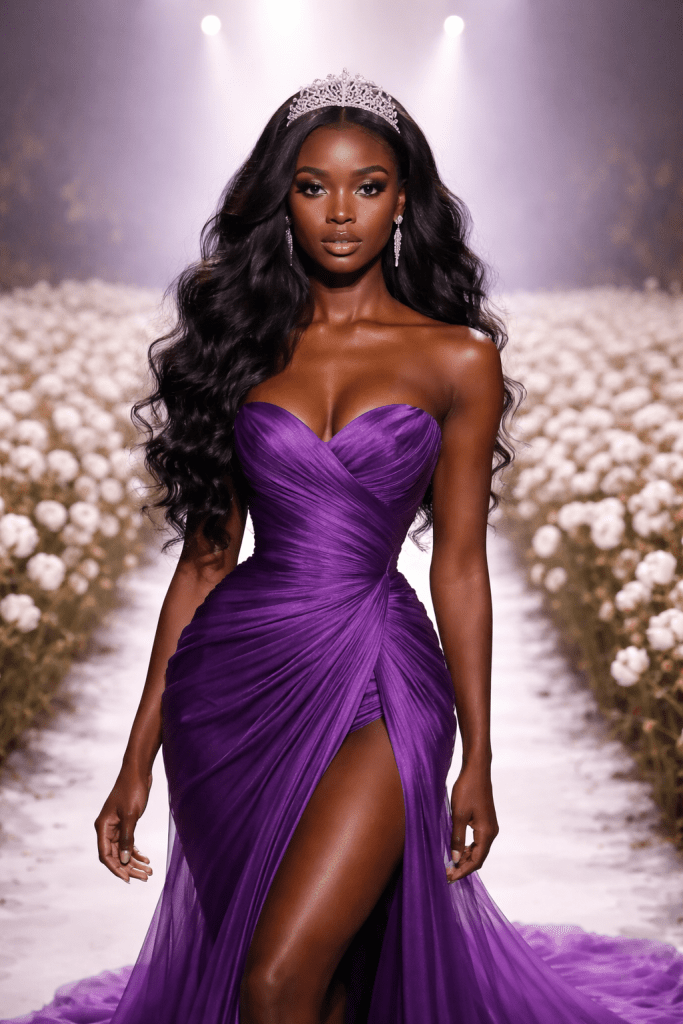
The story of the Brown woman is one of resilience, rebirth, and reclamation. Her journey from servitude to sovereignty—both internal and external—has been marked by centuries of struggle and transcendence. From the brutal realities of plantation life to the glittering lights of fashion runways, the evolution of her image mirrors a greater spiritual awakening: the rediscovery of her worth, beauty, and divine identity. Her path is not just a chronicle of survival but a testament to the enduring radiance that oppression could never extinguish.
In the cotton fields of America’s South, the Brown woman was both the backbone and the burden of a system designed to exploit her body and silence her voice. Her skin, kissed by the sun, became a symbol of labor and loss. Yet, even as she toiled under inhumane conditions, her strength radiated an unspoken grace. Enslaved women bore the brunt of physical, sexual, and emotional exploitation, yet within them lay the seeds of future generations who would redefine Black and Brown womanhood (Collins, 2000).
Her labor was not only agricultural but existential. Every day, she cultivated survival strategies—songs, prayers, and quiet defiance—that preserved her humanity. Spirituals sung in the fields were coded messages of freedom and hope, expressing an inner beauty that no master could steal. The Brown woman’s endurance was divine resistance, an echo of the Hebrew women in Exodus who “feared God, and did not as the king of Egypt commanded them” (Exodus 1:17, KJV).
As centuries turned, the Brown woman carried her ancestral pain into new forms of identity. The Reconstruction era offered minimal reprieve, yet the cultural memory of servitude continued to shape her self-image. Society imposed new shackles—colorism, Eurocentric beauty standards, and class-based discrimination. Lightness became currency, while darker tones were dismissed as undesirable. The trauma of the cotton fields mutated into the social hierarchies of complexion (Hunter, 2007).
In the early 20th century, Black and Brown women began to redefine beauty on their own terms. The Harlem Renaissance gave birth to a cultural revolution where art, literature, and music celebrated melanin and femininity. Icons like Josephine Baker and Zora Neale Hurston embodied a new consciousness of self-love. They challenged the world’s gaze, asserting that beauty was not confined to whiteness but could emerge proudly from the soil of struggle.
Still, the world continued to commodify the Brown woman’s image. In the age of advertising and media, she was alternately hypersexualized or erased altogether. The Brown woman became both muse and martyr, desired yet devalued. Her body was used to sell products, her curves celebrated only when worn by non-Black bodies. The struggle for representation became an extension of the plantation’s legacy—her labor admired but her personhood denied.
Yet, from this erasure rose a fierce reclamation. The Brown woman began to take control of her narrative, reshaping the lens through which she was seen. The natural hair movement, melanin-positive campaigns, and digital activism became modern-day revolutions. Social media platforms became her new battleground, where she could proclaim unapologetically, “I am my ancestors’ wildest dream.”
Fashion, once an industry of exclusion, began to shift under the pressure of her presence. The catwalk, a space that once rejected her, now bore witness to her glory. Models like Naomi Campbell, Alek Wek, and Duckie Thot redefined what global beauty could look like. Each stride on the runway became an act of defiance—a declaration that the daughter of the field worker had ascended to the stage of the world.
The symbolism of this transformation is profound. The same hands that once picked cotton now shape couture. The same skin once mocked for its depth of hue now commands admiration under golden lights. It is not simply a story of economic mobility or fashion inclusion, but of spiritual elevation. The Brown woman’s body, once a site of oppression, has become a canvas of divine artistry.
Still, her journey to self-love remains layered and complex. Generational trauma and systemic inequities continue to haunt her psyche. Colorism persists within her own community, and media still struggles to portray her diversity. Yet, the Brown woman’s resilience endures. Her love for herself is not a trend but a spiritual revolution—a return to the truth that she was always enough.
This self-love is radical because it challenges centuries of indoctrination. To love oneself in a world that profits from one’s insecurity is a political act. When the Brown woman looks into the mirror and sees beauty, she dismantles the psychological residue of colonialism. Her reflection becomes a form of resistance—a reminder that her worth was never for sale.
Spiritually, her journey mirrors the biblical narrative of restoration. Like Ruth gleaning in the fields before being elevated to royalty, the Brown woman’s life is marked by divine orchestration. Her pain prepared her for purpose. Her ancestors’ prayers planted the seeds of the empowerment she now harvests. “He hath made every thing beautiful in his time” (Ecclesiastes 3:11, KJV) captures the essence of her evolution.
In embracing her melanin, her curls, her history, and her imperfections, she reclaims her crown. This reclamation is not only external but deeply internal. She no longer measures herself by European standards, but by divine ones. Her beauty, like her spirit, is infinite—rooted in the soil of her ancestors and watered by the tears of generations who refused to disappear.
Education, art, and faith have become her tools of restoration. Through poetry, scholarship, and entrepreneurship, she is rewriting her narrative. From Maya Angelou’s “Phenomenal Woman” to Beyoncé’s Brown Skin Girl, every creative expression becomes a hymn of affirmation. These cultural works reaffirm that self-love is not vanity but healing—an act of remembrance and liberation.
The Brown woman’s presence on catwalks across Paris, New York, and Lagos is more than fashion; it is prophecy fulfilled. The world now watches what God already ordained: that the first shall be last and the last shall be first (Matthew 19:30, KJV). The once-overlooked is now celebrated, yet her power lies not in external validation but in self-realization.
Her journey continues, for the fight for equitable representation, safety, and dignity is ongoing. But each generation rises taller, walking with greater confidence and consciousness. She carries the voices of her foremothers in every graceful step. From the cotton fields to catwalks, her story is a sacred dance between pain and glory, oppression and freedom, despair and divine deliverance.
To love herself fully is to love the God who made her. Her journey is not merely about beauty but about identity—about returning to the sacred truth that she is fearfully and wonderfully made (Psalm 139:14, KJV). The Brown woman’s journey to self-love is, therefore, not an ending but a resurrection—a radiant testimony that from suffering can come splendor, and from bondage can bloom brilliance.
Her crown, once tarnished by history, now gleams with wisdom, faith, and grace. She stands on the shoulders of queens who came before her, not just as a model or icon, but as a miracle. The Brown woman is the living embodiment of triumph, the divine muse of history’s redemption song. Her journey is every woman’s reminder that no matter where the story begins, it can end in glory.
References
Collins, P. H. (2000). Black feminist thought: Knowledge, consciousness, and the politics of empowerment (2nd ed.). Routledge.
Hunter, M. (2007). The persistent problem of colorism: Skin tone, status, and inequality. Sociology Compass, 1(1), 237–254.
Holy Bible, King James Version. (2017). Cambridge University Press.
Hooks, B. (1992). Black looks: Race and representation. South End Press.
Walker, A. (1983). In search of our mothers’ gardens: Womanist prose. Harcourt Brace Jovanovich.
West, C. (1993). Race matters. Beacon Press.

 THE BROWN GIRL DILEMMA