
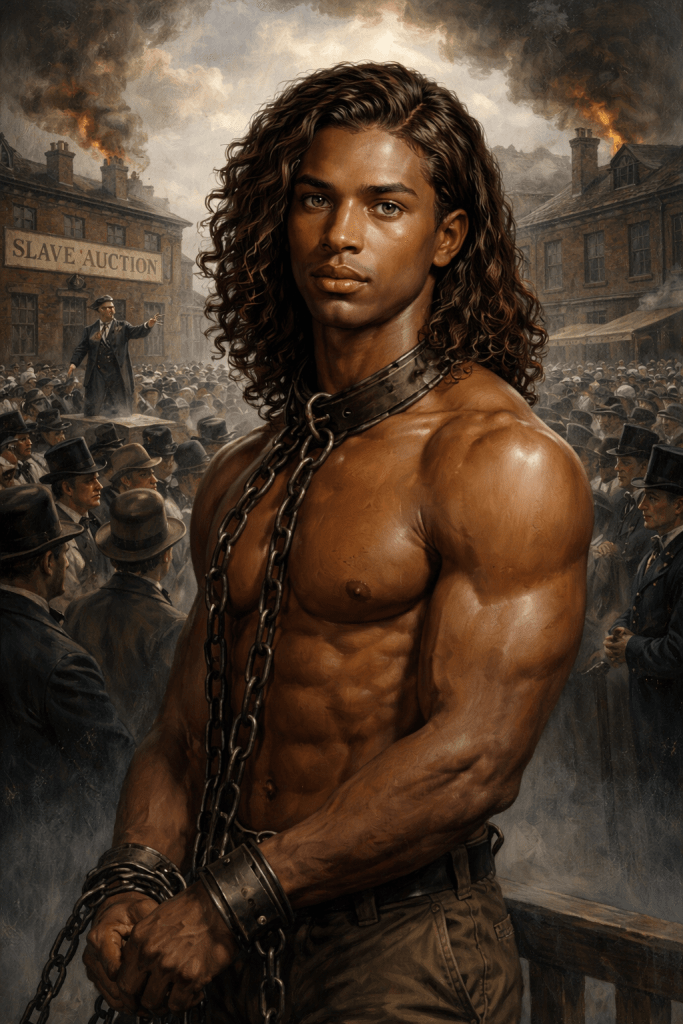
The phrase “The Richmond Horror” has circulated in various historical anecdotes and online retellings connected to the slave markets of Richmond, Virginia, during the nineteenth century. The story typically centers on an enslaved man described as extraordinarily handsome, whose appearance allegedly caused a dramatic spectacle at a slave auction. While the account is often repeated in popular storytelling, historians emphasize that the broader context of Richmond’s slave markets reveals the true horror: the commodification of human beings, where physical appearance, strength, and perceived desirability determined a person’s price and fate.
During the antebellum period, Richmond, Virginia, became one of the most significant hubs of the domestic slave trade in the United States. After the federal government banned the transatlantic slave trade in 1808, the internal trade expanded dramatically. Enslaved people were sold from Upper South states such as Virginia and Maryland to plantation regions in the Deep South, including Mississippi, Louisiana, and Alabama. Richmond’s geographic position and its transportation connections made it a central marketplace for this trade.
Within Richmond, the district known as Shockoe Bottom became infamous as a center for slave auctions, slave jails, and trading offices. Enslaved men, women, and children were held in confined quarters before being publicly sold to the highest bidder. Buyers evaluated individuals based on perceived physical attributes such as strength, youth, fertility, and sometimes physical attractiveness. The market logic of slavery reduced human bodies to commodities, assigning monetary value to traits that slaveholders believed would increase productivity or status.
Stories like the so-called Richmond Horror draw attention to the way enslaved people were objectified during these auctions. In many slave narratives and historical accounts, observers described auctions where potential buyers inspected enslaved individuals closely—checking teeth, muscles, posture, and complexion. Enslaved men who were tall, strong, and physically striking were often sold at particularly high prices because they were expected to perform intense labor or serve in visible household roles.
The legend of the “most handsome slave” describes a moment when a young man was brought to auction and stunned the crowd with his appearance. According to the story, wealthy buyers competed aggressively to purchase him, driving the price unusually high. In the narrative, the bidding war escalated into a spectacle of greed and obsession, highlighting the moral corruption embedded in the slave system. The horror, according to the story, lies in the grotesque contrast between admiration for the man’s beauty and the simultaneous willingness to treat him as property.
Although this specific anecdote is not firmly verified in archival records, it reflects a broader reality documented in historical scholarship. Slave auctions frequently turned human lives into public entertainment. Crowds gathered to watch the sale of enslaved individuals, and newspapers occasionally advertised people with descriptive language emphasizing physical traits. The emphasis on bodily features mirrored the pseudoscientific racial thinking of the nineteenth century, which attempted to categorize people based on physical appearance.
Richmond’s slave-trading infrastructure made such spectacles possible on a large scale. Traders operated offices, holding pens, and prisons where enslaved people were detained before sale. One of the most notorious facilities was Lumpkin’s Jail, sometimes called “the Devil’s Half Acre.” This compound served as a private slave jail where individuals were confined under harsh conditions while traders arranged their sale or transport to other states.
Conditions inside these slave jails were often brutal. Enslaved people were chained, crowded into small spaces, and deprived of adequate food or sanitation. Many were awaiting forced transport to plantations in the Deep South, where demand for labor was expanding alongside the growth of cotton cultivation. Richmond functioned as a staging ground for these forced migrations.
Another horror associated with the Richmond slave trade was the systematic separation of families. Parents were sold away from children, spouses from one another, and siblings from siblings. Auction blocks became sites where lifelong bonds were permanently severed in moments of financial transaction. Numerous narratives written by formerly enslaved individuals describe the emotional trauma of watching loved ones being sold to distant plantations.
The commodification of beauty within this system was not limited to men. Enslaved women were often evaluated not only for labor but also for their perceived attractiveness. This objectification exposed them to sexual exploitation and abuse by slaveholders and traders. The valuation of physical traits within the slave market thus intersected with broader systems of racial hierarchy and gendered violence.
While the exact details of the Richmond Horror story remain uncertain, its enduring presence in cultural memory reflects a deeper truth about slavery. The institution did not merely exploit labor; it transformed human beings into objects whose worth could be measured, inspected, and purchased. The fascination with the appearance of an enslaved man—combined with the eagerness to own him—captures the disturbing contradictions at the heart of the slave system.
Several enslaved people connected to the slave trade and resistance in Richmond, Virginia, are historically documented. Unlike the anonymous figure in the “Richmond Horror” legend, their names and actions appear in historical records and have become important parts of American history.
1. Gabriel Prosser
One of the most well-known enslaved men connected to Richmond was Gabriel Prosser, an enslaved blacksmith who organized a large slave rebellion in 1800. Gabriel was highly skilled and literate, which allowed him to move somewhat freely in the city and communicate with other enslaved workers.
He planned a massive uprising that would involve enslaved people from plantations surrounding Richmond. The plan was to seize weapons, capture the city, and demand freedom. Gabriel reportedly adopted the slogan “Death or Liberty.”
However, heavy rain delayed the planned revolt, and informants revealed the plot to authorities. Gabriel was captured and later executed in Richmond. Although the rebellion failed, his resistance became one of the earliest major organized revolts against American slavery.
2. Henry Box Brown
Another remarkable figure connected to Richmond was Henry Brown, later known as “Henry Box Brown.” He was an enslaved man who worked in a tobacco warehouse.
In 1849, desperate to escape slavery after his wife and children were sold away, Brown devised an extraordinary plan. With the help of abolitionist friends, he shipped himself in a wooden crate by mail from Richmond to Philadelphia. The journey took about 27 hours.
When the box was opened by abolitionists in Philadelphia, Brown reportedly stood up and began singing a hymn of freedom. His daring escape made him famous among abolitionists, and he later became a public speaker advocating against slavery.
3. John Jasper
John Jasper was born into slavery in Virginia but later became one of the most influential Black preachers of the nineteenth century.
After emancipation, Jasper founded the Sixth Mount Zion Baptist Church in Richmond, where he became a powerful orator. Thousands attended his sermons, and he became known throughout the region for his charismatic preaching and strong theological messages.
His life reflected the transition from slavery to freedom and the leadership roles many formerly enslaved people assumed in Black communities after the Civil War.
The Real Horror of Richmond
While legends like the “Richmond Horror” circulate online, the verified history of Richmond’s slave trade reveals a much deeper tragedy. The district known as Shockoe Bottom served as one of the largest slave markets in the United States. Enslaved people were imprisoned in facilities such as Lumpkin’s Jail, where traders held men, women, and children before selling them to plantations in the Deep South.
Historians estimate that hundreds of thousands of enslaved people were sold or transported through Virginia during the domestic slave trade. Families were separated, individuals were chained together in forced marches called coffles, and human beings were treated as commodities.
Today, Richmond continues to confront this past through historical research, memorialization, and preservation efforts that honor the lives of those who endured slavery and fought for freedom.
Modern historians emphasize that the true horror of Richmond lies not in a single dramatic auction but in the scale of the trade that occurred there. Historians estimate that hundreds of thousands of enslaved people were transported out of Virginia through the domestic slave trade during the nineteenth century. Richmond played a central role in that forced migration, sending countless individuals to plantations throughout the American South.
Today, scholars, archaeologists, and community activists work to preserve the historical memory of places like Shockoe Bottom. Efforts have been made to protect burial grounds, interpret historical sites, and educate the public about Richmond’s role in the domestic slave trade. These initiatives aim to ensure that the experiences of the enslaved are not erased or forgotten.
The legend of the Richmond Horror, whether literal or symbolic, ultimately reminds us of the dehumanizing nature of slavery. In a system where beauty, strength, and youth could raise the price of a human being, admiration and cruelty coexisted in the same moment. The spectacle of an auction—where a person’s body could inspire awe while simultaneously being sold—reveals the moral contradictions that defined the institution of slavery in the United States.
References
Berlin, I. (2003). Generations of captivity: A history of African-American slaves. Harvard University Press.
Campbell, E. B. (2007). Richmond’s unhealed history. Brandylane Publishers.
Fogel, R. W., & Engerman, S. L. (1995). Time on the cross: The economics of American Negro slavery. W.W. Norton & Company.
Johnson, W. (1999). Soul by soul: Life inside the antebellum slave market. Harvard University Press.
Rothman, A. (2005). Slave country: American expansion and the origins of the Deep South. Harvard University Press.
Tarter, B. (2016). The Grandees of government: The origins and persistence of undemocratic politics in Virginia. University of Virginia Press.
National Park Service. (n.d.). Shockoe Bottom and the Richmond slave trade. U.S. Department of the Interior.
Johnson, W. (1999). Soul by soul: Life inside the antebellum slave market. Harvard University Press.
Library of Virginia. (n.d.). Gabriel’s Conspiracy (1800). Retrieved from https://www.lva.virginia.gov
Library of Virginia. (n.d.). Henry “Box” Brown. Retrieved from https://www.lva.virginia.gov
National Park Service. (n.d.). Shockoe Bottom and the Richmond slave trade. U.S. Department of the Interior.
Smithsonian Institution. (2013). Lumpkin’s Jail and the slave trade in Richmond. Smithsonian Magazine.
 THE BROWN GIRL DILEMMA