
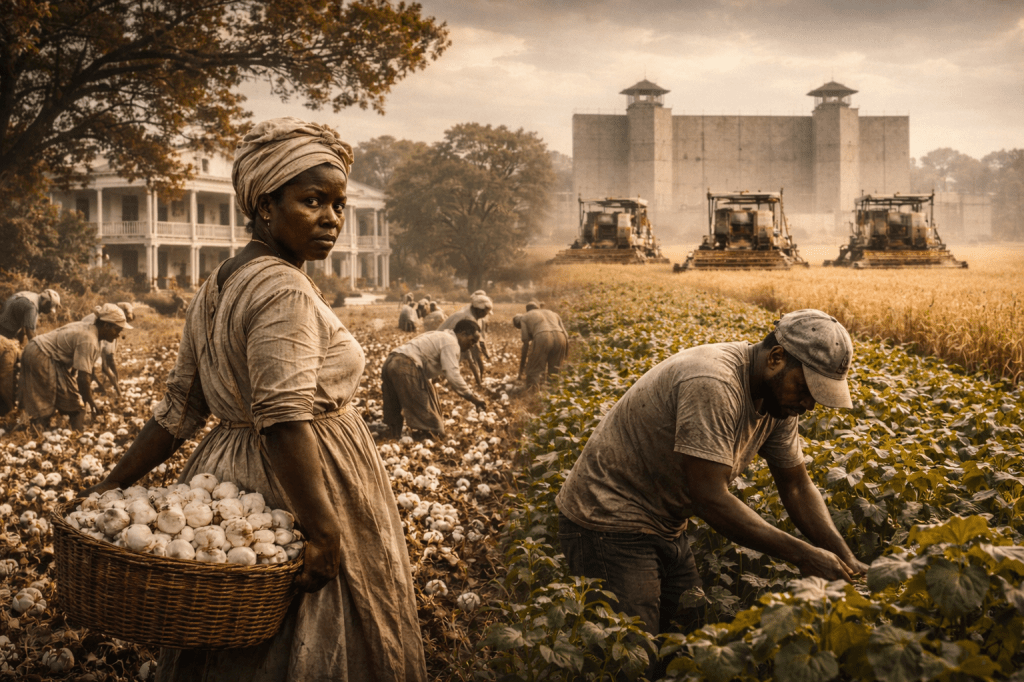
The legacy of slavery continues to shape the modern world in ways that are often overlooked. While chattel slavery in the United States officially ended in 1865, its economic, social, and psychological structures persist in subtle yet profound forms. Modern “plantations” manifest not only as historical sites but also as systemic systems of exploitation that disproportionately impact Black communities.
During the antebellum period, plantations were economic engines built on the labor of enslaved Africans. They relied on dehumanization, control, and violence to maintain productivity, wealth, and social hierarchy. The plantation system created lasting inequities in land ownership, education, and wealth accumulation.
Enslaved individuals were subjected to grueling labor from dawn to dusk, often under extreme conditions in the fields or as domestic workers. Families were torn apart, and basic human rights were denied. The psychological and cultural impact of this trauma has resonated across generations, creating long-lasting challenges in Black communities.
Plantations were also centers of cultural erasure. Enslaved Africans were forbidden from speaking their native languages, practicing their religions, or maintaining cultural traditions. This forced assimilation sought to strip individuals of identity while normalizing the supremacy of white culture.
The “modern plantation” can be understood metaphorically in terms of systemic oppression. Mass incarceration, exploitative labor practices, and economic marginalization of Black Americans are frequently described as contemporary forms of plantation-like control. While the methods differ, the underlying structures of surveillance, discipline, and economic extraction remain.
Historically, plantations relied on racialized hierarchies to maintain control. White supremacy dictated who could own property, access education, or participate in governance. These hierarchies have influenced social and institutional structures into the 21st century, contributing to persistent racial disparities in wealth, health, and political representation.
The psychological effects of plantation life continue to manifest in generational trauma. Studies on epigenetics suggest that stress and trauma experienced by enslaved ancestors may impact the mental and physical health of descendants, contributing to disparities in mental health, chronic illness, and resilience.
Education on plantation history often sanitizes the brutality experienced by enslaved individuals. Museums and historical sites sometimes focus on the architecture, wealth, or “heritage” of plantation owners while minimizing the suffering, resistance, and humanity of the enslaved population. This selective narrative reinforces systemic racism by erasing the lived experiences of Black Americans.
Labor exploitation continues in modern industries. Many low-wage sectors disproportionately employ Black workers under precarious conditions, echoing the economic dependency that existed on plantations. Farm labor, domestic work, and service industries reveal structural patterns reminiscent of historical exploitation.
Slavery and modern oppression are also interconnected through wealth disparities. The descendants of enslaved individuals were denied the ability to accumulate land, start businesses, or inherit wealth for generations. In contrast, many modern corporations and institutions trace their wealth back to slavery, creating intergenerational inequities that persist today.
Plantations were not only economic sites but also spaces of resistance and culture. Enslaved Africans preserved languages, songs, spiritual practices, and social networks, which formed the foundation of Black American culture. This resilience contrasts sharply with the narrative of passive subjugation often presented in history.
Modern parallels are visible in prison labor systems, where predominantly Black populations are employed for minimal wages. Scholars argue that this represents a continuation of the plantation logic: controlled labor extracted under constrained autonomy, producing profit for others while restricting freedom.
Cultural representations of plantations also shape perceptions. Films, literature, and tourism often romanticize plantation life, masking the violence and oppression that defined the institution. This misrepresentation perpetuates myths about the benevolence of slavery and undermines the acknowledgment of Black suffering and agency.
Plantations in the modern imagination can also refer to economic environments where Black workers are overexploited, surveilled, and restricted in mobility. Corporations, supply chains, and gig economies sometimes mirror the control mechanisms of historical plantations through low wages, lack of benefits, and limited upward mobility.
Land ownership remains a critical issue. After emancipation, Black farmers and landowners faced systemic barriers through discriminatory lending practices, violence, and legal maneuvers, preventing them from achieving economic independence. This mirrors the historical denial of land and wealth that characterized the plantation economy.
The plantation metaphor extends to education. Schools in under-resourced Black communities often suffer from overcrowding, poor facilities, and limited access to quality instruction. These conditions reflect structural neglect that echoes the constraints placed on enslaved individuals, shaping long-term outcomes.
Healthcare disparities also reflect plantation legacies. Limited access to medical services, environmental injustices, and systemic bias within healthcare institutions continue to disproportionately affect Black communities, echoing the neglect and exploitation of enslaved populations.
Understanding the link between historical plantations and modern inequalities is critical for policy and social justice. Recognizing systemic patterns enables more effective interventions, targeted support, and reparative measures that address the roots of inequity rather than treating symptoms superficially.
Resistance has always been part of the story. Enslaved Africans organized revolts, preserved cultural practices, and forged communities of resilience. Today, activism, scholarship, and advocacy continue this legacy, challenging modern forms of oppression and advocating for racial equity.
Ultimately, the dilemma of modern plantations reminds society that the end of slavery did not end its effects. The structures, ideologies, and systems established during slavery continue to shape economic, social, and cultural realities for Black Americans. Addressing this requires critical awareness, structural reform, and historical reckoning.
References
Berlin, I. (2003). Generations of Captivity: A History of African-American Slaves. Belknap Press.
Davis, A. Y. (2003). Are Prisons Obsolete? Seven Stories Press.
Kolchin, P. (2003). American Slavery, 1619–1877. Hill and Wang.
Wood, P. H. (1999). Black Majority: Negroes in Colonial South Carolina from 1670 through the Stono Rebellion. W. W. Norton & Company.
Alexander, M. (2010). The New Jim Crow: Mass Incarceration in the Age of Colorblindness. The New Press.
White, D. G. (1999). Ar’n’t I a Woman? Female Slaves in the Plantation South. W. W. Norton & Company.
Finkelman, P. (2009). Slavery and the Founders: Race and Liberty in the Age of Jefferson. M.E. Sharpe.
Gates, H. L., Jr., & Higginbotham, E. B. (2010). African American Lives. Oxford University Press.
 THE BROWN GIRL DILEMMA