
Tag Archives: PHD

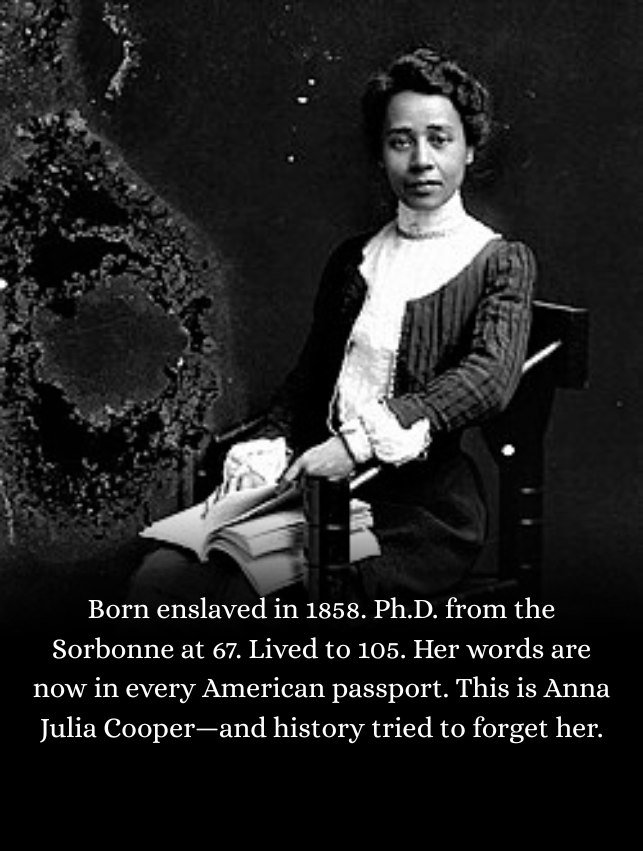
The Slave Files: Anna Julie Cooper

This photograph is the property of its respective owner. No copyright infringement intended.

Anna Julia Cooper was born on August 10, 1858 in Raleigh, North Carolina

Anna Julia Cooper was an influential African American educator, scholar, and author whose life and work left a profound impact on Black education and intellectual thought. Born in the late 19th century, she emerged during a period of systemic oppression and racial discrimination, when opportunities for African Americans—particularly women—were severely limited. Despite these obstacles, Cooper dedicated her life to uplifting her community through education, moral leadership, and scholarly contributions.

Cooper’s early life was marked by a determination to pursue learning despite societal barriers. She believed that education was a fundamental tool for liberation and empowerment. Her passion for teaching and scholarship became a central theme in her life, guiding her professional endeavors and public influence.

As an educator, Julia Cooper worked tirelessly to improve access to quality schooling for African Americans. She advocated for rigorous academic standards, the establishment of Black educational institutions, and curricula that fostered critical thinking and self-worth among students. Her efforts emphasized the transformative power of knowledge as a means to resist systemic oppression.

In addition to teaching, Cooper was a prolific writer and thinker. She authored essays and treatises on the moral, social, and intellectual development of African Americans, emphasizing the necessity of self-respect, cultural pride, and educational attainment. Her writings served as a blueprint for Black uplift during the early 20th century.

Cooper also engaged in public speaking and community organizing. She traveled widely, addressing audiences on the importance of education, civic responsibility, and moral development. Her speeches encouraged African Americans to embrace their intellectual potential and challenge societal narratives that sought to marginalize them.

Her impact extended to her mentorship of younger generations of Black scholars and educators. By providing guidance, encouragement, and access to educational resources, Cooper helped cultivate a new class of African American leaders committed to intellectual excellence and social progress.

Anna Julia Cooper’s work was informed by a deep moral and spiritual philosophy. She believed that personal character and ethical integrity were inseparable from educational and professional achievement. Her vision emphasized holistic development—intellectual, moral, and civic—as essential to individual and communal advancement.

Throughout her career, Cooper confronted racism, sexism, and social prejudice. Her ability to navigate these systemic challenges while achieving professional recognition serves as a testament to her resilience and strategic acumen. She became a symbol of Black female agency in a society structured to limit her potential.

Her legacy is visible in the educational institutions she influenced, the students she inspired, and the broader discourse on African American intellectual empowerment. Cooper’s life exemplifies the potential for knowledge and moral courage to transform communities and challenge entrenched inequalities.

Anna Julia Cooper remains a vital figure in African American history, her life and work illustrating the enduring power of education, scholarship, and leadership in advancing justice and equality. Her contributions continue to inspire educators, students, and leaders committed to intellectual rigor and moral responsibility.


References

  1. Gates, H. L., & Higginbotham, E. B. (2014). African American lives. Oxford University Press.
  2. Gutman, H. G. (1976). The black family in slavery and freedom, 1750-1925. Pantheon Books.
  3. Kelley, R. D. G. (1994). Race rebels: Culture, politics, and the Black working class. Free Press.
  4. Theoharis, J. (2018). A more beautiful and terrible history: The uses and misuses of civil rights history. Beacon Press.
  5. Wiggins, W. H. (2000). The intellectual tradition of African Americans: A historical overview. Greenwood Press.

The Corporate Tightrope: Black Women in Professional Spaces.

Photo by Akorede Ojubanire on Pexels.com

Black women in professional spaces often walk a precarious tightrope, balancing the weight of racial and gendered stereotypes while striving for excellence in corporate structures. Their presence in boardrooms, law firms, government offices, and academic institutions reflects both resilience and sacrifice. Despite progress, they remain underrepresented in leadership positions, often facing the “double jeopardy” of being both Black and female (Bell & Nkomo, 2001). The corporate landscape presents opportunities, but also challenges that demand both strategic navigation and cultural resilience.

Prominent figures such as Michelle Obama, who redefined the role of First Lady with her Harvard-trained legal background, and Condoleezza Rice, the first Black female Secretary of State, represent the heights that Black women can achieve in professional spheres. Similarly, Ursula Burns, former CEO of Xerox, broke barriers as the first Black woman to lead a Fortune 500 company. In academia and technology, women such as Dr. Shirley Ann Jackson, a physicist and president of Rensselaer Polytechnic Institute, embody the intersection of brilliance and leadership. These women, though highly accomplished, illuminate how exceptional Black women must be to gain visibility in predominantly white and male-dominated spaces.

The structural barriers remain significant. Black women are frequently subjected to the “glass cliff” phenomenon, where they are promoted into leadership roles during times of organizational crisis, increasing the risk of failure (Ryan & Haslam, 2005). Additionally, they are burdened with “invisibility” in professional settings, where their contributions are overlooked, or “hypervisibility,” where every action is scrutinized. These contradictions force Black women into roles where they must consistently outperform their peers to receive the same recognition.

Black Women in Professional Spaces: Notable Leaders

  • Law and Politics
    • Michelle Obama – Harvard-educated lawyer, former First Lady, advocate for education and public health.
    • Condoleezza Rice – First Black woman to serve as U.S. Secretary of State.
    • Ketanji Brown Jackson – First Black woman to serve on the U.S. Supreme Court.
    • Lori Lightfoot – Former mayor of Chicago, one of the largest U.S. cities led by a Black woman.
  • Business and Corporate Leadership
    • Ursula Burns – Former CEO of Xerox, first Black woman to lead a Fortune 500 company.
    • Rosalind Brewer – Former CEO of Walgreens Boots Alliance and Starbucks COO, one of the few Black female executives in Fortune 500 leadership.
    • Thasunda Brown Duckett – CEO of TIAA, a major financial services firm.
  • Academia and Science
    • Dr. Shirley Ann Jackson – Physicist, president of Rensselaer Polytechnic Institute, first Black woman to earn a Ph.D. from MIT in any field.
    • Dr. Valerie Montgomery Rice – President of Morehouse School of Medicine, advancing Black representation in medicine.
    • Dr. Ruth Simmons – First Black president of an Ivy League university (Brown University).
  • Media and Arts
    • Oprah Winfrey – Media mogul, philanthropist, one of the most influential women in global media.
    • Ava DuVernay – Acclaimed film director and producer, bringing visibility to Black stories in Hollywood.
    • Shonda Rhimes – Television producer and writer, creator of hit shows such as Grey’s Anatomy and Scandal.
  • STEM and Technology
    • Kimberly Bryant – Founder of Black Girls Code, advocating for diversity in tech.
    • Lisa Jackson – Former head of the EPA, now Vice President of Environment, Policy, and Social Initiatives at Apple.
    • Angela Benton – Tech entrepreneur and investor, founder of NewME accelerator.

Psychologically, the weight of corporate tightrope walking contributes to stress and burnout. The stereotype of the “Strong Black Woman” is replicated in professional contexts, where vulnerability is discouraged and endurance is expected (Woods-Giscombé, 2010). While Black women excel in education—earning advanced degrees at higher rates than their male counterparts—their advancement in corporate hierarchies lags. This disconnect reflects systemic inequities, implicit bias, and the lack of mentorship opportunities that are critical for career progression.

Faith and cultural identity often serve as sources of resilience. For many, spirituality grounds their pursuit of excellence and provides a counterbalance to corporate pressures. Proverbs 31:25 (KJV) describes the virtuous woman as clothed with “strength and honour,” an affirmation that aligns with the dignity Black women carry into boardrooms and offices. Yet the challenge remains to ensure that their humanity is honored alongside their productivity. Professional spaces must not only benefit from Black women’s labor but also foster environments where they can thrive without compromise.

In conclusion, the corporate tightrope for Black women illustrates the broader tension between opportunity and inequality. Figures such as Michelle Obama, Condoleezza Rice, Ursula Burns, and Shirley Ann Jackson stand as evidence of possibility but also as reminders of how exceptionalism is often the price of recognition. To create sustainable change, corporate structures must move beyond tokenism and genuinely dismantle barriers to equity. Only then can Black women’s presence in professional spaces be celebrated not as extraordinary exceptions, but as integral leaders shaping the future of business, government, and academia.


References

  • Bell, E. L. J. E., & Nkomo, S. M. (2001). Our separate ways: Black and White women and the struggle for professional identity. Harvard Business School Press.
  • Ryan, M. K., & Haslam, S. A. (2005). The glass cliff: Evidence that women are over‐represented in precarious leadership positions. British Journal of Management, 16(2), 81–90.
  • Woods-Giscombé, C. L. (2010). Superwoman schema: African American women’s views on stress, strength, and health. Qualitative Health Research, 20(5), 668–683.