
Building the Black Standard of Beauty, Intelligence, and Power.
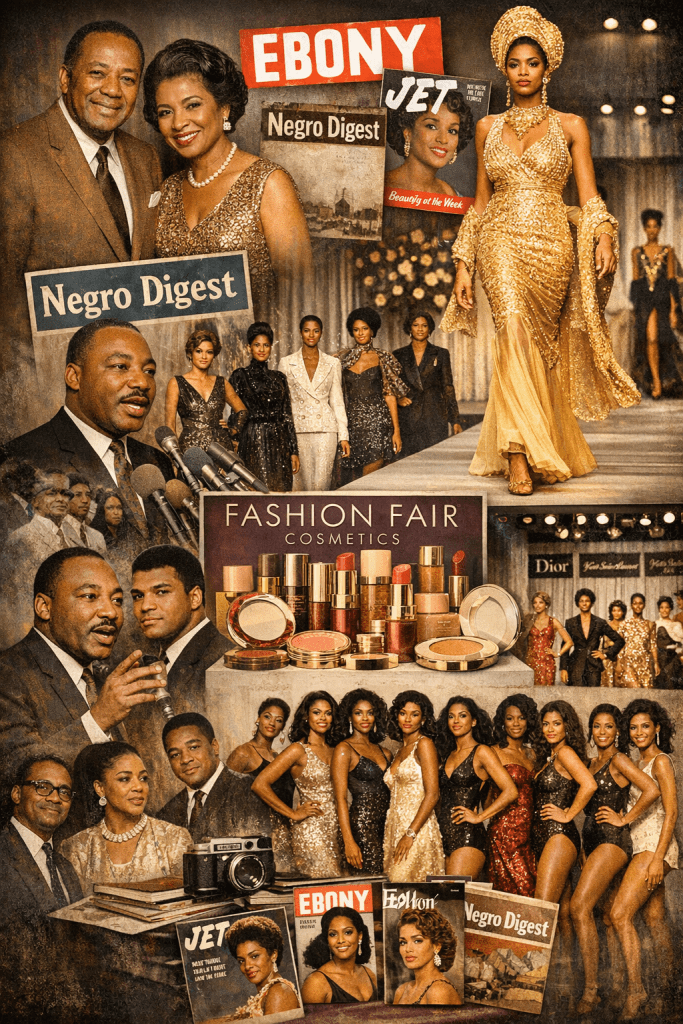
The story of Ebony, Jet, Negro Digest, Ebony Fashion Fair, and Fashion Fair Cosmetics represents one of the most important cultural revolutions in Black history. These institutions did far more than publish magazines or sell beauty products; they created a complete Black world—one in which Black people could finally see themselves reflected with dignity, intelligence, luxury, and divine beauty. At a time when American society systematically erased or distorted Black identity, this media and beauty empire boldly declared that Black people were not inferior, invisible, or marginal, but central to history, culture, and global excellence.
This revolutionary movement was founded by John H. Johnson, one of the most influential Black businessmen and publishers in American history. Born in 1918 in Arkansas and raised in Chicago, Johnson understood that representation was not simply about images, but about psychological power. In 1942, he launched the Johnson Publishing Company, which would grow into the largest Black-owned publishing company in the world. Johnson believed that Black people needed more than civil rights; they needed cultural authority, self-definition, and platforms that affirmed their humanity.
Standing alongside him was his wife, Eunice Johnson, a visionary entrepreneur, fashion editor, and cultural architect. Eunice Johnson was not merely a supportive spouse—she was the creative engine behind the Black beauty and fashion revolution. As the fashion director of Ebony, she reshaped how Black women were represented in style, luxury, and global elegance. Together, the Johnsons did something unprecedented in American history: they created a complete Black cultural mirror, one that allowed Black people to see themselves not through the distorted lens of racism, but through their own truth.
Founded in 1945, Ebony was created as the Black answer to Life magazine. Its mission was simple yet radical—to portray Black people as successful, educated, cultured, and aspirational. Ebony featured Black doctors, lawyers, professors, entrepreneurs, and political leaders. It showcased Black families, marriages, homes, and generational wealth. It highlighted African royalty, global Black leadership, and diasporic excellence. At a time when mainstream media associated Blackness with poverty, crime, and pathology, Ebony unapologetically presented Black affluence, Black intellect, and Black dignity. The magazine created what can be described as a visual theology of Black excellence, teaching Black people that they belonged in luxury, history, and greatness.
In 1951, Johnson expanded this vision with the launch of Jet, known as The Weekly Negro News Digest. Smaller in size but massive in cultural impact, Jet became the visual pulse of Black America. It documented the Civil Rights Movement in real time, including police brutality, racial violence, and social injustice that mainstream media often ignored. It also celebrated everyday Black life—weddings, graduations, church events, and community milestones—proving that Black life was worthy of documentation and historical memory.
One of Jet’s most powerful contributions was its iconic “Beauty of the Week” feature. This single section revolutionized global beauty standards by consistently centering Black women of every complexion, body type, and background. Dark-skinned women, light-skinned women, natural hair, Afro-textured beauty—Jet made visible what the world had erased. Long before diversity became a marketing trend, Jet declared that Black women were not exceptions to beauty, but the standard of beauty itself.
Before Ebony and Jet, Johnson also launched Negro Digest, later renamed Black World. This publication became the intellectual backbone of Black consciousness in America. Negro Digest published Black scholars, historians, theologians, and political thinkers who addressed African history, racism, colonialism, Pan-Africanism, and Black psychology. It served as a philosophical and political platform during the rise of Black Power and global liberation movements. Through Negro Digest, Johnson proved that Black media was not only aesthetic, but deeply intellectual and revolutionary—it nurtured the Black mind.
Across all these platforms, a single unspoken message echoed powerfully: “Look at Black people.” Not as slaves. Not as criminals. Not as stereotypes. But as stylish, educated, intelligent, wealthy, cultured, and global. These publications functioned as psychological counter-propaganda to white supremacy. They repaired centuries of racial misrepresentation by producing positive Black mirrors. They did not simply inform Black audiences; they healed identity and reprogrammed self-perception.
One of the most extraordinary extensions of this cultural revolution was the creation of the Ebony Fashion Fair, founded by Eunice Johnson in 1958. The Ebony Fashion Fair was a traveling luxury fashion show that brought Paris haute couture directly into Black communities across America. For the first time in U.S. history, Black women exclusively modeled designs from elite fashion houses such as Dior, Givenchy, and Yves Saint Laurent. At a time when the fashion industry was segregated and excluded Black models, Eunice Johnson forced global fashion to recognize Black women as symbols of elegance, luxury, and high culture. Ebony Fashion Fair transformed churches, auditoriums, and community centers into international runways, allowing Black audiences to see themselves as part of the global elite.
Out of Ebony Fashion Fair emerged one of the most important Black-owned beauty companies in history: Fashion Fair Cosmetics. Founded in 1973 by Eunice Johnson, Fashion Fair became the largest and most successful Black-owned cosmetics brand in the world. It was created because mainstream cosmetic companies refused to make products for darker skin tones. Fashion Fair developed foundations, powders, and lipsticks specifically for Black undertones and deep complexions. It was sold in major department stores such as Macy’s and became the official makeup brand for Black models and professional fashion shows.
For the first time, Black women could walk into luxury retail spaces and find makeup designed for their skin—not approximations of whiteness, but products made with Black beauty in mind. Fashion Fair Cosmetics sent a revolutionary message: Black women did not need to lighten, hide, or dilute their appearance. They were not a niche market. They were the standard.
Together, Ebony, Jet, Negro Digest, Ebony Fashion Fair, and Fashion Fair Cosmetics created the most powerful Black cultural ecosystem in modern history. This empire produced Black news, Black beauty, Black fashion, Black intellect, Black luxury, and Black self-worth. It set global beauty standards, built Black middle-class identity, preserved Black historical memory, created Black celebrity culture, and rewired Black self-esteem.
Ebony: The Black Answer to Life Magazine
Founded in 1945, Ebony was created to showcase Black people the way white magazines showcased white America—successful, educated, aspirational, and human. Ebony featured:
- Black doctors, lawyers, professors, and CEOs
- Black families, marriages, and generational wealth
- African royalty and global Black leaders
- Black entertainers, scholars, and activists
At a time when Blackness was associated with poverty and pathology, Ebony portrayed Black affluence, Black intellect, and Black excellence. It created the visual theology of the Black middle and upper class.
The unspoken message was radical:
Black people belong in history, luxury, and greatness.
Jet: The Visual Pulse of Black America
Founded in 1951, Jet became the heartbeat of Black America. Known as The Weekly Negro News Digest, Jet documented Black life in real time:
- Civil Rights Movement coverage
- Police brutality and racial injustice
- Black celebrities and athletes
- Weddings, graduations, and community milestones
One of Jet’s most revolutionary contributions was “Beauty of the Week.” This single feature redefined global beauty standards by consistently centering Black women of all shades, textures, and body types—long before diversity was fashionable.
Dark-skinned women, light-skinned women, natural hair, Afro-textured beauty—Jet said to the world:
Black women are the beauty standard.
Negro Digest: The Black Intellectual Renaissance
Before Ebony and Jet, Johnson launched Negro Digest, later renamed Black World. This magazine became the intellectual backbone of Black consciousness.
It published:
- Black scholars and theologians
- African historians and Pan-African thinkers
- Writers on racism, colonialism, and psychology
- Political philosophy and liberation theology
Negro Digest proved that Black media was not just visual—it was philosophical, theological, and revolutionary. It nurtured the Black mind.
“Look at Black People”: Reprogramming the Black Image
Across all Johnson platforms, one message echoed loudly:
Look at Black people.
Not as slaves.
Not as criminals.
Not as stereotypes.
But as:
- Stylish
- Intelligent
- Educated
- Wealthy
- Global
- Elegant
This media empire functioned as counter-propaganda to white supremacy. It repaired the psychological damage of racism by showing Black people who they really were.
These publications didn’t just inform—they healed identity.
Ebony Fashion Fair: Black Models, Global Luxury
One of Eunice Johnson’s greatest achievements was the creation of the Ebony Fashion Fair, a traveling luxury fashion show that brought Paris couture directly into Black communities.
For the first time in American history:
- Black women modeled Dior, Givenchy, and Yves Saint Laurent
- Black audiences saw luxury on Black bodies
- Black beauty entered the global elite fashion world
This was revolutionary. In a segregated fashion industry that excluded Black models, Eunice Johnson forced haute couture to recognize Black women as luxury incarnate.
She didn’t just put Black women in fashion—
She placed Black women at the center of global elegance.
Fashion Fair Cosmetics: The Largest Black-Owned Beauty Brand
Out of Ebony Fashion Fair emerged one of the most important Black-owned companies in beauty history: Fashion Fair Cosmetics.
Founded in 1973 by Eunice Johnson, Fashion Fair became the largest and most successful Black-owned cosmetics brand in the world. It was created because mainstream brands refused to make makeup for darker skin tones.
Fashion Fair:
- Created foundations for deep complexions
- Produced lipsticks and powders for Black undertones
- Sold in major department stores like Macy’s
- Served professional Black models and everyday women
For the first time, Black women could walk into luxury stores and find makeup designed for their skin—not approximations of whiteness.
Fashion Fair Cosmetics told Black women:
You do not need to lighten, hide, or dilute your beauty.
You are the market. You are the standard.
The Greatest Black Media Empire Ever Created
Together, Ebony, Jet, Negro Digest, Ebony Fashion Fair, and Fashion Fair Cosmetics created a complete Black ecosystem:
- Black news
- Black beauty
- Black fashion
- Black intellect
- Black luxury
- Black self-worth
This empire:
- Set global Black beauty standards
- Built Black middle-class identity
- Preserved Black historical memory
- Created Black celebrity culture
- Rewired Black self-esteem
These institutions functioned as:
- Cultural archives
- Psychological liberation tools
- Visual theology of Black excellence
John H. Johnson and Eunice Johnson did not just build magazines and makeup brands.
They reprogrammed Black consciousness.
They taught generations of Black people how to see themselves:
Not through white validation.
Not through colonial distortion.
But through Black truth, Black dignity, and Black divine beauty.
These institutions were not merely businesses; they were cultural liberation tools, psychological healing systems, and visual archives of Black greatness. John H. Johnson and Eunice Johnson did not simply build magazines and makeup brands. They built a Black world within a society that tried to erase Black humanity. They taught generations of Black people how to see themselves—not through white validation, colonial distortion, or racist ideology—but through Black truth, Black dignity, and Black divine beauty.
This was not just media.
This was nation-building.
References
Johnson, J. H. (1989). Succeeding against the odds. Warner Books.
Autobiography of John H. Johnson detailing the founding of Johnson Publishing, Ebony, and Jet, including philosophy of Black representation.
Johnson, E. (2003). Ebony fashion fair: 50 years of style. Johnson Publishing Company.
Primary source on the history, mission, and cultural impact of Ebony Fashion Fair, written by Eunice Johnson herself.
Smith, J. L. (2004). Becoming something: The story of Ebony magazine. Northwestern University Press.
Scholarly history of Ebony’s role in shaping Black middle-class identity and visual culture.
Byrd, R. P., & Gates, H. L. Jr. (2009). The Black intellectual tradition. Harvard University Press.
Context for Negro Digest and Black World as intellectual platforms.
Davis, A. Y. (2016). Freedom is a constant struggle: Ferguson, Palestine, and the foundations of a movement. Haymarket Books.
Used for cultural and political framing of Black media as resistance.
Weems, R. E. (1998). Desegregating the dollar: African American consumerism in the twentieth century. New York University Press.
Key academic text on Black-owned businesses, including Johnson Publishing and Fashion Fair Cosmetics.
Walker, S. (2002). Style and status: Selling beauty to African American women, 1920–1975. University Press of Kentucky.
Scholarly source on Black beauty culture and cosmetics history.
Craig, M. L. (2002). Ain’t I a beauty queen? Black women, beauty, and the politics of race. Oxford University Press.
Supports analysis of Jet’s “Beauty of the Week” and Black beauty standards.
Bennett, J. (2015). Being property once myself: Blackness and the end of man. Harvard University Press.
Theoretical grounding for psychological impact of representation.
Hine, D. C., Hine, W. C., & Harrold, S. (2014). The African American odyssey (6th ed.). Pearson.
General Black history reference supporting media, civil rights, and cultural institutions.
National Museum of African American History and Culture. (n.d.). Ebony and Jet magazines collection. Smithsonian Institution.
Archival institutional source confirming historical importance and preservation.
 THE BROWN GIRL DILEMMA