
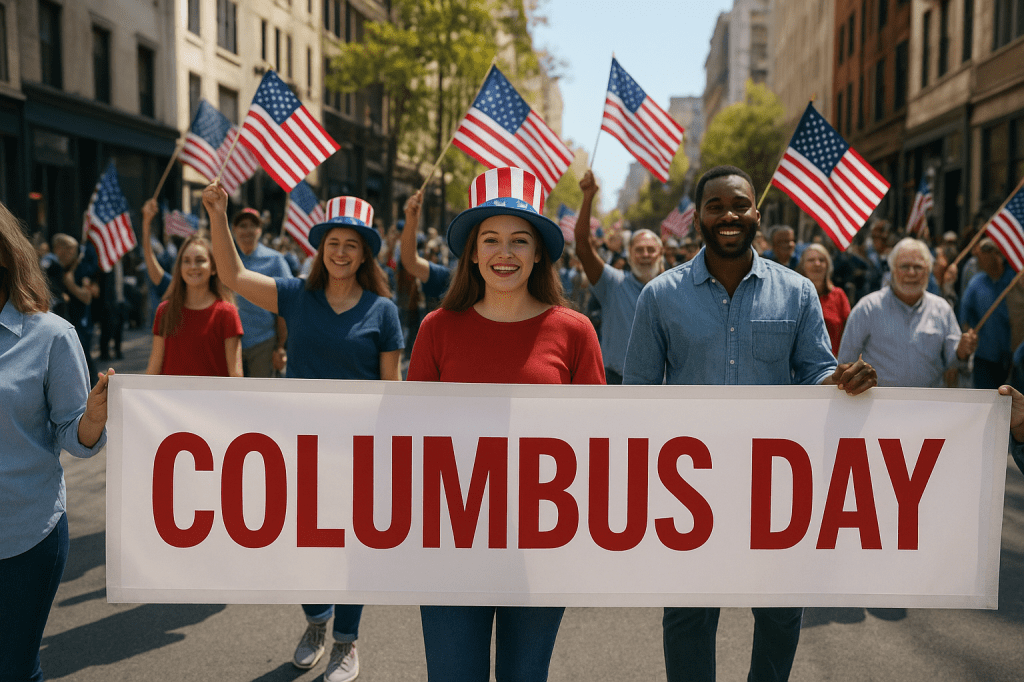
Columbus Day, celebrated on the second Monday in October in the United States, has long been promoted as a day to honor Christopher Columbus, the Italian explorer credited with “discovering” the Americas in 1492. Yet, beneath this national holiday lies a dark and painful legacy of colonization, genocide, and enslavement. To understand why many now question or reject the celebration of Columbus Day, we must revisit history through the eyes of the oppressed — the Indigenous peoples of the Americas and the enslaved Africans who suffered under European conquest.
Christopher Columbus, born in Genoa around 1451, was an ambitious navigator who sought a western sea route to Asia. Backed by Spain’s monarchs, Ferdinand and Isabella, his 1492 voyage was not a mission of peace or discovery, but one driven by greed, power, and imperial expansion. When Columbus landed in the Caribbean, he mistakenly believed he had reached the East Indies. He called the native people “Indians,” beginning a legacy of misnaming and misunderstanding that persists to this day.
Columbus’s arrival marked the beginning of a brutal system of colonization. The Taíno and Arawak peoples of Hispaniola (modern-day Haiti and the Dominican Republic) were among the first to encounter the Europeans. What followed was devastation. Columbus enslaved the Indigenous people, forced them to mine gold, and imposed cruel punishments on those who resisted. His regime was marked by torture, mutilation, and mass murder, documented even by his contemporaries (Zinn, 1980).
Within a few short decades, the Indigenous population of the Caribbean had been nearly wiped out through violence, disease, and forced labor. Columbus’s legacy was not one of discovery, but of destruction. His expeditions paved the way for centuries of European exploitation across the Americas, leading to the transatlantic slave trade that forcibly brought millions of Africans to the New World. Thus, both Native Americans and Africans suffered under systems of oppression rooted in Columbus’s so-called “discovery.”
Despite this horrific history, Columbus was later glorified as a national hero. The idea of celebrating him gained traction in the late 19th century, particularly among Italian-Americans who viewed him as a symbol of ethnic pride in a time of widespread discrimination. In 1937, President Franklin D. Roosevelt, under pressure from the Knights of Columbus (a Catholic fraternal organization), made Columbus Day a federal holiday. The decision was political, not moral — meant to unite Catholics and immigrants under a banner of patriotism.
However, this government-sanctioned glorification of Columbus ignored the historical atrocities committed under his rule. The myth of Columbus as a brave explorer who brought “civilization” to the New World perpetuated Eurocentric narratives that erased Indigenous voices and justified colonial domination. This narrative served to validate white supremacy, expansionism, and the exploitation of both land and people.
For African Americans, Columbus Day represents a celebration of the very system that enslaved and dehumanized their ancestors. The same European expansion that began with Columbus led directly to the transatlantic slave trade, the Middle Passage, and centuries of racial oppression. In this light, celebrating Columbus Day is akin to celebrating the foundations of systemic racism.
For Native Americans, the day symbolizes genocide and cultural annihilation. Entire civilizations were decimated as European powers claimed their lands, destroyed their spiritual systems, and imposed foreign rule. The diseases brought by European settlers wiped out millions, and survivors were forced into reservations centuries later. Columbus became the emblem of Indigenous suffering — not freedom or progress.
The modern push to replace Columbus Day with Indigenous Peoples’ Day represents a moral reckoning with this painful history. Indigenous activists, scholars, and allies have fought tirelessly to reclaim the narrative, emphasizing survival, resilience, and the truth about colonization. Cities and states across the U.S., including California, Minnesota, and New Mexico, have officially recognized Indigenous Peoples’ Day in place of Columbus Day.
The shift toward Indigenous Peoples’ Day reflects a growing awareness of historical injustice and a rejection of whitewashed history. It honors the first inhabitants of the Americas and acknowledges their enduring contributions to humanity, spirituality, and ecological wisdom. It also calls for repentance and reconciliation for the centuries of violence inflicted by European colonization.
Columbus’s voyages cannot be separated from their consequences — the destruction of Indigenous cultures, the theft of land, and the enslavement of Africans. His story symbolizes the birth of a global system of exploitation that shaped modern capitalism and racial hierarchies. Celebrating him, therefore, is not a tribute to exploration but a denial of historical truth.
Many historians now argue that Columbus should be remembered, not revered. His actions and their aftermath belong in the history books as a warning against the dangers of greed and ethnocentrism, not as a model of heroism. The celebration of Columbus Day perpetuates myths that distort the origins of the Americas and obscure the suffering of millions.
For Black people, the connection to Columbus’s legacy is direct and devastating. The European conquest he initiated laid the groundwork for the dehumanization of Africans, justified through false notions of racial superiority. It began a cycle of exploitation that continues to manifest in systemic inequalities today.
True historical education must include both the achievements and atrocities of the past. To celebrate Columbus without acknowledging the cost of his conquests is to dishonor those who perished because of them. It is to endorse the continued erasure of Black and Indigenous histories in favor of colonial pride.
The time has come for America to replace glorification with truth-telling. Recognizing Indigenous Peoples’ Day is not about erasing history — it is about correcting it. It is about lifting up the stories of those who were silenced and acknowledging that the “discovery” of America came at a horrific human price.
Ultimately, the celebration of Columbus Day reflects who society chooses to honor. Will we continue to idolize an oppressor, or will we honor the resilience of those who survived his legacy? The answer to that question defines not only our understanding of history but our commitment to justice and truth.
References (APA Style):
Zinn, H. (1980). A People’s History of the United States. Harper & Row.
Loewen, J. W. (1995). Lies My Teacher Told Me: Everything Your American History Textbook Got Wrong. The New Press.
Dunbar-Ortiz, R. (2014). An Indigenous Peoples’ History of the United States. Beacon Press.
Sale, K. (1990). The Conquest of Paradise: Christopher Columbus and the Columbian Legacy. Alfred A. Knopf.
Churchill, W. (1997). A Little Matter of Genocide: Holocaust and Denial in the Americas, 1492 to the Present. City Lights.
 THE BROWN GIRL DILEMMA