
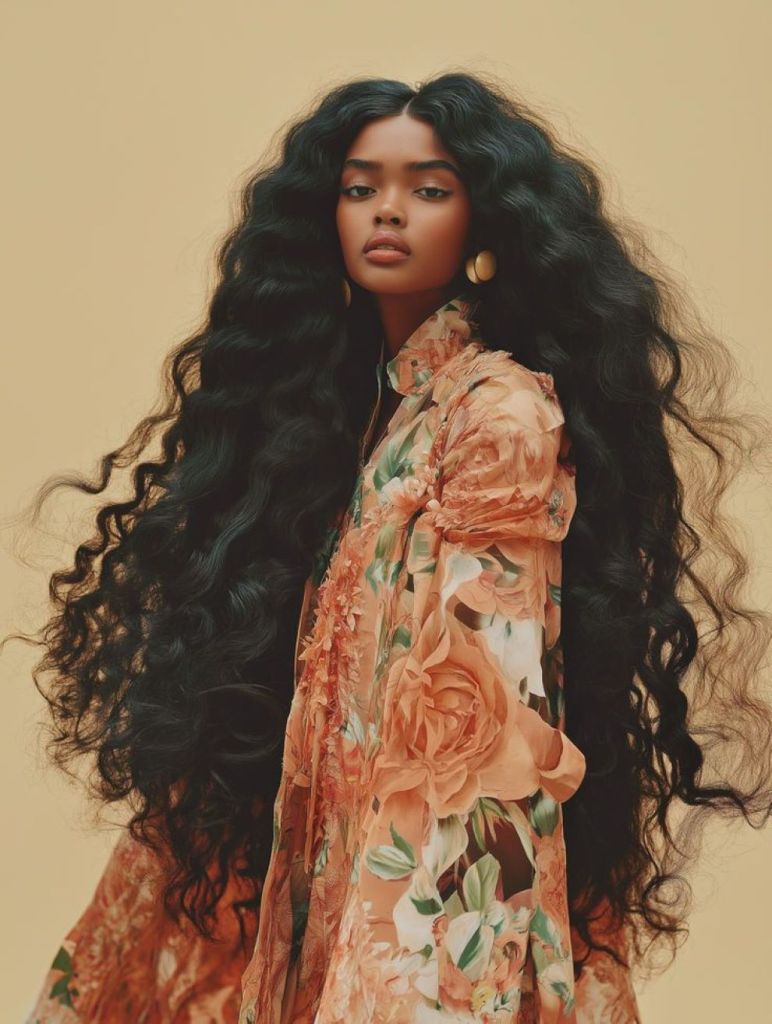
Hair is more than adornment — it is an anointing. In every strand lies a story, in every curl, a code of creation. Scripture declares, “If a woman have long hair, it is a glory to her: for her hair is given her for a covering” (1 Corinthians 11:15, KJV). To understand the sacredness of hair is to recognize it as both physical beauty and spiritual symbolism — a divine marker of identity and inheritance.
For the Black woman, hair is history. It has been braided in kingdoms, cut in captivity, covered in faith, and celebrated in freedom. Each texture — from the tightest coil to the softest wave — bears the fingerprint of God’s artistry. It connects her not only to her ancestors but to the Creator who crowned her with distinction.
In ancient Africa, hair was language. Styles conveyed tribe, status, age, and even spiritual calling. The Yoruba, Himba, and Fulani women wore their stories on their scalps, transforming their heads into living manuscripts of identity. To touch a woman’s hair was to read her soul. In this way, hair became both heritage and halo.
The transatlantic slave trade attempted to sever that connection. Enslaved women were often forced to shave their heads, a violent act of dehumanization meant to erase tribal lineage and pride. Yet, even in bondage, hair remained a silent act of resistance — braided maps, hidden seeds, and whispered prayers wove freedom into every plait.
When Paul wrote of hair as a woman’s glory, he spoke of divine order — not vanity, but sacred symbolism. Hair represents covering, covenant, and consecration. In the Bible, Nazarites like Samson carried divine strength in their locks (Judges 16:17). The cutting of his hair symbolized the breaking of a spiritual vow. Likewise, a woman’s hair remains a visible emblem of her spiritual integrity.
The Black woman’s hair has always carried more than aesthetic meaning — it bears cultural warfare. From workplace discrimination to school dress codes, society has repeatedly tried to regulate her crown. But the CROWN Act and a rising chorus of self-love movements declare a new era: her hair is no longer a battleground but a banner of liberation.
Natural hair is not rebellion; it is revelation. It reveals the divine geometry of God’s creation — coiled like galaxies, spiraled like fingerprints, and strong enough to defy gravity. Each strand stands as a metaphor for resilience: stretched, twisted, and yet unbroken. To wear one’s natural hair is to testify, “I am fearfully and wonderfully made” (Psalm 139:14, KJV).
From wigs and weaves to locs and fros, Black hair expresses multiplicity — not confusion, but creativity. It evolves, transforms, and reinvents itself just as the woman does. Her hair is her canvas; her crown is her story. To style her hair is not vanity but ritual — a daily affirmation of worth and womanhood.
The sacred ritual of haircare connects generations. Mothers oil their daughters’ scalps with tenderness, whispering lessons of patience and pride. Grandmothers pass down recipes of shea, coconut, and castor — ancient anointing oils for modern queens. In those intimate moments, hair becomes ministry.
Hair is also prophetic. It carries spiritual resonance — the way it grows, sheds, and renews mirrors the seasons of a woman’s life. It teaches her detachment when it breaks, humility when it thins, and gratitude when it flourishes. Her crown becomes a compass of divine timing.
To cover the head, as practiced in many biblical and Hebraic traditions, is an act of reverence, not repression. It symbolizes spiritual submission, protection, and modesty. But whether covered or uncovered, sacred femininity reminds her that the glory lies not in the style, but in the spirit beneath it.
Colorism and Eurocentric beauty ideals once tried to shame the kink and celebrate the curl that conformed. Yet today, locs, afros, and braids have returned to their throne. Each twist and cornrow becomes a crown of resilience — a statement that she no longer seeks to assimilate but to ascend.
In the diaspora, hair has been both burden and beacon. It has endured burning combs, toxic relaxers, and societal rejection. Yet, like the phoenix, it rises again — embracing its natural rhythm, its divine pattern. What was once mocked is now magnified.
The theology of hair is the theology of glory. Just as Christ’s transfiguration revealed His divine nature, a woman walking in her authenticity reveals God’s creative intention. Her crown is not for decoration but for declaration: that she is chosen, set apart, and sovereign.
When she adorns her hair with beads, scarves, or oils, she is not performing — she is prophesying. Each adornment is symbolic: beads of remembrance, scarves of sanctity, oils of anointing. Her head becomes holy ground, her hair a visible altar of gratitude.
Hair connects heaven and heritage. In African cosmology, the head — ori — is the seat of destiny, the place where divine purpose dwells. To honor the hair is to honor the spiritual headship God placed upon woman — a reminder that she walks with divine covering and creative authority.
Her hair carries memory — of pain, of pride, of prayer. Each style tells of seasons survived: the big chop of new beginnings, the protective style of rest, the natural growth of self-acceptance. Through each transition, she learns that her beauty is not borrowed; it is born of God.
To despise her natural hair is to reject her divine design. But to embrace it is to walk in resurrection — a restoration of what colonialism tried to cut away. In loving her hair, she reclaims her history, her holiness, and her harmony with heaven.
Thus, hair becomes more than a crown; it becomes a covenant. It binds the woman to her lineage and to her Lord. In the sacred rhythm of braiding, washing, and wrapping, she remembers that she is a daughter of Zion — crowned with compassion, wrapped in wisdom, and radiant in glory.
For indeed, hair is not just her glory — it is her testimony. It tells the world that she has survived every storm and still stands crowned. Her head lifted, her crown intact, she becomes the living fulfillment of Scripture: “She shall give to thine head an ornament of grace: a crown of glory shall she deliver to thee” (Proverbs 4:9, KJV).
References
- The Holy Bible, King James Version. (n.d.).
- Byrd, A., & Tharps, L. L. (2014). Hair Story: Untangling the Roots of Black Hair in America. St. Martin’s Press.
- hooks, b. (2000). Feminism Is for Everybody: Passionate Politics. South End Press.
- Collins, P. H. (2000). Black Feminist Thought: Knowledge, Consciousness, and the Politics of Empowerment. Routledge.
- Walker, A. (1983). In Search of Our Mothers’ Gardens: Womanist Prose. Harcourt.
- Tate, S. A. (2009). Black Beauty: Aesthetics, Stylization, Politics. Ashgate.
- Banks, I. (2000). Hair Matters: Beauty, Power, and Black Women’s Consciousness. New York University Press.
 THE BROWN GIRL DILEMMA