
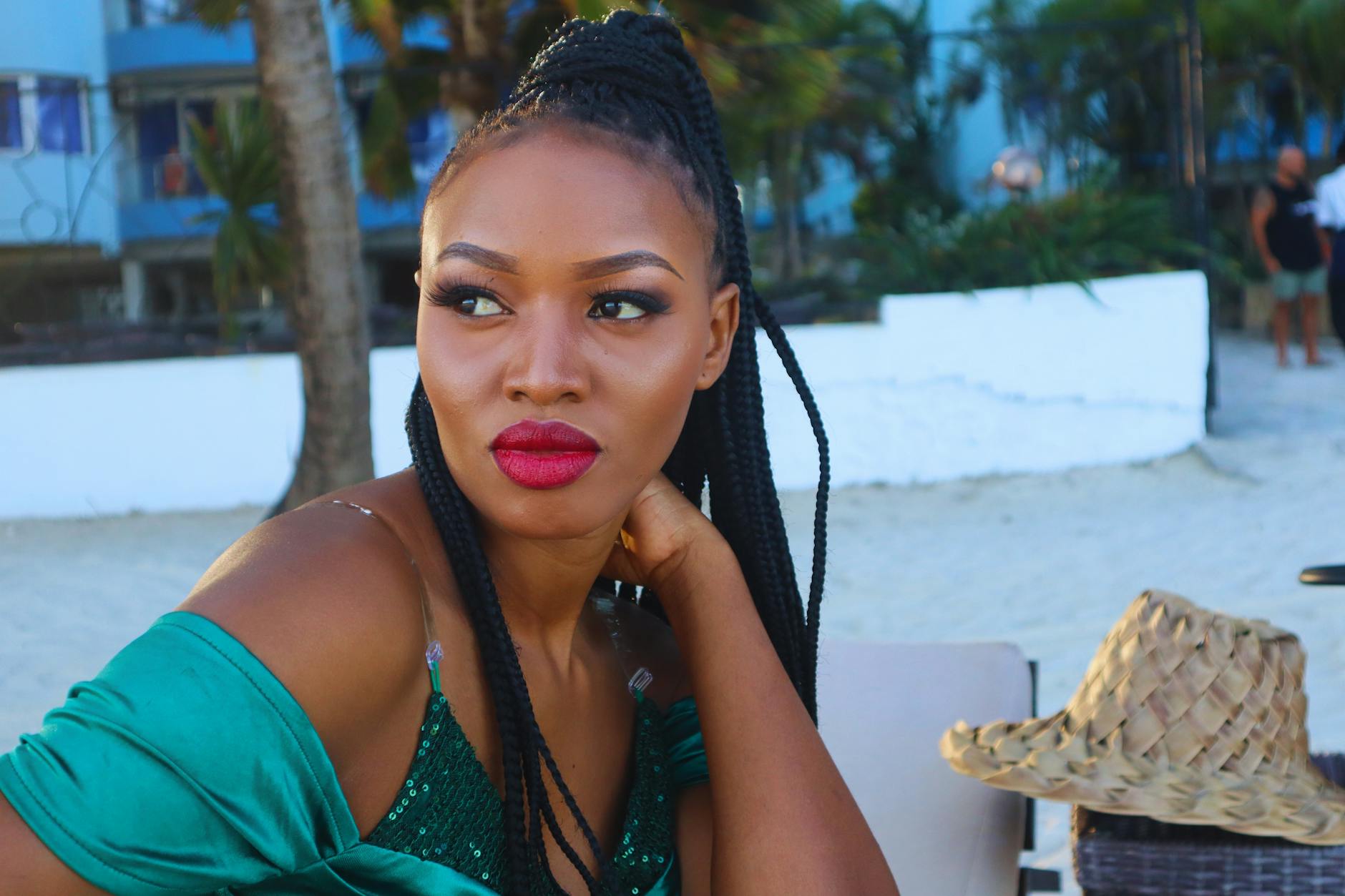
The phrase “I’d kill for your lips” sounds like flattery, but for many brown girls, it is a haunting compliment. It encapsulates a history of desire mixed with exploitation, admiration laced with appropriation. The words roll off tongues in admiration of features once mocked, once ridiculed, and once pathologized — yet now celebrated when worn by someone else.
For centuries, the lips of brown women have been sites of fascination and fear. During slavery and colonialism, full lips were used to justify racist caricatures that depicted Black women as hypersexual and animalistic (Collins, 2000). The grotesque imagery of figures like Sarah Baartman, the so-called “Hottentot Venus,” exemplified how European audiences eroticized and dehumanized African femininity (Qureshi, 2004).
To say “I’d kill for your lips” is to unknowingly echo the violence of history. It is an unconscious confession of envy born from centuries of theft — where physical traits of Blackness were plundered even as Black bodies were persecuted. The world both craved and condemned the features it now romanticizes.
In the modern era, the full lips that once symbolized “otherness” have become the pinnacle of Western beauty. From fashion runways to social media filters, the aesthetic of plump, pouty lips dominates global standards. Yet the models of this look are rarely brown-skinned women; they are often white influencers who undergo cosmetic enhancement to mimic what nature gave to women of African descent (Nash, 2019).
This phenomenon exemplifies the paradox of cultural and corporeal appropriation. Society rejects the people but embraces the features. It dismembers identity, taking the aesthetic while discarding the heritage, the struggle, and the soul that shaped it. This disembodied admiration is not love — it is consumption.
The statement “I’d kill for your lips” thus becomes more than an expression of envy; it is a metaphor for how society symbolically “kills” the original to resurrect the imitation. It celebrates the copy but crucifies the source.
Within this paradox lies the pain of countless brown girls who grew up being teased for their appearance. Many remember childhoods filled with mockery — lips called “too big,” noses “too wide,” skin “too dark.” These wounds ran deep, leaving psychological scars that linger into womanhood (Russell, Wilson, & Hall, 1992).
Then suddenly, the very traits that once provoked shame became fashionable. The same lips once mocked in schoolyards were now praised in magazines. But the praise was selective — applauding the imitation while ignoring the originators. This selective admiration creates a silent rage and a longing for justice.
To be a brown girl in such a world is to constantly negotiate between pride and pain. One learns to love one’s reflection while knowing that others only love it in pieces — as long as it is detached from the fullness of identity.
Beauty, then, becomes political. For the brown girl, every selfie, every smile, every expression is a reclamation of what was stolen. Her lips are not merely aesthetic; they are ancestral. They carry the stories of foremothers who survived silence, objectification, and distortion.
The lips of brown women have spoken liberation into existence. They have kissed away fear, sung through struggle, and prayed through suffering. They have articulated protest, prophecy, and poetry. Their fullness is not just biological; it is spiritual — a testament to abundance and resilience.
Historically, white femininity was constructed in opposition to Black femininity. While white women were seen as pure and delicate, Black women were hypersexualized and loud (hooks, 1981). The fetishization of features like full lips reveals how racial desire operates under domination — to desire the exotic without embracing the person.
Contemporary media perpetuates this dynamic through what scholars call commodified Blackness (Weheliye, 2002). Pop culture borrows the aesthetics of Black womanhood — from lips and curves to slang and attitude — yet distances itself from Black identity itself. The result is a hollow performance of beauty stripped of cultural soul.
“I’d kill for your lips” becomes a tragic refrain in this context. It is admiration laced with erasure. Beneath the compliment lies the question: Would you still want them if they came with my skin?
This question echoes across social media spaces where brown women watch their likeness replicated without credit. Lip fillers, bronzers, and contour trends mimic features that were once signs of “too much Blackness.” Now they are marks of luxury.
The irony is painful yet familiar. Beauty industries profit from what society once punished. They commercialize the natural features of women of color while offering those same women limited representation or voice.
But brown women are reclaiming the narrative. Artists, activists, and influencers are using digital platforms to celebrate authentic Black and brown beauty. Hashtags like #MelaninMagic and #BlackGirlJoy function as digital revolutions, redefining what beauty means beyond white gaze.
The psychological work of reclamation is just as vital as the cultural. Brown girls are learning to love what the world once taught them to hate. This self-love is not vanity but healing — an act of decolonization of the mirror.
Healing also involves confronting the contradictions. A brown girl can feel flattered and hurt simultaneously when someone says, “I’d kill for your lips.” She can recognize admiration but still grieve the history that makes that statement possible.
In many ways, the lips symbolize the border between visibility and invisibility. They are the threshold of voice — the space where silence turns into speech. For generations, brown women’s voices have been suppressed, their words deemed “too loud,” “too emotional,” or “too much.” The fullness of their lips reminds the world of what it has tried to silence.
When a brown woman speaks, her lips are political instruments. They challenge stereotypes, they narrate histories, and they bless futures. Every word spoken from those lips resists centuries of objectification.
To “kill for those lips,” then, would mean to destroy what gives them power — to rob them of their context and their story. Society does this symbolically every time it celebrates features but denies identity.
Yet the brown woman refuses erasure. Her lips remain full — of memory, of truth, of divine breath. She smiles not because she has been accepted, but because she has accepted herself.
Her smile is rebellion. It says, You cannot own what you did not create.
Her lips are holy ground. They are the place where trauma transforms into testimony, and beauty into revolution.
She does not need anyone to die for her lips; she simply needs the world to stop killing her joy, her identity, and her authenticity.
When she speaks now, her lips tell a different story — one of reclamation. She knows that her beauty was never a trend; it was always a birthright.
The world can keep its envy. She will keep her fullness — of lips, of life, and of spirit.
References
Collins, P. H. (2000). Black feminist thought: Knowledge, consciousness, and the politics of empowerment. Routledge.
hooks, b. (1981). Ain’t I a woman: Black women and feminism. South End Press.
Nash, J. C. (2019). Black feminism reimagined: After intersectionality. Duke University Press.
Qureshi, S. (2004). Displaying Sara Baartman, the ‘Hottentot Venus’. History of Science, 42(2), 233–257.
Russell, K., Wilson, M., & Hall, R. (1992). The color complex: The politics of skin color among African Americans. Anchor Books.
Weheliye, A. G. (2002). Feenin’: Posthuman voices in contemporary Black popular music. Social Text, 20(2), 21–47.
 THE BROWN GIRL DILEMMA