
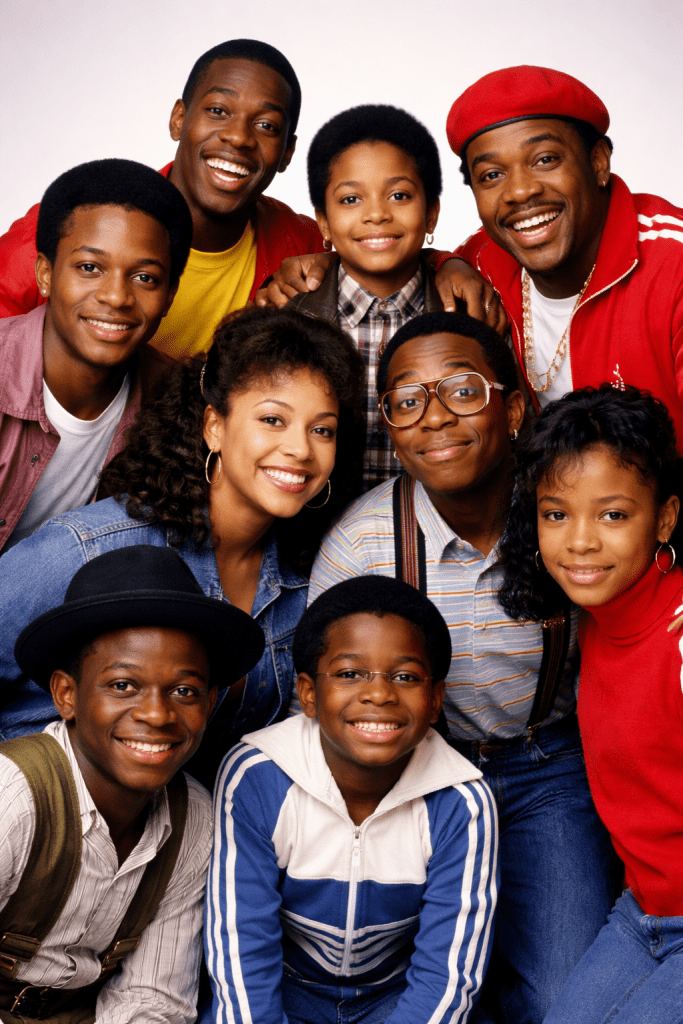
The history of Black child stars in American television reveals a complicated story of talent, visibility, exploitation, and racial inequality. Throughout the twentieth century, Black children appeared in sitcoms and films that were largely created and controlled by white executives, producers, and writers. While these young performers often became beloved cultural icons, their experiences behind the scenes frequently reflected the racial hierarchies that shaped the entertainment industry. Fame brought opportunity, but it also exposed many Black child actors to unequal pay, stereotyping, and limited long-term career support.
Hollywood’s early power structure was overwhelmingly white, especially during the 1970s and 1980s, when many Black child actors rose to prominence. Network executives, casting directors, and producers determined which stories were told and how Black characters were portrayed. Although television increasingly included Black characters, the creative control over those characters often remained outside the Black community. As a result, Black child stars sometimes found themselves performing roles that reflected white expectations about Black identity rather than authentic cultural representation.
One of the most recognizable Black child stars of television was Gary Coleman, who became famous for portraying Arnold Jackson on the sitcom Diff’rent Strokes. Coleman’s character was a witty and charming orphan adopted by a wealthy white businessman. His catchphrase, “What’chu talkin’ ’bout, Willis?” became one of the most famous lines in television history, turning Coleman into a national sensation and making him one of the most recognizable child actors of the era.
At the height of his fame, Coleman was reportedly earning approximately $100,000 per episode, making him one of the highest-paid child actors on television at the time. Despite this financial success, his story later became a cautionary tale about the vulnerability of child performers. Much of the money he earned as a child was mismanaged by adults responsible for his finances. As an adult, Coleman sued his adoptive parents and business advisor for misappropriating his trust fund.
Coleman’s struggles illustrate a broader pattern within Hollywood in which child stars generated enormous wealth for studios while having little control over their earnings. Although laws such as the Coogan Act were designed to protect child actors’ finances, many performers still experienced financial exploitation. For Black child stars, this vulnerability sometimes intersected with racial inequities in an already unequal industry.
Another major Black child star who captured audiences during the 1980s was Emmanuel Lewis, who played the title character on the sitcom Webster. Like Coleman’s role, Lewis portrayed an orphaned Black child adopted by a wealthy white family. The show centered on Webster’s charm and innocence, and Lewis quickly became a household name across the United States.
The premise of shows like Webster and Diff’rent Strokes reflected a recurring trope in Hollywood storytelling: the lovable Black child raised within a white household. While these narratives introduced audiences to talented Black performers, they often framed Black childhood through a lens that centered white benevolence. The stories rarely explored the broader social realities of Black communities or systemic racism.
In many cases, the appeal of these shows depended on the image of the “cute” Black child whose humor and innocence softened racial tensions for white audiences. The characters were often written to be charming, comedic, and non-threatening. While this made them popular with viewers, it also reinforced a narrow representation of Black identity.
Earlier generations of Black child actors experienced similar patterns of limited financial reward and stereotypical roles. One example is Matthew Beard, widely known as “Stymie” from the classic comedy series Our Gang (later called The Little Rascals). Beard was one of the most recognizable child actors of the 1930s, yet like many performers of that era, he reportedly received little long-term financial compensation for his work.
Beard’s experience illustrates how Hollywood historically profited from the talents of Black children while failing to provide long-term economic security. Although audiences loved these characters, the industry rarely invested in the future careers or financial stability of the young actors who portrayed them.
Another figure connected to the conversation about young Black actors in Hollywood is Lamont Bentley, who began acting at a young age and later became known for roles in Black-centered television and film. Like many performers who started as children, Bentley navigated an industry where opportunities for Black actors were limited and highly competitive.
Hollywood’s reliance on stereotypes also shaped how certain Black characters were written for sitcoms. A notable example involves Jimmie Walker, whose character J.J. Evans became the breakout figure on the sitcom Good Times. Walker’s catchphrase “Dyn-o-mite!” became immensely popular with audiences and turned him into one of the show’s most recognizable stars.
However, not everyone celebrated the character’s comedic style. Some cast members and critics argued that J.J.’s exaggerated mannerisms and clownish behavior reinforced negative stereotypes about Black men. Actors within the show reportedly disagreed with producers over the increasing emphasis on comedy at the expense of portraying a serious Black family narrative.
These debates highlight a long-standing tension in Black television representation. Comedy could open doors for Black actors and make shows commercially successful, yet it could also risk perpetuating caricatures that undermined the dignity of Black characters.
Many discussions about Black sitcoms inevitably include the work of influential television producer Norman Lear. Lear was responsible for several groundbreaking television programs that addressed social issues such as racism, poverty, and inequality. His shows helped bring Black family life into mainstream television during a time when representation was limited.
Lear’s supporters argue that his productions challenged audiences to confront uncomfortable social realities. Programs such as Good Times depicted working-class Black families and addressed issues like unemployment and systemic poverty.
At the same time, critics have debated whether some of Lear’s programs relied too heavily on exaggerated comedic elements. While his shows created opportunities for Black actors, they were still shaped by creative decisions made primarily within white-dominated production environments.
Another important figure in the discussion of Black child actors is Kim Fields, who portrayed Dorothy “Tootie” Ramsey on the sitcom The Facts of Life. Fields joined the show as a young actress and quickly became one of its most recognizable characters.
Within the show’s predominantly white ensemble cast, Fields represented one of the few Black characters at an elite girls’ boarding school. Her character brought diversity to the series and resonated with many viewers who rarely saw Black girls represented on mainstream television.
Fields appeared alongside actress Lisa Whelchel, who played Blair Warner, the wealthy and privileged student at the center of many storylines. The contrast between Blair’s affluent background and Tootie’s more grounded personality reflected broader class dynamics often explored in the show.
Although Fields was a beloved member of the cast, many television scholars have noted that storylines frequently centered on white characters. This reflected the broader structure of television writing rooms at the time, which were overwhelmingly white.
Despite these limitations, Fields successfully transitioned into adulthood within the entertainment industry, later starring in the sitcom Living Single. Her longevity in Hollywood is notable because many child actors struggle to maintain successful careers after their early fame fades.
Black child actors often faced a double burden in Hollywood. Like all child performers, they were subject to the pressures of fame, demanding work schedules, and public scrutiny. At the same time, they navigated racial stereotypes and limited roles shaped by systemic inequalities within the industry.
Outside the studio, fame did not shield these actors from the broader realities of American racism. Many experienced discrimination in everyday life despite their celebrity status. Their visibility on television did not always translate into social equality in their personal lives.
Financial instability was another common issue for child stars. Many actors who earned large salaries as children found themselves struggling financially as adults due to poor financial management or exploitation by guardians and managers.
The transition from child star to adult performer proved especially difficult in Hollywood. Once audiences associated an actor with a specific childhood role, casting directors often struggled to imagine them in more mature parts.
For Black actors, these challenges were often intensified by the industry’s limited representation of complex Black characters. Adult roles were scarce, and many performers were confined to stereotypes or minor supporting parts.
Nevertheless, Black child stars played a crucial role in shaping American popular culture. Their performances brought visibility to Black families and children on national television during decades when representation remained limited.
Case Study: Typecasting and the Career of Jaleel White After Steve Urkel on Family Matters
The career of Jaleel White provides a compelling case study on the phenomenon of typecasting in Hollywood, particularly as it affects Black actors who become strongly associated with a single character. White rose to international fame as the nerdy, high-pitched, suspender-wearing Steve Urkel on the sitcom Family Matters, which aired from 1989 to 1998. Although the role brought White immense popularity and cultural recognition, it also shaped public perception of the actor in ways that later complicated his career trajectory.
Jaleel White began acting at a very young age, appearing in commercials and minor television roles during the 1980s. His early career included guest appearances on several television programs, demonstrating his versatility even before landing the role that would define his career. Ironically, Steve Urkel was originally written as a one-time guest character on Family Matters. However, audience reactions were so enthusiastic that the character quickly became central to the show’s storyline.
Steve Urkel soon became one of the most recognizable television characters of the 1990s. With oversized glasses, colorful suspenders, high-water pants, and an awkward personality, Urkel embodied the archetype of the socially awkward genius. His catchphrase “Did I do that?” became a defining line of the era and entered American pop culture. Merchandise, lunchboxes, dolls, and T-shirts featuring the character flooded the market, illustrating the enormous commercial success of the role.
The character’s popularity, however, transformed the direction of Family Matters. Initially conceived as a family-centered sitcom about the Winslow household, the show gradually shifted toward storylines revolving around Urkel’s comedic misadventures and inventions. White himself reportedly played multiple variations of the character, including the suave alter ego Stefan Urquelle, which demonstrated his acting range within the confines of the show.
Typecasting occurs when an actor becomes so strongly associated with a particular role that casting directors and audiences struggle to see them in other types of characters. This phenomenon is common among child actors, whose formative years are closely tied to a specific public persona. For Jaleel White, Steve Urkel became both a blessing and a professional limitation.
After Family Matters ended in 1998, White faced the challenge of redefining his career outside the shadow of Urkel. Casting directors often struggled to envision him in serious or dramatically different roles because audiences had internalized the image of the comedic, awkward teenager. This is one of the central consequences of typecasting: the actor’s identity becomes fused with the fictional character in the public imagination.
In interviews, White has acknowledged the complexities of playing such an iconic role. While he remains proud of the cultural impact of Steve Urkel, he has also spoken about the difficulty of transitioning into adult roles. The entertainment industry frequently pigeonholes actors who become synonymous with a particular character, especially in long-running sitcoms.
Typecasting has historically affected many actors in television history. For example, actors who portray extremely distinctive characters—whether comedic or dramatic—often struggle to escape the expectations attached to those roles. In White’s case, the visual and vocal quirks of Urkel made the character particularly memorable, which strengthened the association between actor and role.
Another factor contributing to White’s typecasting was the character’s exaggerated personality. Urkel’s nasal voice, clumsy physical comedy, and eccentric inventions created a highly stylized performance. While this made the character beloved by audiences, it also made it more difficult for viewers to separate White’s real personality from the fictional character.
White attempted to diversify his career following the end of Family Matters. He appeared in various television programs, including guest roles and voice acting. One of his notable voice roles was portraying Sonic in the animated series Adventures of Sonic the Hedgehog, which demonstrated his versatility beyond live-action sitcom performance.
Despite these efforts, public recognition of White remains strongly tied to Steve Urkel. This phenomenon illustrates the enduring power of television characters in shaping an actor’s identity. Even decades after the show ended, audiences often refer to White primarily through the lens of his famous character.
Typecasting also intersects with broader structural patterns within Hollywood. Black actors historically have had fewer opportunities in mainstream television and film compared to their white counterparts. When a Black actor becomes strongly associated with a single role, the limited number of available roles can make it even more difficult to break free from that identity.
In the case of Jaleel White, however, the actor has embraced the legacy of Urkel while also attempting to redefine his career. He has appeared in various television projects, including reality competitions and guest appearances that highlight his personality beyond the fictional character.
White’s experience illustrates a broader tension within entertainment culture. Iconic roles bring fame, financial success, and cultural influence, but they can also create barriers for actors seeking artistic evolution. The stronger the cultural impact of the character, the more difficult it becomes for audiences to accept the actor in a different identity.
Scholars studying media representation often cite the phenomenon of typecasting as a structural limitation within the entertainment industry. Actors who portray culturally distinctive characters—particularly those tied to race, comedy, or physical traits—may find their careers defined by those portrayals long after the original performance ends.
Nevertheless, Steve Urkel remains one of the most influential television characters of the 1990s. The character reshaped the narrative of Family Matters and became a central symbol of nerd culture, comedic awkwardness, and television nostalgia. While typecasting influenced White’s career trajectory, it also cemented his place in television history.
Ultimately, the case of Jaleel White demonstrates the double-edged nature of iconic television roles. The success of Steve Urkel provided global recognition and cultural legacy, yet it also illustrates how Hollywood can confine actors within the boundaries of their most famous characters. For many performers, the challenge is not achieving fame, but escaping it.
For many Black viewers, these characters were deeply meaningful because they provided rare moments of identification on mainstream television. Seeing Black children on screen helped affirm cultural identity and possibility.
At the same time, the experiences of these actors reveal how deeply race shaped opportunities in Hollywood. Their careers highlight both the progress and the persistent inequalities that characterized the entertainment industry.
In recent decades, the industry has begun to change. Greater representation among writers, producers, and directors has created new opportunities for Black performers to tell their own stories.
Modern audiences are increasingly aware of the historical treatment of child actors, and there is growing advocacy for stronger protections and more equitable contracts.
The stories of performers such as Gary Coleman, Emmanuel Lewis, Kim Fields, and others remind us that behind every beloved television character was a young person navigating fame, expectation, and structural inequality.
Their experiences reveal both the joy that Black child stars brought to audiences and the systemic challenges they faced within a white-dominated entertainment industry.
Understanding this history allows scholars and audiences alike to examine how race, power, and media representation intersect in the making of American television.
References
Bogle, D. (2016). Bright Boulevards, Bold Dreams: The Story of Black Hollywood. Running Press.
Coleman, G. (1998). Gary Coleman: The Unauthorized Biography. St. Martin’s Press.
Gray, H. (2004). Watching Race: Television and the Struggle for Blackness. University of Minnesota Press.
Hunt, D., Ramón, A., & Tran, M. (2021). Hollywood Diversity Report. UCLA College of Social Sciences.
Watkins, S. C. (2005). Hip Hop Matters: Politics, Pop Culture, and the Struggle for the Soul of a Movement. Beacon Press.
Bogle, D. (2001). Toms, Coons, Mulattoes, Mammies, and Bucks: An Interpretive History of Blacks in American Films. Continuum.
IMDb historical production archives for Diff’rent Strokes, Webster, Good Times, and The Facts of Life.
White, J. (2012). Interviews discussing his career and the legacy of Steve Urkel.
IMDb. (n.d.). Family Matters production and cast archives.
Turner Classic Movies Media Archive on sitcom television history.
 THE BROWN GIRL DILEMMA