
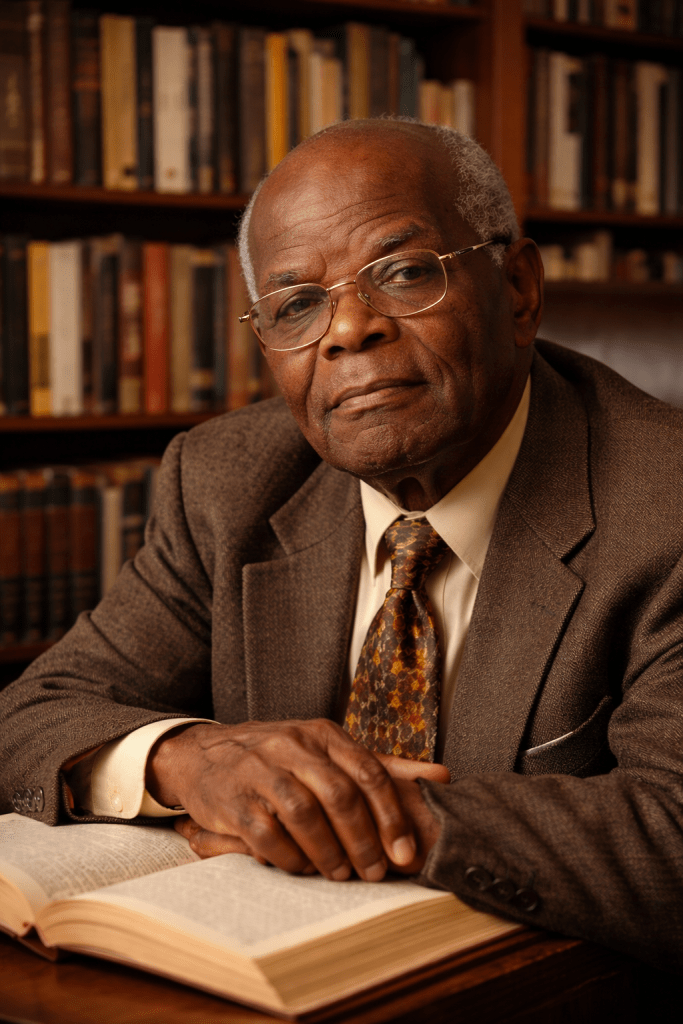
John Henrik Clarke is widely regarded as one of the most influential intellectual activists in modern Black history. A historian, educator, lecturer, and Pan-African thinker, Clarke devoted his life to correcting what he believed were distortions and omissions in Western scholarship regarding African and African-American history. Through decades of teaching, writing, and public speaking, he helped generations of Black people rediscover their historical roots and cultural identity.
Clarke was born John Henry Clark on January 1, 1915, in Union Springs, Alabama, into a family of sharecroppers. Growing up in the racially segregated South during the Jim Crow era, he witnessed firsthand the harsh realities of racism and economic hardship that shaped the lives of many African Americans during the early twentieth century. These early experiences deeply influenced his lifelong mission to understand the historical roots of oppression and to educate Black communities about their past.
Like many African Americans seeking better opportunities, Clarke migrated north during the Great Migration. As a young man, he moved to Harlem in New York City, which at the time was a vibrant center of Black intellectual, artistic, and political life. Harlem introduced Clarke to writers, activists, and scholars deeply engaged in discussions of race, identity, colonialism, and global Black liberation.
Although Clarke did not initially attend a traditional university, he became largely self-educated through extensive reading and mentorship. He studied history, philosophy, literature, and politics with a passion that would later earn him recognition as one of the most respected independent scholars of African history. His intellectual discipline demonstrated that scholarship could emerge both inside and outside formal academic institutions.
One of the individuals who inspired Clarke was the Jamaican-born Pan-African leader Marcus Garvey. Garvey’s philosophy of Black pride, self-determination, and global African unity had a profound influence on Clarke’s worldview. Garvey’s movement emphasized that people of African descent should study their history, celebrate their heritage, and build independent institutions.
Clarke was also inspired by the historian Carter G. Woodson, who founded Negro History Week, which later became Black History Month. Woodson’s work demonstrated that African-American history was worthy of serious academic study. Clarke followed in Woodson’s footsteps by expanding the study of African and diasporic history.
Another major intellectual influence on Clarke was the Senegalese scholar Cheikh Anta Diop. Diop’s research argued that ancient Egypt was fundamentally an African civilization and that African cultures played central roles in early human development. Clarke promoted Diop’s scholarship throughout the United States and helped introduce many Americans to these perspectives.
Clarke’s work centered on correcting what he believed to be Eurocentric interpretations of history. He argued that Western historical narratives often minimized Africa’s contributions to world civilization while exaggerating European influence. Clarke believed that restoring Africa’s historical role was essential for the psychological liberation of African people.
Throughout his career, Clarke emphasized that history shapes identity. He frequently explained that people who do not know their history struggle to understand their place in the world. For African Americans whose ancestry had been disrupted by slavery, historical knowledge became a tool for cultural reconstruction and empowerment.
Clarke believed that African civilizations had made significant contributions to philosophy, science, architecture, and governance long before the rise of Europe. By highlighting ancient African kingdoms and intellectual traditions, he challenged stereotypes that portrayed Africa as historically primitive or disconnected from global progress.
In the 1960s and 1970s, Clarke played a significant role in the development of Black Studies programs in American universities. At a time when many institutions had little or no coursework focused on African or African-American history, Clarke advocated for academic departments dedicated to Africana studies.
He helped establish scholarly organizations that centered African perspectives in research. One of the institutions he helped found was the African Heritage Studies Association, which was created by Black scholars who believed African history should be studied through African and diasporic intellectual frameworks.
Clarke also served as a professor at Hunter College in New York, where he taught courses on African history and the African diaspora. His lectures were widely attended and known for their passionate delivery and depth of knowledge. Many students described him as a master storyteller who could connect historical events across continents and centuries.
Beyond the classroom, Clarke was deeply committed to educating the broader community. He delivered lectures in churches, community centers, and public forums. He believed knowledge should not remain confined within universities but should reach everyday people.
Clarke’s scholarship helped many African Americans develop a stronger sense of cultural pride. By reconnecting Black communities with African history, he challenged narratives that had historically portrayed people of African descent as culturally inferior.
His work also emphasized the global nature of African history. Clarke taught that the African diaspora extended across the Americas, the Caribbean, and Europe, linking the experiences of African people across continents through shared histories of migration, slavery, and cultural resilience.
In addition to teaching, Clarke wrote numerous essays and books. Among his most influential works was African People in World History, which provided a broad overview of Africa’s historical role in global civilization. The book became widely used in Black Studies courses and community education programs.
Clarke also wrote extensively about the relationship between colonialism, slavery, and European economic development. He argued that the transatlantic slave trade and the exploitation of African resources played significant roles in the rise of Western economies.
Regarding race relations, Clarke held complex views about white people and European institutions. He often criticized systems of colonialism, racism, and imperialism that had oppressed African populations around the world. However, his critiques were primarily directed at historical systems of power rather than individual people.
Clarke believed that racism was a structural problem embedded in political and economic institutions. His writings focused on dismantling these systems through historical awareness, education, and cultural self-determination.
At the same time, Clarke maintained that true historical scholarship required honesty and critical thinking. He encouraged students to question dominant narratives and examine historical evidence carefully.
Clarke also stressed that African history should be studied within the broader context of world history. Rather than isolating Africa, he argued that African civilizations interacted with Europe, Asia, and the Middle East through trade, diplomacy, and cultural exchange.
Despite beginning his career outside traditional academic pathways, Clarke eventually received numerous honors and recognition for his scholarship. Universities awarded him honorary degrees acknowledging his contributions to the study of African history.
Clarke was also respected for his mentorship of younger scholars and activists. Many historians, writers, and educators credit Clarke with encouraging them to pursue research in African and African-diasporic history.
His influence extended beyond academia into cultural and political movements focused on Black empowerment. Clarke’s lectures often emphasized self-knowledge, cultural pride, and historical awareness as tools for liberation.
On a personal level, Clarke was married to Augusta Clarke, and together they raised children while balancing family life with his demanding career as a lecturer and writer. Despite his public role as an intellectual leader, he remained deeply committed to family and community.
Clarke continued teaching and writing well into his later years. His dedication to historical scholarship remained unwavering throughout his life. Even as new generations of scholars entered the field of Africana studies, Clarke remained a respected elder within the intellectual community.
He passed away in 1998, leaving behind a legacy that reshaped the way African history is studied and understood in the United States. Today he is remembered as one of the pioneers who helped establish Africana studies as a legitimate academic discipline.
For many scholars and students, Clarke represents the power of intellectual independence and cultural pride. His work reminds people that history is not merely a record of the past but a foundation for understanding identity and shaping the future.
Through his teaching, writing, and activism, John Henrik Clarke helped millions of people see Africa not as a footnote in world history but as one of its central chapters.
References
Clarke, J. H. (1993). African People in World History. Black Classic Press.
Clarke, J. H. (1999). Christopher Columbus and the Afrikan Holocaust: Slavery and the Rise of European Capitalism. A&B Books.
Hine, D. C., Hine, W. C., & Harrold, S. (2018). The African-American Odyssey. Pearson.
Howe, S. (1999). Afrocentrism: Mythical Pasts and Imagined Homes. Verso.
Asante, M. K. (2009). The History of Africa: The Quest for Eternal Harmony. Routledge.
Wikipedia contributors. “John Henrik Clarke.” Wikipedia, The Free Encyclopedia.
 THE BROWN GIRL DILEMMA