
The HBCU Students and Black Elites Who Passed as White.
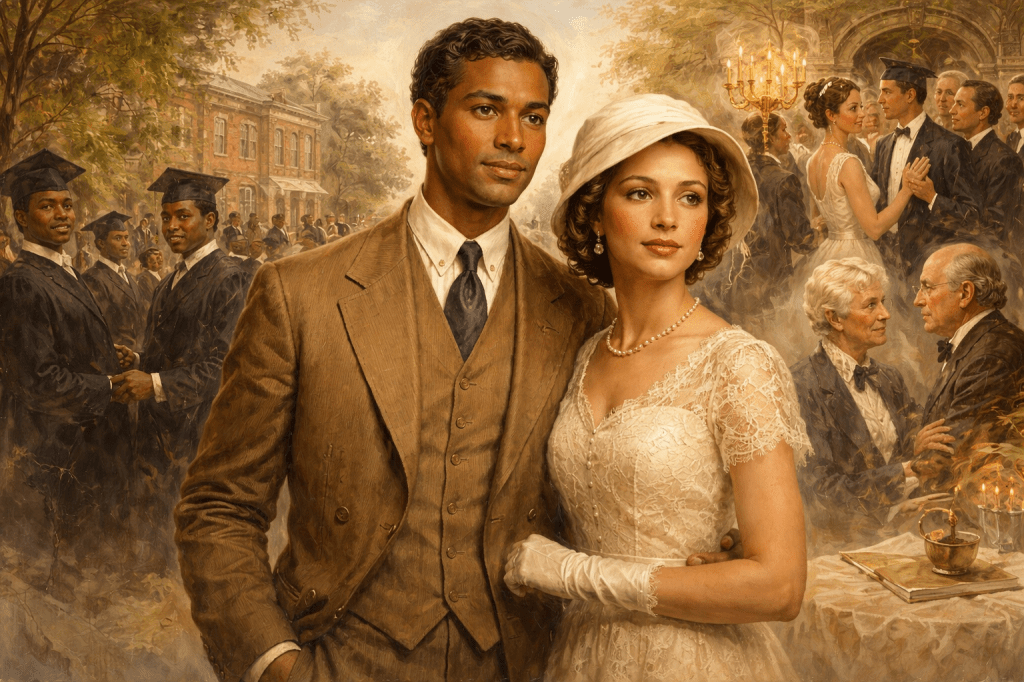
In the nineteenth and early twentieth centuries, the United States operated under a rigid racial system that determined nearly every aspect of a person’s life. Laws, customs, and social practices divided society into categories of “white” and “Black,” with whiteness granting access to education, wealth, safety, and political power. Within this oppressive system, some light-skinned African Americans made the difficult decision to “pass for white,” meaning they presented themselves as white to escape racial discrimination and gain opportunities otherwise denied to them.
Passing was not merely a social choice; it was a survival strategy shaped by systemic racism. During the era of slavery and the decades that followed Reconstruction, Black Americans faced constant threats to their livelihoods and safety. Segregation laws, violence, employment discrimination, and educational barriers created a society where whiteness often meant security and opportunity. For individuals whose physical appearance allowed them to cross the color line, passing became a pathway into a different social world.
Many of the individuals who passed came from educated Black families and elite communities. Some were graduates of historically Black colleges and universities, institutions that produced a generation of highly educated African Americans despite limited resources. Schools such as Howard University, Fisk University, and Atlanta University trained teachers, doctors, lawyers, and intellectuals who sought to uplift Black communities during the late nineteenth and early twentieth centuries.
Yet even with advanced education, racial barriers remained severe. Black professionals were often barred from practicing in white hospitals, law firms, and universities. Segregation limited their clientele and opportunities, making it difficult to fully utilize their education. In this environment, some light-skinned graduates chose to cross the racial boundary in order to practice their professions freely in white society.
One of the most famous examples of passing in American history is Anatole Broyard. Broyard was born into a Creole family of mixed ancestry in New Orleans but later lived as a white man in New York. As a literary critic for The New York Times, he built a successful career while concealing his Black heritage from most colleagues and friends.
Another example is Walter Francis White, whose appearance was so light that he could pass for white. Unlike many who crossed the color line permanently, White used his appearance strategically while working for the National Association for the Advancement of Colored People (NAACP). He traveled through the South investigating lynchings by posing as a white man to gather information.
The phenomenon of passing was deeply connected to America’s complex history of racial mixing. During slavery, many enslaved women were forced into relationships with white slave owners, resulting in generations of mixed-race descendants. By the late nineteenth century, some individuals of mixed ancestry had physical features that allowed them to be perceived as white.
For many who passed, the decision involved enormous personal sacrifice. Passing required cutting ties with family members, friends, and the Black community. Maintaining the illusion of whiteness meant living with constant fear that one’s racial background might be discovered. Exposure could result in job loss, social rejection, or even violence.
Some individuals passed temporarily to obtain employment or housing, while others permanently reinvented their identities. Those who crossed the color line often relocated to new cities where their past was unknown. Large urban centers such as New York City, Chicago, and Los Angeles provided anonymity that made it easier to construct new identities.
The pressures that encouraged passing intensified during the era of Jim Crow laws. Throughout the late nineteenth and early twentieth centuries, segregation laws enforced strict racial boundaries in schools, transportation, housing, and public life. These laws institutionalized racial inequality and reinforced the social advantages associated with whiteness.
Light-skinned members of the Black elite sometimes faced complicated choices within this racial hierarchy. On one hand, many felt a strong commitment to racial solidarity and community leadership. On the other hand, the opportunities available to whites could be dramatically different from those available to even the most educated Black citizens.
Passing was therefore not always motivated by rejection of Black identity. In many cases, it reflected the brutal realities of a society structured around racial discrimination. Economic advancement, personal safety, and professional success were powerful incentives for individuals seeking stability in an uncertain environment.
Literature and film have explored the psychological complexities of passing. Novels such as Passing depict the emotional tension experienced by individuals who cross the racial boundary. These stories reveal the internal conflict between personal ambition and loyalty to one’s heritage.
Historians estimate that thousands of African Americans passed for white during the late nineteenth and early twentieth centuries. However, the exact number is impossible to determine because many individuals successfully concealed their origins and left few records documenting their decisions.
Within Black communities, reactions to passing were mixed. Some viewed it as a betrayal or abandonment of the struggle for racial equality. Others understood it as a tragic consequence of systemic racism that forced people into impossible choices.
The existence of passing also exposed the arbitrary nature of racial categories. American society often defined race according to the “one-drop rule,” meaning that even a small amount of African ancestry classified a person as Black. Yet the fact that some individuals could move between racial identities demonstrated how socially constructed these categories truly were.
Passing gradually became less common after the civil rights movement of the 1950s and 1960s. As legal segregation was dismantled and new opportunities emerged for African Americans, the incentives to permanently abandon one’s racial identity diminished.
Nevertheless, the history of passing remains an important chapter in understanding race in the United States. It reveals the extreme pressures created by a society that rewarded whiteness while marginalizing Blackness.
For the students, professionals, and elites who crossed the color line, passing represented both opportunity and loss. While it sometimes brought economic stability and professional success, it often required the painful sacrifice of family ties, cultural heritage, and community belonging.
Ultimately, the phenomenon of passing highlights the human cost of racial inequality. It illustrates how deeply racism shaped personal identity, forcing individuals to navigate a world where the boundaries of race could determine the course of an entire life.
References
Ginsberg, E. K. (1996). Passing and the Fictions of Identity. Duke University Press.
Hobbs, A. (2014). A Chosen Exile: A History of Racial Passing in American Life. Harvard University Press.
Kennedy, R. (2001). Interracial Intimacies: Sex, Marriage, Identity, and Adoption. Pantheon Books.
Larsen, N. (1929). Passing. Alfred A. Knopf.
Smithsonian National Museum of African American History and Culture. History of racial passing in America.
Hine, D. C., Hine, W. C., & Harrold, S. (2014). The African American Odyssey. Pearson Education.
Library of Congress. Historical records on race and identity in the United States.
 THE BROWN GIRL DILEMMA