
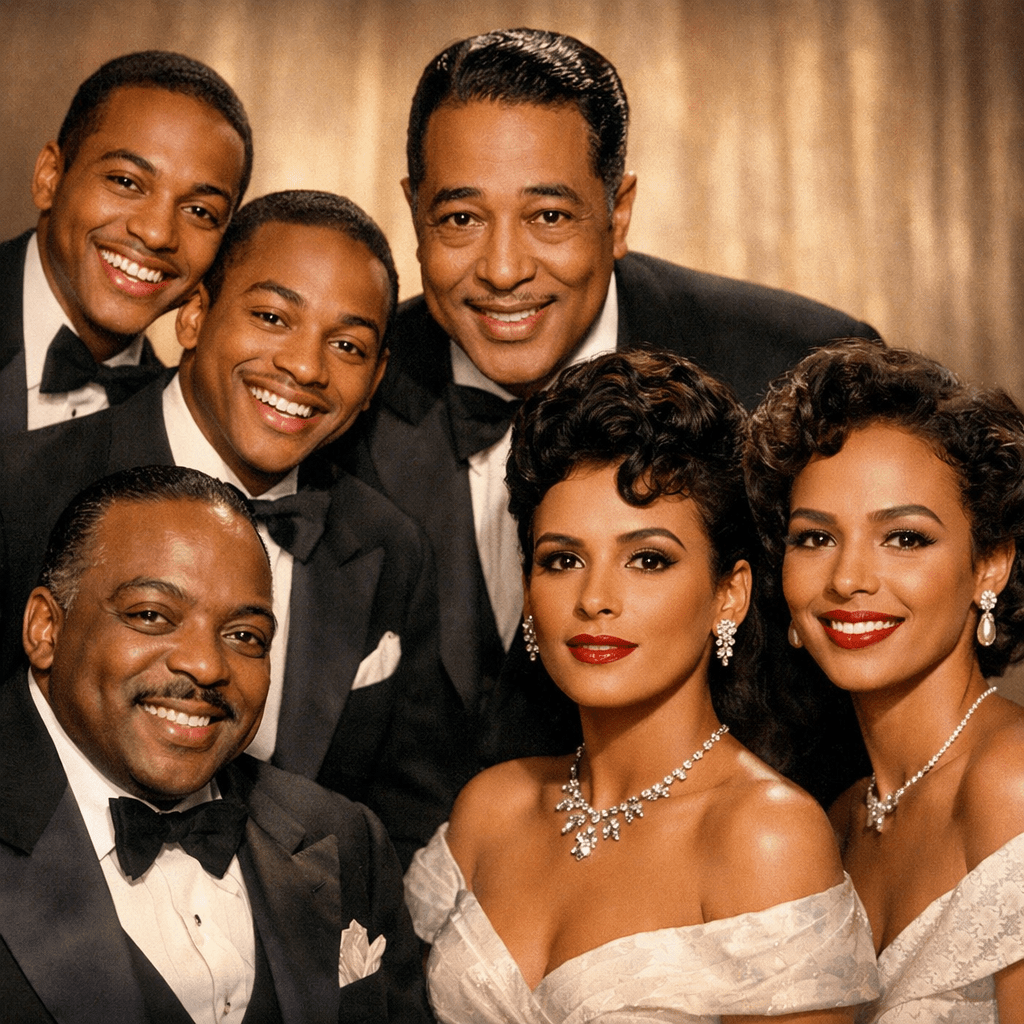
The Harlem Renaissance is often remembered as a golden age of Black brilliance, a period when music, theater, literature, and fashion converged into a global statement of cultural power. Yet behind the elegance, tuxedos, and spotlight glamour existed a harsher reality of emotional trauma, racial exploitation, violent relationships, and broken families. The icons of this era were not only cultural heroes but also human beings navigating fame inside a deeply racist society that consumed their talent while disregarding their humanity.
At the center of this world stood Duke Ellington, whose orchestra became the sound of Black sophistication. Ellington’s genius reshaped American music, elevating jazz into an art form worthy of concert halls and classical comparison. Yet his personal life reflected the era’s contradictions. Constant touring strained his marriage, and his emotional distance from his family mirrored a broader pattern among male entertainers whose careers required near-total devotion at the cost of intimacy and fatherhood.
Ellington’s rise was inseparable from the Cotton Club, a glamorous but deeply ironic institution. The club showcased the finest Black talent in America, yet barred Black patrons entirely, catering exclusively to wealthy white audiences. Black performers were celebrated on stage but segregated in the audience, reinforcing a system where Black excellence was profitable but Black dignity remained negotiable.
Another towering figure was Count Basie, whose Kansas City swing style brought raw energy and improvisation into the mainstream. Basie’s orchestra became legendary for its tight rhythms and blues-infused arrangements. Yet like many musicians of the era, Basie endured exhausting schedules, exploitative contracts, and a culture of heavy drinking, gambling, and infidelity that destroyed numerous marriages and family structures.
The Harlem Renaissance was not only sound but spectacle, and no performers embodied physical artistry more than the Nicholas Brothers. Fayard and Harold Nicholas stunned audiences with gravity-defying acrobatics and revolutionary tap technique. Their performances symbolized Black excellence at its most athletic and joyful, yet Hollywood consistently limited them to specialty acts, cutting their scenes from films to avoid placing Black men too centrally in white narratives.
One of the most significant cultural artifacts of the era was the film Stormy Weather, a rare Hollywood production centered entirely on Black performers. The film showcased Lena Horne, Bill Robinson, and the Nicholas Brothers, and became a landmark in Black cinematic history. Its impact was both empowering and bittersweet, as it represented possibility within an industry that still refused to grant Black actors complex, romantic, or authoritative roles.
At the emotional core of Harlem glamour stood Lena Horne, whose beauty and voice made her one of the first Black women marketed as a global sex symbol. Horne broke color barriers in Hollywood but paid a severe psychological price. She faced constant racism, was prohibited from romantic scenes with white actors, and lived under surveillance from studios that feared interracial desire more than injustice.
Horne’s personal life exposed even deeper wounds, particularly her relationship with Joe Louis, the most famous Black athlete in the world at the time. Their affair was passionate but devastating. Louis repeatedly cheated on Horne, humiliating her publicly and reinforcing a pattern of emotional abandonment that haunted many Black women whose partners were consumed by fame, ego, and unhealed trauma.
The image of Black male celebrity during this era was often violent beneath the surface. Many stars engaged in domestic abuse, alcoholism, and emotional neglect, behaviors rooted in unresolved rage from racism, poverty, and emasculation. Fame did not heal these wounds; it amplified them, turning private pain into public dysfunction and generational trauma.
Another tragic icon was Dorothy Dandridge, the first Black woman nominated for an Academy Award for Best Actress. Dandridge’s beauty made her famous, but her vulnerability made her exploitable. She endured abusive relationships, financial mismanagement, studio manipulation, and the emotional devastation of raising a daughter with severe disabilities while being denied meaningful roles.
Dandridge’s love life was marked by violent men, emotional instability, and betrayal. She was beaten by partners, financially drained by managers, and psychologically crushed by Hollywood’s rejection. Her story represents how Black women were hypersexualized, commodified, and discarded once their youth or novelty faded.
Beneath the elegance of Harlem nightlife existed a culture of physical violence, emotional neglect, and fractured families. Many entertainers fathered children they barely raised, leaving behind single mothers and emotionally abandoned sons and daughters. These children grew up in the shadow of famous names but without stability, guidance, or protection.
The psychological toll of passing, colorism, and racial performance also shaped these lives. Lighter-skinned stars like Lena Horne and Dorothy Dandridge were promoted more aggressively, reinforcing internal hierarchies within the Black community itself. Darker-skinned performers were often excluded from leading roles, feeding cycles of resentment, insecurity, and identity conflict.
The Harlem Renaissance thus produced not only artistic revolutions but psychological casualties. Many stars self-medicated through alcohol, drugs, gambling, and sex. The pressure to represent an entire race while being denied full humanity created emotional contradictions that manifested as addiction, narcissism, and relational dysfunction.
Even male icons like Duke Ellington and Count Basie struggled with emotional availability. Their dedication to craft demanded emotional withdrawal from family life. The myth of the brilliant Black genius often came paired with the reality of absent fathers and emotionally distant husbands.
The Cotton Club itself symbolized this contradiction perfectly. Black bodies created white pleasure, Black culture generated white profit, and Black suffering remained invisible behind velvet curtains and champagne glasses. Harlem glittered, but it was built on structural inequality.
The Nicholas Brothers, despite their brilliance, were never allowed narrative depth. They were celebrated for physicality but denied psychological complexity, reinforcing a stereotype of Black men as entertainers rather than thinkers, lovers, or leaders.
Stormy Weather remains iconic because it briefly shattered that ceiling, allowing Black performers to exist without white intermediaries. Yet even that film existed as an exception, not a new rule.
The legacies of Lena Horne and Dorothy Dandridge reveal how Black women paid the highest emotional price for proximity to fame. Their bodies were adored, their souls neglected, and their pain silenced beneath glamour.
Joe Louis represents the darker side of Black male hero worship, where athletic power replaced emotional maturity, and fame excused infidelity, neglect, and misogyny.
Ultimately, the Harlem Renaissance was not only a cultural awakening but a psychological battlefield. These icons were pioneers navigating fame inside a system designed to exploit them, isolate them, and emotionally fracture them.
Their stories remind us that Black excellence has always coexisted with Black suffering, and that beauty, talent, and legacy do not erase trauma. Behind the tuxedos, stage lights, and platinum records were slashed emotions, broken homes, and souls trying to survive history itself.
References
Bogle, D. (2016). Toms, Coons, Mulattoes, Mammies, and Bucks: An Interpretive History of Blacks in American Films. Bloomsbury Academic.
Cohen, H. G. (2010). Duke Ellington’s America. University of Chicago Press.
Giddins, G. (2014). Visions of Jazz: The First Century. Oxford University Press.
Horne, L. (2018). Lena: A Personal and Professional Biography. Da Capo Press.
Lewis, D. L. (2004). When Harlem Was in Vogue. Penguin Books.
Shipton, A. (2007). A New History of Jazz. Continuum.
Dandridge, D. (1999). Everything and Nothing: The Dorothy Dandridge Story. Hyperion.
Bogle, D. (2001). Dorothy Dandridge: A Biography. Amistad.
Erenberg, L. A. (1981). Steppin’ Out: New York Nightlife and the Transformation of American Culture. Greenwood Press.
 THE BROWN GIRL DILEMMA