
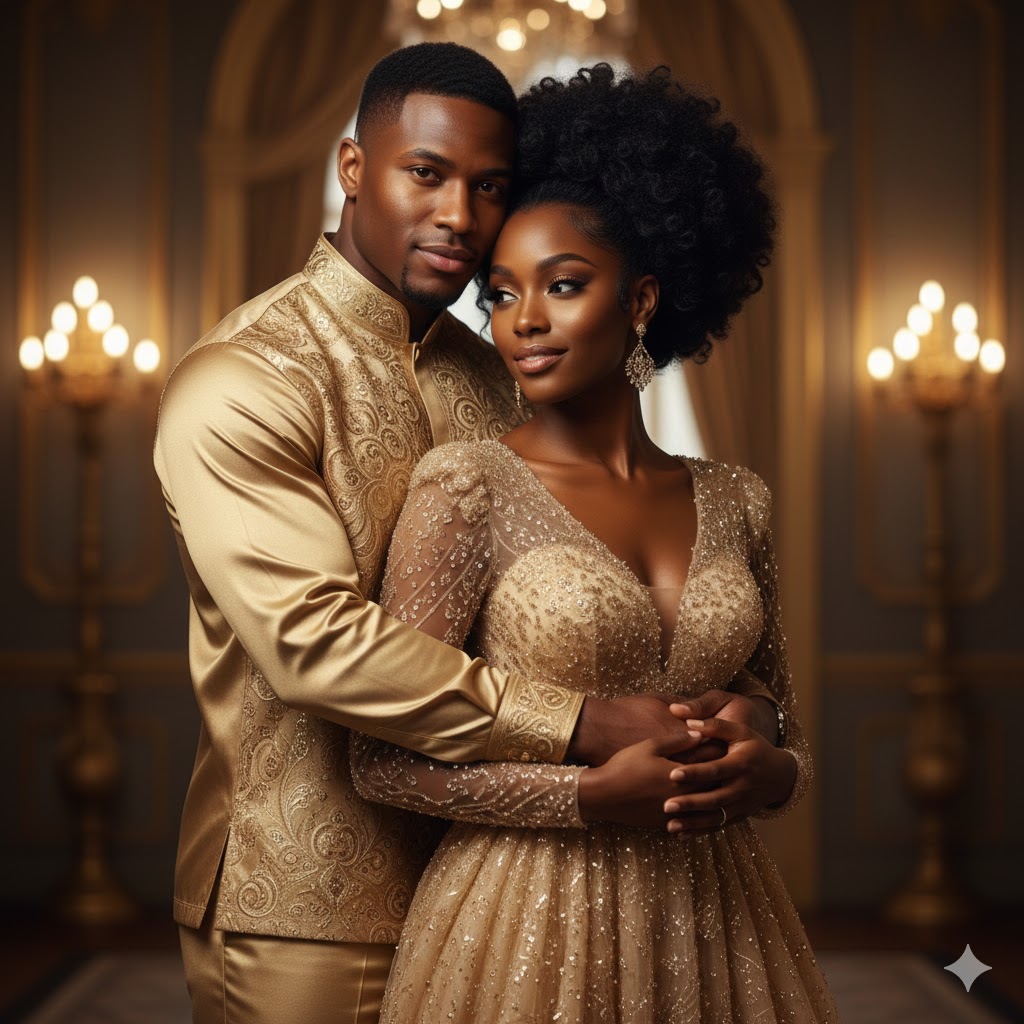
There is a luminous quality in beauty that transcends time, a radiance rooted in ancestry, heritage, and enduring dignity. “Golden Essence” explores how timeless aesthetics, cultural heritage, and ancestral identity intersect to shape perceptions of worth, influence social capital, and confer privilege. It celebrates the richness of Black beauty as both a visual and moral inheritance, emphasizing that true value lies in character, lineage, and the grace of history rather than fleeting trends.
Historically, African civilizations cultivated beauty not only as visual appeal but as a reflection of social, spiritual, and moral integrity. Hairstyles, adornments, clothing, and physical demeanor conveyed status, wisdom, and communal respect. As Asante (2003) emphasizes, aesthetic expression in Africa was interwoven with principles of balance, harmony, and dignity. The visual presentation of self was a statement of lineage and societal role, a reflection of collective and ancestral identity.
The concept of aesthetic capital, articulated by Bourdieu (1986), illuminates how beauty functions as social currency. Individuals embodying ancestral traits, poise, or classical proportions accrue recognition, social deference, and opportunity. This capital is amplified by contemporary social structures, wherein beauty intersects with economic, professional, and cultural advantage. The “golden essence” thus operates as both inherited dignity and cultivated advantage.
Psychologically, the halo effect enhances the perception of virtue in those who embody timeless beauty. Dion, Berscheid, and Walster (1972) observed that physically attractive individuals are often assumed to possess other positive traits, including intelligence, moral integrity, and competence. In the context of Golden Essence, beauty is inseparable from the perception of ancestral wisdom, poise, and social grace, making physical presence a marker of historical and moral authority.
Colorism complicates the recognition of ancestral beauty. Hunter (2007) notes that lighter skin tones, often aligned with Eurocentric ideals, are disproportionately privileged within and across communities of color. Golden Essence challenges this hierarchy, affirming that aesthetic value and social recognition should honor the depth, history, and diversity inherent in ancestral traits rather than conform to imposed standards.
Economically and socially, those who embody ancestral aesthetics often experience amplified advantages. Hamermesh (2011) documents that attractiveness influences wages, promotions, and opportunity. In communities valuing ancestral traits, these advantages are reinforced by historical recognition and social reverence. Conversely, individuals whose appearances are marginalized face invisibility and diminished access to social and professional networks, demonstrating the intersection of beauty, race, and structural bias.
The media often distorts or erases ancestral aesthetics, privileging images that align with Western beauty ideals. This misrepresentation contributes to the invisibility of Golden Essence, reinforcing biased perceptions of desirability. Representation is critical: authentic portrayals of Black heritage restore dignity, affirm cultural pride, and challenge inequitable hierarchies (Rhode, 2010).
Biblically and spiritually, Golden Essence underscores that true worth transcends appearance. Scripture repeatedly emphasizes the primacy of character, heart, and virtue over external looks. In 1 Samuel 16:7, God instructs that “man looketh on the outward appearance, but the LORD looketh on the heart,” affirming that divine favor is not contingent upon conformity to human aesthetic standards. The golden essence of an individual is therefore measured by integrity, resilience, and moral alignment.
Psychologically, the recognition of ancestral beauty fosters self-confidence, social influence, and communal pride. Individuals who are celebrated for their Golden Essence internalize a sense of worth that counters external marginalization, while communities that honor ancestral aesthetics reinforce identity, heritage, and cultural continuity.
Education and representation are vital to sustaining the recognition of Golden Essence. Schools, cultural institutions, and media platforms play a key role in celebrating ancestral beauty, teaching its historical significance, and validating diverse expressions of grace. By codifying respect for heritage, society affirms the enduring value of ancestral traits in contemporary contexts.
Ethically, acknowledging Golden Essence requires dismantling superficial and imposed hierarchies of beauty. It demands the rejection of colorism, Eurocentric dominance, and narrow media portrayals, centering dignity, history, and intrinsic value. True recognition of beauty encompasses lineage, virtue, and resilience rather than transient social approval.
Culturally, Golden Essence bridges past and present, connecting contemporary visibility with ancestral legacy. It preserves the visual and moral memory of communities while shaping modern standards of grace, poise, and influence. In this way, beauty becomes an expression of historical continuity, cultural pride, and social legitimacy.
Spiritually, Golden Essence reflects the enduring favor that accompanies virtue, integrity, and righteousness. Beauty rooted in heritage conveys symbolic significance, representing resilience, wisdom, and the blessings of ancestry. Recognition of this essence elevates not merely physical presence but the moral and historical narrative embodied by individuals.
Socially, honoring Golden Essence strengthens solidarity, reduces internalized bias, and affirms identity. Communities that embrace ancestral beauty cultivate pride and resilience, counteracting the marginalization imposed by contemporary beauty hierarchies. In doing so, they reinforce a legacy of dignity, authority, and grace.
Psychologically, the affirmation of Golden Essence mitigates the pressures of appearance-based discrimination. Individuals who see their ancestral beauty valued internalize worth beyond superficial standards, gaining confidence and self-respect that inform personal, social, and professional success.
Ultimately, Golden Essence illustrates that true beauty is timeless, moral, and historically grounded. It transcends social trends, cultural impositions, and transient media representations. Recognizing Golden Essence affirms both individual dignity and collective heritage, highlighting the importance of ancestral wisdom, resilience, and grace.
In conclusion, Golden Essence celebrates the enduring power of ancestral beauty, cultural dignity, and moral integrity. It challenges superficial hierarchies, restores visibility to historically marginalized aesthetics, and emphasizes that human worth is measured not by conformity to ephemeral standards but by character, legacy, and the luminous quality of heritage. By honoring Golden Essence, society affirms both the individual and the enduring spirit of generations past.
References
Anderson, T. L., Grunert, C., Katz, A., & Lovascio, S. (2010). Aesthetic capital: A research review on beauty perks and penalties. Sociology Compass, 4(8), 564–575.
Asante, M. K. (2003). The history of Africa: The quest for eternal harmony. Routledge.
Bourdieu, P. (1986). The forms of capital. In J. Richardson (Ed.), Handbook of theory and research for the sociology of education (pp. 241–258). Greenwood Press.
Dion, K., Berscheid, E., & Walster, E. (1972). What is beautiful is good. Journal of Personality and Social Psychology, 24(3), 285–290.
Eagly, A. H., Ashmore, R. D., Makhijani, M. G., & Longo, L. C. (1991). What is beautiful is good, but… Psychological Bulletin, 110(1), 109–128.
Eze, E. C. (2010). Intellectual history in contemporary African thought: Ancient wisdom, modern debates. Palgrave Macmillan.
Feingold, A. (1992). Good-looking people are not what we think. Psychological Bulletin, 111(2), 304–341.
Gafney, W. (2017). Womanist midrash: A reintroduction to the women of the Torah and the Throne. Westminster John Knox Press.
Hamermesh, D. S. (2011). Beauty pays: Why attractive people are more successful. Princeton University Press.
Hunter, M. (2007). The persistent problem of colorism: Skin tone, status, and inequality. Sociology Compass, 1(1), 237–254.
Langlois, J. H., et al. (2000). Maxims or myths of beauty? Psychological Bulletin, 126(3), 390–423.
Rhode, D. L. (2010). The beauty bias: The injustice of appearance in life and law. Oxford University Press.
Wilson, T. D. (2002). Strangers to ourselves: Discovering the adaptive unconscious. Harvard University Press.
 THE BROWN GIRL DILEMMA